

Good Omens Explained: The Apocalypse Comedy Where Heaven, Hell, And Humanity All Lose Control
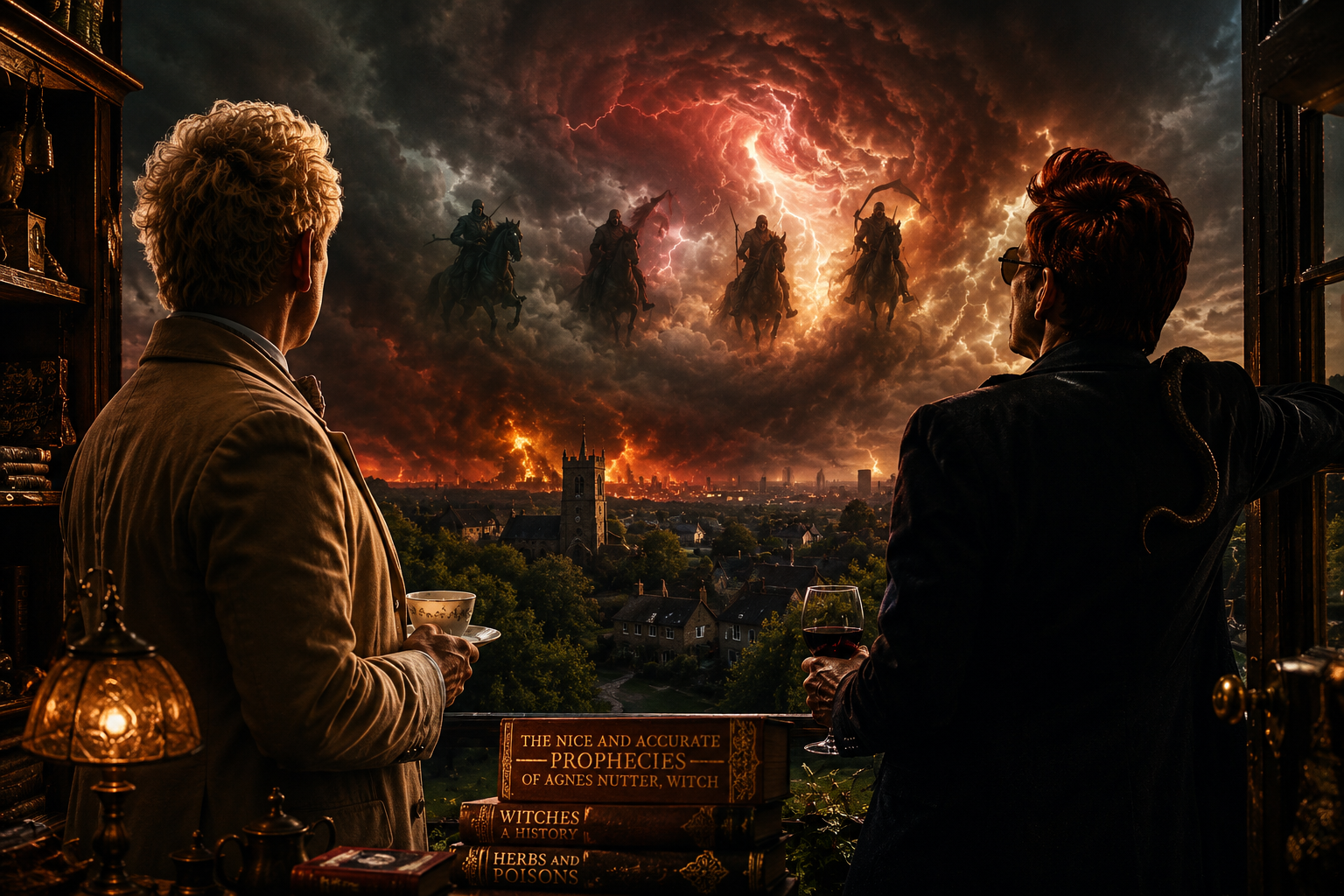
Why The End Of The World Becomes A Test Of Free Will
The Angel, The Demon, And The Antichrist Who Refused To End The World
The funniest thing about the end of the world is that almost nobody involved seems emotionally prepared for it.
Heaven thinks it is following a plan. Hell thinks it is executing a war. The Four Horsemen think they are answering the call of destiny. The occultists think the prophecies can save them. The witchfinders think they still matter. The humans mostly think the weather is strange, the traffic is bad, and children should be home by dinner.
At the centre of it all is a boy who is supposed to destroy the world but has accidentally grown up normal.
That is the great trick of Good Omens. It takes the largest possible religious event, Armageddon, and relocates its emotional centre into the smallest possible human question: what if the Antichrist liked his friends, his village, his dog, his parents, and the ordinary world too much to burn it down?
Good Omens: The Nice And Accurate Prophecies Of Agnes Nutter, Witch is the 1990 comic fantasy novel by Terry Pratchett and Neil Gaiman. It was published in the UK by Gollancz and in the US by Workman, and its premise is built around the birth of the son of Satan, the coming End Times, and the angel Aziraphale and demon Crowley trying to stop the apocalypse because they have become too fond of life on Earth.
The point is not just that Good Omens is funny. The point is that its comedy is a weapon. It laughs at bureaucracy, prophecy, religious certainty, human stupidity, and cosmic management systems that have forgotten the value of the very world they claim to rule.
The question underneath the book is simple.
If Heaven and Hell both demand the end of the world, who is actually on humanity’s side?
Book Covered
Good Omens by Neil Gaiman and Terry Pratchett.
The Big Idea Of The Book
The big idea of Good Omens is that destiny only looks unbeatable when nobody questions who benefits from it.
The novel presents the apocalypse as a scheduled institutional event. Heaven and Hell both expect it. Angels and demons have prepared for it. Ancient prophecy has pointed towards it. The machinery of the universe appears to be moving toward one final confrontation.
But the story’s deeper argument is that life on Earth is not an abstract battlefield between Good and Evil. It is food, books, weather, music, traffic, childhood, friendship, irritation, compromise, and ordinary affection.
The book asks whether a person is defined by origin or by upbringing. It asks whether moral choice can survive systems built to erase it. And it asks whether humanity’s messy, contradictory freedom might be more valuable than either side of a perfect cosmic war.
The Plot In One Flow
The story begins not with fire, war, or thunder, but with an arrangement.
Aziraphale, an angel who once guarded the Eastern Gate of Eden, and Crowley, the demon who was once the serpent, have been on Earth since the beginning. They are supposed to be enemies. One represents Heaven. The other represents Hell. One is meant to encourage virtue. The other is meant to encourage temptation.
In practice, after thousands of years, their opposition has become strangely comfortable.
They have learned that humans can be sinful without demonic help and kind without angelic supervision. They have also learned that Earth is much more enjoyable than either of their head offices seem to understand. Aziraphale loves books, food, old-fashioned manners, and the quiet pleasures of ownership. Crowley loves fast cars, modernity, music, and the stylish performance of wickedness more than true evil itself.
Their relationship is not officially friendship, because official friendship between an angel and a demon would cause problems. But functionally, emotionally, and narratively, it is one of the central bonds of the book.
They have developed an informal arrangement. Instead of constantly undoing each other’s work, they often agree to cancel out effort in advance. If Aziraphale is meant to perform a small act of divine influence somewhere, and Crowley is meant to perform a demonic one elsewhere, they may simply agree that the paperwork can show both sides were active while neither wastes too much time.
This is the first major joke of the novel, but it is also the first major insight. Heaven and Hell are not just spiritual forces. They are bureaucracies. They have objectives, departments, expectations, reporting structures, and absurd inefficiencies.
Then the real plot arrives.
Crowley is given the infant Antichrist and instructed to deliver him into the world. The plan is that the child will be swapped with the baby of an American diplomat, then raised in a powerful environment until the appointed time. Eventually, he will trigger Armageddon.
Crowley understands the implication immediately. This is not an ordinary demonic assignment. This means the end of everything is now in motion.
He should be pleased. Instead, he panics.
Crowley does not want the world to end. Not because he has become pure, but because he likes the world. He likes roads. He likes restaurants. He likes the small daily pleasures that Hell dismisses and Heaven underestimates. He has invested too much time in Earth to watch it become collateral damage in a cosmic performance.
So he approaches Aziraphale.
Aziraphale, at first, is torn. Heaven expects the end. The divine plan apparently requires it. The angel’s conditioning tells him that what Heaven wants must be Good. Yet his life on Earth has softened him into doubt. He does not want the bookshops, gardens, meals, music, people, and small civilities of the world to vanish either.
Together, Aziraphale and Crowley decide on a plan. They cannot openly rebel. They cannot simply kill the Antichrist without catastrophic consequences. But perhaps they can influence him.
If they can make sure the child grows up balanced between good and evil, perhaps he will not choose destruction. They identify the boy they believe is the Antichrist: Warlock Dowling, the son of the American diplomat. Aziraphale and Crowley then spend years subtly shaping him. One appears in his life as a gardener. The other as a nanny. One nudges him one way. The other nudges him the other way.
There is only one problem.
They have the wrong child.
At the hospital, the satanic nuns responsible for the baby swap made a mess of the handover. The true Antichrist was not raised by diplomats. He was not raised in political privilege. He was not raised by carefully balanced supernatural influence.
He was raised as Adam Young, a normal boy in Lower Tadfield, Oxfordshire.
This mistake is the engine of the entire novel.
Adam is not surrounded by global power. He is surrounded by fields, lanes, parents, neighbours, and friends. He is not trained to rule the world. He leads a small gang of children called the Them: Pepper, Wensleydale, and Brian. To them, he is not the Beast, Destroyer of Kings, or Prince of Darkness. He is simply Adam: charismatic, imaginative, stubborn, bossy, and magnetic in the way some children naturally become the centre of a small universe.
This is where the book’s apocalypse becomes brilliant.
The Antichrist does not grow up learning statecraft, war, or infernal purpose. He grows up playing, arguing, exploring, inventing rules, telling stories, and forming opinions from half-understood adult conversations and strange magazines. His imagination becomes dangerous because, unlike other children, he can make reality obey it.
At first, his powers appear indirectly. The world begins to shift around his beliefs and interests. Atlantis rises because he has absorbed stories about lost civilizations. UFOs appear because aliens have entered his imaginative world. Environmental restoration begins in strange ways because Adam’s mind has taken in ideas about ecological damage. Things become real not because he consciously commands them, but because his childish understanding of the world has supernatural force behind it.
Meanwhile, the rest of the plot begins to converge.
Agnes Nutter, a seventeenth-century witch, once wrote The Nice And Accurate Prophecies Of Agnes Nutter, Witch. Her prophecies are completely accurate, but often so specific, oddly phrased, or context-dependent that they are difficult to use until the exact moment arrives. This is one of the book’s sharpest jokes about prediction: knowing the future is not the same as understanding it.
Agnes herself died when she was burned as a witch by Thou-Shalt-Not-Commit-Adultery Pulsifer. But she knew it was coming. She prepared for it. She packed explosives and nails into her clothing so that her execution would destroy many of the people executing her. Even in death, Agnes is not passive. She turns victimhood into a final act of control.
Her descendant, Anathema Device, has inherited the prophecies and the burden of interpreting them. Anathema is not a vague mystical eccentric. She is organised, committed, and trapped by inherited certainty. Her life has been shaped by the belief that Agnes’s book contains the route through the End Times.
Anathema comes to Tadfield because the prophecies point there. She knows something is happening. She does not yet fully understand what.
At the same time, the Witchfinder Army still exists in absurd miniature. It is effectively reduced to Sergeant Shadwell, an angry, suspicious, old-fashioned man obsessed with witches, and Newton Pulsifer, his awkward new recruit. Newt is a descendant of the man who burned Agnes Nutter, which ties him into the prophecy line even before he understands his role.
Newt is not heroic in the conventional sense. He is not especially competent. In fact, technology tends to break around him. But his weakness becomes plot-relevant. In a story about systems running toward automated catastrophe, someone who disrupts machinery by existing becomes unexpectedly useful.
Shadwell also has a neighbour, Madame Tracy, a sex worker and medium. He disapproves of her while depending on her far more than he admits. Their relationship is comic, abrasive, and strangely tender. Like Aziraphale and Crowley, they embody one of the book’s recurring patterns: people may spend years pretending not to care for someone they are clearly attached to.
As the appointed day approaches, Heaven and Hell prepare for war.
The Four Horsepersons of the Apocalypse assemble. War appears as a glamorous war correspondent whose presence inflames conflict. Famine appears as a modern figure of hunger, dieting, consumption, and manufactured emptiness. Pollution replaces Pestilence, who retired after penicillin, making environmental contamination the modern form of plague. Death, unlike the others, is not merely a villain. Death is elemental, patient, and inevitable.
Their arrival gives the novel its darkest energy. The apocalypse is funny until the Horsepersons begin to represent what humans already do to themselves. War does not need to invent human violence. Famine does not need to invent deprivation. Pollution does not need to invent damage. They simply amplify patterns that already exist.
This is why Good Omens remains sharper than a simple parody. Its supernatural figures are absurd, but the human world they exploit is recognisable.
Crowley and Aziraphale eventually realise their terrible mistake. Warlock Dowling is not the Antichrist. All their careful influence has been applied to the wrong boy. They have spent years managing a child who was never going to end the world.
The real Antichrist is missing.
This discovery sends them into desperate motion. Crowley is terrified of Hell’s punishment and the destruction of the world. Aziraphale is increasingly torn between official obedience and personal conscience. They try to find the real child, but the plot has already become too chaotic for clean intervention.
Aziraphale gets hold of vital information, but before he can act properly, he is separated from his body. Shadwell, believing him to be demonic, causes events that lead to Aziraphale’s physical form being destroyed. Aziraphale is not gone, but he is disembodied, forced into a comic spiritual detour that eventually involves Madame Tracy.
Crowley, meanwhile, is pursued by forces from Hell. Hastur and Ligur, more traditional demons, represent the infernal system Crowley has outgrown. They are not interested in earthly pleasures or moral ambiguity. They are old Hell: cruel, rigid, and hungry for punishment. Crowley survives them through speed, cunning, and his long practice of living by improvisation.
The novel keeps tightening.
Anathema gets closer to the truth. Newt stumbles into her orbit. Their relationship begins with suspicion and prophecy but becomes personal. They are both trapped by inherited roles: she by Agnes’s book, he by the Witchfinder line. Their connection matters because it offers another version of freedom. They can follow ancient scripts, or they can choose what to do next.
Adam’s powers become more visible and more dangerous.
At first, his imagination is local and playful. Then it becomes ideological. He begins absorbing adult fears, conspiracy theories, and grand ideas about how the world should be fixed. This is the darkest part of his arc. Adam starts to sound less like a child and more like a ruler. He begins to imagine reorganising the world according to his will.
The danger is not that Adam is pure evil. The danger is that he is powerful, young, convinced, and emotionally untested.
He starts to become what the universe expects him to become.
He imagines dividing the world among the Them. He begins to think in terms of power and correction. The apocalypse does not arrive because Adam hates Earth. It arrives because a child with unlimited power briefly thinks he knows what is best for everyone.
This is the central moral pressure of the book. Evil does not always begin as cruelty. Sometimes it begins as certainty without humility.
Adam’s friends save him before anyone else can.
Pepper, Wensleydale, and Brian react with horror when Adam’s behaviour changes. They do not flatter him. They do not worship him. They do not treat him as the Antichrist. They treat him as their friend who is acting wrongly.
That is why they matter.
The Them are not cosmically powerful in the same way Adam is. But they possess something Heaven and Hell do not: an ordinary human relationship with him. They can reach the boy beneath the title. They can remind him of who he was before prophecy tried to claim him.
This is the point where nurture defeats destiny.
Adam comes back to himself. He recognises that he does not truly want to remake the world. He does not want to destroy it either. He wants his place in it. He wants Lower Tadfield, his friends, his dog, his family, and the imperfect world he actually knows.
The story then converges at Tadfield Air Base.
The Four Horsepersons move toward triggering nuclear catastrophe. The systems of the modern world are vulnerable. The apocalypse does not require a flaming sword in every hand. It can work through computers, military procedure, escalation, and human-designed machinery already capable of ending civilisation.
This is where Newt’s incompetence with technology becomes crucial. His tendency to break machines is transformed from personal embarrassment into practical salvation. He interferes with the systems that would help trigger the end.
Adam and the Them confront the Horsepersons.
The children defeat War, Famine, and Pollution not through superior force in a conventional battle, but through symbolic rejection. These beings depend on the patterns they represent. When challenged by the direct imaginative clarity of children, they lose their hold. Death remains different. Death cannot be abolished in the same way. He accepts the outcome and withdraws because he is not merely a temporary corruption. He is part of existence.
This matters. The book is not pretending that all darkness can be removed. War, famine, and pollution can be resisted because they are intensified human failures. Death remains because mortality is not the same category of problem.
With the Horsepersons defeated, Armageddon appears to have failed.
But then the final authority arrives.
Satan, Adam’s true father, begins to rise.
This is the last and greatest test of Adam’s identity. The world says his father is Satan. Prophecy says his role is Antichrist. Heaven and Hell say the war must happen. Every cosmic label points in one direction.
Adam rejects the label.
When he hears that his father is coming, he chooses the father he knows: Mr Young, the ordinary human man who raised him. Reality bends around that choice. Instead of Satan arriving to claim him, Adam’s human father appears.
That is the emotional climax of the novel.
The apocalypse is not defeated by an angel, a demon, a witchfinder, a prophecy, or an army. It is defeated by a child choosing his human life over his cosmic assignment.
Adam then adjusts reality so that the immediate consequences soften. Memories are altered. The world does not fully understand how close it came to ending. The machinery of Armageddon stops. The day passes. Humanity continues.
In the aftermath, the characters are left with the consequences of choice.
Aziraphale and Crowley reflect on what happened. They wonder whether the failure of Armageddon may itself have been part of the ineffable plan. This is one of the book’s cleverest moves. It refuses to give a simple answer. Maybe the divine plan was never the obvious script Heaven and Hell thought they were executing. Maybe free will, rebellion, error, and affection were always inside the plan. Or maybe that is just a comforting interpretation after the fact.
Either way, Aziraphale and Crowley understand something important. The real future conflict may not simply be Heaven versus Hell. It may be humanity versus both systems if those systems try again to turn Earth into a battlefield.
Shadwell and Madame Tracy move toward an unexpected domestic future together. The Witchfinder Army collapses into irrelevance, which is one of the happier endings the book can give it. Newt and Anathema begin a relationship that allows both to step out of inherited roles.
Then Anathema receives a new book of prophecies from Agnes.
This could restart the entire cycle. She could open it. She could submit herself to another life of prediction, obligation, and inherited certainty. Instead, she burns it.
That act is one of the quiet victories of the novel.
Adam, finally, remains Adam. He still has power, but the ending places him back inside childhood, mischief, family limits, and ordinary temptation. He disobeys his grounding and steals apples, echoing Eden in comic miniature.
The apocalypse has been prevented, but innocence has not become obedience. Humanity survives not because it becomes perfect, but because it remains free.
The Main Characters Inside The Plot
Aziraphale begins as an angel who wants to believe in Heaven’s righteousness, but his life shows that he loves Earth more than he is supposed to. His arc is the slow movement from obedience toward conscience. He never becomes anti-Heaven in a simple way, but he becomes willing to question whether official goodness is always good.
Crowley begins as a demon who enjoys the aesthetics of wickedness but no longer has the appetite for true destruction. He is cynical, stylish, frightened, and often morally clearer than he wants to admit. His arc is not redemption in the sentimental sense. It is recognition. He knows Earth is worth saving because he has actually lived in it.
Adam Young is the Antichrist by origin but not by identity. His arc is the heart of the book. He moves from ordinary childhood into dangerous power, then back into chosen humanity. The story tests whether he will become what he was made to be or what his life has taught him to value.
Anathema Device is trapped by accuracy. She has the best information in the story but is burdened by its authority. Her arc is freedom from prophecy. Burning the second book matters because she stops outsourcing her life to a dead ancestor’s certainty.
Newton Pulsifer appears weak, awkward, and useless, but his uselessness becomes useful. His inability to function smoothly inside technological systems becomes exactly what the climax needs. He is a comic argument against efficiency worship.
Shadwell is ridiculous but not empty. His witchfinder identity is outdated, but his stubbornness still pushes events forward. Madame Tracy, meanwhile, is treated by the world as marginal but becomes essential because she is open to the strange, the emotional, and the spiritually inconvenient.
The Four Horsepersons are not just villains. They are human failure given mythic form. War, Famine, Pollution, and Death show that the apocalypse is not imposed on humanity from outside. It grows from patterns humanity already understands too well.
The Central Conflict Inside The Plot
The central conflict is not simply whether the world will end.
The deeper conflict is whether identity is imposed from above or chosen from within.
Adam is supposed to be the Antichrist. Crowley is supposed to be evil. Aziraphale is supposed to obey Heaven. Anathema is supposed to follow Agnes. Newt is supposed to inherit the guilt and absurdity of the witchfinder line. Even the Horsepersons are bound to roles older than themselves.
Every major character is pressured by a script.
The plot becomes powerful because the best characters survive by breaking script. Crowley refuses Hell’s purpose. Aziraphale questions Heaven’s certainty. Adam refuses Satan’s claim. Anathema burns the future. Newt stops being a joke by becoming useful in the exact wrong way.
The apocalypse fails because people stop behaving like their assigned categories.
The Turning Points Inside The Plot
The first turning point is the baby swap going wrong. Without that mistake, the Antichrist would be raised under the eyes of power and supernatural influence. Because of it, he becomes Adam Young of Lower Tadfield.
The second turning point is Crowley and Aziraphale deciding to interfere. Their rebellion begins as self-interest, but it becomes moral action. They do not yet understand how wrong their information is, but they have already crossed the line from obedience into resistance.
The third turning point is Adam’s powers reshaping reality. Until then, the apocalypse is mostly theoretical. Once Adam’s imagination changes the world, the reader understands that the danger is real and growing.
The fourth turning point is Adam’s friends rejecting what he is becoming. This is the emotional rescue. They do what no supernatural institution can do: they reach him personally.
The fifth turning point is the confrontation at Tadfield Air Base. The abstract apocalypse becomes a practical crisis involving military systems, the Horsepersons, and the possibility of nuclear destruction.
The final turning point is Adam choosing his human father over Satan. That choice resolves the entire moral structure of the novel. Blood, origin, prophecy, and cosmic title lose to lived relationship.
The Emotional Journey Inside The Plot
The story starts in comic comfort. Aziraphale and Crowley are enjoyable because they are already compromised. They know their sides, but they also know Earth. The opening feeling is not terror. It is amused dread.
Then the anxiety builds. The Antichrist is missing. Prophecies are moving. Strange phenomena multiply. Characters who do not understand each other begin travelling toward the same point. The reader sees the shape of the disaster before most of the characters do.
The darkest emotional section comes when Adam begins to enjoy power. He is not a monster, which makes the danger sharper. He is a child briefly intoxicated by the idea that the world can be corrected by will.
The emotional release comes when friendship interrupts destiny. The Them do not save Adam through theology. They save him through recognition. They know when their friend is no longer acting like himself.
The ending feels light because the world survives, but it is not shallow. The book leaves behind a serious warning: systems may call destruction necessary, planned, or holy, but life is defended by those who have actually learned to love it.
The Ending Explained
The ending of Good Omens is about chosen identity defeating assigned destiny.
Adam prevents the apocalypse because he refuses to be reduced to his supernatural origin. When Satan comes to claim him, Adam chooses Mr Young as his father instead. That choice rewrites the event. The father who matters is not the cosmic one who created a role for him, but the human one who raised him.
Aziraphale and Crowley survive with a deeper understanding of their own rebellion. They are no longer simply representatives of Heaven and Hell. They are protectors of Earth, even if they would avoid that job description.
Anathema burning the second prophecy book is equally important. The world has just survived one ancient script. She refuses to become prisoner of another.
The final apple theft returns the story to Eden, but with a comic reversal. Human disobedience is not framed as pure fallenness. It is framed as mischief, appetite, choice, and life continuing.
The Story Anchor
The story anchor is Adam choosing his human father.
That moment contains the whole book. Heaven and Hell can argue. Prophecy can predict. Satan can rise. The Horsepersons can assemble. But Adam’s final answer is not theological. It is personal.
He belongs to the life he has lived.
That is why the apocalypse fails.
If You Only Remember Three Ideas
First, labels are weaker than lived experience.
Adam is born as the Antichrist, but he does not become the Antichrist in the way Hell expects because his actual life teaches him something else. The book’s deepest argument is that identity is not just origin. It is relationship, habit, place, affection, and choice.
Second, institutions can become loyal to outcomes that betray their purpose.
Heaven and Hell both accept Armageddon because it fits their cosmic structure. The novel makes that terrifying by making it funny. A system can become so invested in completing the plan that it forgets to ask whether the plan is worth completing.
Third, ordinary attachment can be morally superior to abstract certainty.
Crowley and Aziraphale save the world partly because they like it. That sounds shallow until the alternative arrives. The beings most certain about destiny are ready to destroy Earth. The beings compromised by affection are the ones who defend it.
The Sentence That Explains The Entire Book
The world is saved because the people who are supposed to obey destiny love ordinary life too much to let destiny win.
Why This Book Still Matters
Good Omens still matters because modern life is full of systems that treat human beings as pieces inside a larger process.
The book understands bureaucracy, institutional loyalty, ideological certainty, and the absurdity of people following scripts they no longer believe in. Its apocalypse works because everyone assumes someone else understands the plan.
That remains painfully current.
It also matters because it treats comedy as serious intelligence. The jokes do not weaken the moral argument. They sharpen it. The novel’s humour allows it to say something brutal: the end of the world may not arrive through obvious evil, but through procedure, certainty, escalation, and people doing what they were told.
Where The Book Is Weakest
The book’s greatest strength is also its limitation. Its comic speed means some emotional consequences are softened. Events that could be traumatic or devastating are often absorbed into wit, absurdity, and narrative momentum.
Some readers may also find the prophecy machinery deliberately overcomplicated. That is part of the joke, but it can make sections feel busy rather than emotionally direct.
The novel’s treatment of apocalypse is also more satirical than tragic. It is not trying to make the reader feel the full horror of extinction. It is trying to expose the ridiculousness of the forces arranging it.
That makes the book brilliant, but it also means readers wanting solemn theological depth may find it too playful.
What Most People Misunderstand About This Book
Many people reduce Good Omens to the angel-and-demon friendship.
That friendship matters enormously, but it is not the whole machine. The book is also about childhood, prophecy, environmental anxiety, nuclear risk, institutional obedience, and the danger of mistaking cosmic structure for moral truth.
The deeper reading is not just “an angel and demon become friends.”
It is that the official representatives of Good and Evil become morally useful only after they stop behaving like official representatives.
What The Internet Gets Wrong About This Book
Online discussion often turns Good Omens into a character-vibe property: Crowley’s coolness, Aziraphale’s softness, the odd-couple chemistry, the aesthetic of supernatural bureaucracy.
That is understandable, especially after later adaptations brought those dynamics to a wider screen audience. A BBC Radio 4 dramatisation and later screen versions helped expand the story beyond the original novel, with Penguin describing the audio version as a full-cast adaptation of Pratchett and Gaiman’s apocalyptic comic novel.
But the internet version can flatten the book into comfort.
The original story is stranger and sharper. It is not merely cosy supernatural banter. It is a comic argument against pre-written endings.
The Taylor Tailored Interpretation
Good Omens is a story about what happens when people inside failing systems become more loyal to reality than to the institution.
Crowley knows Hell is wrong because he has seen Earth closely. Aziraphale begins to suspect Heaven may be wrong because obedience no longer matches conscience. Anathema escapes prophecy because certainty has consumed too much of her life. Adam rejects cosmic identity because his real world is more meaningful than his assigned destiny.
The book reveals that power often depends on making people believe the script is inevitable.
The way out is not fantasy rebellion. It is noticing the contradiction, protecting what is real, and refusing to destroy your life for someone else’s plan.
The Real-Life Test
The real-life test of Good Omens is simple: where are you obeying a script that no longer deserves your loyalty?
In careers, this can look like following a process everyone knows is broken because the organisation still rewards compliance. In relationships, it can look like acting out a family role long after it has stopped serving anyone. In leadership, it can look like defending a plan because changing course would embarrass the people who approved it.
The book’s practical lesson is not “be rebellious.”
It is more precise than that.
Love the real world enough to notice when the official story is asking you to betray it.
How To Apply The Lessons Without Turning Them Into A Fantasy
Do not use Good Omens as an excuse to reject every system, rule, or institution. That would be the lazy misreading.
Use it as a test of alignment.
Ask what the plan is meant to protect. Ask whether the process still serves that purpose. Ask who benefits if nobody questions the direction. Ask whether obedience is being confused with goodness.
Then look at behaviour, not labels.
Crowley is a demon who helps save the world. Aziraphale is an angel who has to disobey. Adam is the Antichrist who chooses humanity. The lesson is not that labels mean nothing. It is that labels are never enough.
Who Should Read This Book
This book is ideal for readers who like comic fantasy with serious moral pressure underneath.
It is especially strong for people who enjoy Douglas Adams-style absurdity, theological satire, British humour, supernatural bureaucracy, and stories where the fate of the world depends on small human choices rather than heroic speeches.
It also works for readers interested in free will, institutional critique, childhood, prophecy, and the psychology of refusing assigned identity.
Who Should Ignore This Book
Readers who dislike comic digression may struggle with it.
The book moves through many characters, subplots, jokes, and tonal shifts. It is not a clean minimalist thriller. It is deliberately crowded, strange, and playful.
Readers wanting solemn apocalyptic horror may also find it too irreverent. The novel treats the end of the world as serious, but it reaches seriousness through comedy rather than dread.
Five Questions To Test Whether You Actually Understood This Book
What does Adam’s childhood give him that Heaven and Hell fail to account for?
Why do Crowley and Aziraphale become more morally useful after compromising with Earth?
What does Anathema gain by burning the second book of prophecies?
Why can War, Famine, and Pollution be defeated differently from Death?
Where does the novel suggest that “Good” and “Evil” become dangerous when they turn into institutions?
The Final Lesson
Good Omens ends with the world still messy, disobedient, funny, fragile, and alive.
That is the victory.
The apocalypse fails not because humanity proves itself pure, but because purity was never the point. Earth is worth saving because it is imperfect, loved, irritating, beautiful, and real. Heaven and Hell look at the world and see a battlefield. Adam looks at it and sees home.
