

Sapiens And Homo Deus Explained: From Apes To Algorithms In One Brutal Human Story
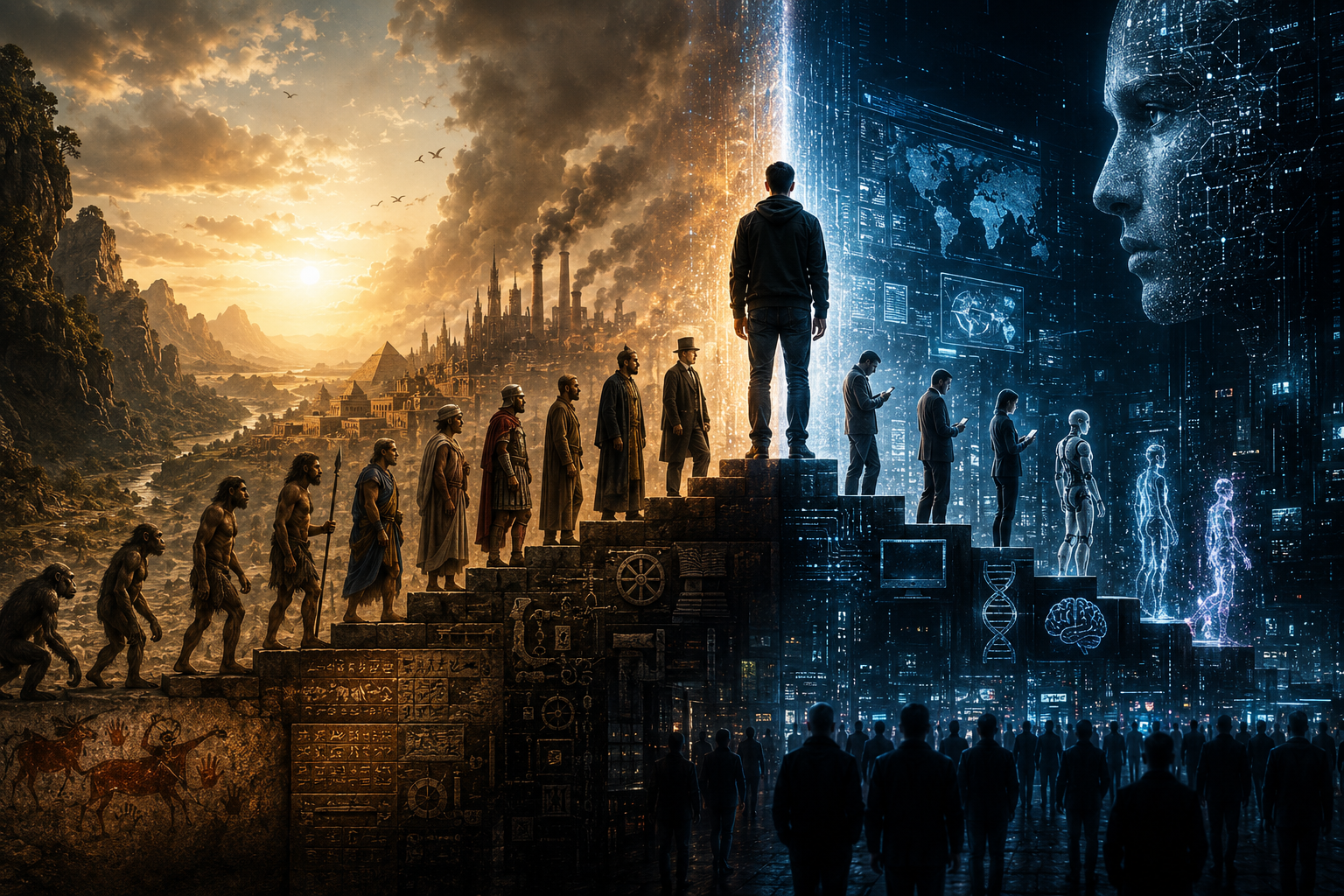
Humanity Won The Planet, Then Built The System That Could Defeat It
How Humans Invented Gods, Empires, Money, And Machines — Then Strive To Become Obsolete
Money. Nations. Gods. Empires. Human rights. Corporations. Laws. Brands. Political ideologies. Economic systems.
These are not meaningless lies. They are imagined orders. They exist because enough people behave as though they exist. Once enough people believe in them, they can move armies, build cities, create banks, justify wars, organise hospitals, raise taxes, and shape the lives of billions.
Sapiens: A Brief History Of Humankind surveys humanity from the Stone Age to the modern world, focusing on processes such as agriculture, money, religion, empire, and the nation state. Harari’s official site describes the book as a multidisciplinary work bridging history, biology, philosophy, and economics.
Homo Deus: A Brief History Of Tomorrow continues the argument into the future. Harari’s official site describes it as an exploration of what may happen when old myths are joined to godlike technologies such as artificial intelligence and genetic engineering.
Read together, the two books form a ruthless arc.
Sapiens explains how humans became gods to animals.
Homo Deus asks whether humans are now building gods above themselves.
The emotional promise of this combined summary is simple: by the end, you should understand Harari’s full argument about humanity, power, belief, technology, free will, happiness, death, data, and the future of the species.
The Big Idea Of Both Books
The big idea of Sapiens is that humanity’s greatest superpower is collective imagination.
A single human is not stronger than a chimpanzee in every meaningful physical sense. A small group of humans is not automatically more impressive than a pack of wolves or a troop of other primates. But millions of humans can cooperate around things that exist only in shared belief.
That ability changes everything.
The big idea of Homo Deus is that the same species that conquered the planet through stories may now be entering an age where stories are replaced by data flows, biological engineering, algorithmic prediction, and machine intelligence.
In Sapiens, humans move from animals to rulers.
In Homo Deus, humans try to move from rulers to gods.
The contradiction is that the very systems humans built to gain control may eventually make ordinary human beings less important. The humanist age put individual feelings, choices, and experiences at the centre of meaning. The data age may decide that humans are not sacred authors of meaning but biochemical algorithms that can be predicted, manipulated, upgraded, or bypassed.
That is the combined argument.
Humans became powerful by inventing meaning.
Now they may lose power to systems that process reality better than human meaning can.
The Argument In One Flow
Sapiens begins by shrinking human pride.
For most of history, Homo sapiens were not the obvious masters of Earth. They were one human species among others. There were Neanderthals, Denisovans, Homo erectus, and other human relatives. Sapiens were not born as kings of creation. They were animals inside an ecosystem, vulnerable to predators, climate, hunger, disease, and accident.
Harari’s first major move is to strip away the comforting idea that history was always heading toward us. It was not inevitable that Homo sapiens would dominate. For a long time, we were simply one branch of the human family.
Then came the Cognitive Revolution.
This is the first great turning point. Harari argues that something changed in the mental and linguistic capacities of Homo sapiens. Humans became able to communicate not only about immediate reality but about things that did not physically exist.
A monkey can warn another monkey about a lion. A human can tell a story about a spirit, a tribe, a law, a debt, a future reward, a divine command, a national destiny, or a sacred ancestor.
That difference seems small until it scales.
The Cognitive Revolution allows humans to cooperate flexibly in large numbers. Other animals cooperate, but usually within tighter biological limits. Bees cooperate through instinct. Wolves cooperate in packs. Chimpanzees manage social politics inside limited groups. Humans can cooperate with strangers because they both believe in the same imagined order.
This is the engine of Sapiens.
A nation is not a physical object in the same way a mountain is. A company is not a biological organism. A currency note is not valuable because of its paper. A legal system is not found inside nature. These things work because humans collectively believe in them, enforce them, and behave as if they are real.
The first shocking implication is that fiction is not the opposite of power.
Fiction is one of power’s main technologies.
After the Cognitive Revolution, Sapiens spread across the planet. This expansion is not presented as a gentle story of noble hunter-gatherers living in perfect harmony. Harari is clear that wherever humans arrive, ecological consequences follow.
Large animals disappear. Ecosystems change. The human ability to organise, hunt, communicate, plan, and adapt makes Sapiens devastatingly effective. Long before factories, capitalism, fossil fuels, and modern weapons, humans are already reshaping the natural world.
This is one of Sapiens’ harshest corrections to modern self-image. The ecological crisis did not begin only with industrial capitalism. Industrial capitalism accelerated it massively, but the human pattern of expansion and destruction is much older.
Then comes the Agricultural Revolution.
Many histories treat agriculture as obvious progress. Harari famously complicates that story. Agriculture allows larger populations, permanent settlements, cities, states, taxation, bureaucracy, hierarchy, written records, armies, and civilisation as most people understand it.
But for the average individual, Harari argues, the shift may not have been a simple improvement.
Hunter-gatherers often had varied diets, diverse skills, flexible social lives, and a deep knowledge of their environments. Farmers could end up working longer hours, eating narrower diets, suffering more disease, enduring harder labour, and living under new forms of hierarchy.
The Agricultural Revolution is therefore not just “humans domesticated wheat.”
It is also “wheat domesticated humans.”
Humans cleared forests, bent their backs, guarded fields, stored grain, fought over land, built villages, accepted rulers, and became locked into a system that could support more people while not necessarily making those people happier.
This is a core Harari move: distinguish between the success of the species and the wellbeing of the individual.
Agriculture is a triumph for Homo sapiens as a population machine. It is not automatically a triumph for the individual farmer, the domesticated animal, or the ecosystem.
As agricultural societies grow, imagined orders become more important. Larger societies need myths, hierarchies, classifications, and administrative systems. Humans invent social ranks, gender roles, property systems, kingdoms, priesthoods, empires, and laws.
Writing emerges not as poetry first, in Harari’s telling, but as administration. States need to count grain, tax labour, track property, record obligations, and manage complexity. Bureaucracy becomes one of civilisation’s hidden foundations.
This is another deflationary move.
Civilisation does not rise only from wisdom, art, and moral progress. It also rises from accountancy, taxation, coercion, and record-keeping.
Money becomes one of humanity’s most successful imagined orders. It works across cultures because it converts trust into a portable system. Two people who do not share religion, language, tribe, or politics may still accept the same coin, credit system, or financial instrument.
Money is powerful because it is universal and flexible. It can turn land, labour, time, loyalty, risk, and desire into comparable values. It may be spiritually empty, but it is socially brilliant.
Empires become another unifying force. Harari resists the simple view that empires are only evil or only civilising. They destroy cultures, impose violence, extract resources, and create suffering. Yet they also spread languages, laws, technologies, trade routes, administrative systems, and shared identities.
Most people today are heirs of imperial mixing, whether they like it or not. Our cultures, cuisines, languages, religions, legal systems, and political ideas often come from long histories of conquest, absorption, adaptation, and memory loss.
Religion also plays a major role in unifying humanity. For Harari, religion is not only belief in gods. It is any system of human norms and values founded on belief in a superhuman order. This means that certain political ideologies can function in religion-like ways, even when they reject traditional theology.
The Scientific Revolution marks another decisive turn.
Before modern science, many societies believed the most important truths had already been revealed by ancestors, scriptures, sages, or tradition. Modern science begins from a different emotional posture: ignorance.
“We do not know” becomes powerful.
This admission drives exploration, experimentation, measurement, and technological progress. Science joins forces with empire and capitalism. Empires fund research to map, classify, conquer, navigate, extract, and govern. Capitalism funds research because new knowledge can produce new power and profit.
This alliance transforms the world.
Capitalism becomes more than an economic system. It becomes a belief in future growth. Credit depends on trust that the future will be bigger than the present. Investment depends on the expectation that tomorrow can generate more than today.
This growth-oriented mindset changes politics, science, business, empire, and daily life. The modern world is built on the assumption that growth is possible, desirable, and necessary.
But growth has costs.
Industrialisation turns energy, labour, animals, land, and human time into inputs for production. Harari is especially severe about the suffering of domesticated animals. Modern agriculture and industry may produce abundance for humans, but they often produce misery for animals at an unprecedented scale.
By the end of Sapiens, humanity has become extraordinarily powerful but not necessarily wise or happy. Humans can split atoms, map genomes, build global markets, create vast cities, reduce some forms of suffering, and extend life. Yet the question remains: have we become happier?
This question matters because it stops the book from becoming a simple triumphal history.
Harari asks whether power has actually improved the subjective experience of human life. If happiness depends on expectations, biology, social comparison, meaning, and mental states, then progress is more complicated than GDP, lifespan, or technological capacity.
The final movement of Sapiens looks toward the possible end of Homo sapiens as we know it. Biotechnology, genetic engineering, cyborg technology, and artificial intelligence may allow humans to redesign bodies, minds, emotions, and life itself.
This is where Homo Deus begins.
If Sapiens asks how humans conquered the world, Homo Deus asks what humans will do after conquest.
Harari opens from the claim that for much of history, humanity was dominated by three huge problems: famine, plague, and war. He does not argue that they have vanished completely. He argues that modern humanity has become far better at managing them than previous generations, and that they are no longer viewed as uncontrollable natural destiny in quite the same way.
When famine happens now, people usually look for political, logistical, economic, or military causes. When epidemics spread, scientists investigate pathogens, vaccines, public health, and treatment. When wars begin, humans generally understand them as political decisions rather than unavoidable acts of nature.
That shift changes the human agenda.
If survival threats become more manageable, humanity’s ambitions expand. Harari argues that the new elite projects may become immortality, happiness, and divinity.
Immortality does not necessarily mean mystical eternal life. It means the technical project of defeating ageing, extending life, repairing bodies, replacing organs, editing genes, and treating death as an engineering problem rather than a metaphysical certainty.
Happiness becomes a technical project too. If emotions are biochemical processes, then perhaps mood, desire, satisfaction, and suffering can be modified through drugs, brain stimulation, genetic design, or algorithmic life management.
Divinity means the acquisition of godlike powers: creating life, redesigning organisms, engineering minds, controlling environments, and possibly producing beings beyond current humanity.
This is the bridge between the two books.
Sapiens shows humans becoming gods in relation to animals.
Homo Deus asks what happens when humans try to become gods in relation to themselves.
Harari then turns back to humanism. In the modern age, he argues, many societies moved meaning from gods to humans. Instead of asking priests, kings, or scriptures for ultimate authority, modern humanism tells us to look inside.
What do you feel?
What do you choose?
What does your conscience say?
What makes you happy?
Democracy, liberalism, consumer culture, romantic love, modern art, and human rights all depend in different ways on the authority of human experience. The voter knows best. The customer is always right. Beauty is in the eye of the beholder. Follow your heart.
Humanism makes the individual human experience sacred.
But Homo Deus argues that science may undermine the very foundation of humanism. If humans are biological algorithms, and if our choices arise from genetics, hormones, neurons, environment, and unconscious processes, then the old idea of a free, sovereign inner self becomes unstable.
This does not mean humans have no experiences. It means those experiences may not be authored by a magical free agent inside the mind. They may be processes that can be measured, predicted, and manipulated.
Once that becomes practical, humanism faces a crisis.
If an external algorithm knows your body, habits, desires, weaknesses, and future behaviour better than you do, why should authority remain with your inner feeling?
This is one of Homo Deus’s most important questions.
In the humanist age, the individual says: “I know how I feel.”
In the data age, the algorithm may say: “I know why you feel that, what you will feel next, and what will make you act.”
Harari introduces Dataism as a possible emerging worldview. Dataism treats the universe as data flows and sees the value of any phenomenon in terms of its contribution to data processing. Humans, animals, markets, societies, and machines become information systems.
In this worldview, human beings are not the centre. They are processors. If better processors emerge, human authority may decline.
This is where artificial intelligence becomes central. AI does not need consciousness to become powerful. It does not need feelings to outperform humans in many tasks. It only needs intelligence, pattern recognition, prediction, optimisation, and connection to systems that matter.
That distinction is vital.
For centuries, humans assumed intelligence and consciousness went together. A highly intelligent being was imagined as a conscious being. But modern AI raises the possibility of intelligence without consciousness: systems that can diagnose, trade, recommend, design, translate, target, surveil, and decide without feeling anything.
This creates a historic threat to human economic and political value.
If machines can perform tasks better than humans, many people may become economically useless in the sense that the system no longer needs their labour. Harari calls attention to the possible emergence of a “useless class” — people not worthless morally, but no longer needed by the dominant economic and military systems.
That possibility is more frightening than ordinary unemployment. Previous technological revolutions often replaced old jobs but created new ones. The question in Homo Deus is whether future systems will still need most humans at all.
Biotechnology adds another layer. If the rich can enhance bodies, intelligence, emotions, lifespans, and children, inequality may become biological. The gap between elites and ordinary people could move from wealth and education into engineered capacity.
This would mark a break from modern humanist equality. Liberal societies often assume that all humans share a basic dignity and political equality. But if some humans are upgraded into radically enhanced beings, the moral and political foundations of equality may weaken.
The title Homo Deus means “man-god” or “human god.” It is not simply optimistic. It is dangerous.
A small elite may pursue godlike upgrades while ordinary Homo sapiens lose influence. Humans may split into castes not just of money but of biology and cognition. Algorithms may know us better than we know ourselves. The systems we built may stop asking for our permission.
Homo Deus ends not with a firm prediction but with questions.
Are organisms really just algorithms?
What is more valuable: intelligence or consciousness?
What happens when non-conscious but highly intelligent algorithms know us better than we know ourselves?
These questions are the real conclusion. Harari is less interested in giving a single prophecy than in forcing the reader to confront the fragility of modern assumptions.
The combined story of Sapiens and Homo Deus is therefore not “humans are amazing.”
It is darker and more precise.
Humans are myth-making animals who used shared fictions to dominate Earth. Those fictions built tribes, farms, states, empires, religions, markets, sciences, industries, and humanist democracies. But now the same drive for power may produce technological systems that make ordinary humans less central to meaning, labour, politics, and decision-making.
The species that became powerful by telling stories may be overtaken by systems that do not need stories to function.
The Main Concepts Inside The Argument
The first major concept is the imagined order.
This is the backbone of Sapiens. An imagined order is a shared belief system that enables mass cooperation. It is not “fake” in the sense of being irrelevant. It is imaginary in the sense that it exists because humans collectively sustain it.
A limited company is an imagined order. So is a monarchy, a currency, a nation, a legal right, a caste system, a border, or a university. These things can shape life and death precisely because people believe in them and institutions enforce them.
The second concept is intersubjective reality.
Objective reality exists independently of human belief. Radioactivity exists whether humans believe in it or not. Subjective reality exists inside one person’s experience. Pain, fear, memory, and desire are subjective.
Intersubjective reality exists between minds. Money, gods, laws, brands, and nations live there. They are not physical in the same way as rocks, but they are not merely private fantasies either. They exist in networks of shared belief.
The third concept is the success-versus-happiness distinction.
Harari repeatedly separates what helps the species expand from what helps individuals flourish. Agriculture allowed more humans to exist, but not necessarily happier ones. Empire unified territories, but often through brutality. Industrial farming feeds billions, but creates massive animal suffering.
This distinction prevents lazy progress worship.
The fourth concept is humanism.
Humanism places human experience at the centre of meaning. It tells people to trust their feelings, choices, creativity, conscience, and personal experience. Modern politics, art, consumption, therapy, romance, and ethics are deeply shaped by this assumption.
The fifth concept is the algorithmic view of life.
Homo Deus pushes the idea that organisms may be understood as biochemical algorithms. This does not mean humans are simple machines. It means that our feelings and decisions may arise from complex but potentially analysable processes.
The sixth concept is Dataism.
Dataism is Harari’s name for a worldview that treats data flow as the supreme value. In this frame, human experience matters less than information processing. The danger is that humans may willingly surrender authority to systems that appear to know better.
The Central Conflict Across Both Books
The central conflict is between human meaning and impersonal optimisation.
In Sapiens, meaning wins. Humans create stories, and those stories organise the world. A god, nation, company, or currency can make strangers cooperate because it gives them a shared mental framework.
In Homo Deus, optimisation begins to challenge meaning. Algorithms do not need meaning in the human sense. They need data, goals, feedback, and processing power. They can make decisions without dignity, narrative, suffering, love, or selfhood.
That is the terrifying shift.
For thousands of years, power belonged to the best human stories.
In the future Harari imagines, power may belong to the best data systems.
The old ruler said: “Believe this story.”
The new ruler may say nothing. It may simply predict, nudge, rank, recommend, exclude, optimise, insure, diagnose, price, approve, reject, and manage.
Human beings may not experience this as tyranny at first. They may experience it as convenience.
That is the danger.
The Turning Points
The first turning point is the Cognitive Revolution.
This gives humans the ability to cooperate through imagined realities. Without it, Homo sapiens remain clever animals. With it, they become myth-making network builders.
The second turning point is the Agricultural Revolution.
This locks humans into larger, denser, more hierarchical societies. It increases population and complexity while introducing new forms of labour, disease, inequality, and dependency.
The third turning point is the rise of money, empire, and universal religions.
These systems allow cooperation across larger distances and stranger populations. Humanity becomes increasingly unified, though often through conquest, extraction, and cultural destruction.
The fourth turning point is the Scientific Revolution.
Humanity admits ignorance and turns knowledge into an engine of power. Science joins empire and capitalism, creating the modern world’s explosive expansion.
The fifth turning point is the humanist revolution.
Meaning moves inward. The individual’s feelings, choices, and experiences become sacred. The modern person is told to trust themselves.
The sixth turning point is the algorithmic revolution.
Science and technology begin to suggest that the self may not be sovereign after all. If humans can be decoded, predicted, and upgraded, then humanism loses its monopoly on authority.
The final turning point is the rise of AI and biotechnology.
At this stage, humanity may no longer merely use tools. It may create systems and beings that change the definition of humanity itself.
The Emotional Journey Inside The Argument
The emotional journey of Sapiens begins with humility.
Humans are not the centre of the universe. They are not even the only humans history produced. They are one species that happened to develop extraordinary cooperative abilities.
Then comes awe.
The rise of large-scale cooperation is astonishing. Myths become cities. Stories become empires. Trust becomes money. Curiosity becomes science. Ignorance becomes discovery.
Then comes guilt.
Human success has been catastrophic for many animals, ecosystems, cultures, and individuals. The triumph of Sapiens is also a trail of extinctions, suffering, domination, and self-deception.
Then comes doubt.
Did all this power make us happier? Did civilisation improve subjective life, or did it mostly increase scale, complexity, and expectation?
Homo Deus begins with confidence.
Humanity has reduced the helplessness it once felt before famine, plague, and war. The modern world believes problems can be managed. Death itself begins to look like a technical challenge.
Then comes ambition.
If we can reduce suffering, why not engineer happiness? If we can heal bodies, why not enhance them? If we can understand biology, why not redesign life?
Then comes dread.
The same tools that promise liberation may destroy human centrality. The same algorithms that help us may know us too well. The same technologies that extend life may create biological inequality. The same data systems that optimise society may make human judgement obsolete.
The combined emotional arc is therefore ascent followed by vertigo.
Humanity climbs from animal vulnerability to planetary dominance, looks upward, and realises it may be building something above itself.
The Overall Premise
Because Sapiens and Homo Deus are non-fiction arguments rather than novels, their “ending” is intellectual rather than plot-based.
Sapiens ends by asking whether Homo sapiens are approaching the end of their own era. After conquering the planet, humans have begun acquiring the power to redesign life. The species that emerged through natural selection may soon alter itself through intelligent design.
The final emotional effect is not triumph. It is unease. Harari portrays humanity as powerful but dissatisfied, capable of miracles but unsure what it wants.
That is one of his most famous warnings: dissatisfied and irresponsible gods are dangerous.
Homo Deus ends by intensifying that unease. It does not say with certainty that humans will be replaced by algorithms or upgraded into gods. Instead, it argues that the assumptions of modern humanism are under pressure.
If organisms are algorithms, if data systems know us better than we know ourselves, and if intelligence can separate from consciousness, then the future may not belong to ordinary human experience.
The ending of the combined argument is a warning about authority.
In the ancient world, authority came from gods.
In the humanist world, authority came from human feelings.
In the data world, authority may come from algorithms.
The unresolved question is whether humans can build powerful technologies while preserving human dignity, consciousness, freedom, and meaning.
The Story Anchor
The strongest anchor across both books is wheat.
In Sapiens, wheat appears not merely as a crop but as a reversal of perspective. Humans think they domesticated wheat. Harari asks whether wheat domesticated humans.
Before agriculture, humans moved across landscapes, ate varied diets, and lived within flexible ecological rhythms. After agriculture, many humans bent their lives around fields, seasons, settlements, storage, taxes, property, and grain.
Wheat spread across the world.
Humans did the work.
That image captures Harari’s entire method. He takes something humanity calls progress and asks who really benefited.
The same anchor applies to Homo Deus.
Humans may think they are building AI and biotechnology to serve them. But the wheat question returns in a new form: are we using the system, or is the system using us to spread itself?
If You Only Remember Three Ideas
The first idea is that humans rule through shared fictions.
This does not make civilisation meaningless. It makes civilisation astonishing. Humans can cooperate with strangers because they believe in the same laws, currencies, gods, companies, nations, rights, and futures. The danger is that we forget these systems are invented and start treating them as natural destiny.
The second idea is that progress for the system is not the same as happiness for the individual.
Agriculture, empire, industry, and capitalism can increase scale, power, production, and population while still creating suffering. A society can become richer and more technologically advanced without making people calmer, freer, or more fulfilled.
The third idea is that the next great transfer of authority may be from humans to algorithms.
Modern culture tells people to follow their feelings. But if algorithms can understand, predict, and manipulate those feelings better than individuals can, then the humanist world begins to crack. The future may not abolish choice. It may quietly outsource it.
The Sentence That Explains Both Books
Humans conquered the world by inventing shared stories, but the systems they built may now become powerful enough to write the next story without them.
Why These Books Matter
Sapiens still matters because it gives readers a usable framework for understanding civilisation as a network of shared beliefs rather than a natural fact.
That matters in an age of political polarisation, financial instability, culture wars, institutional mistrust, religious conflict, and digital identity. Once you understand imagined orders, you can see why people fight so fiercely over flags, currencies, borders, pronouns, gods, markets, and histories.
Homo Deus matters because its central questions have become more urgent. AI, genetic engineering, biometric surveillance, algorithmic recommendation, brain-computer interfaces, longevity research, and data-driven governance are no longer abstract futurism. They are active forces.
Harari’s later work has continued to focus on information networks and AI. A Guardian review of Nexus described his argument that AI differs from past technologies because it can make decisions independently, making his earlier concerns in Homo Deus feel even more current.
What aged well is Harari’s emphasis on data, algorithmic authority, and the fragility of humanism.
What aged less perfectly is the confidence of some broad claims. Specialists often criticise Harari for compression, simplification, and sweeping synthesis. That criticism is fair. These books are not narrow academic monographs. They are big-idea narratives.
But their usefulness lies precisely in the scale.
They give readers a map. The map is not the territory, but it helps people see the territory differently.
What Most People Misunderstand
The shallow misunderstanding is that Sapiens is just a history book.
It is not.
It is an argument about the role of fiction in power.
The second misunderstanding is that Homo Deus is simply a book of predictions.
It is not.
It is an argument about the possible collapse of humanist authority.
The third misunderstanding is that Harari is saying nothing is real because nations, money, and rights are imagined.
That is wrong.
He is saying imagined things can be extremely real in their consequences. A company may be a legal fiction, but it can employ thousands, destroy forests, fund research, lobby governments, and change history.
The fourth misunderstanding is that the books are anti-human.
They are better understood as anti-human-arrogance. Harari does not deny human brilliance. He denies that brilliance guarantees wisdom.
Common Misconceptions
“Wheat domesticated humans.”
“Money is fiction.”
“Human rights are imagined.”
Those lines are memorable, but they can become shallow if detached from the full argument. Harari is not merely being provocative. He is showing that civilisation runs on intersubjective belief.
The internet often turns Homo Deus into AI doom content.
That also misses the structure. The book is not only about machines replacing jobs. It is about the deeper question of authority. Who should make decisions when external systems know more about us than introspection does?
Productivity culture also misuses Harari by turning his ideas into personal optimisation slogans. But the books are not mainly about becoming more productive. They are about recognising the systems shaping human life.
The influencer version says: understand the story and win.
The deeper version says: understand the story and ask whether you are inside one.
The Taylor Tailored Interpretation
The Taylor Tailored interpretation is this: Sapiens and Homo Deus are really about the danger of mistaking successful systems for moral systems.
Agriculture succeeded, but it did not necessarily make individuals happier.
Empire succeeded, but it often crushed cultures.
Capitalism succeeded, but it can turn growth into a sacred demand.
Humanism succeeded, but it may have oversold the sovereignty of the individual.
Data systems may succeed, but success will not prove they serve human flourishing.
That is the key.
History is full of things that spread because they are effective, not because they are good.
Wheat spread. Empires spread. Money spread. Corporations spread. Algorithms spread.
The brutal question is not “does this system work?”
The brutal question is “what does this system work for, and who becomes smaller when it gets bigger?”
The Real-Life Test
The real-life test is to ask what story is currently organising your behaviour.
In a career, the story may be status, promotion, security, revenge, service, mastery, or freedom.
In money, the story may be scarcity, growth, comparison, independence, or fear.
In relationships, the story may be loyalty, abandonment, power, romance, family duty, or control.
In politics, the story may be nation, class, identity, faith, fairness, resentment, or progress.
Harari’s point is not that you can live without stories. You cannot. The point is to notice which stories you have inherited, which ones you have chosen, and which ones are using you.
The Homo Deus extension is to ask which algorithms are now shaping those stories.
Your feed is not neutral.
Your search results are not neutral.
Your recommendations are not neutral.
Your health data, spending history, dating profile, location trail, and work metrics are not merely passive records. They are increasingly part of systems that classify, predict, and influence you.
How To Apply The Lessons Without Turning Them Into A Fantasy
Do not read these books and become smug about everyone else believing in fiction.
That is the cheap interpretation.
The useful interpretation is to become more precise about your own operating systems.
Write down the five imagined orders that most shape your life. They might include your employer, mortgage, family role, political identity, religion, nationality, business, relationship status, or social media persona.
Then ask what each one demands from you.
What does it reward?
What does it punish?
What does it make easy?
What does it make almost unthinkable?
Next, audit your algorithmic environment. Which platforms can change your mood within minutes? Which apps know your impulses? Which systems do you obey because they are convenient? Which metrics have quietly become your scoreboard?
Finally, separate power from wisdom.
A tool that makes you stronger does not automatically make you better. A system that makes you visible does not automatically make you respected. A technology that makes life easier does not automatically make life meaningful.
Five Questions To Test Whether You Actually Understood These Books
What is the difference between objective reality, subjective reality, and intersubjective reality?
Why does Harari argue that agriculture may have been bad for many individual humans while still successful for Homo sapiens as a species?
How do money, empire, and religion each help unify large numbers of strangers?
Why does modern humanism depend on trusting individual feelings?
What happens to human authority if algorithms know our feelings, choices, and weaknesses better than we do?
The Final Lesson
Sapiens and Homo Deus are not comforting books.
They do not tell humanity that progress is fake. They tell humanity that progress is dangerous when power outruns self-knowledge.
The species began as an animal trying to survive. It learned to tell stories. The stories became tribes, gods, farms, empires, markets, nations, sciences, and machines. Then the machines began to learn the storytellers.
That is the full Harari warning.
Humans conquered the world by turning imagination into infrastructure. The next question is whether we can keep control of that infrastructure before it turns us into yesterday’s animal.
