The Prophecy, the Horcruxes and the Elder Wand
The First Letter Knows Where Harry Sleeps
The envelope is addressed to the cupboard under the stairs. Before Harry Potter knows who sent it, he has evidence that somebody outside the Dursley household knows where they make him sleep. His uncle tears the letter away. More arrive. When the family moves Harry into a bedroom, the address changes too. It is a peculiar sort of kindness, being accurately located, and an apt beginning for J. K. Rowling’s seven novels. Harry will spend much of his childhood discovering how many people know his name and how few know what happened to him. The difference becomes important on his first shopping trip, when strangers queue to shake his hand over an event he cannot remember.
Book One: Harry Potter and the Philosopher’s Stone
On Harry’s eleventh birthday, Rubeus Hagrid arrives to deliver the information the Dursleys have spent years withholding. Harry is a wizard. His parents, James and Lily, were murdered by Lord Voldemort. When Voldemort tried to kill their infant son, the attack failed, leaving Harry with a scar and the wizarding world without the tyrant it had learned to fear. The Dursleys have explained his parents’ deaths as a car accident. In one conversation Harry gains a school place, an inheritance and a history of deliberate lies told by the adults who put him to bed.
Hagrid, the first grown-up Harry remembers taking his side, assumes that some parts of his new life will be obvious. They seldom are. The Hogwarts Express leaves from a platform Harry cannot find until he overhears a mother giving her children instructions. Mrs Weasley helps him through the barrier without demanding an explanation of his ignorance. On the train he can afford sweets and Ron Weasley has sandwiches he does not want. Sharing what they have gives them something to do together before either has learnt how to talk about the family the other possesses. Ron would like some distinction in a family full of brothers. Harry would scarcely know where to begin with the luxury of having brothers to complain about.
At Hogwarts, the Sorting Hat considers placing Harry in Slytherin. He asks to go elsewhere and joins Ron in Gryffindor. The encounter establishes a useful limit to magical authority. An object with access to his thoughts can identify abilities he has barely begun to exercise, yet his objection still counts. He has seen Draco Malfoy offer friendship on the understanding that a boy of Harry’s standing should choose his company carefully. Declining Draco has given him more practical information about the person he wants to be than any amount of speculation about inherited talent.
Hermione Granger takes longer to become his friend. She has prepared for school by reading, knows answers other pupils cannot give and initially assumes that the best response to a dangerous idea is to point out which rule prohibits it. Harry and Ron find her unbearable until an encounter with a mountain troll leaves all three facing questions from their teachers. Hermione lies to protect the boys who came looking for her. It is a striking first act of friendship from a girl who has spent weeks correcting their behaviour. She has discovered a situation in which giving an accurate disciplinary account would betray something more important about what they did.
Why the Wrong Teacher Looks Guilty
Hogwarts contains a forbidden corridor, a three-headed dog and a concealed object that somebody appears keen to steal. Harry sees Professor Snape behaving suspiciously and has ample personal reason to dislike him. Snape mocks him in class and plainly resents his father. During a Quidditch match Harry’s broom begins behaving dangerously, and Hermione sees Snape muttering with his eyes fixed on Harry. She intervenes. The broom rights itself. From the stands, the conclusion looks excellent: identify the man concentrating on the victim, interrupt him and observe the danger pass.
What the children cannot see is that two adults are concentrating on the same boy for opposite reasons. Professor Quirrell is endangering Harry. Snape is attempting a counter-curse. Hermione disrupts Quirrell on her way to Snape. The clue works because Snape’s cruelty is real. Harry has made the ordinary mistake of allowing a sound judgement about how a teacher treats children to settle a different question about which teacher is trying to kill him.
The hidden object is the Philosopher’s Stone, which can produce an elixir that prolongs life. Harry becomes convinced that someone is about to take it. With Dumbledore away, the three friends go after it themselves. The obstacles divide the labour among them. Ron understands the chessboard well enough to see why one piece must be lost. Hermione can solve a problem involving potions by reasoning from the information given. Harry reaches the final room because two other children recognise the moment when their own contribution matters more than accompanying him to the finish.
There he finds Quirrell, carrying Voldemort on the back of his head. Between them and the Stone stands the Mirror of Erised. Earlier Harry saw his parents in it and returned night after night for the pleasure of standing before a family he could neither touch nor join. Dumbledore noticed how easily that pleasure could consume his days. Now the same property makes the mirror an unusually effective lock. Quirrell wants to use the Stone for his master. Harry wants to find it while having no intention of using it. Dumbledore’s enchantment gives it to the second kind of seeker. Harry sees his reflection pocket the Stone and feels it arrive in his real pocket.
Quirrell cannot bear contact with Harry’s skin. Lily’s decision to die protecting her child left a protection Voldemort failed to understand, and sharing Quirrell’s body exposes him to it. Harry holds on long enough for help to come. He wakes in the hospital wing knowing that his mother did something for him that survived her death. He still cannot remember her voice. The novel permits magic to answer the question of why he lived while leaving intact the much more ordinary deprivation the mirror exposed.
The Stone is to be destroyed, and its elderly maker, Nicolas Flamel, accepts what that means. Harry has spent a year discovering that extraordinary objects exist. Two adults end it by agreeing that the world can manage without this one. At the end-of-year feast Dumbledore also recognises Neville Longbottom, who tried to stop his friends leaving their dormitory and received little thanks for his trouble. Gryffindor wins partly because the school rewards a child who opposed the very expedition its headmaster has just honoured. Harry’s new home has room for a more interesting idea of courage than agreement with Harry Potter.
Book Two: Harry Potter and the Chamber of Secrets
Summer with the Dursleys leaves Harry wondering why his friends have failed to write. Dobby, a house-elf, has intercepted their letters in the hope that loneliness will persuade him to stay away from Hogwarts. Dobby knows something dangerous is being prepared there. Bound to serve a wizarding household and punished for disobedience, he cannot simply explain himself. He tries to protect Harry by making the loss of school feel voluntary. The trouble is that Dobby knows what enslavement looks like and knows almost nothing about what another summer at Privet Drive would mean to this particular boy.
Back at school, Harry begins hearing a voice that nobody beside him can hear. Then the caretaker’s cat is found petrified beneath a message announcing that the Chamber of Secrets has been opened. According to the school’s history, Salazar Slytherin left a chamber that his heir could use to purge Hogwarts of pupils he considered unworthy. For Hermione, whose parents are non-magical dentists, what sounds like a colourful piece of school folklore to some classmates is an explicit judgement on whether she belongs at her desk.
Suspicion falls on Harry when he speaks to a snake in front of other pupils. He thinks he is telling it to leave another boy alone. They hear a language traditionally associated with Slytherin and see a frightened child within striking distance. Harry has done something brave and acquired witnesses who sincerely believe they saw him do something sinister. His earlier experience with Snape ought to make the misunderstanding intelligible. It does very little to make breakfast more pleasant when the other pupils give him a wide berth.
Harry and his friends suspect Draco. A carefully prepared disguise gives Ron and Harry access to the Slytherin common room, where they learn that Draco shares the attacker’s prejudices but does not know the attacker’s identity. This is a useful disappointment. A boy can enjoy the thought of somebody terrorising his classmates without having the courage or knowledge to carry it out. Looking for a single guilty heir risks overlooking all the people prepared to make such a person feel welcome.
A Diary Gives Harry the Wrong History
A battered diary bearing the name T. M. Riddle answers Harry when he writes in it. Its owner can even show him scenes from the previous opening of the Chamber, fifty years before. Harry sees a young Tom Riddle catching Hagrid with a monstrous spider. A pupil had died, and Hagrid was expelled. Here appears to be precisely the evidence missing from the school legend. Harry has seen the event with his own eyes. What he has actually seen is a scene selected by a witness with an excellent reason to stop the account at the moment of Hagrid’s apparent exposure.
The distinction becomes urgent when the authorities take Hagrid to Azkaban as a precaution. Harry and Ron follow a clue Hagrid leaves them and discover that the spider, Aragog, was never the creature in the Chamber. Hermione, meanwhile, has identified a basilisk. A direct look into its eyes kills. The present victims have encountered its gaze indirectly, through something such as a reflection or a camera, and have been petrified instead. The pipes explain how a creature of its size moves unseen through the castle. Harry hears it because he can understand snakes. A clue the school treated as evidence against him turns out to be the faculty that can lead him to the victims’ attacker.
The pupil who died fifty years earlier has been available for questioning all along. Moaning Myrtle, the ghost haunting a girls’ bathroom, remembers seeing great yellow eyes by the sinks. She has spent decades being treated as a nuisance in the very place where she was killed. Once Harry asks what happened to her, a school joke becomes a witness. The entrance is there, and Harry’s ability to speak Parseltongue opens it.
Below, Ron’s young sister Ginny is dying. She has been confiding in the diary throughout the year. Riddle has exploited her loneliness and embarrassment, drawing strength from what she tells him and using her to act inside the school. He is the preserved adolescent self of the wizard who grew up to call himself Voldemort. The grand confrontation between an heir and an enemy has depended on a much less grand piece of cruelty: getting an eleven-year-old girl to believe she has finally found somebody who will listen without laughing.
Harry’s loyalty to Dumbledore brings assistance from Fawkes, the headmaster’s phoenix. Fawkes blinds the basilisk, and the Sorting Hat yields the sword of Godric Gryffindor. Harry kills the creature, is wounded by a fang and survives through the healing power of the phoenix’s tears. The fang then supplies the means of destroying the diary. Piercing the book destroys the Riddle drawing life from Ginny, and she wakes. Harry cannot yet explain how much of a person could exist in an object. He has established something more immediately useful: damage the diary beyond recovery and this version of Riddle can no longer sustain itself.
Lucius Malfoy put the diary among Ginny’s belongings. Harry subsequently tricks him into presenting Dobby with a piece of clothing, which ends the elf’s servitude under its own rules. There is a pleasing difference between Harry’s two rescues. In the Chamber, an old inheritance responds to his commitment to Hogwarts. Outside it, he uses a dirty sock and a shrewd estimate of what an angry man will do with something he considers beneath his notice. Dobby leaves able to decide whom he wants to help. That freedom will give his later acts a value no master could command.
Book Three: Harry Potter and the Prisoner of Azkaban
Sirius Black has escaped from Azkaban, and adults who normally complain about Harry breaking rules are suddenly desperate to keep him within sight. The school is guarded by Dementors, creatures employed by the Ministry of Magic to contain prisoners. Their presence drains happiness and forces people back towards their worst experiences. Harry suffers more visibly than his classmates. In their vicinity he begins to hear his mother pleading for his life. He once spent hours before a mirror hoping for contact with his parents. Now he has something like access to his mother’s voice and would give almost anything to stop hearing it.
Professor Remus Lupin, the new Defence Against the Dark Arts teacher, understands why the Dementors affect him so badly. He teaches Harry to produce a Patronus, a guardian that can drive them away. It requires Harry to summon happiness while in the presence of something that drains his ability to feel it. Practice gives him more than a spell for emergencies. An adult has noticed his difficulty, explained it without humiliating him and made time for him to improve. After two years of teachers who variously tried to kill him or claim credit for other people’s work, ordinary professional competence looks almost miraculous.
Harry learns what adults believe Sirius did. James and Lily Potter hid under a charm that entrusted the secret of their location to one person. Sirius, James’s closest friend and Harry’s godfather, was believed to be that Secret Keeper. Peter Pettigrew supposedly confronted him after the Potters died. Witnesses heard Peter accuse Sirius, an explosion killed bystanders and only a finger remained of Peter. Sirius went to prison. Each detail fits the accepted account remarkably well. Nobody can explain to Harry why a man his father loved would betray him, so anger rushes in to fill the space.
A schoolboy possession offers a better kind of evidence. The Marauder’s Map identifies the people moving around Hogwarts, including people whose appearances ought to conceal them. Its makers knew every passage because they explored the grounds as boys. They were James, Sirius, Peter and Lupin. Lupin is a werewolf. His friends learnt to transform into animals so that they could accompany him during his transformations. The extraordinary labour behind that act of friendship makes the fate of their adult relationships harder to dismiss as a simple error about which man was good.
The Man Everybody Saw Die
Events around Ron’s pet rat, Scabbers, lead Harry, Hermione and Ron into the Shrieking Shack. Sirius is there. Lupin arrives after seeing Peter’s name on the map. The explanation that follows overturns almost every material inference drawn from the old scene. Sirius and James secretly switched Secret Keepers to Peter because an apparently insignificant friend would be an unlikely target. Peter betrayed them. When confronted, he staged his own apparent murder, leaving his finger behind and escaping as a rat. People really did see Sirius in the wreckage. They were wrong about what had happened a second earlier.
Peter has spent years in the Weasley household. What looked like the uneventful life of a family pet afforded him access to news of the wizarding world and shelter from retribution. His physical presence allows the adults to test the story. Harry is no longer choosing between two men’s accounts of a distant evening. Ron’s rat can be made to resume human form, and that man has something considerable to explain about attending his own memorial as a living creature.
Sirius and Lupin want to kill him. Harry stops them, partly because he cannot bear to see his father’s friends become killers on his account. He wants Peter handed over alive, which would also clear Sirius. For a short time Harry can picture moving out of the Dursleys’ house and living with his godfather. The possibility gives the journey back towards the school an almost unbearable optimism. His parents are still dead. One of the people they chose to love him has been found, and for Harry that changes the shape of next summer.
Then Lupin transforms under the full moon. Peter escapes in the confusion. Dementors surround Sirius and Harry by the lake, and a powerful Patronus drives them off. As he loses consciousness Harry thinks he has seen his father saving him from the opposite bank. The official case against Sirius is again stronger than anything Harry can produce. The whereabouts of an escaped prisoner can be established. The whereabouts of the supposedly dead man required to exonerate him cannot.
Why Harry Knows He Can Cast the Patronus
Hermione has been using a Time-Turner to attend lessons scheduled for the same hours. At Dumbledore’s prompting, she and Harry go back through the evening. They release Buckbeak, the hippogriff condemned after injuring Draco, before his executioner can kill him. What they had previously heard and interpreted as an execution never established the animal’s death. Their intervention fits inside the events they experienced the first time. They cannot erase Peter’s escape and return to a happier version of the afternoon.
At the lake Harry waits for the figure he took to be James. Nobody comes. Gradually he recognises the position where he saw the figure standing. It is where he stands now. He can produce the extraordinary Patronus because he has finally understood that he already saw himself do it. The stag it assumes connects him to his father, whose animal form was a stag, while allowing Harry to perform the rescue with his own ability. The father he longed for has contributed something to the act without returning from the dead to do it for him.
Harry and Hermione free Sirius on Buckbeak. A legal acquittal and a home together remain beyond reach. Lupin resigns once his condition becomes known, despite having been the best defence teacher Harry has had. For the first time a Hogwarts year closes with the children knowing far more of the truth than the institutions responsible for enforcing it. Knowing is sufficient to save two lives. It cannot by itself clear a name, change an employer’s mind or persuade a minister that his government has guarded the wrong prisoner for twelve years.
Book Four: Harry Potter and the Goblet of Fire
The Quidditch World Cup gives Harry his first sustained view of wizarding life on an international scale. It looks exuberant until a group of masked wizards terrorises a family of non-magical people and Voldemort’s old mark appears overhead. The distinction between those acts will matter. Some former followers are willing to dress up, hurt people and revisit the pleasures of belonging to a feared group. The sight of the mark frightens them. They would prefer the privileges of their former allegiance without the inconvenience of an actual master returning to collect on it.
At Hogwarts, the Triwizard Tournament promises regulated competition among three schools. Each school will have a champion, and an age restriction is meant to protect younger pupils. The Goblet selects the expected three names, including Hogwarts pupil Cedric Diggory. Then it produces Harry’s. Someone has entered him under a fictitious fourth school and deceived the Goblet into accepting an additional competitor. Harry has done nothing to seek the role. The magical contract is nevertheless treated as binding, and very few classmates believe a famous boy protesting that he would rather have gone unnoticed.
Even Ron suspects him of secretly putting his name forward. Ron’s reaction hurts because it comes from someone who knows what Harry’s fame actually cost. It is also rooted in a difficulty Harry rarely has to consider. Ron has grown up receiving second-hand things and standing beside talented brothers. His best friend appears to have discovered yet another way of being chosen. Their eventual reconciliation matters less as a settlement about the Goblet than as an acknowledgement that Harry can experience unwanted attention and Ron can experience exclusion at exactly the same time.
The tasks reward resourcefulness and invite cheating. Adults routinely help their preferred champions while sustaining the fiction of a fair contest. Harry passes information to Cedric so that the other boy knows about the dragons. Cedric later returns a clue. In the lake Harry stays to make sure another competitor’s little sister is brought up safely, even though doing so costs him time. His belief that a hostage might actually be abandoned looks naive once everyone is back on dry land. Given what adults have already allowed to happen to children at Hogwarts, he has considerably better reasons for caution than the judges do for amusement.
Why Cedric Is in the Graveyard
Much of Harry’s progress appears to come from a demanding but effective new teacher, Alastor Moody. Moody teaches pupils about dangerous curses, notices useful talents and directs attention towards help without always supplying the answer himself. Harry has learnt from Lupin that a teacher can show genuine interest in his survival. That welcome precedent makes him vulnerable to someone whose interest in his survival has an entirely different end date.
In the final maze, Harry and Cedric help each other and reach the Cup together. Each has a claim to it and each believes the other deserves it. They agree to take it at the same time. The decision is decent, and the novel refuses to make decency an insurance policy. The Cup has been turned into a Portkey. It carries both boys to a graveyard where only Harry was expected. On Voldemort’s order, Peter Pettigrew kills Cedric because his presence serves no purpose. A boy whose scrupulous sense of fairness has occupied a whole school year is disposed of as an administrative complication.
Pettigrew helps restore Voldemort to bodily life. An important ingredient in the ritual is blood taken from an enemy. Voldemort insists on Harry’s, believing that incorporating it will allow him to overcome the protection Lily left. When he can touch Harry without suffering Quirrell’s fate, that judgement appears vindicated. His restored followers see a master who has engineered a resurrection and can exhibit the boy associated with his defeat. Voldemort insists on a duel because mere survival is insufficient. He needs witnesses to a corrective performance in which the earlier failure can be publicly reversed.
Harry’s wand and Voldemort’s contain feathers from the same phoenix. Forced into combat against each other, they connect, and Voldemort’s wand begins producing echoes of its recent victims. Among them are Cedric and Harry’s parents. These figures cannot restore the family Harry saw in the mirror. They can give him a brief opportunity to get away. Cedric asks Harry to take his body home. Harry reaches the Cup with him and returns to Hogwarts carrying the person whom the organisers expected to emerge holding a trophy.
It is an especially important request in a series crowded with magical approximations of the dead. Cedric’s parents cannot have him back. They can have his body brought out of a place whose location and events might otherwise remain entirely unknown to them. Harry accomplishes something for this family that has nothing to do with winning a duel. He makes his escape harder in order to perform the last service a schoolmate asked of him.
The man posing as Moody draws Harry away afterwards and reveals too much knowledge of the night’s events. He is Barty Crouch Jr, a devoted follower who escaped Azkaban through his mother’s substitution and spent years concealed by his father. He imprisoned the real Moody, used Polyjuice Potion to take his appearance and shepherded Harry through the tournament so he would reach the Portkey. A year’s worth of apparently helpful interventions acquires a new and consistent purpose. Their immediate benefits were real. Harry needed to reach the maze alive.
Cornelius Fudge, the Minister for Magic, refuses to accept Voldemort’s return. A Dementor has already taken Crouch Jr’s soul, removing a witness who could have spoken. Dumbledore sees preparations that must begin immediately. Fudge sees a political catastrophe that can still be denied. Harry ends his fourth year having brought a dead child home to a community willing to mourn him but divided over whether it will acknowledge who killed him. He gives his tournament winnings to Fred and George Weasley for their joke shop. After a school year in which virtually every adult use of competition has failed him, he finds a surprisingly purposeful use for prize money: buying the possibility of future laughter.
Book Five: Harry Potter and the Order of the Phoenix
Harry spends the summer waiting for information while the public story of Cedric’s death hardens around him. When Dementors attack him and Dudley near Privet Drive, Harry must choose between performing forbidden underage magic and leaving his cousin defenceless. He casts a Patronus. A Ministry hearing then turns on whether the threat existed and whether his response was justified. Being right is only the beginning. He needs someone prepared to appear before officials and attest to a reality that embarrasses their department.
The Order of the Phoenix has reassembled to oppose Voldemort. Its headquarters are in Sirius’s family home, where the décor preserves a devotion to blood purity that Sirius rejected as a boy. He now has to remain inside because the authorities still consider him a murderer. Harry envies the adults their access to information and meaningful work. The adult he loves best is stuck cleaning a house he hates while other people go out. Their closeness grows partly through a shared inability to bear enforced passivity, which will make each particularly vulnerable to danger involving the other.
At school Dolores Umbridge, a Ministry official, teaches defence from a textbook and prevents practical work. A pupil explaining that Voldemort has returned is treated as a disciplinary problem. In detention she makes Harry write lines with a quill that cuts the words into his hand. The punishment repeats the logic of the hearing in a more intimate form. An authority that cannot answer his evidence tries to alter the cost of giving it. Harry is ashamed to tell other people, which leaves her free to represent their encounters as routine school discipline.
Hermione proposes that Harry teach practical defence himself. The group that becomes Dumbledore’s Army gives him a new relation to his own history. For some pupils the famous boy has become an unsettling or boastful figure in a newspaper. In the Room of Requirement they can watch him demonstrate a spell, try it and discover whether his advice helps them improve. Neville, who has good personal reasons to fear Voldemort’s followers, develops through steady work. Harry discovers a pleasure in watching another pupil succeed that teaching by intimidation could never have shown him.
How a True Vision Makes a False One Convincing
Harry dreams of an attack on Arthur Weasley and experiences it from the perspective of the attacking snake. Arthur really has been wounded. Harry’s warning gets help to him in time. The incident establishes that his mental connection with Voldemort can convey true information unavailable through normal means. It creates an entirely reasonable expectation that if Harry sees another loved one in such detail, immediate intervention might save that person too.
Snape is supposed to teach Harry Occlumency, the discipline of defending his mind. The lessons require trust between a man who invades Harry’s thoughts and a boy repeatedly humiliated by him. They go badly. During an intrusion of his own, Harry sees a memory of James and Sirius bullying a teenage Snape. His father once publicly mistreated someone whose adult cruelty Harry knows first-hand. That knowledge neither excuses Snape nor leaves intact the father Harry saw as an uncomplicated rescuer across the lake. A son who has inherited everybody else’s recollections finally encounters one that nobody intended as a gift.
Dumbledore, meanwhile, deliberately distances himself from Harry. He fears that Voldemort may use the connection between them, but withholding the explanation makes his coldness feel personal. When Harry sees Sirius being tortured in the Department of Mysteries, he tries to check the vision through the fireplace at headquarters. Kreacher, the Black family’s house-elf, deceives him about Sirius’s whereabouts. Harry has attempted verification. Unfortunately, the source he consults has grievances of his own and access to the people exploiting them. A piece of false information has met a witness willing to confirm it.
Harry and several members of the student group go to the Ministry. Sirius is absent. The object Voldemort wants is a recorded prophecy concerning himself and Harry. Its retrieval is restricted to people about whom it was made, so inducing Harry to collect it allows Voldemort to pursue its contents without first walking openly into the Ministry. Death Eaters are waiting. The prophecy is destroyed in the fighting. Voldemort has exploited Harry’s loyalty successfully enough to get him to the room and failed to obtain the information for which he arranged the encounter.
Members of the Order arrive. During combat with Bellatrix Lestrange, Sirius falls through the veiled archway in the Department of Mysteries and does not return. Harry has already learnt several different senses in which a dead person might seem present. Here that experience makes the loss worse. The veil is thin. He can still see the place where someone he loves stood a moment earlier. He keeps expecting a form of retrieval the world has occasionally seemed strange enough to permit. This time there is none.
Fudge finally sees Voldemort at the Ministry. Public recognition changes overnight, much too late for Sirius. Dumbledore explains the prophecy to Harry. Its terms could originally have applied to more than one child, including Neville. Voldemort acted on the part reported to him, chose Harry and marked him in the attempt to prevent his own defeat. A prediction gained its extraordinary hold through a frightened ruler’s response to incomplete information. Harry has lost his godfather because Voldemort was still unwilling, years later, to leave the rest of a sentence unheard.
Book Six: Harry Potter and the Half-Blood Prince
The wizarding public now believes Harry. The improvement is smaller than he might have expected. Rufus Scrimgeour, the new minister, would like the boy his predecessor discredited to appear publicly supportive of the government. Harry remembers the words cut into his hand and the convenient arrests of people whose guilt is doubtful. Being called a hero can be another demand that he say something untrue. He declines. At sixteen he has a better memory for what happened under the previous administration than the new administration would prefer.
Dumbledore brings Horace Slughorn out of retirement to teach Potions. Slughorn cultivates talented or well-connected pupils and enjoys the lifelong dividends of having encouraged them early. Unlike an open believer in blood purity, he takes pride in having recognised Lily Evans’s talent despite her non-magical family. He also once gave information to another gifted pupil whose admiration he enjoyed. Dumbledore needs a memory of that conversation, and Slughorn has altered it to obscure the part he played.
At Hogwarts, Harry gets hold of a used Potions textbook full of handwritten corrections. Following them produces better results than following the printed instructions. Its anonymous owner, the Half-Blood Prince, becomes a peculiar sort of companion. Harry feels understood by a set of working notes. It is easy to forget that the diary once offered a similar intimacy until a spell marked for use against enemies does terrible harm to Draco. Harry has discovered, too late, the difference between replicating a successful instruction and understanding its author’s idea of an appropriate occasion for using it.
Meanwhile, Draco has been given a task by Voldemort. Harry correctly detects that his school rival is attempting something serious and spends much of the year unable to prove it. His past record of excessive suspicion makes his friends sceptical. The reversal from the first two books is nicely judged. Draco was capable of talking viciously while knowing less than Harry supposed. Now that an adult has put a real burden on him, he grows secretive, distracted and afraid. Giving a prejudiced teenager actual responsibility for murder makes him look far less like the swaggering villain Harry was prepared to recognise.
What Slughorn’s Memory Adds
Dumbledore uses the Pensieve to take Harry through memories of Tom Riddle’s family and youth. In the orphanage where he grew up, Tom discovered he could frighten other children and take possessions from them. At school he became exceptionally accomplished at appearing to be what a helpful adult wished to see. The series has now given us two boys from loveless childhoods. One sought friends with whom he could share a train compartment. The other learned how satisfying it was to keep a private collection of objects taken from frightened people. The difference appears in their treatment of someone weaker well before either boy has a grand theory of good and evil.
Harry obtains Slughorn’s genuine memory by speaking about his mother and what her sacrifice cost. The uncensored recollection establishes what Riddle wanted to know about Horcruxes. Murder tears the soul. Deliberate dark magic can enclose a fragment in a separate receptacle, preventing the murderer from passing wholly into death while that receptacle survives. Slughorn did not teach Riddle every step. The particularly revealing part of the conversation is the pupil’s interest in dividing a soul into seven parts. It gives Dumbledore grounds to think in terms of six intended external anchors and a seventh portion remaining in Voldemort himself.
The diary now has an explanation. Destroying it in Harry’s second year did more than save Ginny or erase a convincing imitation of a teenage boy. Harry destroyed an actual part of Voldemort. Dumbledore has also destroyed a ring belonging to the Gaunt family, leaving his hand grievously injured. The remaining search is possible because Voldemort’s taste works against him. A person interested solely in hiding could select an unremarkable bit of rubbish. Tom wants objects and locations that certify a special relationship to Hogwarts, his ancestry and his own past. He needs an audience for his greatness even when he is the only person who knows the exhibit exists.
Harry and Dumbledore travel to a cave associated with cruelty Tom inflicted as a child. Reaching the object concealed there costs Dumbledore dearly. Harry has promised to follow his instructions even when obedience becomes almost unbearable. His task is to keep the headmaster drinking a potion that causes profound distress, because stopping would abandon the attempt. Earlier books taught Harry to resist adult instructions that make suffering worse. Here a beloved adult has asked him in advance to recognise a difference between inflicting pain for power and seeing someone through a painful decision they freely made. The experience leaves little room for moral self-congratulation.
What Harry Sees on the Astronomy Tower
Back at Hogwarts, Death Eaters have entered through a Vanishing Cabinet Draco repaired. Draco disarms a weakened Dumbledore. Harry, concealed and immobilised by Dumbledore’s spell, can hear their conversation but cannot interfere. Draco has indeed been tasked with killing the headmaster, under a threat that extends to his family. Earlier attempts nearly killed other people. Now that he is confronting his actual intended victim, he struggles to carry the act through. Dumbledore offers him protection. Then Snape arrives and kills Dumbledore.
From Harry’s position, an old dispute appears settled. He spent years distrusting Snape while Dumbledore offered repeated assurances of the man’s loyalty. He has just watched what looks like the catastrophic consequence of that misplaced trust. Fleeing the school, Snape also reveals that he was the Half-Blood Prince. Harry’s most useful teacher during Potions was the very man whose classroom teaching had done so much to convince him he lacked talent for the subject. One boy responded to the inventive mind on a page. The adult owner of that mind never managed to see past the boy’s surname.
The locket from the cave contains a message signed R.A.B. Someone reached the hiding place earlier and substituted a duplicate. Dumbledore’s death consequently leaves Harry with an incomplete theory, a set of unidentified objects and a false prize obtained at dreadful cost. He resolves to pursue the Horcruxes rather than return for his final year of lessons. Ron and Hermione commit themselves to going with him. The gesture quietly answers the difficulty that opened the search. Voldemort has distributed himself among possessions. Harry’s best chance of finding them lies with two people whom he has never been able to command.
Book Seven: Harry Potter and the Deathly Hallows
The protection attached to Harry’s childhood home is coming to an end. His friends arrange to remove him from Privet Drive, and the journey brings deaths that an earlier departure for school would scarcely have allowed him to imagine. Hedwig is killed, and Mad-Eye Moody does not survive the operation. Later the Ministry falls, and its new officials begin requiring Muggle-born witches and wizards to account for magic they are accused of stealing. The prejudice once written on a school wall has acquired an office, a hearing procedure and people willing to take minutes.
Harry, Ron and Hermione trace the real locket through the history of Sirius’s brother, Regulus Arcturus Black. The change in Regulus began with treatment of Kreacher. Voldemort used the elf to test his cave defences and abandoned him. Ordered by Regulus to come home, Kreacher could use house-elf magic to do something Voldemort had failed to anticipate. Regulus learnt what had happened, returned with him, substituted the false locket and died trying to thwart his former master. He left Kreacher the almost impossible task of destroying the original. For years the elf’s failure looked to the family like the grief and eccentricity of a disgruntled servant. Listening to him reveals a piece of the war nobody else can supply.
The locket passed through other hands and now belongs to Umbridge, who wears it as a badge of distinguished ancestry. The trio recover it at the Ministry while helping some of the people being processed there. Possession still leaves them short of a means to destroy it. Carrying the object aggravates resentments they already have. Ron is hungry, frightened for the large family he left behind and increasingly doubtful that Harry has a plan. The locket can amplify those fears because they existed before he put it on. When he walks out, neither enchantment nor hunger quite erases his responsibility for leaving.
His return is correspondingly valuable. Dumbledore’s Deluminator gives him a way to find his friends after he hears Hermione’s voice through it. A silver doe leads Harry to the sword of Gryffindor, hidden under icy water. The locket nearly kills him as he tries to retrieve the sword, and Ron saves him. Goblin-made metal absorbs what strengthens it. The sword acquired basilisk venom in the Chamber, giving it the capacity to damage a Horcrux beyond magical repair. Ron uses it on the locket while the thing attacks his most intimate fear: that the two people he loves would have preferred to leave him behind. He has come back before receiving proof that he will be welcome. That decision earns him a place no reassurance could have guaranteed in advance.
Why the Hallows Tempt Harry Away From the Hunt
A sign in a book Dumbledore left Hermione leads them to a story about three brothers and three objects associated with Death. There is an extraordinarily powerful wand, a stone that can recall the dead in some form and a cloak of invisibility. Harry recognises the possibility that he has owned one since his first Christmas at school. The other two speak directly to desires he has carried equally long. He would like enough power to survive Voldemort. He would like one more conversation with his parents.
The prospect is particularly seductive because the Horcrux hunt feels so much like going where Dumbledore sent him without being told the whole truth. The Hallows appear to offer an opportunity to discover something for himself. Accounts of Dumbledore’s youth, however, complicate the idea that they represent a nobler quest. As a brilliant, unhappy young man responsible for a vulnerable sister, Dumbledore became close to Gellert Grindelwald and entertained ideas of ruling others for their supposed benefit. A confrontation involving the two young men and Dumbledore’s brother ended with Ariana dead. Albus never established whose spell killed her. His adult reluctance to hold political power grew out of knowledge of how attractive he once found it.
At Malfoy Manor, Bellatrix Lestrange’s alarm at seeing the sword of Gryffindor gives the prisoners a valuable clue. She thinks it should be secured in her Gringotts vault. Her terror suggests she has been entrusted with something else Voldemort would be desperate to protect. Dobby comes to help the prisoners escape and is fatally wounded. Harry digs his grave by hand. A series full of devices for shortening journeys and accomplishing work in seconds gives time and physical effort to an elf who once had neither the right to leave his workplace nor a guarantee anyone would notice his death.
Beside the grave, Harry gains some control over his ability to see into Voldemort’s thoughts. He chooses to pursue the Horcruxes and allows Voldemort to get ahead in the search for the Elder Wand. It is among the more consequential choices he makes without adult direction. If disarming Voldemort depends on finding the spectacular weapon first, Harry has just lost an enormous advantage. If Voldemort’s vulnerability matters more than Harry’s individual power, he has finally decided what kind of contest he is willing to enter.
The break-in at Gringotts yields Helga Hufflepuff’s cup. Once Voldemort learns of the theft, his thoughts disclose both his fear and the importance of Hogwarts to a remaining hiding place. At school, Harry connects Ravenclaw’s missing diadem with the lonely girl who stole it from her mother and later confided its whereabouts to Tom Riddle. The diadem was hidden among generations of discarded possessions in the Room of Requirement. Voldemort fancied himself uniquely clever for discovering the place. He managed to overlook the rather considerable evidence that hundreds of pupils had found it before him.
Hermione destroys the cup using a basilisk fang recovered from the Chamber. The diadem is lost to the destructive magical fire unleashed by Crabbe. Harry nevertheless tries to save the boys who opposed him in the room. Once the task becomes getting people out of a burning space, he does not require them to furnish evidence of good character before he will give them a hand. Some of the people who live because he thinks this way will prove capable of making consequential choices of their own.
What Snape’s Memories Establish
Voldemort believes the Elder Wand will serve him fully only when its previous master has been defeated. He knows Snape killed Dumbledore and concludes that Snape possesses the allegiance he needs. He has Nagini attack him. Dying, Snape gives Harry memories to take to the Pensieve. The teacher who spent years interpreting Harry’s face as an unwelcome resemblance to James entrusts that boy with the story he kept from almost everyone who knew him.
Snape loved Lily from childhood. His increasing attraction to the Dark Arts and associations with future Death Eaters drove them apart. He later overheard part of the prophecy and reported it to Voldemort. When Voldemort concluded it concerned the Potters, Snape sought Dumbledore’s help. His service against Voldemort grew from his responsibility for putting Lily in danger. It took real courage and lasted long after her death. It coexisted with his cruelty to children. Harry can recognise the scale of one achievement without discovering that every humiliating afternoon in Potions was secretly a kindness.
The memories settle the question of the Astronomy Tower. Dumbledore was already dying from the curse on the Gaunt ring. He had asked Snape to kill him when the moment came, sparing Draco the act and preserving Snape’s position with Voldemort. Harry witnessed the killing accurately. What he lacked was access to a conversation between two men who had agreed on it months earlier. Snape also cast the silver doe that led him to the sword. Once again, a protective act Harry recognised as real had an author he could scarcely imagine.
There is a further disclosure. When Voldemort’s original curse rebounded, a fragment of his unstable soul attached itself to the only living person left in the room. Harry has carried it ever since. This accounts for a connection no scar or prophecy could fully explain. Dumbledore believed Voldemort himself must strike Harry to remove that fragment. Harry now walks towards the forest believing he has learnt the price of preventing another generation of children from being hunted as he was. He makes arrangements for Neville to deal with Nagini, the final deliberate Horcrux still alive. Even here his immediate problem is a practical one: somebody else needs to know what remains unfinished.
Why Harry Survives and Why the Elder Wand Turns
The Resurrection Stone, hidden in the first Snitch Harry caught, brings his parents, Sirius and Lupin close enough to accompany him towards Voldemort. They do not promise to fight the battle for him. He lets the Stone fall before the encounter. The child who had to be persuaded away from the mirror can finally walk away from the means of keeping his dead family in view. What he needed was company for a frightening journey. He has reached its end.
Voldemort casts the Killing Curse. Harry experiences a place resembling King’s Cross and a conversation with Dumbledore. The fragment belonging to Voldemort has been struck down. Harry has a choice about returning because of a decision Voldemort made in the graveyard three books earlier. By taking Harry’s blood into his restored body, he preserved Lily’s protection in himself and tethered Harry to life while he lived. The act that allowed Voldemort to touch him also preserved a means by which Harry could survive this encounter. The Stone accompanied his walk. The Stone did not bring him back.
Returning still leaves Harry at the mercy of the people gathered in the clearing. Narcissa Malfoy is sent to establish whether he is dead. She wants to know whether Draco is alive in the castle. Harry tells her that he is. She announces Harry’s death because joining an apparently victorious procession gives her a chance to reach her son. Voldemort assumes that terror can guarantee an accurate report. He has chosen to ask a mother who has a more pressing use for the truth. Harry previously helped Draco escape the burning room. The answer he can now give Narcissa owes something to the fact that he did.
At Hogwarts, Neville kills Nagini with Gryffindor’s sword. The external pieces of Voldemort’s soul are gone. Harry’s willingness to give himself up has also extended sacrificial protection to those for whom he went to the forest. Two separate questions remain. Can Voldemort now die? Yes, because his anchors have been destroyed. Will the exceptionally powerful wand in his hand obey him against Harry? The answer depends on a quite different chain of events.
Draco disarmed Dumbledore on the tower before Snape killed him. The Elder Wand’s allegiance passed to Draco, although Draco never took physical possession of it. Later, at Malfoy Manor, Harry overpowered Draco and took his wand. The Elder Wand recognised that defeat of its master. Killing Snape therefore gains Voldemort nothing. He has accurately established who ended Dumbledore’s life and drawn the wrong conclusion about who defeated him. For a wizard accustomed to demonstrating superiority through murder, it is an entirely characteristic error.
Harry explains the mistake within earshot of the people gathered in the Great Hall. He even gives Voldemort a final opportunity to feel remorse. Voldemort casts the Killing Curse and Harry attempts to disarm him. The Elder Wand will not kill its true master. Voldemort’s curse rebounds and he dies. His body remains on the floor. After seven novels spent watching this man turn people into instruments and himself into objects, the plain physical fact of a dead human being carries more weight than another spectacular disappearance could have done.
What Harry Takes Back to the Station
In the novel Harry uses the Elder Wand to repair his original holly wand. He intends to return the Elder Wand to Dumbledore’s tomb and allow its power to end with him if he dies undefeated. His first use of the instrument Voldemort desecrated a grave to possess is to mend something familiar that was broken. The choice will not restore Fred Weasley, Lupin, Tonks or the other people lost in the battle. Victory leaves the people who loved them with work that even this wand cannot perform.
Nineteen years later, Harry and Ginny are at King’s Cross with their children. Ron and Hermione are there with theirs. Harry’s son Albus Severus worries about being sorted into Slytherin. His father could answer by assuring him that a Potter will certainly be a Gryffindor. He instead tells him about the courage of a Slytherin headmaster for whom he was named, and about the attention the Hat paid to Harry’s own wishes. It is an honest answer from a man who has considerable experience of the distance between a person’s allegiance, appearance and conduct.
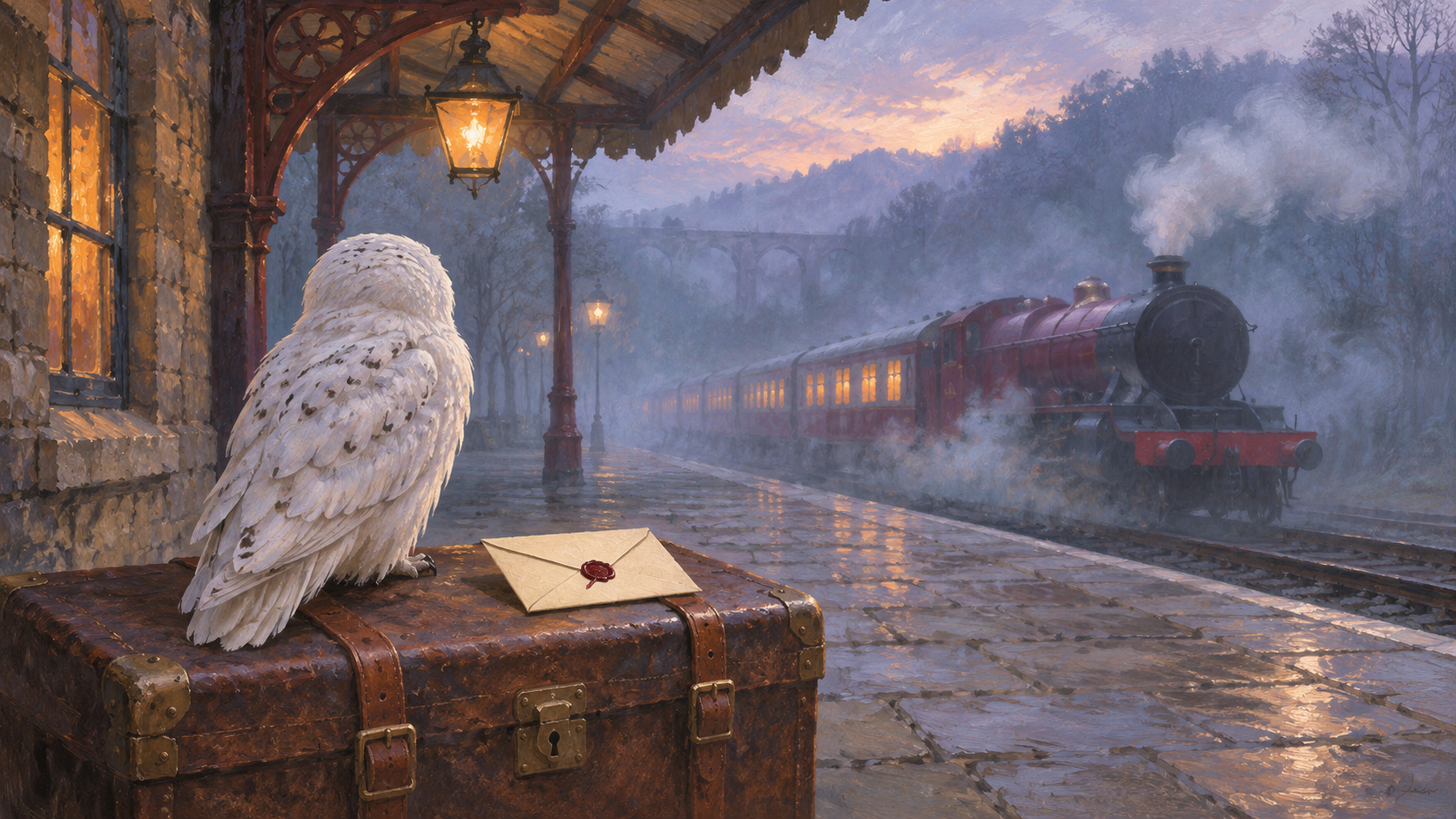
The last departure answers the first letter more intimately than the last duel does. At eleven, Harry reached a London station with a trunk, an owl and no adult beside him who could explain how to find his train. He relied on the kindness of a stranger who already had plenty of children of her own to look after. Now he is the parent on the platform. He knows which question his son is frightened to ask, stays long enough to answer it and lets the train carry the boy towards a school where he can begin finding answers of his own.
Sources
The Bookseller — Harry Potter publication timeline. UK publication history of the seven novels. thebookseller.com
SparkNotes — Philosopher’s Stone, under its US title and Chamber of Secrets. The first two school mysteries, the mirror, the diary and Ginny’s rescue. SparkNotes
SparkNotes — Prisoner of Azkaban and Goblet of Fire. The Secret Keeper switch, the time loop, the tournament and Voldemort’s return. SparkNotes
SparkNotes — Order of the Phoenix and Half-Blood Prince. The Ministry confrontation, the prophecy, Slughorn’s memory and the Astronomy Tower. SparkNotes
SparkNotes — Deathly Hallows. The Horcrux hunt, Snape’s memories, the forest, the final confrontation and the epilogue. SparkNotes
Wizarding World — How Loyal Is a Wand to a Wizard?. Official discussion of wand allegiance and Harry’s defeat of Draco at Malfoy Manor. Wizarding World
Next Reads
Harry Potter and the Philosopher’s Stone Explained: The Mirror of Erised and Quirrell’s Secret — a closer reading of Harry’s first year and the two different kinds of protection he encounters in the final room.
Harry Potter HBO Series: Release Time, How to Watch and What Changes From the Books — Taylor Tailored’s separate guide to the television adaptation.
The Hunger Games Summary and Ending Explained: The Berries, Peeta and Why Snow Wants Katniss Dead — another opening novel in which a child’s act of protection exposes a weakness in an adult’s understanding of power.
