The Mystery That Connects Two Raveloe Families
Who Could Rob a Man Nobody Visits?
Silas Marner keeps his savings beneath the floor of his cottage. In the evenings, when the weaving is finished, he takes out the coins and handles them by the fire. The people of Raveloe know enough about their neighbour to suspect that he has put money by. Hardly anybody knows him well enough to understand what he would lose if somebody took it. George Eliot’s Silas Marner turns on that difference. Its central mystery concerns two things a village might reasonably expect to notice: a man disappearing and another man suddenly acquiring a child. To explain either, somebody would have to ask a question that the most respectable household in Raveloe has excellent reasons to leave unanswered.
The First Theft and the Wrong Man
Before he comes to Raveloe, Silas belongs to a small religious community in an industrial town. At Lantern Yard he has work, a faith, a close friend called William Dane and a woman called Sarah whom he expects to marry. He also experiences episodes in which he remains upright but loses awareness of his surroundings. Some members of the congregation believe there may be spiritual significance in these fits. Silas is less certain about his experiences than William is about practically everything. He finds that certainty reassuring in a friend. It leaves him dangerously unprepared for what a confident person can make other people believe about him.
While an elderly deacon lies dying, members of the congregation take turns watching over him. Money disappears, and the evidence points to Silas. His pocketknife is found where the money had been. The empty money bag turns up among his possessions. Silas remembers where he last used the knife and realises that William had access to it. He knows himself to be innocent. He also believes that the people among whom he has lived faithfully will find a way to distinguish the truth from the appearance carefully arranged around him.
The congregation draws lots, trusting that God will disclose the thief. The result goes against Silas. The particular cruelty of this procedure is that it turns his innocence into a fresh difficulty. A guilty man could confess, repent and perhaps regain a place among the faithful. Silas cannot give the answer that would begin his reconciliation without lying. Sarah breaks off their engagement and subsequently marries William. His friend has taken his future wife as effectively as someone has taken the deacon’s money.
Silas loses more than his good name. Until the lots were drawn, he believed that honest people struggling with inadequate evidence could appeal to a source of judgement beyond themselves. Now the God to whom he appealed appears to have endorsed William’s arrangement. A reader can distinguish between divine judgement and a group of people assigning meaning to the fall of a lot. For Silas, who trusted the group to teach him what divine judgement looked like, the distinction is harder to make. He leaves Lantern Yard with no account of his experience that he can bear to live by.
What Silas Buys With Fifteen Years of Work
Silas settles in Raveloe, makes linen and lives near a disused stone pit. His portable occupation allows him to leave his old life behind. It also marks him as a stranger in a village where people generally know whose field a man works and which family he comes from. The sound of his loom, the look of his eyes and his tendency to spend his evenings alone acquire more significance among the neighbours than an actual conversation with him might justify.
There is an early opportunity for things to go differently. Silas knows something about herbs from his mother and helps a local woman who is suffering. Word spreads. Other people come expecting him to cure ailments about which he knows nothing. He declines to make promises beyond his knowledge, and his refusal encourages suspicion that he could help if he chose. Lantern Yard punished him for denying an act he never committed. Raveloe begins to distrust him for declining a power he never claimed. Withdrawal seems quite a sensible response to his experience of company.
The money starts innocently enough. A customer pays for a piece of work, and Silas enjoys receiving the coins. As the sum grows, it becomes possible to recognise individual pieces, handle them and look forward to seeing them again. He has few purchases in mind. Spending the coins would deprive him of the evening’s pleasure. He works to enlarge the hoard, and counting the hoard gives him a reason to sit down at the loom again tomorrow.
Eliot makes this habit sad without making it contemptible. These are wages for long hours of skilled labour. Silas has earned every evening beside the fire. In contrast to William, a coin can be expected to remain precisely where he put it. The limit of the arrangement emerges in his attachment to an earthenware pot that he accidentally breaks. He fits the fragments together and keeps the pieces. The object mattered because it had been his companion through repeated little actions. He already possesses a considerable capacity for affection. What he lacks is a living recipient who can do something unexpected with it.
How Godfrey Cass Puts His Brother on the Road
At the Red House, Squire Cass’s sons enjoy the advantages of being known from birth. Godfrey, the elder, is regarded as a decent young man, particularly beside his bullying brother Dunstan, usually called Dunsey. That estimate is broadly fair and dangerously incomplete. Godfrey has secretly married Molly Farren, with whom he has a small daughter. He fears disinheritance if his father learns of the marriage. He also loves Nancy Lammeter, a woman he cannot honourably court while Molly lives.
Dunsey knows enough to blackmail him. The immediate difficulty concerns rent money that should have reached their father and instead went to Dunsey. To replace it, Godfrey agrees that his brother can sell his valuable horse, Wildfire. An honest account to the Squire would expose several previous dishonesties. Another arrangement between brothers offers the possibility of getting through the week without having to confess. Godfrey repeatedly chooses the course that demands the least courage today, even when it will leave him with a harder decision tomorrow.
Dunsey finds a buyer but continues riding Wildfire in the hunt before handing him over. The horse dies after a badly judged jump. Walking home in poor conditions, Dunsey comes upon the weaver’s cottage. He has heard the local talk about Silas’s hoard. He initially considers obtaining money from him through pressure. Finding the cottage empty makes theft easier. He locates the hiding place and walks out carrying the savings it has taken Silas fifteen years to accumulate.
The chain connecting the two households is remarkably short. A wealthy young man puts family income into his brother’s hands to purchase silence. The brother risks a horse he has already agreed to sell. A workman who took none of those risks loses everything he owns. No scheme to ruin Silas was necessary. Dunsey merely needs a new source of money and knows of somebody whose misfortune he can expect to cause very little inconvenience at the Red House.
When Silas returns, there is food waiting for him and nothing visibly wrong with the room. His hand goes to the familiar place. For a time he can scarcely comprehend the absence. He searches where he knows he never put the bags because the alternative requires him to accept that his entire private life has been accessible to a stranger. Eventually he does something the coins have saved him from having to do for years. He goes out at night looking for other people.
What Changes When Silas Enters the Rainbow
At the Rainbow inn, local men have been enjoying an evening’s argument. Eliot spends time on their conversation before Silas enters because these men possess something he has been missing almost beyond the point of remembering it. They can disagree, repeat themselves, be interrupted and return another evening to the same company. Their disputes sound important partly because everybody can rely on them having no permanent effect on anybody’s right to a seat.
Silas appears in such distress that his neighbours scarcely recognise him. He briefly accuses Jem Rodney, a local man he has reason to associate with the vicinity of his cottage. Jem denies it. The men at the inn can help establish where he was, and Silas withdraws the accusation. In his first real appeal to Raveloe, he has come close to doing to somebody else what Lantern Yard once did to him. There is one considerable difference. Here the accused can speak, somebody can supply relevant information and the accuser can change his mind without challenging the authority of heaven.
The village investigation does little to recover the money. Suspicion passes to an itinerant pedlar on the strength of doubtful recollections that acquire detail in the retelling. People who would be deeply reluctant to accuse the Squire’s son encounter few inhibitions when discussing a stranger who has left the neighbourhood. Raveloe is capable of kindness to Silas and prejudice against somebody else in the same conversation. Having given him a warmer reception than Lantern Yard did, it still possesses no reliable means of discovering whose hand lifted his floor covering.
What does change is the meaning of his cottage door. People come to offer sympathy and advice. Some are tactless enough to treat prolonged grief as a defect he should put right for their convenience. Dolly Winthrop, a wheelwright’s wife, brings food and practical goodwill. Her religious vocabulary differs so much from Silas’s that they occasionally talk past each other. Yet Dolly can see that a man who has suffered needs a visit, and she can make the visit without first establishing what he believes. For someone whose last congregation required him to assent to a falsehood before it would receive him again, this is an unfamiliar order of operations.
Dunsey, meanwhile, has failed to come home. His family knows his character well enough to find an extended absence unsurprising. Godfrey can admit the loss of the horse and the trouble over the rent without disclosing what gave his brother power over him. He survives the immediate crisis. That small success encourages a disastrous hope: perhaps he can wait long enough for events to release him from obligations that he lacks the courage to meet.
Two Families on New Year’s Eve
At the Red House on New Year’s Eve, Godfrey has an opportunity to dance with Nancy. She is attracted to him and wary of him. His conduct has given her grounds for both feelings, although she does not know the fact that would most materially affect her decision. The gathering gives them every conventional assistance towards becoming a couple. There are clothes to admire, partners to select and relatives disposed to approve. Nobody asks whether the man dancing with Nancy has a wife and child elsewhere. That question would seem insulting in a room full of people who have known him all his life.
Outside, Molly is walking through the snow carrying their daughter. She intends to enter the Squire’s house and confront Godfrey before his family. Part of her purpose is revenge, but she is also on her way to make an elementary fact public. Godfrey’s child exists. The respectable household enjoying its party owes that child something more dependable than whatever her father can arrange in secret. Molly’s dependence on opium and her desire to punish Godfrey make her an inconvenient person to idealise. Neither diminishes the child’s claim on him.
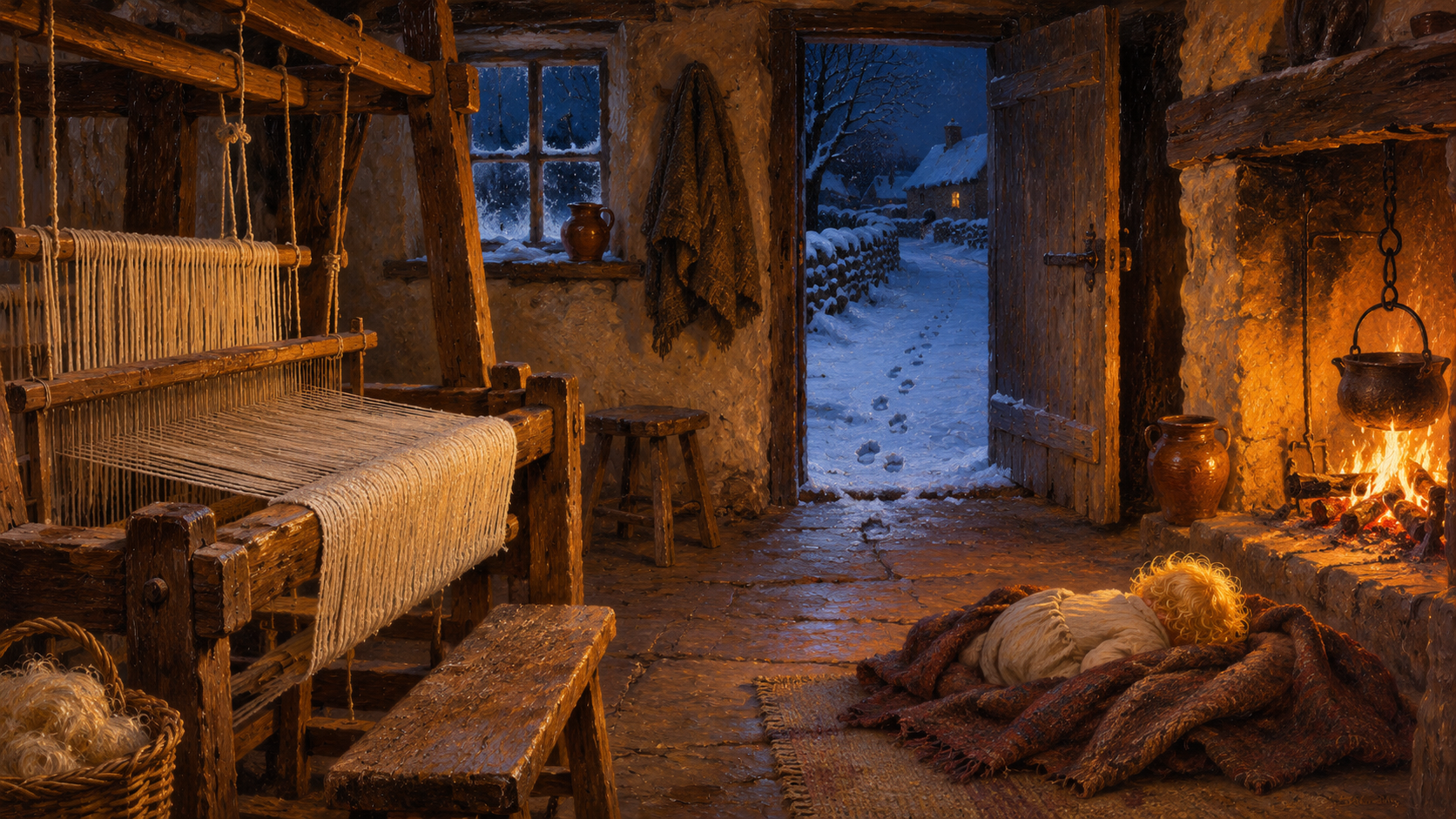
Overcome on the journey after taking opium, Molly sinks into the snow. Her daughter wakes, sees light and finds her way to the weaver’s cottage. Silas has been looking out into the night and experiences one of his fits at the open door. The child passes him unobserved and settles by the fire. When he recovers awareness, he has no memory of anybody entering. What he sees in the firelight looks momentarily like the return of his gold.
He reaches towards it and feels a child’s hair. The movement has the shape of a fairy-tale exchange, but Eliot is exact about the physical steps that produced it. A mother fell, a little girl followed a light, a man stood unaware and a fire offered warmth. Silas will have good reason to experience the arrival as a gift. The reader also knows enough about the woman lying outside to resist the comforting idea that the night’s events were kindly arranged for everybody.
The child’s clothes and the marks in the snow eventually lead Silas to Molly. He carries the girl into the Red House to get help. Godfrey sees his daughter in another man’s arms. He goes to establish whether the woman outside is indeed Molly and whether she is dead. On receiving the confirmation, he feels relief. A future with Nancy has become possible. Nothing prevents him from acknowledging the child now except the prospect of having to tell the truth about yesterday.
Why Silas Keeps the Child
People at the gathering assume that somebody more suitable will take charge of the little girl. Silas wants to keep her. He cannot defend the decision by claiming experience, spare money or a household particularly well arranged for a toddler. His reasons lie in the timing of her arrival and the strength of what he felt on finding her. When his gold disappeared, he learnt that work was a poor reason to get up if there was nothing after it. With this child, tomorrow already contains several things that somebody will have to do.
Godfrey allows the arrangement to go ahead. He offers assistance and tells himself that he can keep an eye on his daughter. It is a compromise with obvious attractions for the person making it. The child will be fed. He can help financially. Nancy need never find out why he takes an interest. Silas, by contrast, offers to deal with the part of parenthood that cannot be performed discreetly. If the child wakes in the night, the man who has publicly claimed her will have to wake too.
Dolly helps Silas with childcare and christening arrangements. The name Hephzibah belonged to his mother and his little sister. The child becomes Eppie for short. Naming her brings the life before Lantern Yard’s betrayal back into use. Silas once knew how it felt to be a brother and a son. Until Eppie came, those memories had no place in his present household. He gives his daughter a family name because, by the decision he is making, it now belongs to her too.
Eppie grows up interested in practically everything her father has managed to exclude. She wants to be outdoors. She notices creatures and plants. She wanders, and responsibility for recovering her gives him reasons to be on speaking terms with people beyond his usual route. The gold could lie still while he worked all day. A growing child changes what counts as a satisfactory day’s work. He has to decide which interruption matters more than the piece of linen on the loom.
Eliot is particularly funny about Silas’s efforts at discipline. Advised that Eppie must learn to expect consequences, he tries putting her in the coal-hole after one of her adventures. The experiment is considerably more distressing to him than to her. Eppie subsequently blackens herself on purpose, quite pleased to repeat the experience. From the child’s point of view, her father has introduced a new game and then displayed an inexplicable lack of enthusiasm for playing it again.
The joke shows the particular quality of their home. Silas has ample authority to frighten a small child, and very little willingness to use it. That may make him an inconsistent disciplinarian. It also means Eppie can grow up sufficiently confident in his affection to have preferences that differ from his. The girl who once decided for herself whether the coal-hole was a punishment will eventually have to tell two prosperous adults that they have misunderstood what would make her happy.
What the Stone Pit Gives Back
Sixteen years pass. Eppie is a young woman thinking about a garden, marriage and the future of the cottage. She loves Aaron Winthrop, Dolly’s son, and wants any arrangement they make to include Silas. It is worth meeting her as a person with these plans before the question of her parentage reopens. Otherwise, deciding where she ought to live can sound like a reasonable discussion for three older people to conduct on her behalf. She already knows where she would like to plant things and who she hopes will help her dig.
Godfrey has married Nancy. The death of their baby has left lasting grief, and they have no surviving children. Godfrey has previously suggested adopting Eppie. Nancy opposed adoption because she believed that deliberately seeking a child in this way would resist the condition Providence had assigned them. Godfrey knew something that might have changed her judgement. He could never explain why this particular child had a claim on their home without admitting how long he had concealed it. Every year of silence increased the severity of the confession that honesty would require.
When the water in the stone pit recedes after drainage work, Dunsey’s remains are discovered with Silas’s money. The missing man had fallen into the pit after the robbery. The solution comes from a change in the land itself. Raveloe’s most confident talkers never got close to it. While villagers were reconstructing the movements of a passing pedlar, the thief lay near the cottage with the evidence that could clear every stranger they had suspected.
For Godfrey, the discovery makes secrecy look suddenly temporary. A brother whose disappearance scarcely disturbed the arrangements at the Red House has come back into the family’s public history. Godfrey tells Nancy that Molly was his wife and Eppie their daughter. Nancy says that, had she known the truth, she would have helped him bring up the child. Her earlier resistance to adopting somebody else’s daughter tells him almost nothing about what she would have done for a child to whom he already owed a father’s duty.
He has spent sixteen years privately congratulating himself on understanding his wife’s principles well enough to know what she could bear to hear. Now she can answer for herself, and the answer costs him a favourite excuse. Readers of The Remains of the Day may recognise the peculiar pain of this discovery. Silence can feel like a sacrifice made on another person’s behalf right up to the moment that person gets a chance to speak.
Why Does Eppie Choose Silas?
Godfrey and Nancy visit the cottage and offer to take Eppie into their home. The proposal has much to recommend it to people in their position. Eppie could live comfortably, receive an education appropriate to her birth and look forward to a substantial inheritance. Godfrey can finally discharge a duty. Nancy can give affection and care to her husband’s daughter. The trouble only becomes apparent when Eppie is asked what she wants. Her present life is dear to her in ways that an improvement in social position would actively damage.
When Godfrey discloses that he is her father, Silas finally learns who has stood nearby all these years while he brought her up. His anger has a precise object. Godfrey was content for the poor man to have her when she was small, when she needed bathing, feeding and watching. Now that she is a young woman whose companionship gives the cottage its happiness, the wealthier man has arrived to claim her as a daughter. Silas has had sixteen years of being her father. He also knows that even he has no entitlement to decide her future. He must allow her to answer, including the possibility that she may wish to go.
Eppie stands by the family she knows. She wants to remain a working woman, marry Aaron and share her home with Silas. Nancy and Godfrey have mistaken their ability to offer an objectively more comfortable house for evidence that she must experience her present one as a deprivation. The garden matters here. It gives Eppie a future in a place the visitors regard chiefly as her past. She has imagined its planting more fully than they have imagined her.
The encounter is more generous to Godfrey than a simple condemnation would be. He genuinely wants to give something to his daughter. He is prepared to acknowledge a connection he once concealed. The offer comes too late because Eppie has been living during the years he spent postponing it. Repentance changes what he is willing to do today. It cannot put him in the cottage on any of the nights when a little girl needed looking after. He leaves understanding that there was a time when he could have claimed her and that he made use of that time for something else.
What Silas Finds When He Returns to Lantern Yard
With his savings recovered and the mystery of the second theft resolved, Silas goes back to the town he left, taking Eppie with him. He wants to know whether the truth about William Dane ever came out. It is a natural final wish. Raveloe now knows who stole the weaver’s gold. Somewhere there might still be people able to tell him that Lantern Yard at last discovered who stole the deacon’s money.
He recognises enough of an old building to establish that he has reached the right place. The chapel and the community around it have disappeared. A factory occupies the site, and the people he asks have arrived too recently to remember the congregation. Silas cannot obtain the verdict he deserved. Eliot gives the village theft an almost uncannily complete solution and leaves the earlier injustice as it stood. Sometimes evidence emerges when a pit is drained. Sometimes the last person who could answer a question leaves town and nobody keeps an address.
Dolly cannot explain why the first congregation’s cruelty was permitted. What she can offer is an account of how people continue when particular events remain beyond explanation. Silas can look at the girl who accompanied him and recognise grounds for trust without pretending that everything which happened to him was good. Eppie has met the man whose accusation drove him away only through her father’s story. That is enough for him to have something he lacked when he first left Lantern Yard: a person who believes him without requiring him to prove the past all over again.
Eppie marries Aaron, and their life together has room for Silas. Godfrey helps improve the cottage but does not attend the wedding. The gold recovered from the pit can finally do what money does best and make a household more comfortable. Silas has no need to take it out at night for company. At the beginning, his hand knew the familiar hollow beneath the floor. At the end, Eppie comes up the path looking at their home and tells him how happy she is. Nothing in the cottage is more securely his for having been locked away.
Sources
George Eliot, Silas Marner — Project Gutenberg. The complete novel, including the two thefts, Nancy’s response to Godfrey’s confession, Eppie’s decision and the return to Lantern Yard. gutenberg.org
Silas Marner — University of South Florida, Lit2Go. Chapter-by-chapter text and audio, with the original 1861 William Blackwood and Sons publication details. Lit2Go ETC
Silas Marner Full Book Summary — SparkNotes. Independent cross-check of the Cass family relationships, the discovery at the stone pit and the final offer to Eppie. SparkNotes
Next Reads
The Remains of the Day: Stevens, Miss Kenton, Lord Darlington and the Cost of Duty — for another man who waits years to discover what someone might have said if he had spoken sooner.
Crime and Punishment Explained: Raskolnikov’s Theory, His Choices and the Ending — for a different account of what confession can repair after another person has borne the consequences.
The Picture of Dorian Gray Explained: Beauty, Reputation and the Cost of Looking Perfect — for a society even more willing than Raveloe to let an attractive reputation stand in for evidence.
