If This Is a Man, Night, and The Drowned and the Saved: The Holocaust Books That Explain Survival, Memory, and Evil
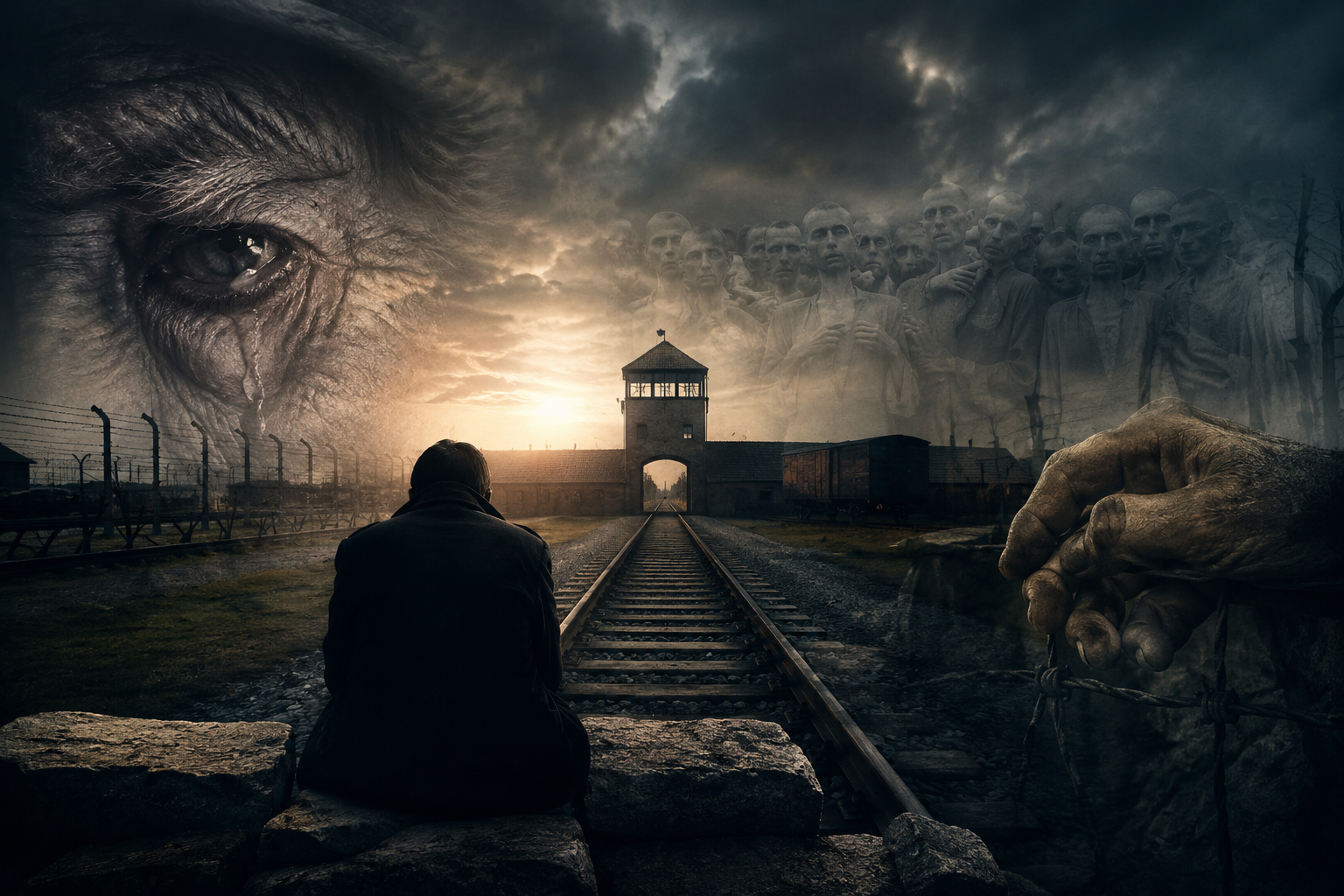
Three Books That Explain What Auschwitz Did To The Human Soul
Three Books That Explain What Auschwitz Did To The Human Soul
There are books about suffering, and then there are books that make ordinary language feel inadequate.
If This Is a Man, Night, and The Drowned and the Saved belong to the second category. They are not just Holocaust testimonies. They are moral investigations conducted from inside the ruins.
Primo Levi writes with the discipline of a chemist, refusing melodrama because the facts are already unbearable. Elie Wiesel writes with the wound still open, turning memory into accusation, prayer, and silence. Together, they create a brutal trilogy of witness: the arrival, the destruction, the survival, and the terrible afterlife of remembering.
These books matter because they do not let the reader escape into easy explanations. They do not allow the comforting belief that suffering automatically makes people noble. They do not pretend that survival is clean, heroic, or spiritually complete.
They ask a darker question.
What if survival itself is morally complicated?
Books Covered
If This Is a Man — Primo Levi
Night — Elie Wiesel
The Drowned and the Saved — Primo Levi
Primo Levi’s If This Is a Man was first published in Italian in 1947 as Se questo è un uomo, and his later The Drowned and the Saved appeared in 1986 as one of his final reflections on the Holocaust and survival.
Elie Wiesel’s Night grew out of his own deportation from Sighet, imprisonment in Auschwitz-Birkenau and Buchenwald, and liberation in 1945; the Elie Wiesel Foundation notes its publication path from Yiddish in 1956 to French in 1958 and English in 1960.
The Big Idea Connecting These Books
These books belong together because they form a single moral arc.
If This Is a Man shows what happens when a human being is reduced to hunger, cold, numbers, labour, and chance. Night shows what happens when faith, family, childhood, and moral certainty are burned away almost at once. The Drowned and the Saved returns decades later to ask why memory itself is unstable, why witnesses are misunderstood, and why the survivor is not necessarily the purest interpreter of the catastrophe.
The deeper pattern is this: Auschwitz did not only kill bodies. It attacked the structures that make human life meaningful — names, family, time, language, morality, religion, shame, dignity, and trust.
Levi and Wiesel both show that the camp was not chaos. It was a system. Its purpose was not merely to imprison people, but to make them participate in their own degradation before destroying them.
That is why these books remain so disturbing. They reveal that civilisation is thinner than we want to believe, and that under the right machinery of fear, hunger, bureaucracy, and violence, the human being can be dismantled piece by piece.
If This Is a Man Summary
Primo Levi’s If This Is a Man is one of the clearest and most devastating books ever written about Auschwitz.
Levi begins not with spectacle, but with a moral challenge. He asks the reader to consider whether a person stripped of home, name, possessions, safety, future, and social recognition is still seen as a man. The title is not rhetorical decoration. It is the whole case.
The book follows Levi, an Italian Jewish chemist, after his arrest and deportation to Auschwitz. He is transported with other prisoners in conditions designed to break the body before the camp even receives it. Arrival is the first great separation. Some are sent immediately to death. Others, including Levi, enter the machinery of labour, registration, shaving, stripping, numbering, and humiliation.
From there, the book becomes a study in systematic reduction.
The camp destroys ordinary identity. A man is no longer primarily a father, son, worker, thinker, believer, friend, or citizen. He becomes a number, a body, a unit of labour, a mouth to feed as little as possible. Hunger becomes the organising principle of life. Cold becomes a second prison. Time loses normal meaning because the future shrinks to the next ration, the next selection, the next command.
Levi’s genius is restraint. He does not need to shout because every detail is already an indictment. He observes the camp almost scientifically, but never coldly. He notices the economy of bread, the hierarchy among prisoners, the difference between newcomers and veterans, the strange moral compromises created by starvation, and the small acts of intelligence required to remain alive.
The central conflict is not simply prisoner versus guard. It is human being versus a system designed to make humanity unusable.
Levi survives partly through chance, partly through adaptability, partly through work in a laboratory because of his chemistry background, and partly through human connection. But he never lets the reader mistake survival for triumph. Survival often depends on conditions that are morally uncomfortable: luck, timing, usefulness to the system, the death or weakening of others, and the ability to detach enough to function.
The emotional journey is gradual devastation. At first, the camp is incomprehensible. Then it becomes routine. That is the horror. The abnormal becomes normal. What would once have seemed impossible becomes a daily calculation.
The ending is not a clean liberation scene. The collapse of the camp comes with illness, abandonment, and the slow arrival of freedom into a world already emptied of its former meaning. Levi survives, but the book leaves the reader with the sense that survival is not a return. It is an obligation.
The Plot In One Flow
Levi is arrested as a Jewish Italian and deported to Auschwitz, where the journey itself begins the stripping away of ordinary life. On arrival, prisoners are separated, processed, robbed of names and possessions, and forced into a world where every rule is designed to reduce them.
He learns the camp’s brutal logic: conserve strength, understand hierarchy, trade when possible, avoid unnecessary attention, and recognise that moral instincts formed in normal life may become dangerous in the camp. Hunger governs thought. Cold governs movement. Language breaks down. The body becomes a battlefield.
As Levi adapts, he observes other prisoners with painful clarity. Some collapse quickly. Some become cunning. Some retain flashes of generosity. Some are absorbed into the grey moral machinery of camp life. The strongest human moments come not from grand heroism, but from tiny acts of recognition — a word, a shared memory, a fragment of dignity preserved against design.
Near the end, Levi falls ill and is left behind as the Nazis evacuate the camp. This accident of illness helps save him. Liberation arrives not as cinematic redemption, but as the exhausted end of a system that has already done almost everything it intended to do.
If You Only Remember Three Ideas
First, dehumanisation works by stages.
The camp does not merely beat people. It removes the conditions under which people can appear human to themselves and to others. Names, clothes, privacy, rest, speech, food, and choice are not luxuries. They are part of personhood.
Second, survival is not morally simple.
Levi refuses to turn survivors into saints. Hunger and terror create a world where normal morality is strained, distorted, and sometimes inverted. The uncomfortable truth is that survival may require adaptation to a degraded system.
Third, memory must be precise.
Levi’s power lies in his refusal to exaggerate. Precision becomes a form of justice. To describe clearly is to resist the fog of denial, sentimentality, and myth.
The Sentence That Explains The Entire Book
A human being can be stripped almost to nothing, but the act of witnessing proves that the destruction was never morally complete.
Why This Book Still Matters
This book still matters because modern societies remain vulnerable to bureaucratic cruelty, group dehumanisation, and the quiet normalisation of abuse.
Its ideas have aged with terrifying relevance. Levi shows how evil becomes practical, administrative, and routine. He helps explain not just genocide, but every system that turns people into categories before turning categories into targets.
If written today, the book might face a world even more saturated with images, slogans, and instant outrage. Its restraint would be even more valuable. Levi teaches that seriousness is not the same as volume.
Where The Book Is Weakest
Its greatest strength can also be a limitation. Levi’s calm, analytical tone may feel emotionally distant to readers expecting a more openly anguished memoir.
The book also focuses heavily on male prisoner experience and Levi’s own observational frame. It does not attempt to represent every Holocaust experience, nor could it. Its truth is deep, but not total.
Who Should Ignore This Book
Readers looking for easy inspiration should not start here.
This is not a book about “resilience” in the modern motivational sense. It is not designed to make suffering useful, neat, or uplifting. Anyone wanting a simple heroic survival story may find Levi’s honesty difficult.
How This Compares To Night
Compared with Night, Levi’s book feels colder, more forensic, and more analytical.
Wiesel writes from the burning centre of personal loss: the child losing his family, his faith, and his former self. Levi writes like a witness building a moral case from evidence. Wiesel’s power is spiritual devastation. Levi’s is lucid dissection.
Both books enter the camp, but they move differently. Night feels like a scream compressed into prose. If This Is a Man feels like testimony sharpened into a blade.
Night Summary
Night is shorter than Levi’s work, but emotionally it is almost unbearable.
Eliezer, the young narrator based on Wiesel himself, begins in Sighet, a Jewish community that does not fully grasp what is coming. There are warnings, rumours, and signs, but disbelief becomes its own tragedy. People cannot imagine the scale of the crime being prepared for them.
The early movement of the book is therefore about delayed recognition. The danger approaches, but ordinary life continues for as long as people can make it continue. Then the ghettos come. Then deportation. Then the train. Then Auschwitz.
The central characters are Eliezer and his father. Their relationship becomes the emotional spine of the book. As the world collapses, the bond between father and son becomes both source of strength and source of torment. Eliezer wants to protect his father, but the camp is designed to make such loyalty almost impossible.
The great conflict in Night is not only physical survival. It is the collapse of inherited meaning. Eliezer begins as a religious boy, drawn toward spiritual study and mystical questions. Auschwitz attacks not only his body and family, but his belief in divine justice. The silence of God becomes one of the book’s central terrors.
Major events arrive with dreadful speed: deportation, separation from mother and sister, forced labour, beatings, selections, hunger, the death march, transfer to Buchenwald, and the father’s decline. Each stage removes another layer of the old world.
The emotional progression is from innocence to shock, from shock to endurance, from endurance to guilt. Eliezer survives, but he is horrified by what survival has required of him internally. At moments, he feels anger at his father’s weakness. At moments, he fears his father has become a burden. That is the book’s most devastating honesty.
The ending matters because liberation does not restore the boy who entered the camps. When he looks at himself after liberation, what remains is not victory but a kind of ghostly recognition. The self has survived, but it has also been transformed into witness, wound, and accusation.
The Plot In One Flow
Eliezer begins as a devout Jewish boy in Sighet, living inside a world of family, study, ritual, and community. Warnings of Nazi violence are ignored or minimised until German occupation and anti-Jewish measures make denial impossible.
His family and community are forced into ghettos, then deported in cattle cars. On arrival at Auschwitz, Eliezer is separated from his mother and younger sister. He remains with his father, and that bond becomes the centre of his remaining life.
The camps reduce existence to hunger, exhaustion, obedience, and fear. Eliezer watches faith collapse under the pressure of atrocity. He sees death become routine and human attachment become dangerous. The relationship with his father keeps him human, yet also exposes him to guilt, frustration, and helplessness.
As the Nazis retreat, prisoners are forced into a death march and eventually reach Buchenwald. Eliezer’s father weakens and dies near the end. Liberation follows, but the emotional climax has already happened: the son has survived the destruction of his family, his childhood, and much of his former belief.
If You Only Remember Three Ideas
First, disbelief can be fatal.
One of the most painful parts of Night is how long people try to believe things will not become as bad as they are. The mind protects itself from impossible horror, but that protection can delay action.
Second, suffering can destroy faith rather than purify it.
Wiesel does not offer a neat spiritual lesson. He shows faith being burned, tested, broken, and transformed into protest. The silence of heaven becomes part of the testimony.
Third, love under extreme pressure becomes morally agonising.
Eliezer’s love for his father is real, but the camp turns love into burden, fear, guilt, and survival calculation. That honesty is what makes the book so powerful.
The Sentence That Explains The Entire Book
The deepest horror is not only that people died, but that a child was forced to survive by watching his world, his God, and his father disappear.
Why This Book Still Matters
Night still matters because it makes the Holocaust emotionally immediate without simplifying it.
The Nobel Prize biography of Wiesel records that he and his family were deported during the war, that his parents and younger sister died, and that he survived Buchenwald before becoming a major witness to the Holocaust.
The book remains relevant because it captures the experience of moral abandonment. It speaks to every age that mistakes civilisation for permanence and every culture tempted to ignore warnings until they arrive at the door.
If written today, it might be received in a louder media world, but its power would still come from compression. Night does not need length. It needs silence around it.
Where The Book Is Weakest
Because Night is brief and intensely focused, it does not offer the wider analytical structure Levi provides. Readers seeking detailed explanation of camp systems, prisoner hierarchies, or postwar memory may need companion works.
Its power is emotional and spiritual rather than sociological. That is not a flaw exactly, but it means the book should not be treated as the whole Holocaust in miniature.
Who Should Ignore This Book
Readers who want historical distance may struggle with Night.
It is not detached. It is not comfortable. It does not create a buffer between reader and suffering. Anyone trying to avoid emotional confrontation should not pretend this is just another important book to tick off a list.
How This Compares To The Drowned and the Saved
Night is the wound. The Drowned and the Saved is the autopsy.
Wiesel writes from the intense memory of a young survivor whose world has been destroyed. Levi, in his later work, returns after decades of thought to examine memory, shame, moral compromise, communication, and the unstable position of the survivor.
Where Night asks, “How could this happen before God and man?” The Drowned and the Saved asks, “Why do we still misunderstand what happened?”
The Drowned and the Saved Summary
The Drowned and the Saved is Primo Levi’s late, disturbing return to the Holocaust.
If If This Is a Man is testimony from the edge of survival, this book is testimony after decades of reflection. Levi is no longer simply reconstructing what happened to him. He is examining the problems that surround all Holocaust memory.
The title itself introduces the central division. The “drowned” are those who were destroyed. The “saved” are those who survived. But Levi immediately complicates any simple moral reading. The saved are not necessarily better, stronger, wiser, or more deserving. Often they survived because of chance, position, skill, timing, compromise, or accident.
This book is less plot-driven than the first two, but it has a powerful intellectual progression. Levi examines the memory of atrocity, the unreliability and necessity of testimony, the shame felt by survivors, the moral ambiguity of prisoner functionaries, the difficulty of communicating camp experience to outsiders, and the danger of false simplification.
Its most famous moral territory is the “grey zone” — the area between victim and perpetrator where coercion, privilege, fear, and survival pressure created morally compromised roles. Levi does not use this to excuse the Nazi system. He uses it to prevent lazy judgment. The system’s evil included its ability to contaminate moral categories.
The emotional journey of the book is not from innocence to horror, but from memory to warning. Levi is fighting against distortion. He knows that time changes testimony. Survivors are questioned, doubted, romanticised, simplified, and sometimes turned into symbols rather than heard as people.
The ending significance lies in its refusal to console. Levi’s late conclusion is not that humanity learned enough. It is that the mechanisms remain possible. The camps were created by human beings, administered by human beings, and remembered badly by human beings. That is why the work of memory must be severe.
The Plot In One Flow
Levi returns to Auschwitz not by retelling his own camp experience in full, but by interrogating what survival and memory mean after the fact. He begins from the divide between those who died and those who lived, then dismantles the comforting assumption that survival reflects moral superiority.
He moves through the psychology of memory, showing that testimony is essential but never simple. He examines shame, especially the shame of surviving when others did not. He considers the compromised prisoner roles created by the Nazi system and warns against judging victims as though they acted under ordinary freedom.
The book then widens into communication and responsibility. Can those who were not there understand? Can language carry the reality? Can later generations resist simplification? Levi’s answer is demanding: understanding may be incomplete, but the duty to try remains absolute.
If You Only Remember Three Ideas
First, the survivor is not the ideal witness because the full witnesses were murdered.
This is one of Levi’s most devastating insights. Those who reached the bottom did not return to explain it. Survival itself means the testimony comes from an exception.
Second, evil corrupts moral categories.
The camp system created positions where victims could be forced into roles that appear morally compromised from the outside. Levi insists that judgment must account for coercion, terror, hunger, and the architecture of domination.
Third, memory is a duty, but memory is not simple.
Time alters recollection. Audiences demand clarity. Culture prefers symbols. Levi warns that remembering badly can become its own form of betrayal.
The Sentence That Explains The Entire Book
The most dangerous lie about atrocity is that it becomes easy to understand once it is safely in the past.
Why This Book Still Matters
This book may matter even more now than when it was published.
Modern culture often turns history into clips, slogans, identity markers, and moral performances. Levi resists all of that. He demands that memory remain difficult, precise, and ethically serious.
The National WWII Museum describes Holocaust survivor memoirs from Auschwitz as part of an “imperative to witness,” which captures exactly why Levi’s late work remains essential: it does not merely remember atrocity, it disciplines the act of remembering itself.
Where The Book Is Weakest
This is the least accessible of the three books.
It is essayistic, reflective, and morally complex. Readers expecting narrative momentum may find it slower than If This Is a Man or Night. It also demands maturity from the reader because it refuses simple categories.
Its weakness is not lack of power, but lack of entry-level ease.
Who Should Ignore This Book
Readers new to Holocaust literature should probably not begin here.
This book works best after some direct encounter with survivor testimony. Without that foundation, its arguments about memory, shame, and moral ambiguity may feel abstract.
The Common Themes Running Through All These Books
The first common theme is dehumanisation.
All three books show that genocide begins before killing. It begins with classification, exclusion, dispossession, forced movement, humiliation, and the destruction of ordinary identity. Murder is the final act of a process that starts with language and law.
The second theme is the collapse of moral certainty.
These books do not offer simple heroes and villains at the level of individual survival. The Nazi system is evil. That is clear. But inside the victim world, hunger and terror create impossible pressures. Levi especially forces the reader to see how cruel systems manufacture moral ambiguity.
The third theme is memory as responsibility.
Wiesel bears witness through emotional and spiritual intensity. Levi bears witness through precision and analysis. Both understand that forgetting is not passive. Forgetting helps the perpetrators finish their work.
The fourth theme is the loneliness of the survivor.
Survival separates the living from the dead, but also from ordinary society. The survivor returns carrying knowledge that others cannot fully receive. That gap becomes another wound.
The Hidden Pattern Across All These Books
The hidden pattern is that each book attacks a different comforting myth.
If This Is a Man attacks the myth that humanity is secure.
Night attacks the myth that faith, family, and innocence are protected by moral order.
The Drowned and the Saved attacks the myth that later generations can easily understand atrocity by condemning it from a safe distance.
Together, they reveal one terrifying truth: evil does not only destroy people. It also destroys the frameworks by which people later try to explain the destruction.
That is why these books keep reaching similar conclusions. They are not simply about cruelty. They are about the failure of normal categories under extreme conditions.
Human nature keeps reappearing here not as good or evil in a simple sense, but as vulnerable. Vulnerable to hunger. Vulnerable to fear. Vulnerable to obedience. Vulnerable to self-deception. Vulnerable to systems that reward adaptation and punish conscience.
The deepest truth is that civilisation depends on conditions. Remove those conditions, and the human being does not become a slogan. He becomes a question.
Where The Books Quietly Disagree
Levi and Wiesel agree on the duty of witness, but they differ in emotional temperature.
Wiesel’s world is charged with spiritual anguish. God’s silence matters. The death of the father matters. The child’s inner collapse matters. The book is a testimony of the soul under annihilation.
Levi is more suspicious of emotional excess. He wants accuracy, structure, and moral clarity without theatricality. His deepest fear is not only forgetting, but misunderstanding.
They also differ on survival. Wiesel presents survival as a wound shaped by loss. Levi presents survival as an unstable category requiring analysis. Wiesel makes the reader feel the cost. Levi makes the reader examine the machinery.
The tension makes the books stronger together.
What Most People Misunderstand About These Books
The shallow reading is that these are books about resilience.
That is too small and too comfortable.
They are not saying, “Human beings can survive anything.” They are saying, “Look what had to be destroyed for survival even to become the question.”
Another misunderstanding is that Holocaust testimony should make readers feel morally superior to the perpetrators. Levi especially blocks that escape. He wants vigilance, not self-congratulation.
The deepest reading is not “I would have been brave.” The deepest reading is “What systems do I currently trust too easily? What categories do I accept without thinking? What suffering do I ignore because it is administratively convenient?”
What The Internet Gets Wrong About These Books
The internet often turns serious books into extractable lessons.
It wants quotes, takeaways, emotional clips, and simplified moral positions. But these books resist compression. Their value is not only in what they say. It is in the discomfort they force the reader to remain inside.
Book-summary culture can flatten them into “lessons about hope” or “warnings about evil.” That misses the darker centre. These books are not motivational content. They are confrontations with human fragility.
The actual argument is harder: memory must be precise, survival is morally complicated, and evil becomes most dangerous when it is normalised by systems.
Framework: The Witness, The Wound, And The Warning
These three books create a practical framework for reading atrocity without turning it into abstraction.
The Witness is the factual duty.
This is Levi’s precision and Wiesel’s testimony. What happened must be named. The details matter. The sequence matters. The victims must not become a blur.
The Wound is the human cost.
This is the father and son in Night. It is hunger in Levi. It is the shame of the survivor. It is the knowledge that liberation does not undo destruction.
The Warning is the modern application.
The point is not to compare every inconvenience to atrocity. That cheapens history. The point is to recognise early patterns: dehumanising language, bureaucratic cruelty, public indifference, moral laziness, and the transformation of people into problems.
The framework is simple.
Witness accurately. Feel honestly. Act earlier.
The Real-Life Test
In careers, these books warn against systems where responsibility is diffused until nobody feels accountable.
In relationships, they reveal the importance of recognition. To treat someone as human is not sentimental. It means seeing their reality, not reducing them to usefulness, inconvenience, or category.
In leadership, they show that language matters. Once people are described as burdens, threats, numbers, or contamination, mistreatment becomes easier.
In decision-making, they teach that pressure reveals systems. People often imagine morality as a belief. These books show morality is also a structure. Food, sleep, fear, incentives, rules, and authority all shape behaviour.
In public life, they warn against delayed seriousness. One of the most frightening patterns in Night is how long people hope the worst will not happen.
How To Apply These Lessons Without Turning Them Into Another Self-Help Fantasy
Do not turn these books into productivity lessons.
Do not say Auschwitz teaches gratitude for your morning coffee. That is obscene.
Apply them by becoming harder to deceive.
Notice when people are turned into abstractions. Notice when institutions hide cruelty behind procedure. Notice when you prefer comfort over truth. Notice when a group is easier to ignore because it has been given a label.
Measure your moral seriousness by behaviour, not emotion. What do you read carefully? What do you remember accurately? What do you refuse to laugh off? What do you challenge before it becomes normal?
The lesson is not “be inspired.”
The lesson is “pay attention before the machinery is built.”
Which Book Should You Read First?
Start with Night if you want the most immediate emotional entry point.
Start with If This Is a Man if you want the clearest and most disciplined account of camp life.
Read The Drowned and the Saved last if you want the deepest moral and psychological analysis.
For most readers, the best order is Night, then If This Is a Man, then The Drowned and the Saved. First feel the wound. Then study the system. Then confront the problem of memory.
Five Questions To Test Whether You Actually Understood These Books
What parts of your identity would disappear first if your name, possessions, privacy, and future were removed?
Do you think survival proves strength, or do these books make that idea harder to defend?
When you condemn evil, are you also studying the ordinary systems that make evil practical?
What kind of suffering do you currently ignore because it is distant, bureaucratic, or inconvenient?
Are you remembering history precisely, or only emotionally?
The Final Lesson
These books do not let humanity stand comfortably outside the dock.
They testify against the Nazis, absolutely. But they also testify against forgetfulness, simplification, cowardice, vanity, and the human desire to turn catastrophe into a lesson that leaves us untouched.
The final lesson is brutal because it is still alive.
A human being is not destroyed only when he is killed. He is destroyed when others stop seeing him, when systems rename him, when language prepares his disappearance, and when memory later makes his suffering easier than it was.
Levi and Wiesel force the opposite task.
See clearly. Remember precisely. Refuse comfort when comfort depends on forgetting.
