The Road, Children Of Men And The Stand Expose The Terrifying Truth About The End Of Society
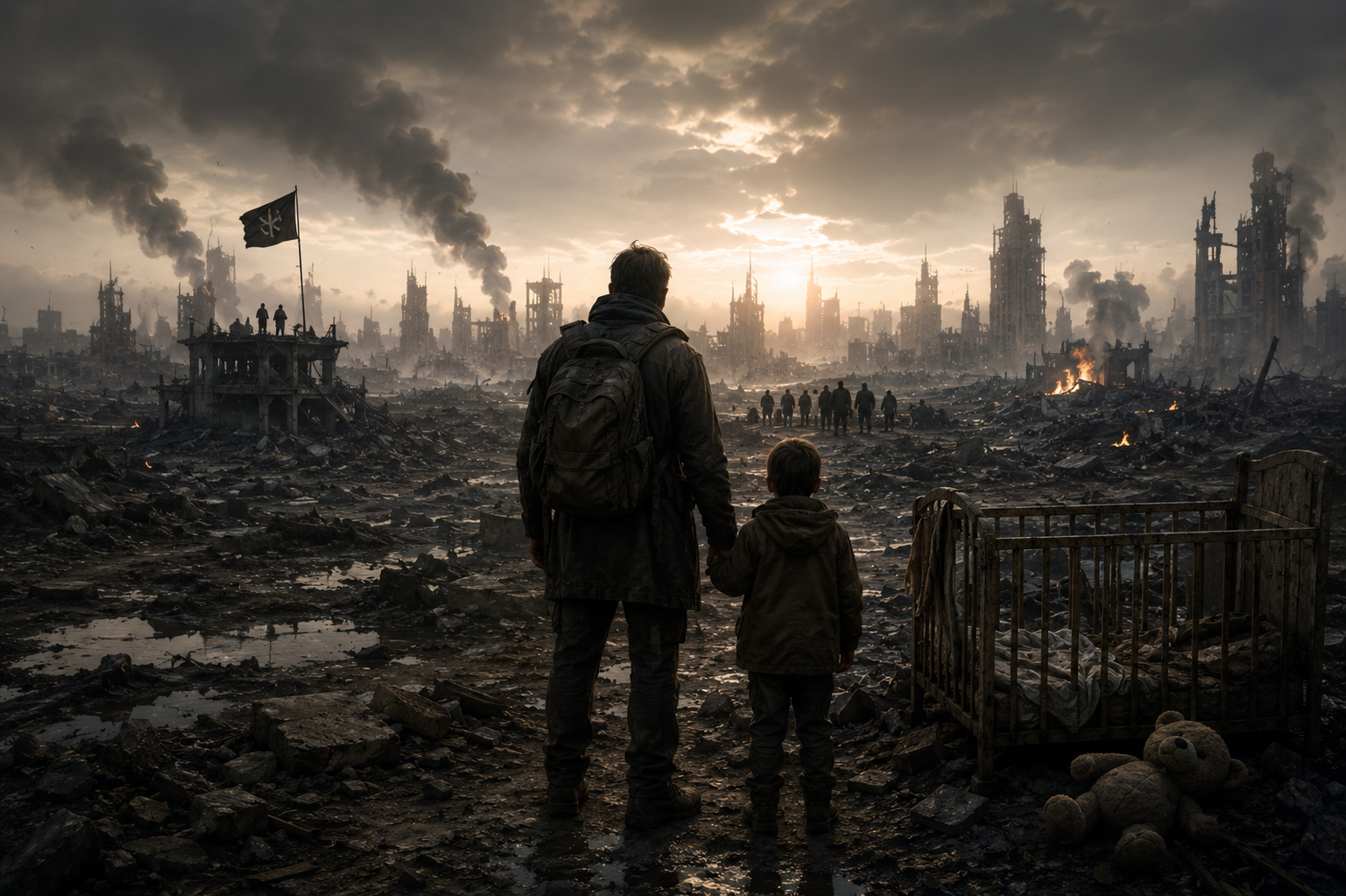
The Road, Children Of Men And The Stand: What Happens After The World Breaks
The Three Books That Reveal What Really Happens When Civilisation Dies
The terrifying question is not whether civilisation can collapse.
It can.
The real question is what remains when it does.
Not what remains in the streets. Not what remains in government buildings. Not what remains in hospitals, schools, supermarkets, petrol stations, courts, or police stations.
What remains inside people.
That is why The Road, The Children of Men, and The Stand belong together. Each imagines civilisation dying from a different wound. In The Road, the world is physically dead. In The Children of Men, the future is biologically dead. In The Stand, society is murdered by plague and then forced to rebuild under spiritual pressure.
Together, they ask one brutal question.
When civilisation dies, do humans become animals, saints, tyrants, pilgrims, parents, or believers?
The answer is worse, and more hopeful, than any simple apocalypse fantasy allows.
Books Covered
The Road by Cormac McCarthy
The Children of Men by P. D. James
The Stand by Stephen King
The Road won the 2007 Pulitzer Prize for Fiction and centres on a father and son walking through a burned America with only scavenged supplies, a pistol, and each other.
The Children of Men imagines a future England where no child has been born for twenty-five years, humanity faces extinction, and Theo Faron is pulled into the fate of a pregnant woman and a dissident group.
The Stand begins with a weaponised super-flu that wipes out almost all of humanity, leaving survivors to gather around Mother Abagail in Boulder or Randall Flagg in Las Vegas.
The Big Idea Connecting These Books
These three books belong together because they understand that civilisation is not merely infrastructure.
Civilisation is a shared agreement about the future.
The Road asks what happens when the physical world can no longer sustain human life. The Children of Men asks what happens when reproduction stops and the future itself disappears. The Stand asks what happens when mass death clears the board and survivors must choose what kind of order will replace the old one.
Each book strips away a different illusion.
The illusion that morality depends on comfort.
The illusion that government can manufacture meaning.
The illusion that rebuilding society is automatically good.
The hidden pattern is this: when civilisation dies, the most important question is no longer “How do we survive?”
It becomes “What deserves to survive through us?”
The Road Summary
The Road is the most stripped-down version of the apocalypse.
There is no grand explanation. No heroic rebellion. No detailed map of the disaster. The world has burned. The sky is dark. Food is almost gone. The landscape is ash, cold, hunger, and threat.
At the centre are two unnamed characters: a father and his young son. They push a shopping cart through the ruins of America, moving south toward the coast because the father believes it may offer warmth, safety, or at least one final chance.
The father wants to keep the boy alive.
The boy wants to remain good.
That difference is the engine of the novel.
The father has seen enough to understand that survival requires suspicion, violence, secrecy, and emotional hardening. He checks houses for supplies. He hides from strangers. He carries a pistol with limited bullets. He teaches the boy what to do if capture becomes inevitable.
The boy, meanwhile, keeps asking whether they are still the good guys.
That question is not childish. It is the moral spine of the book.
As they move through the ruined country, they encounter the full collapse of human behaviour. Travellers hunt others. Armed groups roam the road. Houses contain horrors. One of the most disturbing discoveries is not merely that people have become violent, but that they have become organised around predation.
The father’s protective instinct is absolute. He will lie, threaten, steal, and kill to keep the boy alive. Yet the son keeps pulling him back toward mercy. When they meet the old man on the road, the boy wants to help. When someone steals from them, the boy is horrified by the father’s harsh revenge. When strangers appear, the son sees possible people where the father sees possible danger.
The plot is simple because the moral pressure is not.
They travel. They starve. They hide. They find temporary relief. They lose it. They move again.
Eventually they reach the coast, but it is not salvation. The sea is grey. The world has not secretly preserved a sanctuary. The father’s hope in geography has been exposed as almost empty. His real destination was never the coast. It was the boy’s survival beyond him.
The father is dying. His cough worsens. His body fails. He has carried the boy through the apocalypse, but he cannot carry him forever.
At the end, the father dies, and the boy is found by another man with a family. The ending is deliberately fragile. It does not restore civilisation. It does not prove safety. It offers only the smallest possible continuation: the child may not be alone.
The final meaning is devastating because the father succeeds and fails at the same time.
He does not save the world.
He does not find a new society.
He does not defeat evil.
He keeps one child alive long enough for goodness to have another carrier.
The Plot In One Flow
A father and son move through a dead America after an unnamed catastrophe. The father knows the world has become a hunting ground, so he teaches vigilance, concealment, and ruthless caution. The boy experiences the same world as horror, but he keeps asking whether survival without goodness is still worth having.
Their journey south is a sequence of brief shelters and renewed danger. They search empty houses. They avoid road agents. They find food, lose safety, and keep moving. The father becomes more desperate as his body weakens, while the boy becomes more morally important because he resists becoming what the world now rewards.
By the time they reach the coast, the father’s practical hope collapses. There is no clean escape. His final task is not to reach a place but to transfer the flame. When he dies, the boy’s future passes into uncertainty, but the novel refuses total nihilism. Something human may continue because one child has been taught not only how to live, but why living must mean more than feeding.
If You Only Remember Three Ideas
The first idea is that civilisation dies fastest when people stop believing other people matter. The Road is terrifying because the apocalypse does not create evil from nothing. It removes the consequences that used to restrain it.
The second idea is that love can become both salvation and terror. The father’s love keeps the boy alive, but it also tempts him toward brutality. Protection can become a moral trap when the world makes mercy dangerous.
The third idea is that hope does not need to be large to be real. The book offers no national recovery, no technological solution, and no political programme. It offers the possibility that one child can carry forward a moral inheritance.
The Sentence That Explains The Entire Book
When the world dies, the last civilisation may be a parent teaching a child not to become the darkness.
Why This Book Still Matters
The Road still matters because it removes every comforting layer from moral life.
It is not interested in speeches about values. It asks whether values survive hunger, fear, exhaustion, and grief.
Its relevance has only grown because modern anxieties increasingly circle around fragility: supply chains, climate instability, social trust, war, pandemics, energy, and institutional breakdown. The book does not predict a specific future. It tests a permanent human question.
What are you when nobody is watching, nobody is coming, and nobody can punish you?
If written today, it might contain more visible references to ecological collapse, surveillance failure, or resource politics. But its deepest power would not change. The story is not about the mechanics of disaster. It is about the moral cost of surviving it.
Where The Book Is Weakest
The Road is so mythic and stripped back that some readers may find the world too abstract.
The lack of explanation is powerful, but it also limits social complexity. We see the apocalypse mostly through the father and son’s immediate survival. We do not get much of the wider political, economic, or communal aftermath.
Its women are also largely absent or symbolic. The mother’s despair is important, but the novel’s emotional universe is overwhelmingly father-son, which gives it purity and intensity but narrows its human range.
Who Should Ignore This Book
Ignore this book if you need detailed worldbuilding, fast plot twists, or clear explanations of how the catastrophe happened.
It is not a survival manual.
It is not an action thriller.
It is a bleak moral pilgrimage. Readers who dislike sparse prose, ambiguity, and emotional devastation may admire it more than enjoy it.
How This Compares To The Children Of Men
The Road imagines civilisation after the future has already physically died. The Children of Men imagines civilisation while the future is dying slowly, politely, administratively.
McCarthy’s world is ash and hunger. James’s world is committees, rituals, policing, despair, and demographic extinction.
The emotional difference is huge. The Road is intimate and elemental. The Children of Men is political and theological. One asks whether goodness can survive without society. The other asks whether society can survive without children.
The Road reduces civilisation to a father and son.
The Children of Men reduces civilisation to a question: what is government for when there will be no next generation?
The Children Of Men Summary
The Children of Men begins with one of the most quietly horrifying ideas in dystopian fiction: humanity has stopped having children.
There has been no birth for twenty-five years. The youngest generation, the Omegas, are spoiled, alienated, beautiful, cruel, and symbolic. They are not merely young people. They are the last young people. That makes them worshipped, resented, protected, and spiritually deformed.
The central character is Theo Faron, an Oxford historian and cousin of Xan Lyppiatt, the Warden of England. Theo is intelligent, detached, emotionally numb, and politically compromised by proximity to power. He once advised Xan, then withdrew into private life.
England has not collapsed in the dramatic sense. It still has order. It still has bureaucracy. It still has state power. But its soul has gone.
Without children, politics becomes end-of-life management. The population wants comfort, safety, and distraction. Democracy weakens because citizens no longer feel responsible for a future beyond themselves. Xan’s regime offers control in exchange for passivity.
This is the great terror of the novel.
Civilisation does not fall into chaos.
It accepts managed extinction.
Theo is pulled out of detachment by Julian, a former student and member of the dissident group the Five Fishes. The group wants reforms. They object to the regime’s abuses, its coercion, its treatment of outsiders, its rituals of despair, and its authoritarian control.
At first, Theo is reluctant. He is not a natural revolutionary. His defining condition is distance. He observes more than he acts. His past is marked by emotional failure, including the death of his child and the collapse of his marriage.
But Julian changes the scale of the story.
She is pregnant.
That revelation transforms the novel from political dystopia into sacred emergency. Suddenly the issue is not merely reform. It is whether the first child in a generation will be protected, exploited, hidden, claimed by the state, or used by ambitious men.
The group goes on the run. The journey strips away illusions. Luke dies protecting Julian. Rolf’s motives darken because he wants power and reproductive control. Miriam, a former midwife, becomes essential because birth itself has become a lost social function.
The apocalypse here is not the absence of life. It is the forgetting of how to receive life.
Theo’s arc is from detached witness to morally implicated protector. He begins as a man who has made peace with non-responsibility. He ends as someone forced into action because neutrality becomes collaboration.
The climax arrives after Julian gives birth to a baby boy. Xan appears. Power wants the miracle. The state wants to absorb the future. Theo kills Xan and takes his ring, symbolically stepping into authority even as the novel leaves the moral implications unresolved.
The ending is brilliant because it refuses easy purity.
A child is born.
Hope returns.
But so do violence, ambition, hierarchy, and control.
Humanity is saved, perhaps. But the first act of the new future is not innocence. It is murder, succession, and contested power.
The Plot In One Flow
In a childless England, Theo Faron lives as an emotionally withdrawn historian while his cousin Xan governs a dying country with calm authoritarianism. The population has accepted extinction as long as the state can make decline orderly. Into this numbness comes Julian, who pulls Theo toward a dissident group asking for reform.
Then the real revelation arrives: Julian is pregnant. This makes her the most important person alive and turns her unborn child into a political, biological, and spiritual prize. The group flees, but internal motives fracture. Some want justice. Some want control. Some want the child as proof. Some want the child as power.
Theo gradually changes because the pregnancy makes detachment impossible. He protects Julian, witnesses sacrifice and betrayal, and finally confronts Xan. When the child is born, civilisation’s future returns, but not cleanly. Theo kills the old ruler and takes the symbol of rule, leaving the reader with a magnificent unease: the future has been restored, but the human hunger for power has survived too.
If You Only Remember Three Ideas
The first idea is that civilisation depends on belief in people who do not exist yet. Without children, politics becomes selfish, culture becomes nostalgic, and morality loses one of its strongest anchors.
The second idea is that authoritarianism often arrives as comfort. Xan does not rule only through fear. He rules because a dying population wants someone else to manage the end.
The third idea is that hope is dangerous because everyone wants to own it. Julian’s baby is not just a child. He is future, legitimacy, succession, miracle, and political weapon.
The Sentence That Explains The Entire Book
When the future stops being born, society does not become free; it becomes obedient to whoever promises to manage the despair.
Why This Book Still Matters
The Children of Men still matters because it understands demographic fear, political exhaustion, managed decline, and spiritual emptiness with frightening clarity.
It is not simply a story about infertility. It is a story about what happens when a society loses confidence that tomorrow is worth sacrifice.
That makes it feel increasingly modern. Ageing populations, collapsing birth rates, political cynicism, loneliness, state dependency, and cultural exhaustion all make James’s premise sharper than a simple dystopian gimmick.
If written today, the book might make more of digital distraction, algorithmic control, migration politics, biotech, and media spectacle. But its central insight would remain: a society without a future becomes dangerously easy to govern.
Where The Book Is Weakest
The novel’s theological and political symbolism can feel heavy to readers expecting a thriller.
Some characters function partly as moral positions. Rolf represents corrupted ambition. Xan represents controlled authoritarian decline. Julian represents miraculous futurity. That gives the novel clarity, but sometimes reduces psychological complexity.
The book’s ending is also deliberately unsettling. Readers who want clean hope may find Theo’s assumption of power troubling rather than satisfying.
That discomfort is the point, but it will not please everyone.
Who Should Ignore This Book
Ignore this book if you want the film version’s kinetic refugee-crisis energy. The novel is slower, colder, more theological, and more concerned with power than action.
Readers who dislike political allegory, religious undertones, or morally ambiguous endings may struggle with it.
It is best for readers who want dystopia as social diagnosis rather than spectacle.
How This Compares To The Stand
The Children of Men is about a world where the future disappears before society physically collapses. The Stand is about society being physically erased and then spiritually reorganised.
James asks what happens when people stop expecting descendants.
King asks what happens when survivors must build new tribes.
The Children of Men is compressed, political, and controlled. The Stand is vast, messy, mythic, emotional, and communal. James studies decline. King stages a moral civil war.
In James, civilisation dies through sterility.
In King, it dies through plague.
But both books agree on one thing: once old structures fail, people start looking for authority.
The only question is whether they kneel before life or power.
The Stand Summary
The Stand begins with a catastrophe caused by human institutions.
A deadly super-flu escapes from a biological testing facility. One infected man gets out. The virus spreads. Within weeks, almost the entire human population is dead. Stephen King’s publisher describes the virus as wiping out 99 percent of the world’s population, leaving survivors frightened, leaderless, and forced to choose between emerging powers.
The opening movement is one of the most powerful collapse sequences in modern fiction because King does not rush past death. He shows ordinary people realising too late that something uncontrollable has entered the bloodstream of society.
Hospitals fail. Communications fail. Families die in houses, cars, beds, and public spaces. The old world does not go out heroically. It chokes.
Then the novel changes shape.
The survivors begin dreaming.
Some dream of Mother Abagail, an elderly Black woman in Nebraska who represents humility, faith, endurance, and moral order. Others dream of Randall Flagg, the Dark Man, who represents charisma, domination, cruelty, temptation, and ecstatic disorder.
The apocalypse becomes a sorting mechanism.
People are not merely trying to survive. They are being drawn toward the kind of authority their souls recognise.
In Boulder, the survivors attempt to rebuild a democratic, decent community. Stu Redman, Frannie Goldsmith, Glen Bateman, Larry Underwood, Nick Andros, Ralph Brentner, and others become central to this fragile reconstruction. Boulder is imperfect, bureaucratic, emotionally strained, and vulnerable. But it tries to build through consent, responsibility, and memory.
In Las Vegas, Randall Flagg builds a different civilisation. It is efficient, disciplined, technological, punitive, and terrifying. His people restore power, organise labour, and prepare weapons. Vegas is not chaos. That is what makes it frightening.
Flagg proves that evil can be administratively competent.
This is one of The Stand’s most important insights. Civilisation can be rebuilt in the image of fear just as easily as in the image of virtue.
The character arcs give the book its emotional power.
Larry Underwood begins as selfish, immature, and morally evasive. The apocalypse forces him into responsibility. Frannie begins as a pregnant young woman grieving the dead and trying to imagine motherhood in a broken world. Stu becomes a steady moral centre, not because he dominates, but because people trust him. Nick, who is deaf and mute, becomes one of the book’s clearest figures of decency and judgement. Harold Lauder becomes one of King’s most tragic studies in resentment: a person who could have belonged, but chooses grievance because he cannot forgive being unloved in the old world.
Nadine Cross is another tragic figure. She is drawn toward Flagg by destiny, fear, and inner division. Her story shows how evil recruits not only the cruel, but the wounded, the vain, the lonely, and the fatalistic.
Eventually, the Boulder community understands that it cannot merely hide from Flagg. A small group must go west. Their journey becomes a moral stand rather than a military strategy. They are not strong enough to defeat Vegas conventionally. Their task is obedience, witness, and sacrifice.
The climax is strange, controversial, and deeply religious. The Trashcan Man, a broken pyromaniac drawn to destruction, brings a nuclear weapon to Las Vegas. At the moment Flagg’s regime gathers to punish and display its enemies, the bomb detonates. Vegas is destroyed.
The ending does not simply say good people beat bad people.
It says evil contains the seeds of its own destruction. A society built on domination attracts damaged instruments of catastrophe. Flagg’s power creates the conditions for his downfall.
Stu survives separately and returns to Frannie. They eventually leave Boulder, uneasy about whether even the good society may repeat old mistakes. The novel ends with hope, but not certainty.
Human beings can rebuild.
That is not the same as saying they have learned.
The Plot In One Flow
A military-made plague escapes containment and annihilates most of humanity. The survivors awaken into a world where old systems have vanished, but inner character has become louder. Dreams divide them between Mother Abagail and Randall Flagg, between humble reconstruction and ecstatic domination.
Boulder becomes an experiment in rebuilding decency. Vegas becomes an experiment in rebuilding power. The novel then turns from survival to allegiance. Characters are tested by grief, resentment, faith, ambition, temptation, sexuality, fear, and responsibility.
The final confrontation is not a conventional battle. The Boulder survivors walk into weakness, while Flagg’s empire gathers in apparent strength. But Vegas destroys itself through the very forces it has welcomed. The survivors are left with the harder question: after the evil city falls, can the decent city avoid becoming another version of the old world?
If You Only Remember Three Ideas
The first idea is that collapse does not erase morality. It amplifies it. People become more visibly what they already were becoming.
The second idea is that evil can be organised. The Stand is frightening because Las Vegas is not a failed society. It is a functioning society built around fear, punishment, and worship of power.
The third idea is that rebuilding is morally dangerous. The survivors want to restore civilisation, but restoration can quietly revive the same arrogance that caused the collapse.
The Sentence That Explains The Entire Book
After the plague clears the world, humanity’s real disease is revealed as the hunger to build power without humility.
Why This Book Still Matters
The Stand still matters because it understands mass death, social sorting, charismatic extremism, and the temptation to rebuild too quickly.
Its plague premise became more psychologically vivid after Covid-era experience, not because the book is medically realistic in every detail, but because it captures the social shock of invisible contagion, institutional panic, denial, isolation, and grief.
The book also remains powerful as a study of leadership. Mother Abagail and Randall Flagg are not merely good and evil mascots. They represent two ways people organise under fear.
One asks for conscience.
The other offers permission.
That distinction is permanently relevant.
Where The Book Is Weakest
The Stand is huge, uneven, and sometimes indulgent.
Its scale is part of its greatness, but also its weakness. Some characters and subplots feel more essential than others. The supernatural structure will divide readers. The ending, especially the divine intervention element, can feel too abrupt if read purely as realism.
Its moral architecture is also more overt than The Road or The Children of Men. King is not subtle about the battle between good and evil. That gives the novel mythic force, but some readers may prefer ambiguity.
Who Should Ignore This Book
Ignore this book if you dislike long novels, sprawling casts, supernatural allegory, or slow-burn community building.
It is not just a plague thriller.
It is an American apocalypse epic about dreams, factions, temptation, sacrifice, and rebuilding.
Readers wanting tight minimalism should read The Road first. Readers wanting political compression should read The Children of Men first.
The Common Themes Running Through All These Books
The first common theme is that civilisation depends on the future.
In The Road, the future is one boy. In The Children of Men, the future is one baby. In The Stand, the future is the question of what survivors build after the plague.
The second theme is that survival without morality becomes another form of death.
McCarthy shows this through cannibalism and predation. James shows it through managed extinction and political control. King shows it through Vegas, where order exists but goodness does not.
The third theme is that children expose the truth of society.
A child is not just vulnerable life. A child is a demand. Feed me. Protect me. Restrain yourself. Think beyond yourself. Sacrifice for someone who cannot repay you.
That is why these books are so obsessed with children, pregnancy, parenthood, and inheritance. They understand that civilisation is not proven by monuments. It is proven by what adults are willing to preserve for the young.
The fourth theme is authority.
When the old world fails, people search for someone to obey. The father becomes authority for the boy. Xan becomes authority over a childless England. Mother Abagail and Randall Flagg become rival centres of post-plague allegiance.
The fifth theme is moral memory.
Civilisation survives only if someone remembers what people are supposed to be.
The Hidden Pattern Across All These Books
The hidden pattern is that civilisation dies when adults stop accepting burden.
In The Road, the father accepts the burden of the boy. That burden almost destroys him, but it gives his life meaning.
In The Children of Men, the wider society has stopped accepting the burden of the future. No children means no obligation beyond comfort, control, and managed decline. Theo’s redemption begins when he accepts burden again.
In The Stand, survivors must decide whether to accept the burden of rebuilding ethically. Vegas avoids moral burden by outsourcing conscience to Flagg. Boulder struggles because it tries to carry responsibility without becoming tyrannical.
That is the revelation.
Civilisation is not comfort.
Civilisation is burden organised across generations.
When people refuse that burden, collapse begins long before the buildings fall.
Where The Books Quietly Disagree
The Road suggests morality can survive even when institutions are gone.
The Children of Men suggests institutions without future-orientation become spiritually corrupt.
The Stand suggests institutions will return quickly, and the decisive issue is whether they are rebuilt around humility or domination.
They also disagree about hope.
The Road offers hope as a fragile transfer between individuals.
The Children of Men offers hope as biological miracle corrupted instantly by politics.
The Stand offers hope as communal reconstruction, but warns that even decent communities may repeat old mistakes.
Their disagreement is useful because it prevents sentimental thinking.
Hope is not one thing.
It can be a child.
It can be a birth.
It can be a town.
It can also become a weapon, a regime, or an excuse to start the same cycle again.
What Most People Misunderstand About These Books
People often read The Road as pure despair.
That misses the point. It is bleak, but not nihilistic. The boy’s goodness is not decorative. It is the last serious argument for humanity.
People often read The Children of Men as simply a fertility dystopia.
That is too narrow. The deeper subject is not reproduction alone. It is what happens to politics, morality, faith, and responsibility when the future disappears.
People often read The Stand as a good-versus-evil plague epic.
That is true, but incomplete. Its sharper warning is that both good and evil rebuild. Collapse does not end organisation. It creates a competition between moral orders.
What The Internet Gets Wrong About These Books
The internet often turns serious novels into single-line takes.
The Road becomes “fatherhood in the apocalypse.”
The Children of Men becomes “no babies, society collapses.”
The Stand becomes “pandemic wipes everyone out, good fights evil.”
Those summaries are not wrong. They are just too thin.
The actual argument across these books is more disturbing.
The apocalypse is not interesting because everything changes. It is interesting because the truth becomes harder to hide. Cowards become cowards faster. Parents become protectors more completely. Tyrants become honest. Believers become pilgrims. The resentful become dangerous. The decent become necessary.
Book-summary culture often extracts “lessons” from novels as if stories are containers for advice. These books resist that. Their lessons only work because the reader feels the cost.
You do not understand The Road unless you feel the father’s terror.
You do not understand The Children of Men unless you feel the obscenity of a world with no children.
You do not understand The Stand unless you feel the temptation of Flagg as well as the goodness of Boulder.
The Civilisation After Death Test
The Civilisation After Death Test asks one question:
What would your values become if the systems protecting them disappeared?
It has five parts.
First: The Future Test.
What are you preserving that outlives you? If the answer is nothing, your life will drift toward appetite, comfort, and status.
Second: The Burden Test.
Who or what are you willing to carry when carrying it costs you? Civilisation depends on people accepting burdens they could technically avoid.
Third: The Power Test.
When fear rises, do you look for responsibility or permission? Mother Abagail asks people to become responsible. Flagg gives people permission to become worse.
Fourth: The Mercy Test.
Can you remain humane when mercy becomes expensive? The boy in The Road matters because he keeps asking this question when the father wants only safety.
Fifth: The Rebuilding Test.
If you could rebuild the world, would you rebuild justice or merely control? The Stand and The Children of Men both warn that new orders can inherit the sins of old ones.
The framework is simple.
Future. Burden. Power. Mercy. Rebuilding.
That is how these books judge civilisation.
Not by its wealth.
Not by its technology.
Not by its slogans.
By what it protects when protection is costly.
The Real-Life Test
In careers, this appears when people must choose between status and responsibility. Some build authority to serve the work. Others build authority to protect ego.
In relationships, it appears when love becomes inconvenient. The Road is extreme, but its emotional truth is ordinary: love is proven when protection, patience, and sacrifice are required.
In money, it appears when comfort becomes the only aim. A society with no future becomes a society of consumption, preservation, and managed decline.
In leadership, it appears under stress. Crisis reveals whether leaders create clarity or dependency. Xan offers comfort without freedom. Flagg offers strength without conscience. Mother Abagail offers moral direction without domination.
In decision-making, it appears whenever people ask, “What can I get away with?” rather than “What am I responsible for?”
That is the everyday apocalypse.
Not fire.
Not plague.
Not infertility.
The quiet death of responsibility.
How To Apply These Lessons Without Turning Them Into Another Self-Help Fantasy
Do not turn these books into motivational slogans.
They are darker and more serious than that.
The practical lesson is not “be hopeful.”
It is to build a life that can carry burden.
Measure your behaviour under pressure. Notice whether fear makes you cruel, passive, controlling, avoidant, or useful. Track whether your ambitions create more responsibility or merely more appetite.
Reduce dependence on perfect conditions. The father in The Road cannot wait for the world to become safe before acting. Theo cannot wait until he feels heroic before protecting Julian. The survivors in The Stand cannot wait until they fully understand the supernatural order before choosing a side.
Build systems that preserve your better self before crisis arrives.
Because crisis will not create character from nothing.
It will reveal what has been rehearsed.
Which Book Should You Read First?
Best entry point: The Road
It is short, devastating, and unforgettable. Read it first if you want the purest emotional version of civilisation reduced to love, fear, hunger, and moral inheritance.
Best political dystopia: The Children of Men
Read it first if you are interested in demographics, authoritarianism, managed decline, faith, and the politics of a society with no future.
Best epic experience: The Stand
Read it first if you want scale, character arcs, plague, dreams, factions, leadership, evil, rebuilding, and a vast moral battlefield.
Deepest emotional wound: The Road
Most intellectually disturbing: The Children of Men
Most entertaining and immersive: The Stand
Most relevant to leadership: The Stand
Most relevant to modern decline: The Children of Men
Most relevant to parenthood and moral inheritance: The Road
Five Questions To Test Whether You Actually Understood These Books
What part of your morality depends on comfort, approval, law, or reputation?
If the future depended on one person weaker than you, what would you sacrifice to protect them?
When you imagine collapse, do you secretly imagine freedom from responsibility or deeper responsibility?
Would you rather be safe under Xan, powerful under Flagg, or burdened on the road?
If civilisation had to be rebuilt from your current habits, what kind of world would emerge?
The Final Lesson
The Road, The Children of Men, and The Stand are not really asking whether civilisation can die.
They already know it can.
They are asking whether civilisation deserves to live through us.
A society is not saved by roads, parliaments, armies, medicine, electricity, markets, or machines. Those things matter, but they are not the soul of civilisation. The soul is the adult who protects the child. The citizen who thinks beyond comfort. The leader who refuses domination. The survivor who does not turn hunger into permission. The community that rebuilds without worshipping power.
When civilisation dies, humanity does not face a new question.
It faces the oldest one.
Will you carry the fire, protect the child, and rebuild without becoming the thing that destroyed the world?
