

If This Is a Man Summary: Primo Levi’s Survival in Auschwitz and the Fight to Stay Human
How Auschwitz Turned People into Functions—and What It Still Teaches Us
How Auschwitz Turned People into Functions—and What It Still Teaches Us
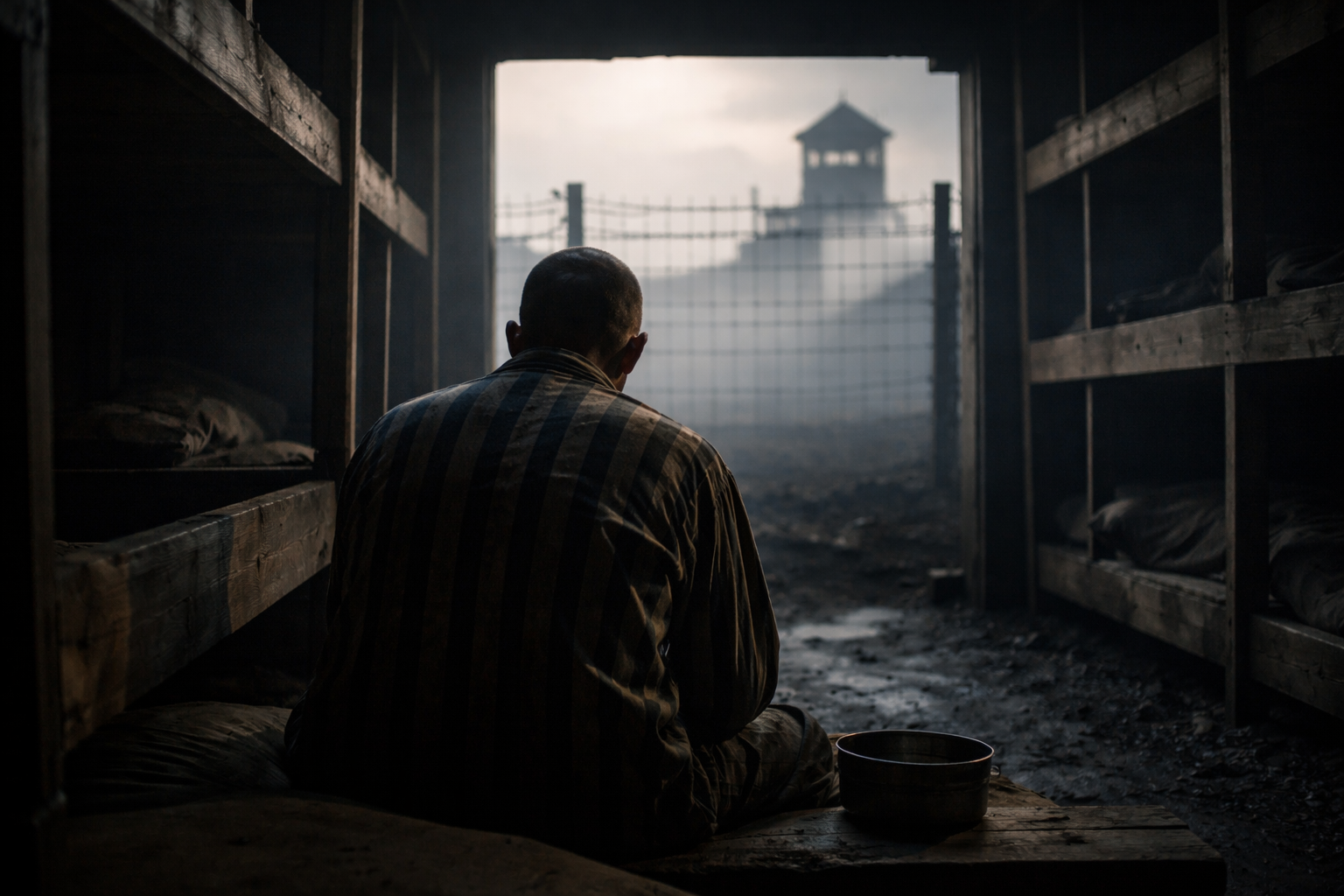
Primo Levi’s If This Is a Man (first published in 1947; known in the United States as Survival in Auschwitz) is one of the clearest eyewitness accounts of what a modern extermination system does to a person’s mind, body, and moral instincts. This summary of If This Is a Man details Levi's experiences in Auschwitz-Monowitz and explains why the book remains a reference point for understanding how cruelty becomes routine.
Levi writes like a chemist and a witness. He does not dramatize events or turn suffering into a spectacle. Instead, he tracks mechanisms: how hunger reorders values, how language collapses into commands, how a camp becomes an economy, and how people are forced to calculate their worth in calories and minutes.
The central tension is not only whether Levi survives. It is whether any form of dignity can survive a system designed to erase names, choices, and relationships—while still demanding performance, compliance, and productivity.
The story turns on whether a person can stay human inside a machine built to erase humanity.
Full Plot
Spoilers start here.
Act I: Setup and Inciting Incident
Primo Levi begins as an Italian Jew and trained chemist living in a Europe where the categories of “citizen” and “person” are already being destroyed by law and war. Levi is arrested in late 1943 and, after a period of detention, is deported in early 1944. The journey is not treated as a single cinematic ordeal but as an initiation into helplessness: once transport begins, personal time ends.
Levi arrives in Auschwitz and is processed into the camp system. Names are replaced by numbers. Bodies are shaved, washed, sorted, and assigned. The violence is not only physical; it is epistemic. Levi is thrust into a world where normal interpretation fails. Orders arrive in unfamiliar languages, and punishment is immediate. The first lesson is that the camp is not designed to be understood by the prisoner. It is designed to be obeyed by the prisoner.
Levi is sent to Auschwitz-Monowitz, a labor camp attached to the Buna industrial project. Work dominates everything. Hunger becomes the baseline condition, and cold becomes a second enemy. Levi learns that survival is not heroic. It is procedural: how to walk, where to stand, when to speak, and what not to ask. The camp runs on routines that make brutality feel like “policy.”
Levi meets other prisoners and begins to map the social and moral landscape. Some men protect small fragments of self-respect through discipline—washing, posture, ritual—while others argue that these habits are wasted energy. Levi does not offer simple answers. He shows how every choice is distorted by malnutrition and fear.
What changes here is that Levi’s identity is officially replaced by a function: a laboring body that must prove usefulness to remain alive.
Act II: Escalation and Midpoint Shift
Life in Monowitz becomes a long, grinding education in scarcity. Levi describes the camp as a system that produces the same outcome through many channels: work that destroys the body, hunger that destroys the will, and bureaucracy that destroys the sense that a life is unique. The day is structured around roll calls, forced marches, labor details, and the constant, aching calculation of food.
The camp’s economy emerges as a secondary engine of control. Prisoners trade what they can: bread, soup, scraps, time, favors, and information. Clothing and shoes matter like armor. A missing spoon is not a minor inconvenience; it is a threat to calories. Morality becomes transactional because the system makes generosity costly. Levi is careful here: he does not excuse betrayal, but he shows the pressure that turns ethics into a luxury.
Levi’s friendship with Alberto deepens. Alberto is quick, socially adaptive, and alert to opportunities. That bond becomes one of Levi’s stabilizing forces. In a place designed to isolate, friendship becomes a form of resistance: it rebuilds a tiny “we” inside a machine that wants only “units.”
Levi also experiences moments where the mind briefly escapes the camp’s language. One of the most famous episodes involves Jean, known as the “Pikolo,” during a task to fetch soup. The two take a longer route so they can talk. Levi tries to recall lines from Dante, translating and explaining as he remembers. The moment is small in external action but huge in meaning. For a short stretch of time, Levi is not only a prisoner. Levi is a person with memory, culture, and speech that is not dictated by orders.
At the midpoint of the memoir’s movement, Levi’s “usefulness” begins to matter in a new way. Because Levi is trained as a chemist, Levi’s knowledge becomes a potential lever. The camp’s industrial needs create narrow cracks where a prisoner can become slightly less disposable, not because the system becomes kinder, but because the system becomes hungry for specialized labor. That shift does not redeem anything. It simply changes the probability curve.
Outside help enters the story through Lorenzo Perrone, an Italian civilian worker. Lorenzo provides Levi with food and support without demanding payment. In the logic of the camp, this behavior makes no sense. That is the point. Lorenzo stands for a world where an action can still be done because it is right, not because it is profitable.
What changes here is that Levi’s survival odds subtly shift from pure endurance toward conditional value—being useful to the machine and being helped by someone who refuses the machine’s rules.
Act III: Climax and Resolution
As time passes, the camp’s rhythms grow more punishing. Levi’s body weakens. Winter presses in, and illness becomes more dangerous because it changes how the camp sees you. In Auschwitz, sickness is not only suffering. It is a bureaucratic status that can trigger removal and death. The threat of selection shadows daily life: a glance, a gesture, or a quick judgment can decide whether you stay in the labor system or disappear.
Levi is eventually sick enough to enter the Ka-Be, the infirmary. The Ka-Be is not a sanctuary, but it alters the immediate terms of survival. It removes Levi from the daily grind of labor, and it places Levi in a different kind of waiting room—where the fear is not the worksite but the sorting process that decides who is “recoverable.”
The war’s approach begins to reshape the camp’s behavior. The external world, which has felt like a rumor, becomes a pressure. As front lines shift, the camp system moves into a late-stage mode: protecting itself, maintaining control, and disposing of what it cannot carry. Prisoners who can walk are pushed into evacuations and marches. Those who cannot are left behind.
Levi remains in the infirmary during the camp’s evacuation. What follows is a stripped-down survival scenario. The system that controlled every minute collapses into absence. Prisoners must scavenge, organize, and care for each other amid filth, cold, and disease. Levi and other sick men live through a period where the usual camp terror is replaced by a different terror: abandonment.
In this final phase, Levi shows something that many readers do not expect: liberation is not framed as a triumphant climax. Liberation arrives in a landscape already reshaped by starvation and loss. The end is quieter and more complicated. It is the return of possibility, not the return of innocence. Levi survives, but the book refuses to treat survival as moral proof. The last note is not victory. It is witness—an insistence that the reader must look at what the system did and what it taught.
Analysis and Themes
Theme 1: Dehumanization as a process
Claim: The camp does not only kill bodies; it engineers a new reality where personhood is replaced by function.
Evidence: Levi is processed into a number, taught commands, punished for misunderstanding, and forced into routines that make obedience automatic. Work at Monowitz ties survival to productivity, turning “fit” and “unfit” into life-or-death categories.
So what? Dehumanization rarely begins with open violence. It begins with categories, procedures, and language that make cruelty feel normal. Once a system trains people to see others as inputs and outputs, atrocities can look like administration.
Theme 2: Scarcity turns ethics into arithmetic
Claim: Extreme scarcity does not erase morality, but it makes every moral choice expensive.
Evidence: Levi describes a camp economy where bread and soup function like currency and where barter and favors shape who gets through the day. Small losses—a spoon, a shoe—create cascading risk.
So what: Under pressure, people do not become angels or demons by default. They become calculators. Modern systems that intensify scarcity—through insecurity, debt, or exploitation—can push ordinary people toward moral compromises they would reject in stable conditions.
Theme 3: Language is a survival tool and a weapon
Claim: Control of language controls thought, and losing language accelerates the loss of self.
Evidence: Levi shows the confusion of orders, the mix of tongues, and the way camp terms define what is “real.” The Dante episode with Jean is powerful because it reactivates a different language: one tied to meaning rather than command.
So what? When language is reduced to slogans, labels, and metrics, thinking shrinks. In any environment—political, corporate, or digital—whoever controls the vocabulary often controls what can be questioned.
Theme 4: Chance shapes survival more than merit
Claim: Survival is not distributed according to virtue; it is shaped by luck, timing, and small advantages.
Evidence: Levi observes how illness, selections, work assignments, and minor opportunities can decide outcomes. Help from Lorenzo and the value of Levi’s chemistry knowledge shift probabilities, not deserts.
So what? People want stories where positive outcomes reflect goodness. Levi refuses that comfort. That refusal matters today because it challenges the way societies blame victims and reward survivors as if outcomes were proof of worth.
Theme 5: Solidarity is real, but fragile
Claim: Human connection can resist the camp’s logic, but the system is built to break it.
Evidence: Levi’s friendship with Alberto provides stability and shared strategy. Lorenzo’s help matters because it arrives without a transactional demand. Yet the camp’s incentives constantly push toward isolation and self-protection.
So what? Solidarity is not a personality trait; it is a structure. When environments punish cooperation and reward extraction, kindness becomes rare not because people are inherently cruel, but because the system makes kindness costly.
Theme 6: Witness is an ethical act, not a performance
Claim: Levi’s restraint is a moral choice; he will not turn suffering into spectacle.
Evidence: The prose stays controlled, analytic, and concrete. Levi describes mechanisms and consequences rather than inviting the reader to consume horror for emotional catharsis.
In a media culture that prioritizes outrage and shock, Levi exemplifies a distinct approach by prioritizing accuracy over drama, and clarity over performance. Witnessing becomes a way to protect truth from becoming entertainment.
Character Arcs
Protagonist: Primo Levi. At the start, Levi’s guiding belief is that the world can be understood through reason, observation, and shared rules. By the end, Levi’s belief is altered: reason still matters, but it must be paired with a hard recognition of how quickly systems can dismantle shared reality. The forcing moments include Levi’s processing into a number, the daily lesson that productivity can equal life, the rare restoration of meaning during the Dante conversation, and the final abandonment phase where survival depends on improvisation and human cooperation rather than formal order.
Key secondary arc: Lorenzo Perrone. Lorenzo begins and ends as a figure outside the camp’s moral distortion. Lorenzo’s actions do not “save” Levi in a simple way, but Lorenzo proves that moral choice is still possible even when institutions are built to destroy it. That contrast sharpens Levi’s central argument: the camp’s logic is not “human nature.” It is a constructed system.
Craft and Structure
Levi’s greatest craft choice is tone. The writing is controlled, almost clinical, and that restraint makes the events harder to distance. A more emotional voice might invite readers to treat the story as a tragedy happening to someone else. Levi’s voice keeps pulling the reader back to mechanisms: “This is how it worked.”
The structure is episodic, built from linked observations rather than a conventional plot engine. That fits the subject. Camps are designed to flatten time, to turn days into identical units. Levi recreates that flattening while still highlighting turning points—friendships, selections, moments of memory, shifts in work status—that change what is possible.
Symbols and motifs appear without being announced. Hunger is not only hunger; it becomes an organizing principle for thought. Dirt is not only dirt; it becomes a sign of forced degradation and a battle over self-respect. The repeated language of “fitness” and “value” turns the camp into a moral laboratory where the results are devastating.
The ending is deliberately unsentimental. Levi does not offer a clean resolution because the experience does not produce one. The book closes with survival as an aftermath and responsibility, not as a triumph.
What Most Summaries Miss
Many summaries treat If This Is a Man as “a story about suffering in Auschwitz.” That is true but incomplete. Levi is also writing a systems analysis of how a modern institution can reprogram everyday perception. The horror is not only what happens. The horror is how quickly people adapt to it, how fast “unthinkable” becomes routine.
Another overlooked element is Levi’s refusal to sanctify survivors. The book does not suggest that survival proves superiority. Levi observes the opposite: the camp often destroys the most vulnerable first, while those with slight advantages or strategic ruthlessness can last longer. This is one of the memoir’s most uncomfortable truths, and it is central to its moral seriousness.
Finally, many readers remember the Dante episode as a poetic oasis and stop there. Levi’s point is sharper: even the most beautiful memory is fragile in a system designed to starve meaning itself. The moment does not rescue Levi from the camp. It shows what the camp is destroying.
Relevance Today
Technology and metrics: Levi shows how people become numbers in a bureaucratic machine. Today, algorithms and dashboards can reduce human judgment to performance indicators. The risk is not that modern life resembles Auschwitz. The risk is learning to treat people as data points because it feels efficient.
Work culture and productivity: Monowitz ties “value” to output under coercion. Modern workplaces can echo smaller versions of that logic when exhaustion is normalized and worth is measured by visibility, speed, and constant availability.
Politics and power: The camp runs on controlled information and forced categories. Contemporary political movements still use dehumanizing language—labels that make empathy feel illegitimate and cruelty feel necessary.
Media and attention: Levi’s restraint contrasts with today’s incentive to sensationalize pain. When suffering becomes content, the audience can consume horror without responsibility, which is another way of avoiding witness.
Inequality and scarcity: Levi shows how scarcity forces moral compromise. In modern societies, precarity can push people into choices they would never make with stable housing, health care, and income.
War and displacement: Levi’s story begins with arrest, transport, and forced movement. Contemporary conflicts produce mass displacement and detention systems where people are processed, sorted, and managed—often with language that hides human detail.
Relationships and identity: The memoir shows how friendship becomes a survival tool and how isolation becomes a weapon. Today, social fragmentation, distrust, and atomized living can make solidarity harder right when it matters most.
Ending Explained
The memoir ends by refusing a comforting arc. Levi survives, but survival is not presented as a reward or a clean return to normal. The final phase deconstructs the camp, leaving its victims to confront sickness, cold, and the remnants of the system's priorities.
The ending means the opposite of closure: it shows that the camp’s deepest damage is not only death but also the way the system trained people to live inside a moral distortion. Liberation restores possibility but not what was lost, nor does it make the experience a story with a satisfying moral.
Levi’s final argument is a demand on the reader. The point is not to feel pity and move on. The point is to understand the mechanisms—how quickly a society can build structures that turn people into functions—and to recognize that resisting those mechanisms begins long before the worst endpoint arrives.
Why It Endures
If This Is a Man endures because it is both testimony and diagnosis. It records what happened to Levi, but it also explains how a system can make cruelty feel administrative and make degradation feel ordinary. Levi does not ask for reverence. Levi asks for attention.
This book is for readers who want clarity without comfort: people interested in moral psychology, systems of power, and the ethics of memory. It is also for anyone who senses that modern life sometimes trains us to accept small indignities, small cruelties, and small reductions—and wants language to resist that drift.
Some readers may not enjoy it if they want a conventional narrative arc, dramatic catharsis, or a heroic survival story. Levi refuses those shapes on purpose. The book’s force is its refusal to let the reader escape into easy meaning.
It leaves you with a question that does not fade: when a system demands you stop seeing others as fully human, what will you do before that demand becomes normal?
