Neverwhere Book Summary: London’s Dark Secret Beneath the Streets
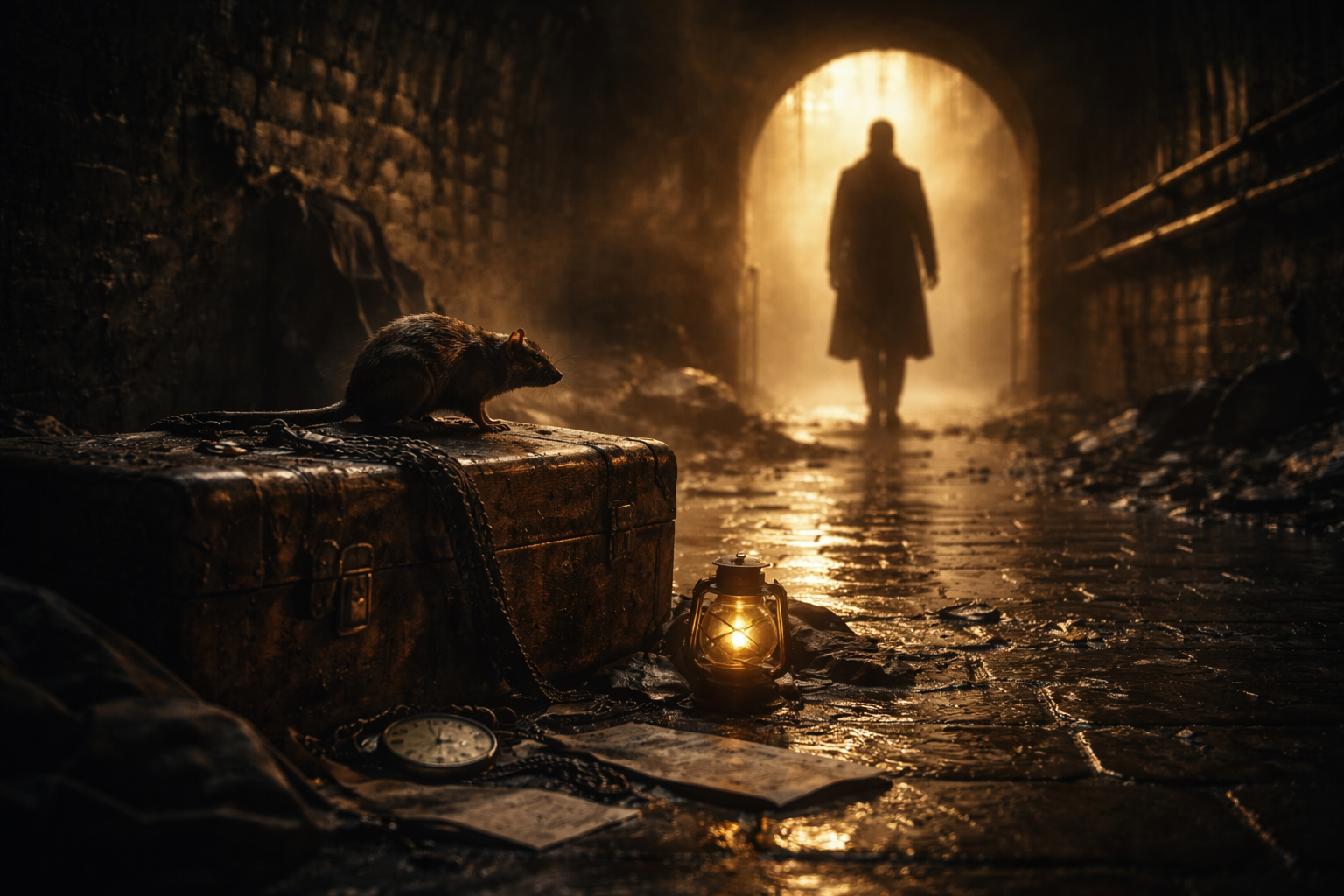
Neverwhere summary of Neil Gaiman’s 1996 novel: a man becomes invisible in London Above and descends into London Below to survive bargains, monsters, and truth.
Beneath London Lies a World That Eats the Lost
This Neverwhere summary covers Neil Gaiman’s urban fantasy novel Neverwhere (1996), a story that turns London into a trapdoor. One choice—helping a wounded stranger—knocks an ordinary man out of his life and into a city beneath the city, where names are literal, favors are currency, and survival depends on learning new rules fast.
Richard Mayhew, a decent and compliant young professional, is at the center of the story, striving to uphold morality and maintain peace. This reflex ultimately leads to his downfall. When he stops to help someone whom no one else can see, he himself becomes invisible to everyone.
London Below is not a hidden theme park. It is a harsh ecosystem built from the scraps and shadows of London Above. It shelters the discarded, the forgotten, and the dangerous, and it demands that people earn their place through bargains, tests, and risk.
“The story turns on whether Richard can reclaim his old life without losing the person he becomes below.”
Full Plot
Spoilers start here.
Act One: Setup and Inciting Incident
Richard Mayhew (a young office worker who wants a stable, respectable life) lives in London and lets his fiancée Jessica (an ambitious social climber who wants status and control) steer most decisions. Richard maintains harmony, extends his apologies first, and strives to be amiable. That habit works until the night it costs him everything.
On the way to a dinner that matters to Jessica’s career, Richard and Jessica find a badly injured girl on the sidewalk. The girl is Door (a frightened fugitive who wants safety and answers). Jessica wants to keep going. Richard stops. Richard’s choice forces a new path: Richard skips the dinner, carries Door home, and tends her wounds, even when Door insists she cannot go to a hospital.
Jessica’s anger has a clean logic. The dinner was lavish. Richard broke the plan, embarrassed her, and proved he would choose a stranger over her script. Jessica calls off the engagement, leaving Richard alone in his apartment, uncertain about his new role.
By morning, Door looks far better than she should. Door uses a pigeon to send a message to the Marquis de Carabas (a suave fixer who wants advantage and repayment). Door explains just enough: Door is being hunted, and Door’s father told Door to find the Marquis if danger ever came.
Danger arrives in human shape with inhuman manners. Mr. Croup (a polite sadist who wants to complete a contract) and Mr. Vandemar (a brutal predator who wants violence and food) knock at Richard’s door searching for Door. Richard stalls, confused by their calm certainty. Door opens a door that should not exist and hides, using a talent that bends space like paper.
Croup and Vandemar miss Door, but the pressure spikes. Richard now knows two things: Door is not ordinary, and someone will hurt Richard if he reaches it. Door admits she comes from London Door reveals that she hails from a world known as Below, a realm that exists beneath the surface of the city.
The Marquis arrives and takes Door away, which triggers the true cost of Richard’s kindness. Richard discovers that London Above begins to slide off him. People look through Richard. Coworkers forget Richard’s name. Friends fail to recognize Richard. Even Richard’s own apartment is no longer his. Richard becomes a “no-person,” erased from the social fabric as if the world has edited him out.
Richard’s goal changes. Richard no longer wants merely to help Door. Richard wants to fix reality, to become real again. That desire drives Richard to chase Door into the one place where Richard is still visible: London Below.
Richard follows a clue to the Floating Market, repeating the name like a prayer because it is the only anchor Richard has. Richard meets a tramp from below (a guide who wants to survive) who can see him and leads him down into stranger territory. Richard crosses into a space where rats are not background noise but a power bloc.
The rat-speakers (servants who want to please their rat masters) surround Richard, threaten Richard, and test Richard. Their attack is not random; it is how London Below checks outsiders. Richard survives this first encounter by luck, fear, and the shifting will of the rats themselves, and the message is plain: Richard is not safe simply because Richard is decent.
Richard continues toward a place called Night’s Bridge, guided by Anaesthesia (a rat speaker who wants to do her job and stay alive). Night’s Bridge is not only a location; it is a psychological trap. The darkness feels active. The silence presses. Anesthesia takes hold of the bridge, leaving Richard alone with the knowledge that London exists. Below are consumed people who hesitate.
Richard reaches the Floating Market, a moving bazaar where traders, oddities, and refugees barter for food, information, and miracles. Richard finds Door again, and Door is not merely hiding. Door is rebuilding a team. Door holds an “audition” for bodyguards because Door needs protection to pursue a larger goal: Door wants to learn who killed his family and why.
Door’s circle forms with visible tensions. The Marquis de Carabas stays close because the Marquis senses a profitable story. Hunter (a legendary warrior who wants the ultimate hunt) joins because danger attracts him, like scent attracts a hound. Richard stays because he has nowhere else to go, and he has begun to care.
Door shows Richard the first real map of the problem. Door’s family is dead. Door escaped. Door suspects that the murders are connected to power in London Below, and she believes her father's guidance will help her understand the situation. The group prepares to seek a figure of authority called Angel Islington (a protector who wants obedience and payment).
The trip begins with a tough lesson: in London Below, even travel is political. The group heads to the Earl’s Court, but the Earl (a ruler who wants respect and old debts paid) will not welcome the Marquis. The Marquis carries grudges like coins. The Earl collects them.
The party rides a strange underground train that follows its schedule, and the Marquis is forced to peel away before the Earl can claim the debt between them. Door, Richard, and Hunter continue without the Marquis, now more exposed and more dependent on each other.
What changes here is that Richard stops trying to return to normal and starts trying to survive the new world.
Act Two: Escalation and Midpoint Shift
At the Earl’s Court, Door learns the next step: to reach Angel Islington, Door must pass through a relic called the Angelus. The Angelus is housed in the British Museum, which creates a new constraint. Door and Richard must enter London. Door and Richard venture above to locate the Angelus, while Hunter stays behind due to a curse that prohibits him from entering the surface world.
Door and Richard move through the museum with the tension of trespassers who do not belong. Door finds the Angelus and opens it using Door’s family talent, treating a sealed boundary as if it were just another door. Door and Richard cross through to Angel Angel Islington's underground residence, which is a place that simultaneously feels like a sanctum and a cage.
Angel Islington explains the price of aid. Angel Islington claims Angel Islington is the protector of London Below, assigned as punishment after a prior disaster. Angel Islington offers Door help finding the murderer but demands a specific payment: Door must retrieve a unique key held by the Black Friars and bring it back.
Door’s goal narrows into a quest. If Door gets the key, she gets answers. Richard goes along because he is now entwined in Door’s life, and he still believes that doing the right thing will lead to safety.
While Door and Richard follow the angel’s instructions, the Marquis pursues information the Marquis cannot resist. The Marquis approaches Croup and Vandemar with a proposition, offering a priceless object in exchange for the name of their employer. The Marquis believes the Marquis can outdeal killers.
Croup and Vandemar accept the trade because they view bargains as tools for hunting. The information comes with a hidden condition: the price is the Marquis’s life. Croup and Vandemar seize the Marquis, torture the Marquis, and kill the Marquis, snapping any promise that was meant to limit their behavior. The Marquis pays for confidence with blood.
Door, Richard, and Hunter travel to the Black Friars’ dwelling, where the story’s moral engine clicks into place. The Black Friars (guardians who want their rules respected) will not hand over the key for pleading. The Black Friars require ordeals.
The first ordeal is strength, and Hunter wins through force and focus. The second ordeal is intellect, and Door wins through cleverness and controlled fear. The third ordeal is character, and Richard faces something far more intimate: a convincing breakdown of Richard’s reality.
Richard’s ordeal attacks Richard’s weakest point, not Richard’s body. Richard is tempted to believe that London Below is a delusion, that Richard is mentally ill, and that the entire adventure is a humiliating fantasy. The pressure is brutal because it offers relief. If it is all a hallucination, Richard can stop fighting and surrender.
Richard survives because of a small, concrete anchor: a trinket connected to Anaesthesia, a person Richard watched disappear. The object yanks Richard back to truth through sensation and memory. Richard chooses reality even when it is terrifying, and the Black Friars grant him the key.
The ordeal alters Richard. The self-doubting man who apologized for existing starts to harden into someone who can make decisions under pressure. Richard becomes more legible to London. Richard finally accepts that London Below is real and that he must act accordingly.
The group returns to the Floating Market to regroup, but the Marquis is missing. Door makes a quiet, strategic decision that will later decide life and death. Door assigns Hammersmith, a selfless smith, the task of creating a duplicate of the Black Friars' key. Door does not announce the transaction to the group. Door keeps it as an insurance policy against forces she does not fully trust.
To reach Angel Islington again, the party needs a guide through dangerous territory. Richard recruits Lamia (a Velvet who wants payment in intimate terms) to lead them. Lamia’s guidance comes with a predatory underside. The Velvets are seductive and lethal, and Lamia’s price is not money. Lamia demands something from Richard that Richard cannot give without dying.
On Down Street, the danger becomes immediate. Richard realizes that “payment” can mean blood, life, or something worse. Richard is cornered by a deal he did not understand when he agreed to it. The Marquis reappears at the last moment and saves Richard, revealing two truths at once: the Marquis is alive, and the Marquis is not a friend out of pure kindness.
The Marquis survived because Old Bailey (a rooftop drifter who wants stories and small trades) retrieved the Marquis’s life, which had been preserved in a box. Old Bailey successfully restores the Marquis, but the Marquis, now aware of his near completion, returns weakened.
The plan tightens. Door has the key. Door must return to Angel Islington. Croup and Vandemar still hunt Door. Hunter travels with Door but carries Hunter’s own obsession. The group heads deeper into the underworld, and the pressure to betray or be betrayed grows as options narrow.
Then, the plot takes a turn. Hunter reveals that he has been working against Door. Hunter trades Door to Croup and Vandemar; in exchange for a magical spear, Hunter needs to hunt the Beast of London. Hunter’s betrayal is not random cruelty. It is Hunter’s religion. Hunter values the hunt over loyalty, and the Beast is Hunter’s promised legend.
Croup and Vandemar take Door and head downward toward the angel, holding Door as the key to their employer’s goal. Richard and the Marquis follow Hunter because Hunter knows the path, and Richard has no other route to save Door.
The pursuit leads to a labyrinth where the Beast of London lives, a place designed to break travelers through fear and exhaustion before the monster even appears. Richard and Hunter face the Beast, and the fight resolves in a cruel inversion. Hunter, the professional killer, dies. Richard, the amateur, survives by necessity, and Richard kills what Hunter wanted most.
Richard takes Hunter’s knife as a dying gift, and the knife becomes more than a weapon. It serves as evidence that Richard has stepped over an unbreakable boundary. Richard is no longer merely a man dragged along by events. Richard has done something that defines him.
What changes here is that Richard stops being a tagalong and becomes the one who can finish the story.
Act Three: Climax and Resolution
Richard and the Marquis race toward Angel Islington’s residence because Door is running out of time. The endgame is simple and terrifying. The door is captive. The door has access to doors and boundaries other people cannot open. Croup and Vandemar can force Door to cooperate by hurting someone they care about. If Door opens the wrong door with the key, the consequences will not stay contained.
The confrontation unfolds as if a trap is finally set in motion. Angel Islington reveals Angel Islington’s true motive. Angel Islington orchestrated Door’s family’s murder as revenge because Door’s father refused to help Angel Islington. The “guidance” in Door’s father’s diary was manipulated to steer Door back to the angel with the key.
Angel Islington’s plan is not modest. Angel Islington wants Door to open a door to Heaven using the key, not as an act of worship but as an act of conquest. Angel Islington wants dominion, revenge, and the satisfaction of rewriting punishment into power.
Door resists, so Croup and Vandemar torture Richard in front of Door. The pain is a lever. The tactic is clear: inflict pain on the person. Door cannot bear to watch suffering, and Door will comply. Richard's life becomes the cost of Door's refusal.
Door agrees to open it, but Door’s earlier caution pays off. Door uses Hammersmith’s duplicate key, not the real key from the Black Friars. Door opens a door “as far away as Door could imagine,” and the opening becomes a violent pull, a wrongness that drags bodies and intentions toward it.
Angel Islington, Croup, and Vandemar are sucked through the doorway into the unknown destination. The door does not lead to Heaven. It leads to a different place, and this place is so catastrophic that it serves as a form of banishment. The door closes, sealing the threat away.
After the collapse of the angel’s scheme, the survivors regroup and face the quieter fallout. The door still has the real key. Richard is still marked by London Below. The Marquis is still the Marquis, alive but altered by near-death and by the knowledge that even the Marquis can miscalculate.
Door uses the Black Friars’ real key to send Richard back to London Above, restoring him to the life that vanished. Richard returns to an apartment that he can call his own once again. Richard returns to work. People recognize Richard. The surface world resets its memory as if nothing happened.
But Richard cannot reset. The restoration reveals the emotional truth of the real ending. Richard sees London Above as thin and scripted, full of conversations that slide off meaning. Richard’s old ambitions feel borrowed. The people around Richard feel like they are acting in a play Richard no longer believes in.
Richard tries to force satisfaction. Richard tries to accept safety as a reward. Richard fails, not because safety is unacceptable, but because Richard has changed shape inside. London Below, Richard was taught to choose, to risk, to matter. London Above asks Richard to shrink back into politeness.
Richard finally attempts to return below by drawing a door shape with Hunter’s knife, but nothing happens. Richard succumbs to a distinct form of despair: the apprehension that he has forfeited all for nothing and is unable to return to the source of his meaning.
Then the Marquis appears, offering a way back, not as a miracle for free but as a continuation of the world Richard entered. Richard steps toward the underworld again, choosing a life that fits the person he became.
Analysis and Themes
Theme 1: Social Invisibility
Claim: The book treats being unseen as both a supernatural rule and a social punishment.
Evidence: Richard becomes a “no-person” after helping Door, losing his job, home, and recognition. London Below is full of people who live beneath notice until they form their systems.
So what? Modern life makes people disappear without magic through poverty, bureaucracy, and exhaustion. The story asks whether “seeing” someone is a moral act, not just an accident of attention.
Theme 2: The Price of Kindness
Claim: A single compassionate choice can trigger consequences that cannot be controlled.
Evidence: Richard’s decision to help Door destroys Richard’s engagement and surface identity. Each attempt to fix the damage pulls Richard deeper into danger and obligation.
So what: Kindness is often framed as harmless, but real help costs time, comfort, and status. The novel insists that responsibility begins when the easy exit disappears.
Theme 3: Power as Bargain
Claim: In London Below, power flows through deals, debts, and leverage.
Evidence: The Marquis trades value for information and pays with his life. Door must win a key through trials, and guides demand for prices that can be fatal.
So what: Institutions and elites often function the same way, dressed in paperwork instead of ritual. The book makes the hidden transaction visible: nothing important is free.
Theme 4: Identity Through Choice
Claim: Richard becomes himself by making decisions under pressure rather than following scripts.
Evidence: Richard survives the Black Friars’ ordeal by rejecting the comforting lie. Richard kills the Beast of London and stops being a passenger in the plot.
So what: A stable identity is not a brand or a résumé; it is a pattern of actions when fear is high. The story argues that adulthood begins when approval stops being the goal.
Theme 5: Sacred Authority Can Corrupt
Claim: A protector can be the most dangerous kind of tyrant when obedience is disguised as salvation.
Evidence: Angel Islington offers help with a price, manipulates Door’s path, and uses torture to force compliance. The “holy” language masks domination.
So what: Charisma and moral framing can hide coercion in politics, workplaces, and relationships. The novel teaches a practical suspicion: judge by methods, not titles.
Character Arcs
Protagonist: Richard begins as someone who wants to be liked, avoid conflict, and keep his life neat. Richard ends as someone who chooses meaning over comfort, even when the choice costs status and safety. The hinge moments are Richard’s erasure, Richard’s survival of the ordeal, and Richard’s decision to return below after his life is restored.
A key secondary arc is the Marquis de Carabas, who treats everything as a transaction until it kills him. The Marquis returns changed, still sly, but more aware that cleverness has limits and that loyalty, even partial loyalty, can be a form of power.
Structure
The book runs on cause and effect disguised as whimsy. Each “wonder” is a test that arrives because someone chose something earlier: Richard helps Door, so Richard is erased; Door seeks a protector, so Door becomes a tool; the group hires a guide, so the guide demands a price. Puns and legends from the setting not only complement the plot, but also accentuate it.
Gaiman also uses a clean split between London Above and London Gaiman utilizes the distinction between London Above and London Below to highlight an internal crisis. Richard’s surface life represents permission, routine, and image. The underworld represents risk, appetite, and consequence. The story’s tension comes from forcing Richard to decide which world deserves him.
What Most Summaries Miss
Most quick summaries treat London Below is the point, as if the book’s main pleasure is quirky geography and eccentric characters. The deeper trick is that Richard’s disappearance is not just a magical penalty. It is a reveal: Richard’s surface identity was already built on being useful to other people’s plans.
The book also refuses the fantasy of “having it all.” Richard cannot keep the old life and keep the new self. The ending is not only about returning to a magical world. It is about refusing to live as a person who is seen but not alive.
Relevance Today
In a time where attention is valuable and invisibility is a penalty, the story resonates strongly. Algorithmic systems decide who gets seen, who gets hired, who gets heard, and who gets ignored. Platforms, employers, or institutions that treat people as data points exaggerate Richard's "no-person" status.
Work culture also mirrors London Below’s bargains. People trade time, health, and identity for security, and the real costs often show up only after the deal is signed. Richard’s arc resonates with anyone who has pursued “stability” only to discover that the cost was a diminished sense of self.
Politics and power echo the book’s warning about moral authority. Leaders and institutions can frame control as protection, especially during crises, and dissent can be treated as moral failure rather than debate. Angel Islington’s methods feel familiar: offer help, demand compliance, punish refusal.
The book fundamentally revolves around relationships and identity. Richard loses Jessica because he disrupts her narrative, and later, he loses his place in the surface world because it no longer suits him. The story captures a modern fear: becoming a stranger to the life you worked hard to build.
Inequality sits in the background like infrastructure. London The surface world barely notices the people who have slipped through the cracks below. The book makes that invisibility literal, forcing the reader to feel how easily a person can vanish without a headline.
Finally, the novel speaks to a culture saturated with “choice” language that hides constraint. London Below makes constraint explicit: every choice closes doors and opens others. That clarity is bracing in a world that sells endless options while narrowing real freedom.
Ending Explained
Richard returns to London above. His life was restored, but the restoration exposes the mismatch between external success and internal meaning. The surface world offers comfort and recognition, yet it asks Richard to shrink back into passivity. Richard can be safe, but Richard cannot be whole in the old shape.
The ending means Richard’s real home is not a place but a level of aliveness that requires risk, agency, and consequence. Richard’s return below is not escapism. It is a refusal to live as someone who is visible but numb.
The Marquis’s final appearance matters because it shows that London Below is not a dream Richard can visit when bored. It is a world of debts and doors that remembers. Richard’s choice to step back into that world answers the book’s central question with action: Richard chooses the self that was forged under pressure.
Why It Endures
It endures because it transforms a familiar city into a moral instrument. It uses fantasy to make a blunt claim: the people we ignore do not cease to exist, and the lives we perform can become prisons. The book is funny, grim, and tender in quick succession, but it never treats danger as decorative.
This novel is for readers who like urban fantasy with teeth, quests built from character rather than prophecy, and stories that make metaphor physical. It may not work for readers who want a cozy tone or a purely escapist adventure, because the book keeps returning to the cost of comfort and the reality of being unseen.
In the end, the tension remains sharp: you can be safe, or you can be awake, but you cannot pretend those are the same thing.
