Of Mice and Men (John Steinbeck) Summary
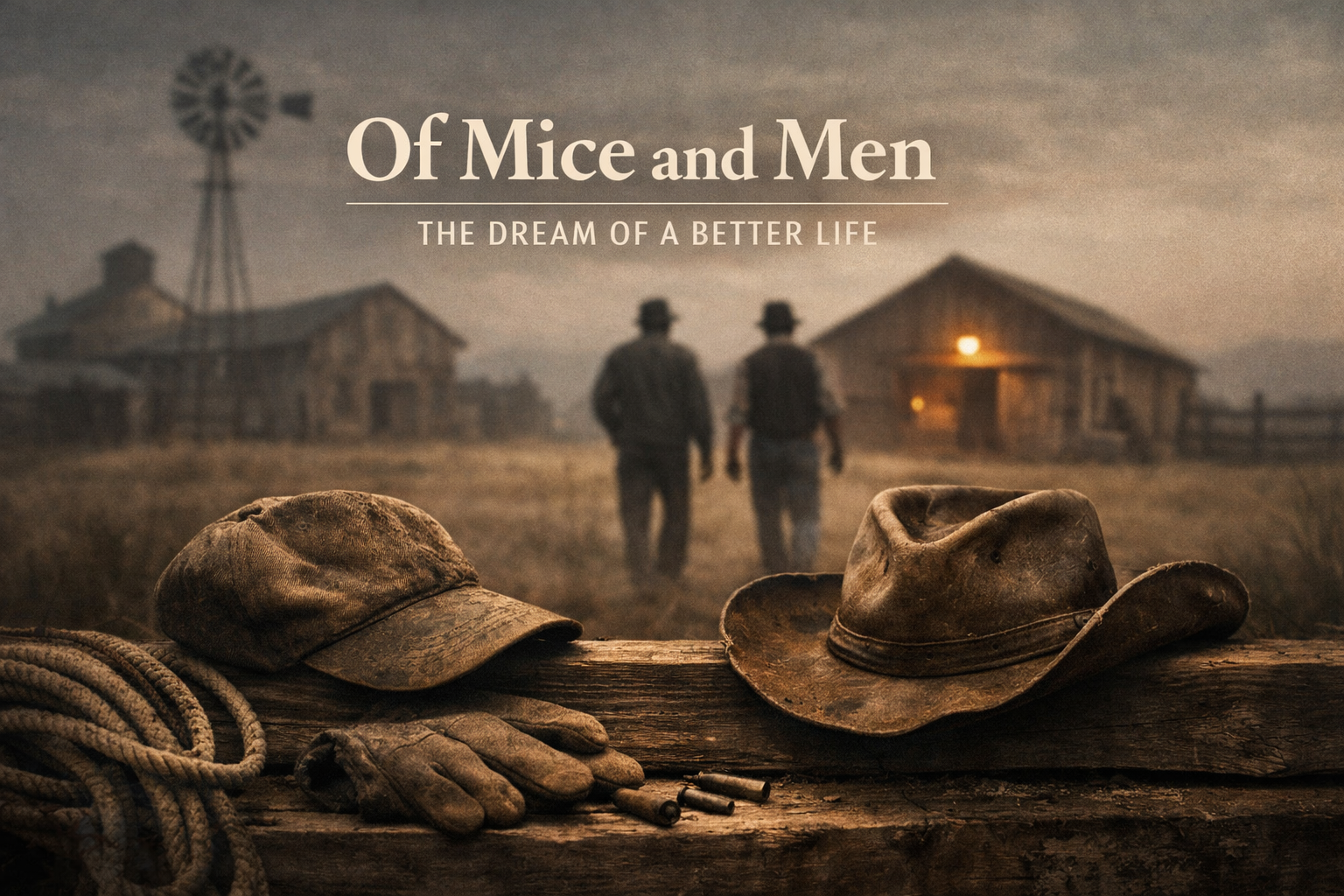
The Dream That Keeps Two Men Breathing
Key Points
The story takes place in California during the Great Depression and follows two migrant ranch hands, George Milton and Lennie Small, as they look for work and a shaky idea of freedom.
George is sharp, wary, and always calculating the next risk; Lennie is physically powerful, mentally vulnerable, and drawn to “soft” things he can’t handle safely.
Their simple dream is to make enough money to buy a small house, grow their own food, and not have to answer to anyone.
The ranch they settle on creates a dynamic environment where loneliness, suspicion, and hierarchy transform ordinary days into perilous situations.
Steinbeck builds tension through small moments—glances, warnings, and casual cruelty—that make the ending feel inevitable rather than random.
Almost every character has a private need: for friendship, respect, safety, or a way out. But the system keeps them apart.
The book’s cruelty isn’t melodramatic; it’s practical. When disaster hits, people move fast—not to save, but to contain.
The core question is brutal: what does mercy look like when the world offers none?
The Plot Engine
George and Lennie don’t just travel together for company. They travel together because they need each other to survive. George brings judgement and a plan. Lennie brings strength, loyalty, and a childlike faith that the plan can come true.
That plan—buying a small farm—does more than promise future comfort. It gives their present meaning. It turns hard labour into a countdown. One more job. One more pay packet. One more week without trouble.
But Lennie is trouble, even when he means well. His need to touch soft things, his panic when people get angry, and his inability to read danger mean the story is always balancing on the edge of something going wrong.
What This Book Is About
George and Lennie arrive in the Salinas Valley looking for ranch work after fleeing an earlier job where Lennie’s behaviour caused panic. George drills rules into him: keep quiet, stay out of fights, avoid attention—especially the kind that comes from powerful men protecting their status.
At the ranch, they meet men who drift from job to job, living in bunkhouses and spending their pay in ways that keep tomorrow identical to today. Among them are an older worker clinging to relevance, a proud and capable mule driver who earns respect, a bitter stable-hand shut away by racism, and a boss’s son eager to prove himself through intimidation.
George tries to keep their heads down. But the ranch has its own gravity. The men watch Lennie’s size and judge him. Tensions flare. A lonely woman wanders the edges of the bunkhouse culture, treated like danger whether she intends to be or not. And the dream farm—once a private bedtime story—starts to sound, to other men, like oxygen.
What makes the book hurt isn’t just the threats. It’s the brief, dazzling moments when escape feels possible—and the way those moments tighten the noose.
The Domino Chain
Because George and Lennie travel together, they stand out on a ranch full of isolated men—and attention becomes a risk.
Because Lennie is powerful but easily frightened, any confrontation carries the possibility of sudden, irreversible damage.
Because George’s dream gives their hardship a purpose, he keeps repeating it—and the repetition makes it feel real enough for others to want in.
Because the ranch runs on status and suspicion, Curley’s insecurity turns into aggression toward the biggest target in the room.
Because the men are lonely, they circle any sign of weakness, hope, or difference—sometimes to connect, often to control.
Because Crooks lives under racism and exclusion, he tests the dream by trying to puncture it—proving how rare hope is in that world.
Because the ranch treats certain people as “trouble” by default, a single mistake doesn’t stay a mistake—it becomes a verdict.
Why It Works
What It Nails
Steinbeck makes the dream feel physical. You can almost taste the imagined meals, feel the soil, and hear the relief in George’s voice when he describes a life without bosses. That concreteness matters, because the world around them is equally concrete: work hours, bunks, pay, and the ever-present threat of being fired or beaten.
The tension also builds with grim discipline. There are no random shocks. Small warnings early on become structural beams later. Every time George says “stay away,” the reader can feel the story narrowing.
Most of all, the friendship lands. George isn’t a saint. He complains, snaps, and fantasises about an easier life. Yet he stays. And Lennie, for all his danger, loves George with a purity that makes the book’s later choices feel like personal violence.
What Might Not Work for Everyone?
The book is short and unsentimental. If you want spacious backstories, multiple plot threads, or a wide cast that develops over time, this will feel harshly compressed.
It’s also a product of its setting and era. Racism, sexism, and cruelty are not background colour—they’re part of the atmosphere. The story doesn’t soften that language or those attitudes, and that can be difficult to sit with.
Finally, the emotional punch comes from inevitability. Some readers will consider that devastating. Others may consider it relentless, like watching a slow-motion fall you can’t stop.
Key Characters
George Milton — A small, sharp migrant worker who carries the plan, the fear, and the responsibility.
Lennie Small — A huge, strong man with a childlike mind and a dangerous inability to gauge his own strength.
Candy — An older ranch hand terrified of becoming useless and being cast out.
Slim — The respected mule driver; calm, competent, and quietly moral.
Curley — The boss’s son; combative, insecure, and hungry to dominate.
Curley’s wife — Lonely, restless, and treated as an object of suspicion and desire rather than a person.
Crooks — The stable-hand isolated by racism; proud, guarded, and starved of companionship.
Carlson — A blunt ranch hand whose idea of “sense” often means emotional numbness.
Themes and Ideas
The American Dream is the book’s engine—and its trap. George and Lennie’s dream is modest: not wealth, just ownership and safety. That modesty is what makes it heartbreaking. They aren’t reaching for the moon. They’re reaching for a locked door.
Loneliness is everywhere, not as sadness, but as structure. The ranch forces men into a life where intimacy is mocked, weakness is punished, and tomorrow is never secured. Characters who want connection often reach for control instead, because control is safer than need.
Power is practical. It belongs to whoever can fire you, accuse you, or hurt you without consequence. That power shapes everyone’s behaviour: silence, caution, bravado, cruelty.
And then there’s mercy. The narrative persistently questions the definition of mercy in a world that relentlessly crushes the weak. Is mercy protection? Is it abandonment? Is it an act that saves someone from suffering—or an act that ends a burden?
Full Plot Summary
SPOILER WARNING: The section below reveals the full plot and ending.
George and Lennie arrive at a riverside clearing near Soledad the night before starting a new ranch job. Lennie carries a dead mouse he’s been petting; George takes it away and scolds him, then softens and tells Lennie their dream again: a small farm, fresh food, and Lennie tending rabbits.
George’s worry isn’t abstract. At their previous job in Weed, Lennie grabbed a girl’s dress because it felt nice, panicked when she screamed, and wouldn’t let go. George got them out before the situation turned lethal. Now he sets rules: Lennie should speak as little as possible, avoid fights, and run back to the clearing if anything goes wrong.
At the ranch, they meet Candy, the ageing “swamper”, and the boss. The boss questions George about why he speaks for Lennie. George senses danger and lies smoothly: Lennie is a good worker, just quiet. Curley appears soon after—a small man with a big need to prove himself—followed by Curley’s wife, who lingers and looks for company in a way that alarms George. George immediately tells Lennie to stay away from both Curley and his wife.
They also meet Slim, the respected mule driver, who has newborn puppies, and Carlson, who complains about Candy’s ancient dog. The ranch’s casual cruelty shows itself: the men talk about killing the dog as a practical mercy, as if deciding the weather.
Slim notices George and Lennie’s bond, unusual among itinerant workers, and George explains how it started. The companionship is real, but it’s also a job: Lennie needs supervision, and George has taken on the role.
Soon, the ranch’s latent violence turns direct. Curley, already agitated and suspicious, picks a fight with Lennie. Lennie tries to avoid it until George orders him to defend himself. Lennie grabs Curley’s hand and crushes it, shattering the bones. Slim forces the aftermath into a story Curley can live with: Curley claims he caught his hand in a machine, saving face instead of demanding public revenge.
The dream farm briefly gains momentum. Candy overhears George and Lennie talking about buying land and begs to join, offering his savings in exchange for security in old age. George, shocked by the possibility that the dream might be achievable, agrees. For a moment, three men can almost see the place.
But the ranch’s loneliness and hierarchy keep tightening. Crooks, isolated in a separate room, taunts Lennie with the idea that George might not come back, probing the fear underneath Lennie’s innocence. Candy arrives and talks money, and even Crooks—hardened by exclusion—momentarily wants in on the dream. Then Curley’s wife enters, insults them, and threatens Crooks with violence that relies on racist power rather than personal strength. The dream shrinks back into something dangerous to say aloud.
The real collapse begins in the barn. Lennie accidentally kills one of Slim’s puppies by petting it too hard. Panicking, he tries to hide what happened, already anticipating George’s anger and the loss of the dream. Curley’s wife finds him there. She doesn’t treat him like a threat at first; she talks. She admits her own dream—fame, escape, a different life—and her loneliness on the ranch. Lennie tells her about the rabbits and the farm.
When she lets Lennie stroke her hair, it triggers the same pattern as Weed: softness, pleasure, then panic. When she protests and raises her voice, Lennie clamps down to silence her. His strength, paired with fear, becomes fatal. He breaks her neck.
Lennie immediately runs—straight to the riverside clearing, exactly as George instructed. On the ranch, Candy discovers the body and brings George to see it. Candy’s grief turns into fury, not just at Lennie, but at the dream dying again. Curley gathers a posse, more lynch mob than search party, determined to kill Lennie himself.
George understands what Curley will do if he reaches Lennie first. He takes Carlson’s gun and heads to the clearing alone.
Lennie waits by the river, tormented by visions: Aunt Clara scolds him for causing trouble, and a giant rabbit mocks him for ruining the dream. George arrives and, despite everything, sits with him. Lennie begs to hear the story one more time.
George tells it in full: the little place, the freedom, the rabbits. He tells Lennie to look across the river and imagine it. As the men draw nearer through the brush, George raises the gun and shoots Lennie in the back of the head. Lennie dies believing the dream is about to begin.
When the posse arrives, George lets them believe he wrestled the gun from Lennie and did what had to be done. Slim understands the truth immediately. He leads George away, offering the only comfort available: the recognition that George chose mercy over vengeance.
Curley and Carlson watch them go, baffled by the grief. They can understand killing. They can’t understand love.
The Point of No Return
The moment Lennie kills Curley’s wife, the story’s options collapse. After that, there is no version of the dream that survives, and no version of Lennie that the ranch will allow to live.
The Domino Chain (Cause → Effect)
Because Lennie can’t control his strength and fixates on soft things, George must constantly manage risk.
Because the Weed incident proves how fast panic can turn to disaster, George creates the “run to the clearing” escape plan.
Because George and Lennie stand out as friends, the ranch notices them—and pressure finds them.
Because Curley needs dominance, he targets Lennie, and Lennie crushes Curley’s hand, raising the stakes.
Because Candy’s fear of being discarded is desperate, he offers savings, and the dream suddenly feels achievable.
Because Crooks tests the dream and Curley’s wife weaponises social power, the ranch’s cruelty is revealed as structural, not personal.
Because Lennie kills the puppy and is already frightened of punishment, he spirals into secrecy and panic.
Because Curley’s wife seeks attention and confides in Lennie, she enters the one place where Lennie’s fear can become lethal.
Because she screams, Lennie tries to silence her, and he kills her.
Because the ranch operates on vengeance and containment, Curley forms a posse to kill Lennie.
Because George knows Lennie will be tortured or lynched, he takes Carlson’s gun and finds him first.
Because George chooses mercy over revenge, he tells the dream one last time and shoots Lennie.
Because Slim understands moral cost, he supports George—while the others remain blind to what was lost.
Who Should Read This
If you like short, high-impact classics that hit like a punch to the chest, this is essential. It’s also ideal if you’re interested in stories where character flaws aren’t quirks—they are fate.
If you want a comforting arc, a fair world, or an ending that rewards hope, this will ruin your evening. In the best way. In the worst way. Probably both.
Also worth saying plainly: the book contains racist and sexist attitudes and language reflective of its setting, plus violence and themes of disability, exploitation, and death.
If You Liked This, Try
The Grapes of Wrath — John Steinbeck — A larger canvas of Depression hardship and dignity.
The Pearl — John Steinbeck — A tight, fable-like tragedy about hope and greed.
Flowers for Algernon — Daniel Keyes — Vulnerability, intelligence, and the cost of being “different.”
To Kill a Mockingbird — Harper Lee — Power, injustice, and moral courage in a community.
The Road — Cormac McCarthy — Love and survival stripped to essentials.
A Separate Peace — John Knowles — Friendship warped by fear, jealousy, and violence.
The Outsiders — S. E. Hinton — Class, belonging, and the fragility of young loyalty.
The Old Man and the Sea — Ernest Hemingway — Stoic endurance and meaning forged through struggle.
Death of a Salesman — Arthur Miller — The dream of success turned into a private collapse.
The Loneliness of the Long-Distance Runner — Alan Sillitoe — Defiance, class, and the limits of escape.
The Final Word
Of Mice and Men doesn’t just show the dream failing. It shows why it fails: because poverty turns people into temporary tools, because loneliness makes empathy rare, and because even love can become a kind of sentence. It’s a story about two men who try to build a future with their bare hands—and discover, too late, that bare hands are exactly where the world bites hardest.
