Parable of the Sower Explained: Lauren, Earthseed and Survival in a Fractured Society
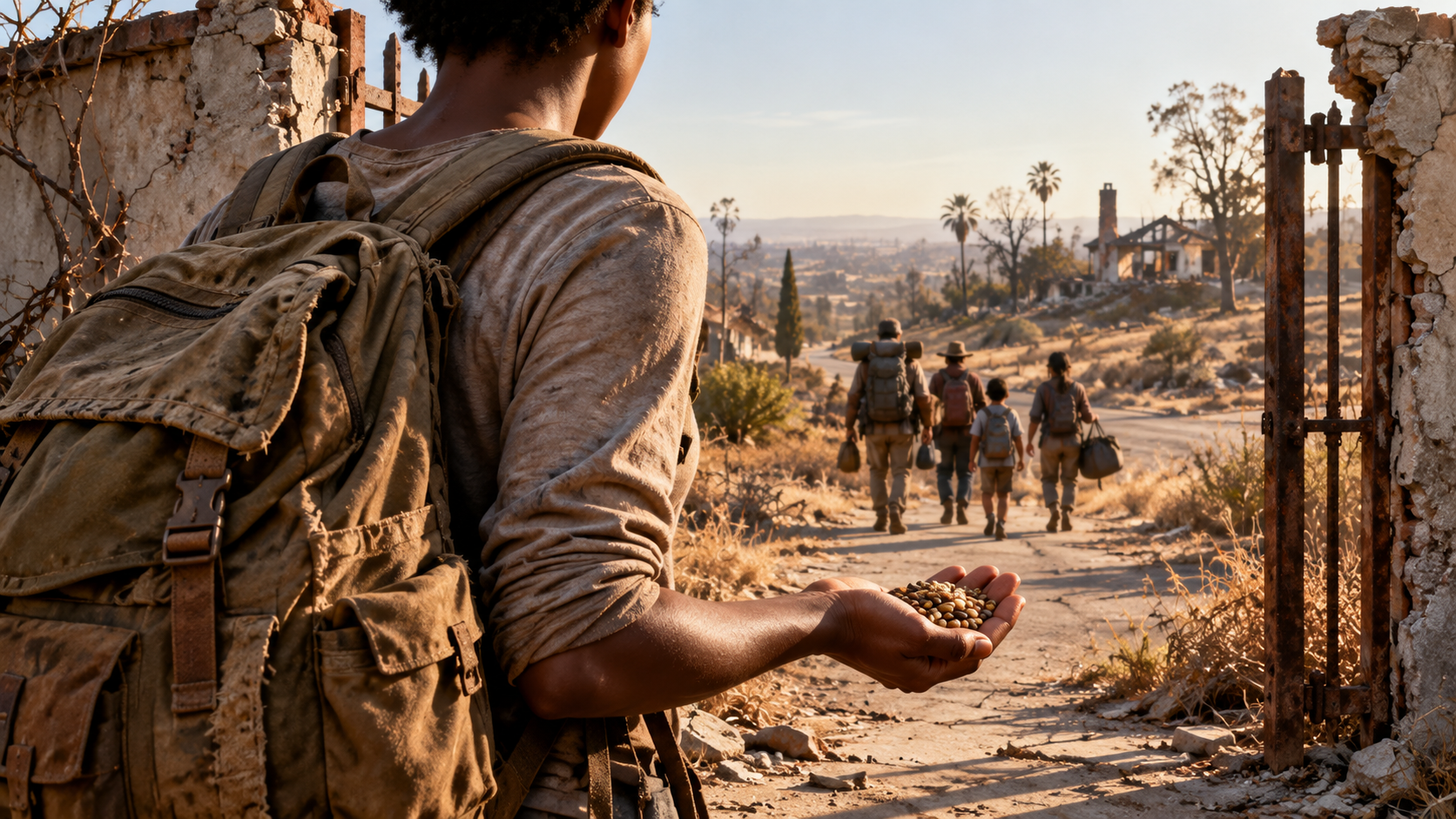
When Society Falls Apart, Who Do You Trust?
A Wall Can Keep People Out, but Not Collapse
Lauren Olamina lives behind a wall in a country that is becoming harder to inhabit. Water is expensive, work offers little security, and the journey beyond her neighbourhood can end in violence. The adults around her struggle to preserve ordinary life. Lauren worries that preserving it is no longer enough.
Published in 1993, Octavia E. Butler’s Parable of the Sower follows a young Black woman confronting environmental breakdown, inequality and the erosion of public protection. Alongside practical preparations, she develops Earthseed, a belief system built around change.
The novel asks what people owe one another when survival becomes uncertain. Its answer emerges through difficult choices about trust, freedom, leadership and the kind of future worth building.
Lauren Recognises What Her Neighbours Cannot Accept
The novel begins in July 2024, just before Lauren’s fifteenth birthday. She lives in Robledo, near Los Angeles, with her father, her stepmother Cory and her younger brothers.
Their neighbourhood is an enclosed refuge. Families grow food, educate children and organise protection. Lauren’s father is a Baptist minister whose responsibilities extend beyond preaching. He helps hold together a community that cannot depend on reliable outside assistance.
Butler makes this place recognisably domestic. People have relationships, disagreements, routines and expectations. Their lives have narrowed, but they have not stopped trying to live normally.
That matters because collapse is easier to imagine as something happening elsewhere. Inside the wall, a familiar meal or church service can suggest that the worst remains outside.
Lauren sees the situation differently.
She observes the widening gap between what the neighbourhood needs and what its defences can provide. Theft, hunger and violence are already pressing against its boundaries. The wall offers protection, but it cannot restore employment, make water plentiful or rebuild the surrounding society.
Her concern becomes especially urgent after the death of Amy Dunn, a small child killed by a bullet fired through the neighbourhood’s defences.
Lauren begins reading about survival and preparing emergency supplies. When she discusses her fears with her friend Joanne Garfield, the conversation reaches the adults and causes alarm.
Her father objects to frightening people. Yet he is not simply foolish or passive. He also understands danger and supports practical precautions.
Their disagreement concerns how far preparation should go. He wants to defend the community they have. Lauren believes they must also prepare for its disappearance.
The conflict gives the opening its emotional force. Accepting her argument would require adults to admit that years of effort may not protect their children.
Hyperempathy Makes Other People’s Suffering Physically Dangerous
Lauren has hyperempathy syndrome, which she associates with her biological mother’s use of a drug during pregnancy.
She experiences other people’s perceived pain and pleasure as physical sensations. Watching someone suffer can incapacitate her. Violence therefore threatens her even when she is not its direct target.
This is a fictional condition, rather than a clinical explanation of ordinary empathy.
It also does not grant Lauren access to another person’s thoughts. Sharing pain cannot tell her whether someone is honest, what they intend or whether they will become dangerous.
That distinction makes the condition more challenging than a straightforward gift.
Lauren must remain alert to suffering while concealing a vulnerability that others could exploit. She learns to handle weapons, but causing injury can bring its own immediate physical consequences.
Butler consequently prevents self-defence from becoming emotionally weightless.
In many survival stories, the capable protagonist learns to act without hesitation. Lauren must act while remaining exposed to what violence does to bodies.
However, hyperempathy does not make her automatically virtuous. She can be calculating, impatient and ruthless. Feeling pain is different from making a fair decision about what to do.
That is one of the novel’s most useful moral distinctions. Sensitivity may draw attention to another person’s suffering, but responsibility still requires judgement.
Lauren’s condition also makes the organisation of society a bodily question. A world that produces widespread injury is especially difficult for her to inhabit. Her interest in cooperation has practical urgency: reducing the suffering around her can help make survival possible.
Earthseed Gives Change a Name and a Direction
Lauren no longer believes in her father’s religion, although she participates in her baptism.
Her private thinking develops into Earthseed, whose central statement is simple:
“God is Change.”
Lauren uses God to describe the force that continually transforms existence. This God does not promise fairness, rescue or personal affection. Change happens whether people approve of it or understand it.
But Earthseed does not ask its followers to become passive.
People are changed by circumstances, yet their actions also influence what happens next. Preparation, learning and cooperation become ways of participating deliberately in an uncertain world.
This is where Earthseed differs from a general instruction to accept hardship. Acceptance begins with recognising reality. It does not settle the question of how reality should be answered.
The novel’s diary form allows readers to watch Lauren build these ideas. Her recorded experiences appear alongside Earthseed verses, placing immediate events beside the principles she draws from them.
We therefore encounter two kinds of writing: the account of a life under pressure and the beginnings of a text intended to guide other lives.
That arrangement creates a productive uncertainty. Lauren is observant and persuasive, but her journal remains her perspective. Readers can take her ideas seriously while questioning her confidence.
Earthseed eventually includes a distant collective purpose: humanity should establish life beyond Earth.
Within the ruined world of the novel, that ambition can seem wildly impractical. Food, shelter and clean water are urgent. Space travel belongs to a scale of planning that appears almost inaccessible.
Yet the distance is part of its purpose.
Lauren wants people to imagine themselves as participants in a future extending beyond the next emergency. Earthseed offers a reason to preserve knowledge, educate children and cooperate across generations.
Whether that requires a religion remains an open question. The novel gives Lauren room to argue her case without requiring readers to become believers.
Keith and Olivar Offer Different Routes Out
Lauren’s younger brother Keith also rejects the limits of life behind the wall.
Where Lauren seeks preparation and shared purpose, Keith seeks money, status and independence. He leaves the neighbourhood and becomes involved in violent criminal activity.
His returns briefly make that choice appear successful. He has possessions and cash that the household badly needs.
But the apparent escape ends when he is tortured and killed.
Keith’s story exposes a brutal route to adulthood. In a society offering few credible opportunities, the ability to take from others can look like power.
His behaviour remains his responsibility. Nevertheless, Butler places it within a world where legitimate routes to security are disappearing.
Another apparent escape appears in Olivar, a coastal town taken over by a corporation.
The company offers employment and protection. For frightened families, the attraction is obvious. Cory is interested because she wants the people she loves to remain alive.
Lauren and her father fear the terms.
If a company controls work, accommodation and essential supplies, low wages and debt can make leaving increasingly difficult. What looks like security may become dependence without a realistic exit.
Joanne’s family decides to move there.
The disagreement resists an easy division between sensible people and gullible people. An offer can be dangerous and still look preferable to the alternatives available.
Butler’s question is therefore about the conditions under which choices are made.
How free is a decision when refusing an employer’s terms may mean hunger or exposure?
Olivar makes that question concrete. Protection becomes something people may have to purchase with their independence.
For Lauren, neither Keith’s predatory freedom nor the company town’s controlled security offers the future she wants.
The Attack Turns Preparation Into a Journey
Before Lauren can carry out her own plans, her father disappears.
Searches do not establish what happened to him. His absence leaves the family grieving without certainty and removes one of the neighbourhood’s central sources of authority.
Lauren begins taking on greater responsibility. The community continues, but its ability to absorb further losses is weakening.
In July 2027, attackers breach the neighbourhood and set it ablaze.
Lauren wakes to fire and confusion. The suffering around her makes escape even harder because her hyperempathy exposes her to other people’s injuries.
She survives and later returns to the devastation.
There she encounters two other survivors: Harry Balter, a young white neighbour, and Zahra Moss, a young Black woman who had been one of Richard Moss’s wives.
Zahra tells Lauren that Cory and her remaining brothers were killed.
The distinction between preparation and control now becomes painfully clear. Lauren anticipated disaster, but anticipation cannot prevent bereavement or guarantee a safe escape.
It gives her something narrower: resources and a possible next action.
She decides to head north. Harry and Zahra join her, and Lauren presents herself as male to reduce some of the dangers facing their small group.
Their relationships must change quickly. Familiarity from the old neighbourhood does not mean they already understand one another.
Zahra brings experience of deprivation and exploitation that Lauren’s sheltered upbringing has not provided. Harry has to reconsider assumptions about trust and acceptable force.
They begin travelling among many other displaced people. The road contains possible allies, potential attackers and strangers whose intentions cannot be known in advance.
Trust Becomes a Skill the Travellers Must Practise
The journey forces Lauren to negotiate between two dangerous extremes.
Trusting everyone could expose the group to theft or violence. Refusing everyone would leave them too small to rest safely, share responsibilities or protect vulnerable members.
Their safety depends on learning how to cooperate selectively.
Lauren reveals her hyperempathy to Harry and Zahra. The disclosure matters because concealment can also create danger: companions who misunderstand her reactions may make poor decisions during an attack.
A travelling family, Travis and Natividad Douglas and their baby Dominic, becomes part of the growing group. Conversation about Earthseed begins to move Lauren’s ideas beyond her notebook.
Travis questions how she can believe in something she has developed herself.
His challenge is important. Readers are allowed to hear resistance rather than a sequence of effortless conversions.
Lauren answers by presenting Earthseed as something grounded in observation. Her claim invites further scrutiny: observation can support a philosophy without proving every ambition attached to it.
The group’s practical arrangements provide another test.
Do people keep watch? Do they contribute knowledge? Can disagreements be discussed without destroying cooperation?
These repeated obligations make community more demanding than a declaration of belonging.
Lauren’s leadership also develops through them. She gains influence partly because she notices danger and organises responses.
Yet influence brings a responsibility that good intentions cannot erase. If people follow her advice, they share the consequences of her mistakes.
The road therefore turns Earthseed into an experiment. Its value must appear in how people live together, alongside whatever its verses promise.
Bankole Tests the Future Lauren Wants to Build
After an earthquake, the travellers encounter Taylor Franklin Bankole, an older Black man who is a doctor.
Other people join them, including sisters Allie and Jill Gilchrist, who have escaped an abusive father, and a young orphaned child, Justin.
Each arrival changes the group’s needs. More people can provide more protection and knowledge, but children and injured travellers also require care.
Bankole and Lauren become lovers.
Their relationship contains a substantial age difference: Lauren is eighteen, while Bankole is fifty-seven. His experience, medical knowledge and access to property complicate the balance between them.
Lauren nevertheless remains clear about her own commitments.
Bankole owns land in northern California, where his sister and her family have been living. The property offers a possible destination beyond indefinite travel.
For him, it also offers the prospect of a more settled life with Lauren.
She sees the possibility of establishing an Earthseed community there.
Their disagreement concerns what safety should make possible. Bankole’s desire for an intimate, manageable future is understandable after so much loss. Lauren’s larger ambition asks more of both of them.
The relationship prevents the novel’s future from becoming purely ideological. A person can believe in collective responsibility while also wanting affection, privacy and rest.
It also raises a question about Lauren’s leadership. Can a shared project accommodate people whose deepest hopes differ from hers?
A community cannot remain healthy if one person’s sense of destiny automatically outranks everyone else’s needs.
Inequality Shapes Who Can Escape and Who Can Refuse
The group later takes in Emery Solis and her daughter Tori, followed by Grayson Mora and his daughter Doe.
Their experiences reveal forms of enslavement and coercive labour within the fractured society.
These accounts deepen the concerns first raised by Olivar. Economic dependence can become captivity when an employer controls necessities, debt and the consequences of attempted departure.
The novel’s historical echoes matter. Its future contains recognisable mechanisms of domination: restricted movement, family separation and the treatment of human beings as resources.
Butler does not present technological development as a guarantee of moral progress.
A society can retain sophisticated systems while allowing older forms of exploitation to return or expand.
This gives the book a useful modern application, provided the comparison remains precise.
An exhausting job, an insecure contract and forced labour are different conditions. Treating them as interchangeable would obscure the specific violence of enslavement.
The shared analytical question is about the ability to refuse.
What resources does someone need to leave an exploitative situation? Where can they live? How will they eat? Who will care for their children?
Lauren’s own position helps expose the importance of those questions.
Her intelligence matters, but so do her education, supplies and relationships. She has advantages that some companions were denied.
A reading that turns her into proof that anyone can overcome disaster through determination would miss much of the novel.
Her survival increasingly depends on exchanging different forms of knowledge with others. The group becomes stronger when experience is recognised beyond conventional markers of status.
Climate Breakdown Makes Existing Vulnerability More Dangerous
The environmental pressures in Parable of the Sower operate through ordinary necessities.
Water costs money. Heat and drought affect how people travel and live. Fire can destroy shelter, possessions and the means of starting again.
The landscape is inseparable from the social system through which people must navigate it.
A wealthy person and a displaced family do not encounter scarcity with the same options. One may purchase protection or relocate. The other may have to continue on foot.
This relationship has a grounded contemporary parallel. Climate assessments identify poverty, marginalisation and unequal access to resources as important factors shaping vulnerability.
That evidence supports a specific comparison: environmental hazards interact with existing inequalities.
It does not establish that Butler’s fictional America is an inevitable destination.
The distinction matters because calling the novel a prediction can make its future sound settled. The story’s deeper value lies in examining decisions and arrangements that make harm more likely.
Readers can use it to ask practical questions about their own societies.
Who has reliable access to clean water? Who can recover after losing a home? Which communities have somewhere safe to go?
Those questions are more revealing than matching every fictional event to a contemporary headline.
The novel also challenges a narrow understanding of adaptation.
A person may become skilled at enduring worsening conditions while the causes of those conditions remain untouched. Survival skills matter, but a society that leaves everyone to develop them alone has already withdrawn something essential.
Lauren’s developing group suggests another possibility: adaptation through shared knowledge, care and organised responsibility.
The Final Journey Tests the Cost of Belonging
The travellers’ growing strength does not remove their vulnerability.
During an attack, Jill is killed while trying to carry Tori to safety. Lauren is wounded.
The death makes collective care painfully concrete. Protecting a child can require someone to accept danger that an isolated calculation of self-interest would tell them to avoid.
Afterwards, Lauren discovers that Emery, Tori, Grayson and Doe also have hyperempathy.
What she had treated as a closely guarded individual vulnerability becomes an experience shared by others in the group.
That recognition does not make their condition safe. It changes the possibility of being understood.
Emery also explains how exploiters can use the condition against people. An ability that creates connection can become another means of control under violent authority.
The group continues through further danger, including a major fire, before reaching Bankole’s property.
There they find the house destroyed.
Human remains suggest that his sister and her family have been killed. Attempts to obtain answers do not resolve the uncertainty.
The destination has suffered the same insecurity they hoped to escape.
The Ending Makes Hope a Decision About What to Do
The survivors disagree about whether to stay.
The ruined property is evidence against treating it as a refuge. Moving on, however, offers no guaranteed improvement.
Lauren sees resources they might use: land, surviving plants and the knowledge held within the group.
Eventually, they agree to remain.
They bury the remains and hold a memorial for the people they have lost. Their new community is named Acorn.
The ending offers a beginning whose survival remains uncertain.
That uncertainty is essential. Butler does not reward Lauren with proof that her judgement will always be right. The land has already failed to protect another household, and the wider conditions have not been repaired.
What changes is the group’s willingness to take responsibility for a particular place and one another.
The memorial belongs to that decision. Their future cannot undo the dead or make the journey’s suffering necessary. Remembering prevents renewal from becoming an excuse to overlook its cost.
The name Acorn joins the practical settlement to the novel’s larger imagery of seeds and growth.
A seed contains potential, but potential needs conditions. It requires somewhere to take root and enough protection to develop.
The biblical parable invoked by the title similarly directs attention towards the ground on which seeds fall.
Applied to Lauren’s project, the implication is demanding. Belief alone cannot sustain a community. People need food, care, learning and workable relationships.
Earthseed’s distant ambition now has an immediate test: can these survivors build a life together?
The novel closes before that question receives a secure answer.
What Lauren’s Story Asks of a Modern Reader
Parable of the Sower resists the comforting idea that recognising danger is enough.
Lauren recognises it early and still suffers devastating losses. She prepares carefully and still needs other people. She develops a philosophy and still encounters questions it cannot instantly resolve.
Her example is useful because her competence has limits.
A modern reading can therefore hold several lessons together without turning the novel into a manual.
Preparation can improve someone’s options. It cannot make them responsible for every disaster they fail to prevent.
Trust requires judgement. It also requires some willingness to become dependent on people whose experiences differ from one’s own.
Adaptation can preserve life. It should also prompt questions about why people are being forced to endure increasingly harmful conditions.
Most of all, community requires more than agreement with an inspiring leader.
It needs arrangements that allow people to contribute, challenge decisions, receive care and retain a meaningful voice.
Lauren’s greatest achievement in this novel is bringing a group to the point where such a future can be attempted. Whether her certainty will help or constrain that future remains a legitimate question.
That tension keeps the book alive beyond its imagined dates.
Its world is frightening because insecurity reaches into every ordinary activity. Its hope is persuasive because it begins with activities just as ordinary: teaching, keeping watch, sharing resources and deciding where to plant.
Sources
Octavia E. Butler’s Official Website — The Parable Series — Authoritative background on the novel, Lauren and its central premise.
Parable of the Sower — Plot Summary and Chapter Guide — Plot and character details were checked against the linked chapter accounts, with Encyclopedia.com’s overview and eNotes’ final-chapter summary used for corroboration. Literary interpretations in this article are readings of the novel.
Climate Change 2022 — Impacts, Adaptation and Vulnerability — Evidence supporting the limited contemporary comparison between climate hazards, inequality and vulnerability.
Next Reads
Lord of the Flies Explained: Civilisation and Human Nature — Another examination of leadership, fear and the rules people build under pressure.
The Road, The Children of Men and The Stand: What Happens When Civilisation Dies — Three contrasting visions of survival and responsibility.
1984 by George Orwell: How Big Brother’s Predictions Compare With Modern Society — A different dystopian perspective on power, freedom and control.
