The Dead Know Where You Live
A Familiar Town Begins Closing Its Doors
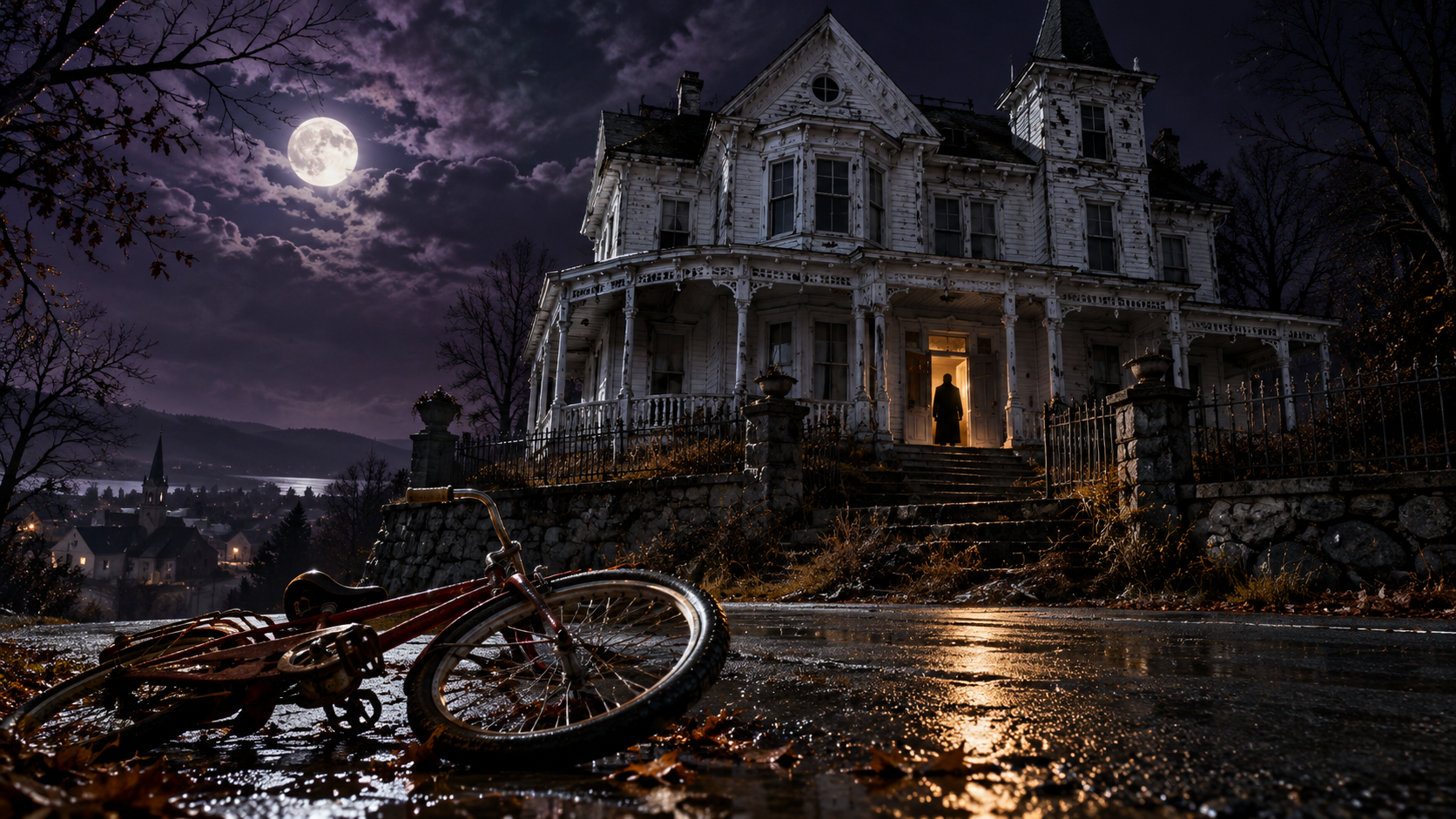
Ben Mears returns to Jerusalem’s Lot hoping that the place where he spent part of his childhood might help him understand a fear he has carried into adulthood. The Marsten House still stands above the town, but it has new owners. Soon, disappearances and unexplained illnesses make the familiar streets feel increasingly difficult to read.
Stephen King’s 1975 novel ’Salem’s Lot places a vampire story inside the routines of a small Maine community. Its horror depends as much on neighbours, households and everyday assumptions as on what waits after sunset. Following the novel means watching scattered disturbances become a collective catastrophe, then understanding what the survivors can achieve once the town itself has become dangerous.
Ben Mears and the House Above the Town
Ben arrives as a writer with a personal connection to the Marsten House. As a child, he entered it and experienced something he understood as an encounter with the dead Hubie Marsten. That memory gives the building a significance other residents cannot fully share.
His return is partly an attempt to approach the experience through writing. By turning an old fear into material he can examine, Ben hopes to gain some control over it.
The house is already occupied, however. Richard Straker and his business partner, Kurt Barlow, have purchased it, along with premises for an antiques business. Straker is visible in the town; Barlow remains a more elusive presence.
Ben instead takes a room at Eva Miller’s boarding house. He meets Susan Norton, whose interest in him develops into a relationship, and forms a friendship with the teacher Matt Burke.
These connections establish reasons for him to remain in the community beyond the house. Susan offers the possibility of a future, while Matt provides intellectual companionship and an attentive listener.
That matters because the novel does not leave Ben alone with his childhood obsession. It gives him people through whom the town becomes present and particular. If the place is threatened, he will lose more than an opportunity to resolve a memory.
The Marsten House nevertheless dominates his imagination. Its position above the streets makes it an obvious focus for suspicion, and its history encourages the idea that evil can accumulate in a location.
The book does not require readers to treat that idea as a complete explanation of everything that follows. Barlow makes decisions, Straker assists him and individual residents become victims. The house supplies a centre of dread, but people carry the danger outward.
Ben’s early concentration on one building therefore establishes a limitation as well as an insight. He recognises that something is wrong there before he understands how widely the consequences can travel.
The Town Before the Vampires
King spends considerable time moving beyond Ben’s immediate circle. Homes, businesses, marriages, private cruelties and small ambitions all receive attention.
This breadth can initially feel like a delay in the vampire story. In fact, it establishes the routes along which that story will spread.
The reader learns that Jerusalem’s Lot is not an innocent collective waiting for an entirely alien corruption. Some residents already harm people close to them. Others conceal resentments or maintain appearances while their private lives deteriorate.
That does not mean the town deserves what happens. The distinction is essential. Ordinary wrongdoing and supernatural predation are not interchangeable, and victims do not become responsible for being attacked because the community contains cruelty.
Instead, the existing tensions prevent the town from functioning as a united body. People know fragments of one another’s lives. They gossip, make assumptions and often fail to notice what happens behind another household’s door.
Barlow enters a place where proximity does not guarantee understanding. A neighbour can be familiar without being closely observed.
The novel’s movement between residents gives readers a broader view than any single character possesses. We can recognise an emerging pattern while people inside the town continue interpreting events separately.
That difference creates dread without requiring constant confrontation. An empty workplace, a missed appointment or a person who seems unusually tired can become significant because the reader has seen related disturbances elsewhere.
The town also has a daily rhythm. Daylight suggests business, school and ordinary contact; darkness permits another pattern of activity. As the balance changes, the same streets serve two incompatible communities.
King’s detailed social picture therefore becomes part of the horror’s mechanism. The more distinctly a resident has been established, the harder it is to treat that person’s disappearance as an anonymous addition to a body count.
The threat is measurable through lost routines. A place can still have standing houses, intact roads and familiar names while the human relationships that made it a town are being removed.
The Glick Brothers and the First Recognisable Pattern
The disappearance of Ralphie Glick and the illness of his brother Danny turn unease into a crisis that the town cannot easily explain.
Danny’s deterioration and death initially enter the world of ordinary explanations: illness, medical uncertainty and family grief. Those categories are reasonable starting points. They become dangerous only when events continue to exceed them and people cannot adjust.
Danny’s return as a vampire makes the underlying threat explicit. He is no longer simply a dead child being mourned. He becomes a means by which the danger reaches other people.
The choice of a child matters because familiarity can disarm resistance. A voice at a window can appeal to affection before the listener fully considers the impossibility of its presence.
Mark Petrie survives such an encounter by recognising the pattern. When Danny appears outside his bedroom, Mark uses a small cross from a model kit to repel him.
Mark’s knowledge of monsters is useful because he can connect what he sees with a set of rules. The interests that might make an adult dismiss him as absorbed in childish fantasy give him a practical vocabulary for the emergency.
His response also requires nerve. Knowing a story about vampires is different from acting on that knowledge when a friend appears outside the glass.
The scene joins those two forms of competence. Mark recognises the danger and does something specific before invitation or sympathy can place him at greater risk.
The window becomes an unusually effective boundary. It separates a protected domestic space from an outside presence that wants to be admitted. The horror lies partly in the possibility that the person inside will open it willingly.
As the infection spreads, the dead exploit the relationships they had while alive. Family and friendship provide access.
That is why the vampire premise fits the small-town setting so closely. Barlow does not need to personally approach every household. Each converted resident can carry the threat into another intimate connection.
Matt Burke and the Work of Believing
Matt Burke’s involvement gives the resistance an adult who can take evidence seriously without beginning from unquestioning belief.
His encounter with Mike Ryerson, the gravedigger, forces him to reconsider what he thought possible. Once he recognises the danger, he helps connect observations that others have encountered separately.
This is a significant form of action in the novel. Fighting vampires requires physical courage, but it first requires someone to say that the scattered events belong to the same problem.
Matt’s position as a teacher suits that role. He listens, compares accounts and helps other people move from disbelief towards a usable understanding.
His heart attack limits what he can do physically. The group must therefore distinguish between being able to participate and being able to run, fight or search.
Even from hospital, Matt remains important because knowledge needs to be gathered and communicated. A resistance made only of physically active heroes would be less convincing in a novel so interested in how communities function.
Ben, Matt, Dr Jimmy Cody, Mark and Father Callahan gradually form the central group. Each brings a different source of authority: personal experience, education, medical observation, practical monster knowledge or religious belief.
Their cooperation is necessary because no single way of understanding the world is sufficient by itself. Medical investigation can identify abnormalities without immediately explaining vampirism. Religious symbols matter, but their meaning cannot be reduced to equipment. Mark recognises rules but still needs adult allies.
The group’s strength lies in combining these partial resources.
Susan’s difficulty accepting the explanation reveals the cost of that process. From an ordinary perspective, the vampire hypothesis sounds absurd. Her scepticism is understandable even when the reader knows it is dangerous.
King makes belief a practical decision with consequences, rather than a badge dividing clever people from foolish ones. Characters must decide when the evidence warrants abandoning assumptions that have governed their whole lives.
By the time the group becomes capable of coordinated action, Barlow has already gained ground.
Susan’s Decision and the Cost of Direct Proof
Susan goes to the Marsten House seeking a direct answer. There she encounters Mark, who has also traced the threat towards its source.
Their motives are not identical. Mark accepts the existence of vampires and wants to act against them. Susan wants to test claims she finds difficult to believe.
That difference matters because direct investigation can seem sensible in the abstract while being poorly suited to the danger involved. Susan approaches a situation in which the people inside control the setting and understand the threat far better than she does.
Straker captures them. Mark escapes, but Susan does not. Barlow turns her into a vampire.
Her fate alters the novel’s emotional direction. Ben’s relationship with her had offered a reason to imagine that returning to Jerusalem’s Lot could lead towards renewal. The town now takes away the person most closely associated with that possibility.
Susan also becomes an example of how the threat transforms what survivors must do. It is no longer enough for Ben to defend himself from an unknown predator. He must confront someone he loves whose body and familiar appearance remain present.
When the group later enters the Marsten House, Barlow has moved. Straker is dead, punished for allowing Mark to escape, and Susan remains in the cellar.
Ben stakes her.
The act is an attempt to end her condition, but it still requires violence against the person he hoped to protect. The story refuses to let correct action feel clean.
That emotional difficulty distinguishes vampire destruction from an uncomplicated victory over an external monster. The heroes are repeatedly asked to recognise a loved person and then act against the appearance that invites recognition.
Barlow’s absence from the house also corrects the group’s earlier spatial assumptions. The obvious centre of evil is no longer its only refuge.
Their attack on the Marsten House produces knowledge and loss, but it does not end the crisis. Barlow has anticipated pursuit, left a taunting message and directed attention towards another vulnerable household.
Father Callahan and the Limits of His Assurance
Father Callahan joins the struggle with a religious understanding of evil and a desire to encounter it in a form he can recognise.
Barlow appears to offer exactly that clarity. The vampire is a concrete adversary, apparently less ambiguous than the compromised human behaviour Callahan encounters in ordinary parish life.
Yet the confrontation exposes a weakness in that expectation. Recognising evil does not automatically provide the inward confidence needed to resist it.
Callahan accompanies Mark to warn the boy’s parents. Barlow arrives before the warning can secure their safety and kills them.
The vampire then confronts the priest with a test centred on faith and the cross. Callahan’s hesitation allows Barlow to overpower him.
Barlow forces him to drink vampire blood. Callahan survives, but he experiences the encounter as desecration and exclusion. Unable to return to the church as he previously understood it, he leaves the town.
It is important not to simplify this into “Callahan becomes a vampire”. That is not what this novel shows.
His defeat concerns his relationship to faith, religious authority and his own sense of belonging. The physical violation gives those questions an immediate bodily form.
The cross has power earlier in the story, including when held by Mark. Callahan’s failure therefore does not mean religious symbols are universally useless.
Rather, the confrontation makes a distinction between possessing a symbol and sustaining the conviction through which it functions in this fictional world.
There is cruelty in the form of Barlow’s challenge. He controls the circumstances and uses Mark’s vulnerability to intensify the pressure. Callahan is not taking a calm examination in which all conditions are fair.
That matters when assessing his failure. The scene exposes a fracture in him, but it also shows an ancient predator deliberately forcing that fracture open.
His departure removes another member of the resistance. Mark loses his parents and the protection an adult priest might have offered. The struggle becomes smaller, more exhausted and less able to absorb further losses.
A Community That Can No Longer Help Itself
As the group weakens, the town becomes increasingly difficult to navigate. Empty houses and missing residents no longer represent isolated incidents.
The familiar network of assistance has broken down. A person who might once have offered shelter may now be a threat. A building associated with everyday life may contain sleeping vampires.
This changes the meaning of local knowledge. Knowing where someone lives no longer tells the survivors whether approaching that address is safe.
The distinction between daylight and darkness becomes more urgent, but daylight does not restore the town to its previous condition. It merely provides a limited period in which the living can move against creatures temporarily inactive.
The search for Barlow illustrates the need to revise interpretations. A mark of blue chalk suggests one possible hiding place, but Jimmy Cody recognises another explanation connected with a pool table.
That small correction matters because the struggle is not won through bravery alone. A detail must be interpreted accurately, and an initially plausible inference must be abandoned.
Jimmy and Mark search the boarding house. There, a trap kills Jimmy.
His death is particularly harsh because it comes during necessary investigative work. Competence does not guarantee survival, and the familiar location offers no protection.
Matt also dies after another heart attack. With Callahan gone and Susan lost, Ben and Mark are left to carry the struggle forward.
The narrowing group prevents the climax from feeling like the arrival of a fully equipped team. The survivors reach the decisive confrontation depleted.
Mark’s position is especially painful. His knowledge has helped keep him alive, but it has not preserved his childhood world. Being right about the monsters has not enabled him to save his parents.
Ben similarly cannot convert understanding into restoration. He knows more about the danger than when he arrived, yet the life he might have built in the town has already been destroyed.
Their remaining purpose becomes more limited and immediate: find Barlow and stop him before the available daylight runs out.
The Confrontation as Daylight Runs Out
Ben and Mark locate Barlow’s hiding place in the boarding house. The movement from the conspicuous Marsten House to this ordinary domestic building completes the spread of danger from an obvious symbol into the town’s everyday interior.
The confrontation takes place close to sunset. Time matters because the vampire’s vulnerability is changing as they act.
Ben drives a stake into Barlow and destroys him. The central predator is defeated.
That outcome answers one question decisively. Barlow does not simply escape to threaten the same characters elsewhere within this novel’s conclusion.
It does not answer every question about Jerusalem’s Lot.
The vampires created during his occupation remain. Killing the original invader does not automatically restore the residents or undo the chain of attacks.
This distinction is one of the book’s most important departures from an easy victory. The story has spent too long showing how the threat spreads for a single death to erase its consequences.
Ben and Mark leave for Mexico. Their escape gives them distance from the place where so much has been lost, but it is not a return to their former lives.
They become a pair connected by survival and bereavement. The adult who came home seeking an answer and the boy who recognised monsters are now responsible for one another.
The novel’s opening frame has already presented an adult and a child away from the town. It uses that foreknowledge to create questions about their history. The main narrative explains how Ben and Mark reach that condition.
That structure means suspense does not depend entirely on concealing whether every central character survives. It also depends on discovering what survival costs and why the survivors cannot settle comfortably into distance.
Mexico offers physical refuge, but the unfinished situation in Maine continues to matter.
The climax therefore separates three outcomes: Barlow is destroyed, Ben and Mark escape, and the town remains compromised. Treating those outcomes as identical would erase the reason for the final return.
Returning Without a Promise of Restoration
About a year later, Ben and Mark return to Jerusalem’s Lot. They set a fire intended to drive the remaining vampires out of their hiding places.
The action is deliberate, but the novel does not provide a tidy account in which every creature is destroyed and ordinary civic life resumes.
That uncertainty belongs to the ending itself. The survivors begin another assault; the reader is not given a completed restoration.
Fire changes the scale of their response. Earlier, the group searched particular houses and confronted individual vampires. Now Ben and Mark act against a place whose buildings shelter a widespread infestation.
This is also a painful reversal of Ben’s original return. He first approached the town hoping to recover or understand something from his past. He now accepts that preserving its physical form may be incompatible with confronting what occupies it.
The burning therefore cannot be reduced to cleansing imagery alone. It involves destruction of the place he once called home.
Mark’s participation gives the return an additional meaning. He is no longer simply a child needing to be rescued from the town. He acts with knowledge gained at enormous personal cost.
That does not make his losses worthwhile. The novel does not balance his parents’ deaths against the competence he acquires and declare the exchange beneficial.
Instead, it shows that survival has created obligations neither character wanted. Leaving was necessary, but distance did not settle the problem.
Their renewed attack can be read as resistance to permanent displacement. Barlow and his descendants have already taken people, homes and futures. Ben and Mark refuse to let the place remain entirely theirs.
At the same time, the absence of a guaranteed outcome preserves the scale of what happened. A community was dismantled through many separate acts of predation. Its aftermath cannot be resolved by one additional heroic gesture.
The ending offers determination with limited assurance. The survivors can choose to act; they cannot recover everything that made the choice necessary.
Why the Town Matters More Than a Single Monster
Barlow is the organiser of the catastrophe, but the novel’s distinctive achievement lies in showing what his arrival does to relationships.
The converted residents retain enough familiarity to approach those who loved or trusted them. Recognition, which normally helps people navigate their community, becomes unreliable.
That is more specific than a general fear of strangers. The danger often arrives wearing the face that should make a person lower their guard.
King also distributes knowledge unevenly. Mark understands one encounter, Matt another, Ben another. Their temporary alliance succeeds when they share information across differences of age and profession.
The wider town fails to create an equivalent response before too many of its members are lost.
This contrast does not imply that everyone could have survived through greater neighbourliness. Barlow is powerful, and the novel allows capable people to die. It does suggest that private explanations are inadequate to a danger spreading through collective life.
The title keeps attention on the place rather than naming the vampire. That choice fits a story in which the monster’s defeat is only one stage in the destruction and attempted reclamation of a community.
Ben’s writing is similarly transformed. He arrives wanting to make an old fear intelligible. By the end, understanding has become inseparable from responsibility towards another survivor and an unfinished threat.
Mark’s imagination follows a parallel course. Monster stories give him useful knowledge, but reality supplies consequences that no model kit can make manageable.
The novel can therefore honour imagination without presenting it as an escape from suffering. Ben’s literary thinking and Mark’s fascination with horror help them recognise danger. Neither protects them from grief.
’Salem’s Lot ends with two people returning to a place they cannot simply inhabit again. Their courage consists in facing what remains after the central monster is gone.
The town’s buildings may still be recognisable. The home they once represented has to be understood as something far more fragile than walls.
Sources
’Salem’s Lot — StephenKing.com — official publication and premise information.
’Salem’s Lot Summary and Study Guide — SuperSummary — central narrative and character outcomes.
Salem’s Lot Summary and Study Guide — BookRags — corroborating account of the town’s transformation and conclusion.
’Salem’s Lot — Wikipedia — supplementary plot and publication cross-check.
