Across America’s Darkest Roads: Inside The Talisman
Saving His Mother Means Leaving Her Behind
Twelve-year-old Jack Sawyer can see that his mother is seriously ill. What he cannot see is a way to help her within the life they are living. Then a man named Speedy Parker tells him about another world and an object with the power to change what seems inevitable.
Stephen King and Peter Straub’s The Talisman, published in 1984, turns that possibility into a journey across America and a parallel realm called the Territories. Jack’s task sounds simple: find the Talisman and bring it back. The difficulty lies in reaching it without losing the compassion that gives the journey its purpose. This summary follows the essential stages of his quest and explains how its ending connects power, friendship and the wish to return home.
A Child Facing an Adult Emergency
Jack and his mother, Lily Cavanaugh, are staying at the Alhambra Hotel in New Hampshire. Lily was once a film actress, but the immediate fact of their lives is her declining health.
Jack’s father, Phil Sawyer, is dead. The possibility of losing Lily therefore threatens more than a change in family arrangements. She is the parent who remains.
Morgan Sloat, Phil’s former business partner, is another powerful presence in their history. His interest in the family does not feel reassuring, and Lily has sought distance from him.
The opening places Jack in a recognisable predicament before introducing the fantastic solution. He understands that something is wrong, but the adults’ histories and decisions exceed what he has been told.
His age matters because he has neither ordinary adult freedom nor the comfort of believing that adults will necessarily solve the problem. He is old enough to recognise danger and young enough to lack an accepted way of acting upon it.
Speedy Parker, who works around the seaside amusement park, changes that situation. He recognises possibilities in Jack that the boy does not yet understand.
Speedy introduces the Territories and explains that the Talisman can save Lily. Reaching it requires a journey towards the western coast, with movement between the two worlds.
The proposal places a painful contradiction at the centre of the adventure. Jack must leave his mother precisely because he wants to remain her son rather than become an orphan.
Departure can therefore look like abandonment from the outside while functioning as an attempt at care. The novel does not remove that emotional difficulty merely by providing a magical destination.
Jack sets out with an urgent personal aim. He is not initially seeking a throne, a reputation or a larger role in the universe.
That limited desire gives the expanding story a stable centre. Whatever new territories, enemies or responsibilities appear, the reader can measure them against the original need: a child wants his mother to live.
The Territories and the Meaning of Twinners
The Territories resemble an older, stranger counterpart to Jack’s world. Distances do not correspond exactly, making travel there a possible means of covering ground more quickly.
Many people have counterparts, known as Twinners. Lily’s counterpart is Queen Laura DeLoessian, who is also gravely ill. Morgan Sloat is connected with Morgan of Orris, a figure of power in the Territories.
These relationships make Jack’s private problem part of a wider disturbance. Saving Lily is linked with the fate of someone whose condition matters to an entire realm.
The parallel does not erase the difference between mother and queen. Jack’s emotional motive remains attached to the person he knows. The fantasy enlarges the consequences of that motive without requiring him to begin as an abstract saviour.
Twinners also complicate the idea that entering another world provides a clean escape. Familiar forms of power and danger have equivalents there.
An enemy in America may possess influence across the boundary. Changing worlds can alter the immediate conditions of pursuit without removing the interests driving it.
That is why the ability to “flip” is useful but insufficient. Jack must learn when crossing helps, what waits on the other side and how much he actually understands about the connection.
The two-world structure keeps wonder and uncertainty together. A more vivid landscape can offer relief from ordinary America while containing threats he cannot recognise.
Jack’s unusual relationship to the worlds makes him capable of the journey. Yet that capacity does not supply the experience required to complete it.
Speedy gives him a beginning, not continuous supervision. Much of the quest involves learning how to act when the person who explained the rules is absent.
For the reader, the essential rule is therefore practical rather than encyclopaedic: the worlds are connected, movement between them changes Jack’s options, and actions in one can matter in the other.
The story does not need every feature of its cosmology explained before its emotional stakes become clear.
The Road and the Price of Being Unprotected
Jack’s journey brings him into contact with adults who recognise his vulnerability and exploit it.
At a tavern in Oatley, Smokey Updike traps him in an arrangement of work and control. What might initially appear to be a temporary way of meeting basic needs becomes another obstacle to leaving.
This part of the novel grounds the quest in material dependence. A child on the road needs food, shelter and movement. Someone who controls those necessities can restrict him without requiring supernatural power.
The episode also changes the meaning of work. Productive effort is not automatically a route towards independence when the person setting the terms has no interest in allowing independence.
Jack’s difficulty is therefore not simply that the road contains villains. It is that ordinary arrangements can be manipulated against someone without money, recognised status or a protective adult.
The Territories offer alternatives, but they do not make him untouchable. Strange pursuers and hostile landscapes prevent the other world from functioning as a universal solution.
The journey repeatedly requires him to compare risks rather than find a wholly safe option.
This structure distinguishes the novel from a straightforward sequence of magical upgrades. Jack’s abilities increase, yet his circumstances remain capable of overwhelming him.
Knowledge also arrives unevenly. He learns more about his father’s connection to the Territories and Morgan’s role in the family’s history, but these discoveries do not come in the form of a complete briefing.
The adult past reaches him through consequences before it becomes fully intelligible.
That gives the road a second function. It carries him west, but it also moves him towards a less protected understanding of the people who shaped his childhood.
The danger of that process is cynicism. Jack could conclude that survival requires treating every stranger as a threat and every relationship as a liability.
The novel instead places his next important relationship at precisely this point, testing whether caution can coexist with attachment.
Wolf and a Different Kind of Strength
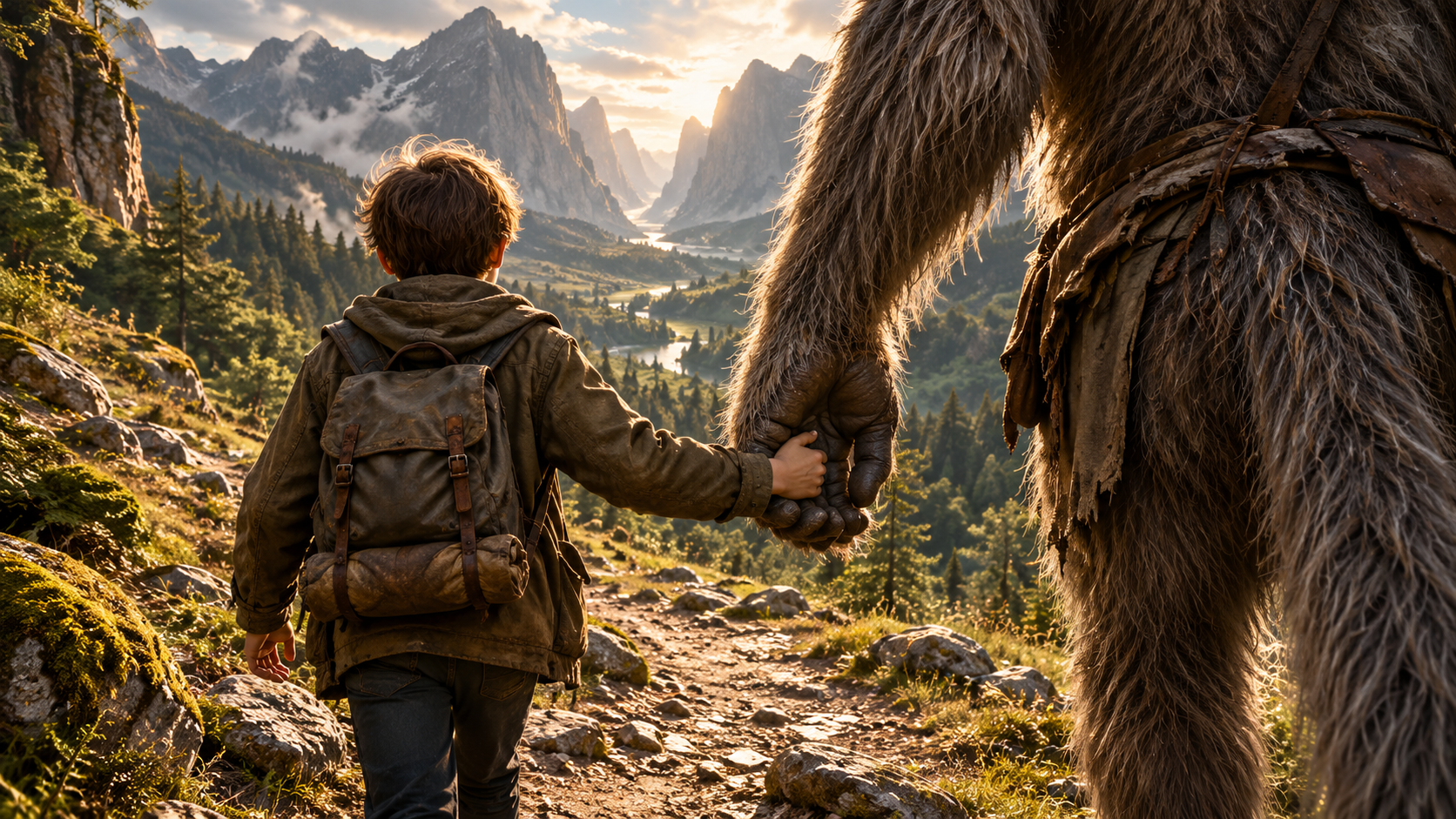
In the Territories, Jack meets Wolf, a werewolf whose loyalty and gentleness make him one of the journey’s central companions.
Wolf’s appearance and nature might suggest danger within a conventional monster story. His behaviour asks Jack and the reader to judge him through relationship instead.
He is powerful, but he is also vulnerable. When circumstances bring him into Jack’s world, unfamiliar smells, environments and social expectations cause profound distress.
The reversal is useful. Jack has often been the child who does not understand where he is or how to survive. With Wolf beside him, he must sometimes become the person who explains, reassures and protects.
Their friendship therefore changes Jack’s role without magically making him an adult. He remains frightened and limited, but someone else now depends on his decisions.
Wolf also gives physical form to the difference between strength and dominance. He can be formidable without organising his relationships around possession.
Morgan’s power seeks control over people and worlds. Wolf’s strength becomes meaningful through fidelity to another person.
The comparison develops through action rather than through a statement that one character represents goodness and another evil. Wolf stays, helps and suffers alongside Jack. His loyalty creates practical consequences.
Bringing him into America also turns the familiar world strange. Environments a human resident might tolerate become overwhelming when experienced through Wolf’s senses.
That perspective challenges the assumption that Jack’s world is the normal standard against which the Territories should be judged. Ordinary America can be hostile to a creature whose needs its inhabitants do not understand.
Jack must take those needs seriously even when they complicate the mission. The fastest route towards saving Lily is no longer the only consideration.
This is a decisive development in the quest. His love for one person begins generating obligations towards others.
The journey’s moral difficulty lies in holding those obligations together. If he abandons every vulnerable companion for the sake of reaching the Talisman, he risks becoming less able to use its power for the purpose that first sent him west.
The Sunlight Home and the Misuse of Care
Jack and Wolf are taken to the Sunlight Home, an institution for boys controlled by Sunlight Gardener.
Its stated purpose suggests correction, supervision and care. Its actual practices make it a place of intimidation and abuse.
The name is part of the contradiction. Light usually promises safety in a horror story, yet the institution’s reassuring language conceals coercion.
Jack has already encountered exploitation on the road. The Sunlight Home intensifies it by giving cruelty an organised setting and a claim to moral authority.
Gardener can present resistance as evidence that a boy needs further discipline. This makes the system self-protecting: the behaviour produced by mistreatment can be used to justify more mistreatment.
Wolf is particularly ill-suited to the institution’s demands. The staff do not understand what he is, and understanding is not their priority.
Jack’s effort to protect him is constrained by their shared captivity. Friendship now involves the anguish of recognising another person’s needs while lacking the freedom to meet them.
The episode also makes bodily power ambiguous. Wolf’s transformation provides the capacity to resist his captors, but it is not a painless release from the conditions that have harmed him.
He fights to protect Jack and is fatally wounded.
His death gives the journey a loss that cannot be treated as a minor expense on the way to the main objective. The relationship has occupied enough emotional space to make its removal alter the meaning of continuing.
Jack survives because of a friend whose strength was used on his behalf. Reaching the Talisman will now carry a debt of memory as well as a hope for Lily.
The story does not allow the reader to assume that a healing object will simply undo every death. Wolf’s loss remains part of what the quest costs.
After the Sunlight Home, Jack’s movement west is therefore more burdened. He has gained experience, but experience arrives through an absence rather than through a clean increase in confidence.
Richard Sloat and the Difficulty of Accepting the Impossible
Jack eventually reaches Richard Sloat, Morgan’s son and his own friend. Richard provides a connection to an earlier life, but he cannot immediately accept the reality Jack has encountered.
His resistance is partly intellectual. The Territories and the dangers surrounding them violate his understanding of the world.
It is also personal. Accepting Jack’s account would require him to reconsider his father.
These pressures reinforce each other. Disbelief protects Richard’s picture of reality and his picture of his family at the same time.
The novel treats that resistance as an obstacle, but it is more persuasive when understood as a defensive response rather than mere foolishness. Jack has been forced to learn through direct experience. Richard is asked to accept conclusions whose emotional cost is enormous.
Their friendship must survive that unequal knowledge.
Jack cannot simply describe the entire journey and expect information to remove fear. Richard needs to encounter a reality he has spent considerable effort refusing.
The danger surrounding the school makes continued denial harder. Eventually, the boys travel together.
Richard’s presence changes the story’s approach to Morgan. The antagonist is no longer only an enemy pursuing Jack; he is also someone whose actions threaten his own child.
That relationship exposes the limits of a possessive idea of fatherhood. Morgan’s desire for power does not translate into dependable protection for Richard.
Jack, by contrast, must decide what he owes the son of the man opposing him. The friendship prevents the conflict from collapsing into guilt by family association.
Richard is not responsible for Morgan’s ambitions. Helping him requires Jack to preserve that distinction under pressure.
This stage of the journey develops the compassion established with Wolf in a different form. Wolf’s trust is direct and wholehearted. Richard’s is obstructed by fear and denial.
Jack must remain loyal to someone whose responses are sometimes frustrating. Friendship becomes a sustained practice rather than a reward for immediately understanding everything.
Across the Blasted Lands
The journey through the Blasted Lands brings the boys into a landscape marked by devastation. Travel becomes increasingly difficult, and Richard’s condition deteriorates.
The setting expands the consequences of the struggle beyond individual acts of cruelty. Power has damaged whole environments.
A ruined landscape differs from a single hostile room because there is no simple boundary after which normal life resumes. The boys must move through the consequences rather than merely escape their source.
The train journey gives their movement a temporary direction, but it does not remove uncertainty about what lies ahead.
Richard’s illness also makes time feel different. Jack is still travelling towards an object intended to heal Lily, yet another person now needs help immediately.
The quest accumulates claims upon its promised solution. Saving his mother remains the original aim, but the road has shown him other lives that cannot be dismissed as incidental.
This creates a meaningful pressure on the fantasy of obtaining power. The Talisman is becoming more desirable at the same time as its eventual use becomes more ethically complicated.
Jack’s capacity to keep moving should not be confused with emotional invulnerability. Much of his courage consists in acting while afraid, exhausted or uncertain that the next step will be enough.
Richard’s dependence makes that courage relational. Jack cannot measure success only by his own arrival.
The western destination gradually changes from an idea into a physical place. At Point Venuti, the Black Hotel holds the object he has crossed the country to find.
The contrast with the Alhambra is structural. Jack began beside his mother in a hotel associated with waiting and decline. He now approaches another hotel associated with the possibility of intervention.
Both are temporary dwellings rather than secure homes. The journey between them has made the return to ordinary family life seem increasingly precious.
Reaching the coast is therefore not the end of the quest. It is the point at which the promise that sustained it must finally be tested.
The Black Hotel and the Burden of Power
The Black Hotel is more than a container for a valuable object. Its danger makes obtaining the Talisman a confrontation with the forces gathered around it.
Jack enters with Richard, whose vulnerability remains part of the task. The quest cannot be reduced to the solitary hero collecting a prize and leaving his companion outside the story.
When Jack reaches the Talisman, he encounters power on a scale far greater than the practical miracle he first imagined.
The object connects with multiple worlds. Its significance exceeds one family’s need, even though that need brought Jack to it.
This enlargement produces a temptation as well as an opportunity. If immense power becomes available, the original purpose can be displaced by the experience of possessing it.
Jack’s crucial response is to remain attached to the wish to save his mother. He does not seek to become a god.
That decision does not make him ignorant of the larger stakes. It establishes a limit within them. He recognises a difference between being able to affect worlds and wanting dominion over them.
Richard continues to matter during this encounter. The boys’ affection and mutual dependence keep the scene connected to particular lives.
This is why the novel’s long investment in friendship is necessary to the climax. Jack’s suitability cannot be established simply by announcing that he is the chosen person. The journey has shown how he behaves when other people obstruct, complicate or depend upon his progress.
The Talisman’s power also brings destruction around the hotel. Obtaining it does not produce an immediate transition into safety.
Outside, the antagonists still intend to control the outcome.
Jack must move from surviving the approach to deciding how to act with what he has found. The qualities that helped him endure the road now face a different test: whether compassion and restraint can survive the acquisition of overwhelming force.
The Final Confrontation and the Journey East
Sunlight Gardener and Morgan Sloat confront the boys. The conflict draws together the personal enemies and the connections between worlds.
Gardener’s counterpart, Osmond, links the confrontation with the violence in Jack’s family history. Jack uses the Talisman against him, ending that threat.
Morgan then attempts to overpower Jack and claim control. His attack is turned back upon him through the Talisman, and he is killed as the hotel is destroyed.
The result follows the opposition developed throughout the journey. Morgan treats power as something to possess and impose. Jack’s use of the object remains connected with protecting and healing others.
That does not make the confrontation bloodless. The novel resolves its fantasy conflict through lethal force, and a reading concerned with compassion must acknowledge that fact.
The distinction lies in purpose and relationship, not in pretending the hero never harms anyone.
Jack heals Richard and Speedy. Yet even after the main enemies are defeated, Lily remains far away.
The journey east restores the original objective to immediate prominence. The grand confrontation at the coast has not replaced the promise that sent Jack there.
This return also allows the novel to revisit loss. An encounter with one of Wolf’s brothers honours the friendship without undoing Wolf’s death.
Resemblance and continuity provide comfort, but they are not identical to restoration. Jack’s companion remains gone.
When Jack reaches Lily, he uses the Talisman to heal her. The corresponding recovery of Queen Laura completes the connection established between the two worlds.
The object then passes out of Jack’s possession. Its role in his life is fulfilled without becoming a permanent instrument he can keep for unlimited future control.
The ending thus returns from vast possibility to a particular human relationship. The achievement that matters most to Jack is the one he wanted before he understood how much else was at stake: his mother can live, and he can return to being her child.
Why the Ending Preserves Both Hope and Loss
The conclusion is hopeful, but it does not make the journey harmless in retrospect.
Lily’s recovery fulfils the central promise. Wolf’s death prevents that fulfilment from becoming a general cancellation of suffering.
Holding those outcomes together gives the ending more weight than either uncomplicated triumph or complete defeat would provide. Jack succeeds, and success has limits.
His refusal to seek godlike status is especially important in that context. A desire to undo every loss could become a desire for endless control.
The novel instead allows him a miraculous intervention without making him the permanent manager of life and death.
That is also why the Talisman’s departure matters. Keeping it might extend the quest indefinitely, with every future danger creating another reason to use it. Letting its role end makes ordinary life possible again.
Jack’s growth does not require him to remain forever on the road. The point of developing courage is partly to recover the life that danger interrupted.
Richard’s place in the ending reinforces the distinction between inheritance and choice. His father’s actions do not fix his own moral identity. The friendship with Jack creates a relationship that is not organised by Morgan’s ambition.
Speedy’s guidance can likewise be understood through the difference between directing and possessing. He helps Jack undertake a task, but the decisive actions still belong to the boy.
The novel’s adults therefore offer competing models of influence. Some use vulnerability to acquire control. Others enable a child to act while recognising that the action cannot be performed for him.
The Territories make those patterns larger and stranger, but their emotional force remains close to childhood experience: needing help, fearing abandonment, discovering that adults can deceive, and finding loyalty where appearances do not promise it.
The Talisman ends by returning immense power to a modest purpose. Jack crosses worlds so that the relationship he began with can continue.
His victory is the recovery of a future in which being a son does not have to mean remaining a hero every day.
Sources
The Talisman — StephenKing.com — official authorship, publication and premise information.
The Talisman — Kirkus Reviews — contemporary review covering the quest’s major stages.
The Talisman Summary and Study Guide — SuperSummary — central relationships and world structure.
The Talisman: Part 4, Chapters 44–Epilogue — SuperSummary — final confrontation, healing and return.
The Talisman — Wikipedia — supplementary cross-check of the journey and principal characters.
