

Swan Song By Charles Spencer Explained: Diana, King Charles, The Funeral, His Interviews And The Legal Fallout
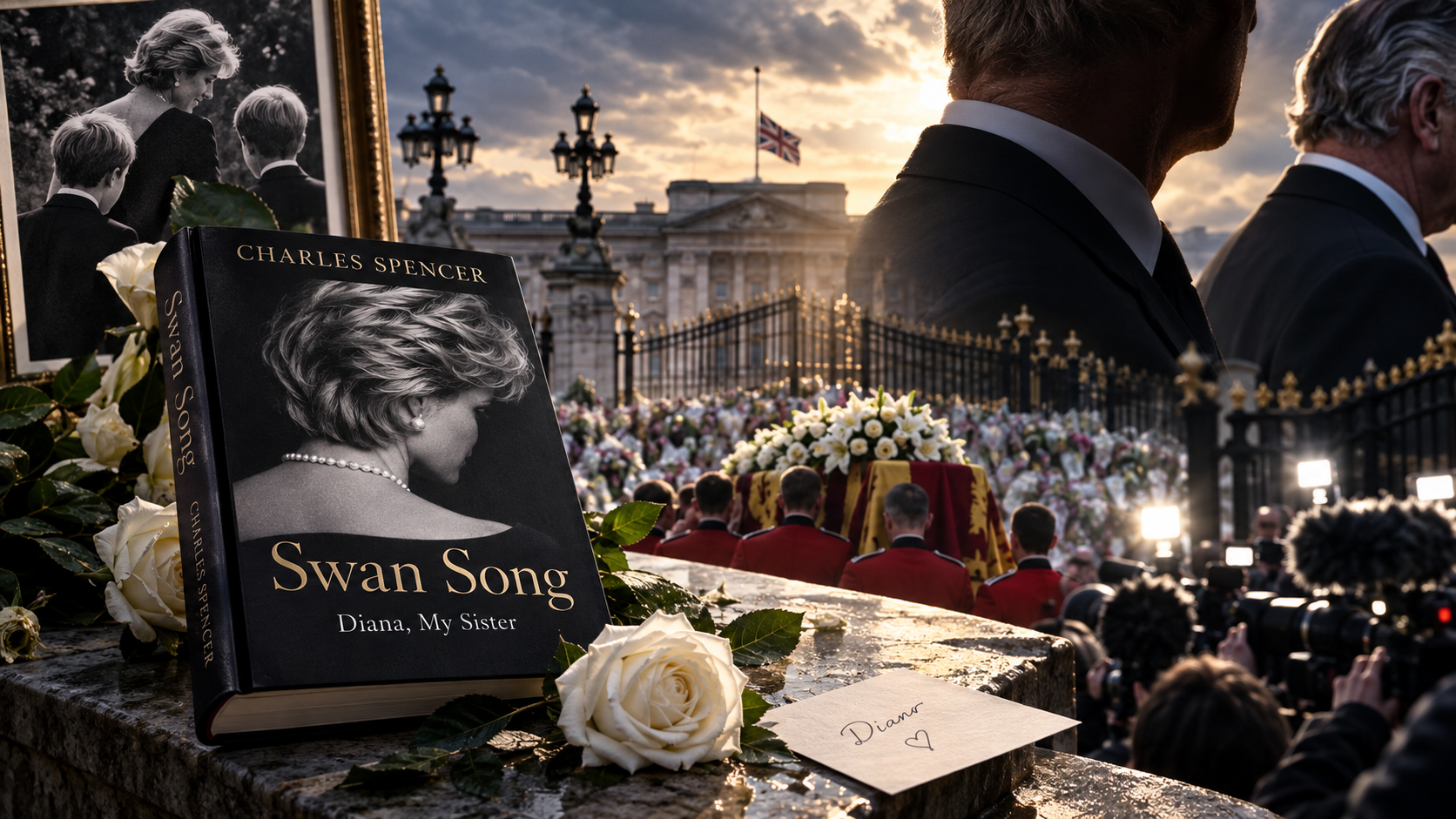
Charles Spencer’s Swan Song Explained: The Diana Memoir, Palace Response And Legal Challenge
Earl Spencer discussing his memoir about Princess Diana
Swan Song: Diana, My Sister by Charles Spencer was published in the UK by Penguin Michael Joseph and in North America by Penguin Press on 22 September 2026. The US edition runs to 384 pages, with audiobook and ebook editions released simultaneously.
It is Spencer’s first sustained book-length account of his relationship with Diana. His stated reason for writing it was straightforward: with the 30th anniversary of her death approaching in 2027, he was receiving repeated requests to contribute to documentaries and other people’s accounts. Rather than continue allowing others to define the story, he decided to record what he remembered himself.
That distinction matters.
Swan Song is not an authorised royal history. It is not an official account of Diana’s life. And it should not be read as an objective reconstruction of every disputed conversation it describes.
It is a brother’s memoir.
That gives Spencer extraordinary access to parts of Diana’s life no conventional biographer could reproduce. It also creates the book’s fundamental problem: much of its most consequential material depends upon private conversations, memories and motives that cannot always be independently established.
That tension — between eyewitness testimony and contested memory — is the real engine of Swan Song.
The Big Idea Of The Book
Spencer wants readers to separate Diana the person from Diana the historical symbol.
The public remembers the wedding, the clothes, the charities, the divorce, the television interviews, the paparazzi and the funeral.
Spencer remembers a sister.
His argument is that once Diana entered the Royal Family, practically every institution around her attempted to interpret her: courtiers, newspapers, broadcasters, biographers, royal households, friends, enemies and eventually an enormous posthumous industry.
Swan Song attempts to place Spencer’s own memories back into that story.
The result is affectionate in places, extremely angry in others and frequently uncomfortable.
Spencer presents Diana as charismatic but insecure, funny but emotionally vulnerable, instinctive rather than academic, capable of enormous warmth but also impulsiveness, and increasingly trapped between her private unhappiness and a public personality that became larger than the institution she married into.
Penguin describes the book as the story of Diana’s life and death told from her brother’s perspective. Spencer himself says his intention is to speak positively on Diana’s behalf and record the truth as he experienced it.
That intention becomes increasingly difficult to separate from his anger at the people he believes failed her.
The Story In One Flow
Before Diana Became “Diana”
One of Spencer’s first objectives is to reclaim Diana’s childhood.
The familiar mythology often presents her early years as almost inevitably tragic: parental separation, an unhappy aristocratic home and emotional insecurity eventually leading into a disastrous royal marriage.
Spencer pushes back against the idea that there was never a happy Diana before the monarchy.
He remembers humour, energy and a close sibling relationship.
In interviews surrounding publication, he has specifically challenged what he regards as a myth that Diana’s entire childhood was miserable. He describes a much happier early family life than many retrospective accounts suggest.
The publisher-released extract offers a glimpse of the Diana Spencer remembers emerging in adolescence. Around 1977 or 1978, he recalls friends beginning to view his sister differently: no longer merely a younger sibling, but someone whose humour, confidence and personality suddenly commanded attention.
That development matters because Spencer does not portray Diana’s later magnetism as something manufactured by royal public relations.
The qualities that eventually made crowds gravitate towards her were already there.
The Royal Courtship
The tone becomes much darker once Prince Charles enters the story.
Spencer’s portrayal of the relationship is overwhelmingly sympathetic to Diana.
He says Charles’s treatment of his sister was troubling from early in the courtship and claims Diana was subjected to comments about her weight, emotional distance and uncertainty over whether Charles genuinely loved her.
A Guardian review of the complete book notes Spencer’s claim that Diana seriously considered withdrawing from the engagement and that their father told her it was too late.
These passages are significant because Spencer does not frame the marriage merely as something that deteriorated years later.
His version suggests the foundations were unstable before the wedding.
That does not settle every historical argument surrounding Charles and Diana. It does, however, reinforce something already evident from decades of biographies and Diana’s own recorded testimony: the relationship carried serious doubts, jealousy and emotional instability long before the couple formally separated.
Diana Discovers Her Power
One of the most convincing parts of Spencer’s portrait concerns the extraordinary public response to Diana.
She enters royal life young and uncertain but discovers that crowds respond to her almost instinctively.
Spencer told CBS that Diana herself noticed very early that when she and Charles stood on opposite sides of a street during official engagements, people gravitated towards her. He believes that disparity became difficult for Charles.
Spencer interprets what followed partly as institutional discomfort.
Diana did not fit the traditional royal mould.
She touched people.
She broke conventions.
She communicated emotion publicly.
She generated global celebrity on a scale that almost no member of the Royal Family could control.
Spencer told CBS that some within the British establishment did not know what to do with what he described as Diana’s unusually powerful personality.
This is one of the book’s larger historical arguments.
The failure of the marriage was personal.
The conflict surrounding Diana was institutional.
Marriage, Isolation And Camilla
Queen Camilla’s presence inevitably runs through the story.
Spencer presents Diana as increasingly conscious that the emotional centre of her husband’s life lay elsewhere.
The memoir revisits an enormous amount of familiar territory — jealousy, insecurity, press intrusion and marital breakdown — but the distinctive feature is Spencer’s perspective as Diana’s younger brother.
He does not claim to have been present for everything.
Instead, the reader often sees events through conversations Diana later had with him.
This is both the strength and limitation of the memoir.
Diana’s private version of events is historically valuable.
But Diana’s recollection, Spencer’s recollection of what she told him and the passage of three decades between event and publication all have to be kept distinct.
The Brother Who Could Not Always Save Her
Spencer does not portray himself as permanently present or perfectly supportive.
That matters.
The more interesting sections acknowledge distance.
Diana’s life became almost impossible for ordinary family relationships to penetrate. Her brother was simultaneously building his own career and spending time abroad, including in South Africa.
The siblings could be extremely close and still fail each other.
This becomes important when Spencer describes Diana attempting to find greater security after her separation.
The book reportedly revisits a controversial episode in which Diana explored living on the Althorp estate, an arrangement that did not materialise.
Critics of Spencer have long used that episode against him.
His memoir attempts to provide his version of why events unfolded as they did.
The book therefore becomes partly an exercise in defending Diana and partly an attempt by Spencer to explain decisions for which he has himself been criticised.
That dual purpose is one reason several reviewers have accused him of occasionally placing himself too prominently inside a story ostensibly centred on his sister. The Guardian’s review describes genuinely affecting sections about Diana but argues that Spencer’s grievances repeatedly pull attention back towards himself.
Diana’s Search For A Different Life
By the mid-1990s, Diana was no longer simply trying to survive an unhappy marriage.
She was attempting to construct a new identity.
She had humanitarian work.
She had international celebrity independent of the monarchy.
She had her sons.
She was exploring relationships outside her former marriage.
And she was considering what a post-royal future could actually look like.
Reporting on the book says Spencer describes Diana considering a possible future in South Africa with heart surgeon Hasnat Khan.
The significance is less the precise practicality of such a plan than what it reveals about Diana’s state of mind.
She was looking for escape routes.
Not from public life completely, perhaps, but from the machinery around it.
The Press Becomes Part Of The Story
No account of Diana can avoid the media.
In Swan Song, Spencer’s hostility towards parts of the press is relentless.
He views intrusive coverage not merely as an inconvenience but as part of the system that steadily removed normal boundaries around Diana’s life.
The book revisits hidden-camera gym photographs, aggressive tabloid coverage and the relentless commodification of Diana’s private life.
It is here that Swan Song itself would unexpectedly become embroiled in a legal dispute.
More on that shortly.
31 August 1997
Diana dies after the crash in the Pont de l’Alma tunnel in Paris.
Everything changes.
From this point, Swan Song becomes something closer to an eyewitness history of national crisis.
Spencer is no longer simply remembering his sister.
He is suddenly participating in decisions over the body, funeral and public commemoration of one of the most famous people on Earth.
The public response is unprecedented.
Crowds gather.
Flowers accumulate.
Public anger grows.
Buckingham Palace faces criticism.
William and Harry are grieving teenagers.
And between the Spencers and the Royal Family, Spencer describes increasingly bitter arguments over what happens next.
The Claim About King Charles After Diana’s Death
The most controversial allegation in the entire book concerns Spencer’s recollection of King Charles — then Prince Charles — immediately after Diana died.
Spencer claims Charles sounded unusually upbeat or “giddy” during one conversation.
He has been careful in interviews to distinguish what he says he heard from any explanation for it.
Speaking to CBS, Spencer said Charles sounded excited or upbeat. When asked why, Spencer suggested one possible explanation might have involved freedom to pursue Camilla but acknowledged that he could not know what Charles was thinking.
That distinction is critical.
Spencer is asserting a recollection of tone.
He cannot establish Charles’s internal emotional state.
The second allegation is considerably more direct.
Spencer claims that during an argument following Diana’s death, Charles told him words to the effect that Diana would soon be forgotten.
Spencer has subsequently repeated that account publicly and insists the words are accurate.
Buckingham Palace took the unusual step of responding.
The Palace did not directly say that the conversation never occurred. Instead, its statement said King Charles recognised that fraternal grief could affect reason, judgment and memory even many years later.
Spencer was furious.
He described the Palace response as an attempt to undermine his recollection rather than explicitly deny the allegation.
That exchange transformed the memoir from a publishing event into a direct public confrontation between Diana’s brother and Diana’s former husband.
The Fight Over William And Harry Walking Behind The Coffin
This is arguably the book’s most historically important section.
The image of William and Harry walking behind Diana’s coffin remains one of the defining images of the funeral.
William was 15.
Harry was 12.
Spencer says he strongly opposed the boys taking part in the public procession.
In his CBS interview, he called the proposal effectively barbaric and said he initially assumed it simply would not happen.
He says he was told the boys wanted to participate.
He has subsequently suggested he came to believe that was not the complete picture.
Spencer also says politicians involved at the time told him there was concern that Prince Charles could face hostility if he walked alone behind his former wife’s coffin and that the presence of William and Harry could alter the crowd’s reaction.
That interpretation remains Spencer’s account.
It is not independently established simply because it appears in his memoir.
But it raises a profound question that has survived long after arguments about royal protocol have faded:
Who was the funeral actually for?
A country?
An institution?
A dead woman?
Or two children who had lost their mother?
That question gives Swan Song much of its emotional power.
Prince Philip And The Funeral Formation
Spencer also recounts the debate over where the men should walk.
According to his account, Prince Philip ultimately intervened in discussions about the order of the procession.
The eventual formation placed William and Harry alongside their father, grandfather and uncle.
Spencer remembers the entire walk as surreal and emotionally punishing.
The Guardian’s review highlights how effectively he writes these scenes, including the physical strain surrounding the coffin and the strange mixture of protocol, grief and extraordinary public emotion.
This is where Spencer’s value as a historical witness is strongest.
He was there.
Whatever disputes exist about private telephone calls, he physically participated in the procession.
The Eulogy
Then comes Spencer’s defining public moment.
At Westminster Abbey, before an enormous global television audience, he delivers the speech that permanently alters his own public identity.
The eulogy attacks the media.
It challenges aspects of the environment surrounding Diana.
It promises that Diana’s blood family will help protect William and Harry.
And it receives spontaneous applause inside and outside Westminster Abbey.
Swan Song returns repeatedly to how the speech was written.
Some reviewers think too repeatedly.
The Guardian criticises sections in which Spencer revisits the wording and construction of the speech in a way that makes his own performance feel overly central.
Yet there is another reason the speech matters today.
Spencer now says one of its most memorable assurances — that Diana’s memory would not disappear — was deliberately connected to the alleged comment he says Prince Charles had made about her soon being forgotten.
Speaking to the BBC in 2026, Spencer cited the eulogy as contemporaneous evidence that the alleged conversation had already affected his thinking at the time.
It does not independently prove the conversation occurred.
But it is relevant corroborative context for Spencer’s claim that the remark was not invented decades later.
The Interview That Reignited Everything
The publication campaign has been almost as consequential as the book.
Spencer gave major interviews to the BBC, CBS, ABC and People.
In the BBC interview with Laura Kuenssberg, filmed at Althorp, he defended the disputed allegations and said he wanted to put his version of events down while he could.
He also said he knew considerably more about King Charles than he had included, stressing that he had excluded material he considered irrelevant.
That statement inevitably generated headlines, although Spencer explicitly framed it as a fact rather than a threat.
He also discussed Harry and Meghan.
Spencer compared aspects of their media treatment with the hostility Diana experienced and argued, particularly from a security perspective, that lessons should be learned from his sister’s death. Reuters reported that he favoured official protection for Harry and Meghan, citing Harry’s place in the succession and former military service.
His argument is personal rather than abstract.
He believes he watched the consequences of extreme media intrusion once already.
The CBS Interview
CBS provided perhaps the clearest explanation of Spencer’s purpose.
Asked why he was writing another Diana book when so much had already been published, Spencer said the approaching anniversary brought endless requests for contributions to other projects.
He decided that rather than appear in fragments inside somebody else’s production, he would produce his own account.
He also described Diana as a force the establishment struggled to contain.
And he discussed Harry’s later difficulties through the lens of the boy who walked behind his mother’s coffin.
Spencer wondered aloud whether gentler handling of Harry’s grief in 1997 might have altered what came later.
That is speculation, not a clinical conclusion.
But it is one of the book campaign’s more revealing moments.
Spencer is effectively arguing that 1997 never really ended.
The ABC Interview And The “Gaslighting” Accusation
In his ABC News interview with Maggie Rulli, Spencer reacted directly to Buckingham Palace questioning his memory.
He said he felt shocked and upset by the response and accused the King of “gaslighting” him.
Most importantly, he noted that the Palace statement had questioned his memory without explicitly stating that Charles never said the words attributed to him.
Spencer insisted the disputed conversation was essential to understanding his account of the funeral period.
He rejected suggestions that the book was motivated by bitterness or an attempt to damage the monarchy.
The Palace position and Spencer position therefore remain fundamentally incompatible.
Spencer says he remembers the conversation accurately.
The Palace says grief can distort memory.
There is no recording publicly available establishing exactly what was said.
A responsible reading has to leave the dispute there.
William And Harry
Spencer says he informed Prince William, Prince Harry and his sisters Sarah and Jane about the project at the same time rather than involving them in its creation.
He told People that he did not want a committee-written family book.
Instead, this was deliberately his perspective.
He said Harry wanted reassurance that nothing embarrassing about him appeared in the memoir and that he reassured both nephews they were primarily depicted as Diana’s sons rather than exposed as adult public figures.
Neither William nor Harry has publicly endorsed Spencer’s disputed allegations.
Both avoided questions from reporters about the memoir around publication.
That silence should not be interpreted either as agreement or disagreement.
The Legal Fallout: Piers Morgan
This is the part of the story that changed dramatically on publication day.
Spencer describes calling newspaper editors before Diana’s funeral to tell them they were no longer invited.
One of them was Piers Morgan.
Spencer says Morgan reacted badly.
The memoir then connects Spencer’s interpretation of Morgan’s reaction to the publication of intrusive photographs showing Diana exercising inside a gym.
There was one major factual problem.
Morgan did not work for the Mirror when those photographs were published.
The photographs appeared in the Sunday Mirror on 7 November 1993.
Morgan did not become editor of the Daily Mirror until October 1995 and was working for rival newspaper The Sun in 1993.
Morgan seized on the error immediately.
He publicly accused Spencer of publishing false and defamatory material and said Spencer and Penguin would hear from his lawyers.
Spencer Apologises
Spencer then conceded the employment-history point.
His representatives issued a statement saying he had incorrectly assumed Morgan occupied the relevant editorial role when the gym photographs were published.
Spencer apologised for that error.
He did not withdraw his separate recollection of Morgan’s behaviour during the telephone conversation about the funeral.
That distinction is legally and journalistically important.
One disputed claim has been admitted to contain a factual error.
A second remains contested.
The Book Will Be Corrected
People reported that the inaccurate passage is expected to be corrected in the second edition.
That is potentially important if the dispute progresses.
It demonstrates that Spencer and the publisher reacted once the chronology was challenged.
It does not automatically resolve any legal argument over publication of the original edition.
Morgan Says The Legal Action Will Continue
Morgan responded that the apology was insufficient.
He said he still intended to pursue legal action against Spencer and Penguin and wanted the disputed material removed, with damages directed to the King’s Trust.
As of 22 September 2026, the safest description is therefore:
Morgan has publicly said he is pursuing or intends to pursue legal action. Spencer has apologised for one factual error. The publisher intends to correct that error in a subsequent edition. Public reporting available at the time of writing does not establish a final court judgment or completed defamation case.
That wording matters.
A threatened or announced claim is not the same as Morgan having already won a lawsuit.
What About King Charles — Is There A Legal Case?
Not at present, based on the reporting reviewed for this article.
Buckingham Palace has rebutted Spencer publicly.
That is a major reputational conflict.
It is not the same thing as legal proceedings.
There has been no comparable public announcement from the Palace that King Charles is suing Spencer over the alleged conversations.
The Morgan dispute is therefore the clearest direct legal challenge arising from the book at publication.
Why The Morgan Error Matters Beyond Morgan
This is where the controversy becomes damaging for Spencer.
If Swan Song contained only subjective memories, critics could largely argue about interpretation.
The Morgan chronology is different.
It is externally checkable.
Morgan either worked at the Mirror in November 1993 or he did not.
He did not.
Spencer acknowledged that.
Critics can therefore use that mistake to attack the reliability of other passages.
Morgan has already made precisely that argument: if Spencer got something so verifiable wrong, why should readers accept memories of private conversations from decades ago?
That criticism has force.
But it has limits too.
One demonstrated factual error does not logically establish that every other recollection in a 384-page memoir is false.
Each claim still has to be assessed on its own evidence.
That is the correct way to read Swan Song.
The Moment Everything Changes
The decisive turn in the book is Diana’s death.
Before Paris, Spencer is her brother observing an increasingly extraordinary life.
After Paris, he becomes a combatant over her memory.
That change explains almost everything that follows.
The funeral.
The eulogy.
His distrust of the Palace.
His anger towards newspapers.
His concern about William and Harry.
His continuing hostility towards certain people who surrounded Diana.
And ultimately the writing of Swan Song itself.
The memoir is not simply a biography travelling towards 1997.
It is written backwards from 1997.
Everything before the crash acquires significance because Spencer knows what happens afterwards.
What The Book Is Really About
The obvious subject is Diana.
The deeper subject is ownership.
Who owns the story of a famous dead person?
Her family?
Her children?
Her former husband?
Historians?
Journalists?
Biographers?
The institution she belonged to?
The public who believed they knew her?
Spencer’s answer is not that he alone owns Diana.
But he clearly believes that his version has been underrepresented while other versions hardened into accepted history.
That explains the title.
A swan song is a final performance.
Spencer is attempting to give his account once, comprehensively, before the 30th anniversary creates yet another wave of interpretations.
What Most Summaries Miss
The headlines concentrate on King Charles.
That is understandable.
But reducing the book to a royal attack misses its more interesting psychological thread.
Spencer is writing about memory itself.
Almost every important relationship in the memoir is filtered through the problem of retrospective interpretation.
Did Diana have an unhappy childhood?
Spencer says the conventional narrative oversimplifies it.
Did Diana know what she was entering when she married?
Spencer believes she underestimated it.
Did the institution understand what it had in Diana?
He thinks it did not.
Did William and Harry truly want to walk behind the coffin?
Spencer questions what he was told.
Did Charles make the statements attributed to him?
Spencer insists he did.
Does Spencer remember every peripheral fact accurately?
The Morgan error proves that at least one important assumption in the published text was wrong.
That makes Swan Song unexpectedly self-referential.
It asks readers to trust memory while simultaneously demonstrating why memory must be checked.
What Most People Misunderstand
The easiest reading is that Swan Song is either “the truth about Diana” or an anti-royal vendetta.
Neither description is sufficient.
It is a primary source.
Primary sources are invaluable because they bring readers close to events.
They are also dangerous when treated as infallible.
Spencer knows things most Diana biographers never could.
He also has loyalties, grievances, regrets and blind spots.
Those qualities do not disqualify the book.
They are part of what makes it historically useful.
The Strongest Section
The funeral sequence is the book’s strongest material.
This is where Spencer’s access is irreplaceable.
He was not reconstructing events from newspaper archives.
He was participating.
The arguments over the procession, the pressure around William and Harry, the extraordinary atmosphere surrounding the coffin and Spencer’s preparation for the eulogy give readers an inside perspective on a week usually remembered through television pictures.
Even the Guardian review, otherwise highly critical of Spencer’s self-focus, praises the effectiveness of these passages.
The Book’s Weakest Point
The weakness is closely related to its strength.
Spencer is too personally invested to disappear from the narrative.
At times that creates honesty.
At others, grievance overwhelms perspective.
The reader repeatedly encounters people Spencer believes behaved badly towards him, Diana or his family.
Some recollections may be entirely accurate.
Others are disputed.
The problem arises when emotional certainty begins to substitute for evidential certainty.
The Morgan mistake crystallises that danger.
Spencer describes himself as a historian.
A historian normally distinguishes between documentary evidence, contemporaneous testimony, later recollection and inference.
Memoir operates differently.
Swan Song sometimes moves between those categories too easily.
The Taylor Tailored Interpretation
Swan Song is most revealing when read not as the final word on Diana but as the final chapter of Charles Spencer’s relationship with Diana.
The sister he remembers cannot answer back.
Neither can the younger Charles who lived through many of these events.
What remains is a 62-year-old man trying to reconcile three versions of the same person:
Diana the sister.
Diana the global icon.
And Diana the dead woman everyone else has spent nearly three decades interpreting.
That is why the book can feel simultaneously loving and furious.
Spencer is not merely preserving Diana.
He is fighting the accumulated versions of Diana created without him.
Why This Book Matters Now
The timing matters enormously.
The 30th anniversary of Diana’s death arrives in 2027.
William is now one of the most senior members of the monarchy.
Harry’s relationship with both the British press and the Royal Family has itself become a major public story.
King Charles is now the monarch whose behaviour Spencer is describing from the period when he was Prince of Wales.
And Diana remains culturally powerful enough that a private conversation allegedly spoken in 1997 can still provoke an official Palace statement in 2026.
That alone tells us something.
Diana was not forgotten.
The argument is now over what should be remembered.
If You Only Remember Three Ideas
1. Swan Song Is A Brother’s Testimony, Not An Official History
Its greatest value is proximity.
Its greatest vulnerability is subjectivity.
Those two facts can coexist.
2. The Funeral Is The Centre Of The Book
Everything Spencer believes about institutions, media, loyalty and his duty to Diana converges in the week after her death.
The fight over William and Harry and the disputed conversations with Charles are not side stories.
They explain Spencer’s view of Diana’s entire public life.
3. The Book’s Publication Has Become Part Of Its Story
Buckingham Palace publicly challenged Spencer’s recollections.
Spencer accused the King of attempting to undermine him.
Piers Morgan identified a factual error.
Spencer apologised.
Morgan maintained his threat of legal action.
A book supposedly intended to settle the historical record immediately created a new dispute over that record.
The Sentence That Explains The Book
Swan Song is Charles Spencer’s attempt to rescue the sister he remembers from the history everyone else has written around her — while revealing how difficult it is for memory, grief and evidence ever to be completely separated.
The Real-Life Test
There is a useful lesson here that extends far beyond royal biography.
When several people live through the same emotionally charged event, they do not automatically carry identical versions of it into the future.
One person remembers words.
Another remembers tone.
Another remembers motive.
Another remembers only the consequence.
Thirty years later, each may be completely sincere.
That does not make every version equally accurate.
The responsible approach is to separate what can be independently verified from what remains recollection.
The Morgan dispute demonstrates the principle perfectly.
The date of his Mirror editorship can be verified.
Spencer’s interpretation of Morgan’s reaction during a telephone conversation cannot be verified nearly as easily.
Treating those two categories identically is how memoir becomes mythology.
Five Questions To Test Whether You Understood The Book
1. Why Did Spencer Decide To Write Swan Song Now?
Because the approaching 30th anniversary of Diana’s death was generating repeated requests for his participation in other people’s projects, prompting him to record his own account instead.
2. What Is Spencer’s Most Serious Allegation Against King Charles?
Among the most consequential is his claim that Charles made a dismissive remark about Diana being forgotten during a post-death dispute, an allegation Spencer maintains is accurate and Buckingham Palace has challenged indirectly by questioning the reliability of grief-affected memory.
3. Why Is The Funeral Procession So Important?
Because Spencer says he opposed William and Harry walking publicly behind their mother’s coffin and came to question the explanation he was given for their participation.
4. What Factual Error Has Spencer Admitted?
He incorrectly connected Piers Morgan with the Mirror when Diana’s gym photographs were published in 1993. Morgan did not join the Daily Mirror until 1995. Spencer apologised for the error and the passage is expected to be corrected in a later edition.
5. Has Piers Morgan Already Won A Lawsuit Against Spencer?
No such outcome has been established in the reporting reviewed here. Morgan says he is pursuing legal action against Spencer and Penguin; that is different from a completed case or judgment.
The Final Lesson
Diana’s story has survived because it contains almost everything that makes history impossible to contain: celebrity, class, love, betrayal, family, institutions, children, media power and sudden death.
Charles Spencer cannot settle that story with one book.
Neither can Buckingham Palace erase his recollections with one statement.
Nor does one admitted factual error invalidate hundreds of pages automatically.
What Swan Song does instead is expose the uncomfortable middle ground.
History is built from documents, photographs, recordings and dates — but it is also built from people remembering rooms nobody else entered and conversations nobody recorded.
That is where this book is strongest and most dangerous.
Charles Spencer has finally put his version on the record.
Now the argument is no longer about whether he would speak.
It is about how much of what he remembers will ultimately survive scrutiny.
