Jealousy and Art in Proust’s Swann’s Way
A Visitor Downstairs Changes Everything Upstairs
Charles Swann has come to dinner, and a little boy knows what that means. His mother will stay downstairs with their guest. He will be sent to bed with a hurried goodnight, then lie awake listening to an evening from which he has been excluded. The adults like Swann. The boy likes him too, except at the hour when the sound of his arrival can spoil an entire night. Marcel Proust begins Swann’s Way with a grievance small enough for most families to forget by morning. Years later, the child can still reconstruct the geography of the house from it. He remembers which staircase separated him from his mother and where to stand if he wanted to hear her coming back.
The Night His Mother Stays
Before Proust takes us to the family home at Combray, his adult narrator describes waking in the dark and briefly losing track of where he is. His body sometimes identifies a room before his conscious mind does. The angle of a limb or the position of a wall brings back a bed in which he slept years ago. For a few seconds, an adult who has lived in several places can become the child for whom there is only one room that matters. That is how we arrive at the house where Swann comes to dinner.
Swann is a family friend whose father was known to the narrator’s grandfather. The household consequently thinks it knows exactly who he is. Its members have little idea of the distinction he enjoys in Parisian society. His discreet manners help them overlook it. He can be an intimate of aristocrats in Paris and the rather undistinguished son of an old acquaintance at Combray, all without changing his coat. The child has an even narrower definition. Swann is the man whose presence downstairs deprives him of his mother.
One evening the boy cannot bear another curtailed goodnight. He sends his mother a note through Françoise, the family servant, hoping the written request will bring her upstairs. His mother sends no satisfactory answer. He then makes a much riskier decision. He will wait up for her and face whatever punishment follows when his father discovers him out of bed. What looks from the garden like a family enjoying an evening with a guest feels, upstairs, like the longest emergency of his young life.
His father surprises him. Seeing his distress, he tells his wife to spend the night in the boy’s room. The child has obtained more than he dared ask for, but the permission changes the nature of the victory. His mother has been trying to teach him to manage this anxiety. He recognises that she regards the concession as a defeat, and her unhappiness gets into the very experience from which he expected perfect comfort. A small child has discovered that getting somebody to stay and making them happy to stay are different achievements.
She reads aloud from George Sand’s François le Champi. The quality of her reading matters as much as the story. She gives the sentences a pace and tenderness that he will associate with her long after he has ceased to need a parent at bedtime. A request for one more kiss has ended in a first experience of what another person’s voice can do for a book. Years later, he can recover that night deliberately. The difficulty is that for a long time it is almost the only part of Combray he can recover in that way. A vividly remembered staircase has come to stand for an entire town.
What the Madeleine Actually Brings Back
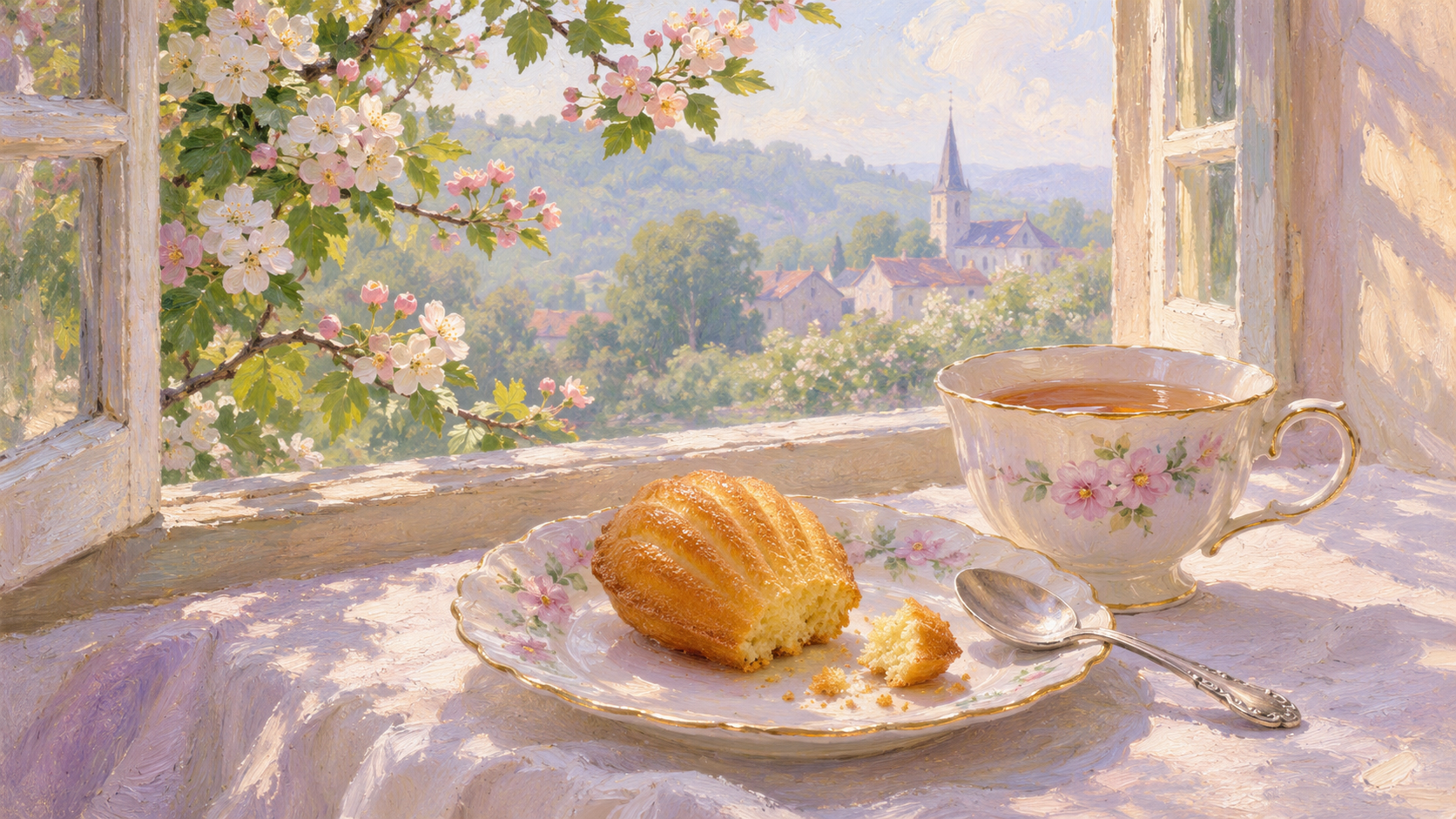
On a winter day much later in his life, the narrator comes home cold. His mother offers him tea and one of the little scallop-shaped cakes called madeleines. He takes a spoonful of tea softened with crumbs. Before he can identify a single memory, he experiences an extraordinary pleasure. That order is essential. He does not recognise a childhood treat and then feel nostalgic. His mood changes first. He has to find out why.
Naturally, he tries another mouthful. It is less effective. Repetition can reproduce the flavour, but it cannot reproduce the surprise of encountering it. He puts down the cup and directs his attention towards the sensation itself. There follows an awkward interval in which he knows there is something to remember, can feel it almost within reach and is tempted to abandon the effort. Proust devotes time to this hesitation because it separates two experiences we often run together. Something can be familiar enough to move us and still resist every attempt to give it a name.
Eventually he recognises the taste. On Sunday mornings at Combray, before Mass, he used to visit his aunt Léonie. She would dip a piece of madeleine in her tea or lime-blossom infusion and give it to him. Seeing the cakes in pastry shops over the intervening years had never produced the same effect. The shape was familiar and had accumulated other associations. The taste, encountered in this particular combination, has preserved an intimacy that looking in a shop window could not reach.
What follows is larger than a kitchen recollection. Once Aunt Léonie’s room comes back, it brings the house around it, the streets outside, the church, the walks and the people whose routines made up a childhood day. The madeleine does not contain a miniature record of everything that happened in Combray. It restores the narrator’s access to the person for whom those things once belonged together. The anxious boy waiting on the stairs finally has somewhere else to go.
Two Walks Out of One House
Aunt Léonie seldom leaves her room. From her bed and her windows, she nevertheless maintains a formidable interest in the inhabitants of Combray. A strange dog in the street requires an explanation. Someone who has missed church becomes a subject for investigation. Françoise supplies information, and visitors must judge what kind of news the invalid wishes to hear. An adult looking back might remember a sickroom as a place where very little happened. To recover this one properly, the narrator has to remember how much could happen simply because a familiar person passed below at an unfamiliar hour.
Outside the house, the family has two principal routes for walks. One runs on the Méséglise side, past Swann’s property at Tansonville. The other goes towards the country associated with the aristocratic Guermantes family. Adults can understand these as directions on a map. For the boy they are quite separate imaginative territories. The family chooses one or the other before setting out. Weather, names, plants and expectations accumulate around each choice until turning in a particular direction means entering a particular state of mind.
The hawthorns on Swann’s side absorb him. Their flowering seems to communicate something he ought to be able to understand if only he looks long enough. Then, near the hedge at Tansonville, he sees a girl. She looks back and makes a gesture whose meaning he cannot securely interpret. Someone calls her Gilberte. She is Swann’s daughter, and hearing her name pronounced in her own garden gives it a distinction no introduction could have supplied. Before he has spoken to her, a place, a flowering hedge and the experience of being looked at have all become part of what she means to him.
The Guermantes name works in much the same way before he sees the duchess who bears it. History, church decoration, landscape and the sound of the name furnish his idea of her. When a real woman appears in church, there is an uncomfortable adjustment to make. A face with ordinary human features has to accommodate centuries of suggestion. The boy’s disappointment tells us remarkably little about the duchess. It tells us how much work a name can do in the years before anyone answers to it.
Occasionally he finds a way to do something with these unruly impressions. Travelling in a carriage, he watches the church steeples of Martinville and the more distant steeple of Vieuxvicq seem to move in relation to one another as the road turns. This time he gets hold of writing materials and composes a short description. Proust lets us read the result. The young writer has been worried by his inability to think of a sufficiently important subject. What releases him is the discovery that he has already seen something quite precise for which he has yet to find words. After writing it down, he feels light enough to sing.
Why Swann Begins to Want Odette
The book now makes its boldest change of direction. It leaves the narrator’s childhood and goes back to a love affair that took place before he was born. Charles Swann, the visitor who once kept the boy’s mother downstairs, becomes the person waiting for a woman who may have other plans. We already know him as Gilberte’s father. Proust gives us the courtship with that future sitting in plain sight. The suspense concerns how Swann comes to want this particular woman badly enough for her conduct to decide whether he can sleep.
When he first meets Odette de Crécy, she scarcely resembles the women he usually finds attractive. She is more forthcoming than he is, and her admiration makes seeing her pleasant. She introduces him to the Verdurins, a prosperous couple who preside over a small group of regular guests. The household likes to present itself as an intimate gathering of people with unusually good taste. Its hospitality carries an expectation. Regulars should agree that no other company could be half so amusing, and should avoid forming attachments elsewhere that might compete with the evenings Madame Verdurin arranges.
At first Swann can afford to find the group faintly ridiculous. He has a much wider social life and can go elsewhere whenever he likes. He does not yet understand what it will mean to need admission to a room when somebody else controls the invitations. Madame Verdurin’s influence over him will grow in proportion to his dependence on finding Odette at her table.
Two works of art help alter what he sees in Odette. He notices a resemblance between her and a female figure painted by Botticelli. Features that had seemed unremarkable become desirable once he can recognise in them an arrangement he has already learned to admire. Then there is a musical phrase from a sonata by Vinteuil. Swann had heard it before without knowing its composer. At the Verdurins’ he hears it again, and the music becomes associated with his evenings in Odette’s company.
These are different kinds of discovery. The Botticelli resemblance lets Swann tell himself why Odette deserves looking at. The music gives a feeling back to him before he has decided what to think about it. Yet both allow him to experience his attraction as something richer and more consequential than the pleasure of being liked by a woman who is available that evening. A man celebrated for his taste begins to treat that taste as evidence about someone else’s character. The painting and the sonata can sustain extraordinarily close attention. Neither can tell him what Odette does when he goes home.
The Night Odette Leaves Before He Arrives
One evening Swann arrives at the Verdurins’ too late. Odette, who usually expects him, has gone. The change in his feelings is far more sudden than anything her presence has achieved. Paris has become an enormous city full of places where one particular woman might be. He searches for her, going from the easy assumption that he can see her whenever he chooses to the alarming possibility that the whole evening might pass without her.
He does eventually find her. During their carriage ride, he offers to straighten the cattleya orchids she is wearing. The excuse for touching her becomes a private expression between them for making love. It is one of Proust’s deftest accounts of how intimacy acquires its own vocabulary. Years of private meaning can grow out of an incident that would require only a line to describe to somebody else. The same peculiarity that makes the expression precious to the lovers also makes it useless as proof of what either still feels. People can keep saying the old words long after the original excitement has changed.
Swann starts organising his evenings around seeing Odette. She has less reason to seek him out now that she can count on him to arrive. His gifts and financial support offer him ways to contribute to her comfort and occasions to believe that he occupies a special position. They buy him no reliable knowledge of what happens during the rest of her day. The more precisely he arranges his own life around their meetings, the more intolerable the unaccounted hours of hers become.
At the Verdurins’ another man, the Comte de Forcheville, proves a welcome addition. He fits the group’s habits in ways Swann never quite has. Madame Verdurin also has reasons of her own to resent Swann’s independence and his connections beyond her circle. Invitations can now bring Odette and Forcheville together while leaving Swann outside. The hostess does not have to make a single statement about what goes on between her guests. Deciding who knows the arrangements for tomorrow is power enough.
The boy at Combray could at least hear the sounds of dinner through an open window. Swann often has to imagine the room from the other side of Paris. His social experience, money and intelligence provide little advantage over a child in his nightclothes. In one respect they make his situation worse. The child had only a few ways to discover what his mother was doing. Swann has the means to hire transport, follow clues, revisit conversations and spend an entire night furnishing himself with reasons to stay awake.
What Swann Sees Through the Wrong Window
On a night when Odette says she is tired and sends him away, Swann becomes convinced she may be receiving somebody else. He returns to the street and sees light behind shutters. He listens to voices. His suspicion seems on the point of becoming evidence. When he finally makes his presence known, he discovers that he has approached the wrong window. The occupants are strangers. He has correctly detected people awake and talking in a room and supplied the rest of the scene himself.
This would be a much simpler book if the mistake proved that Odette was faithful. It proves only that Swann can be thoroughly wrong when he feels most certain. At other times Odette evades questions, contradicts herself or acknowledges experiences that he had dismissed as unlikely. There are truths she would prefer him not to discover. Proust gives jealousy both a real object and a disastrously unreliable method. Swann can have a legitimate reason to doubt an answer without acquiring any corresponding gift for working out what actually happened.
An anonymous letter containing accusations against Odette sends his intelligence in another direction. He considers which of his acquaintances might have written it. People he has known for years briefly acquire sinister motives because each could conceivably have possessed some relevant information. He knows too much about them to eliminate anybody cleanly. A new piece of evidence, which ought to narrow an investigation, has instead increased the number of relationships he cannot trust.
His questioning of Odette carries its own penalty. An admission about an encounter with another woman gives him something he genuinely did not know. It also supplies images and fresh occasions for enquiry. The question he thought would settle the matter divides into questions about when, how often and with whom else. Even a truthful answer today cannot spare him the discovery that he spent a perfectly happy evening months ago under a mistaken impression. What he wants to correct belongs to a past in which he can no longer act.
At a reception given by the Marquise de Saint-Euverte, the little phrase from Vinteuil’s sonata reaches him again. This time Odette is absent. The music restores the emotional atmosphere of their early happiness with a precision no investigation could match. It brings him close to the man he was when he expected a future with her to be delightful. For the duration of the phrase he can feel the distance between that expectation and the occupation that love has become. He once sat beside Odette wanting to hear the music again. He now devotes much of his life to finding out what she did yesterday.
Swann’s attachment eventually loosens. A dream crowds together people, fears and associations from the affair, and on waking he can look back with astonishment at the years consumed by a woman who did not originally appeal to him. There is no decisive confession that cures him and no discovery of a rival’s defeat. His attention has become capable of going elsewhere. Odette herself has changed less dramatically than the place she occupies in his imagination. By the time we return to the narrator’s childhood, she is Madame Swann. Proust passes over the wedding that a more conventional courtship novel might have treated as the point of the whole story.
Gilberte Decides Whether to Come Out and Play
Back in the narrator’s youth, the names of places exercise something like the power Odette once held over Swann. The boy can imagine Florence or Venice from the sounds of their names and the images other people have supplied. A proposed journey to Italy becomes so exciting that he falls ill and the trip is abandoned. The practical alternative is fresh air in Paris. His family sends him to the Champs-Élysées, where an actual person is about to assume more importance than the cities he cannot visit.
Gilberte plays there with other children, and the boy joins her games. At Tansonville she was a glance, a gesture and a name called across a garden. Here he can talk to her and see her again. Happiness becomes a matter of getting to the right place on the right afternoon. He watches the weather and calculates whether the conditions are likely to bring her out. The reader has just watched Swann organise his life around a woman’s attendance at the Verdurins’. It takes fewer resources than Swann imagined to construct a remarkably similar predicament. A public garden and a patch of doubtful sky will do.
The difficult discovery is that Gilberte can enjoy his company without giving their meetings the same weight he does. A change of plan that leaves a hole in his day may be a small adjustment in hers. Games with rules shared by a whole group give him a legitimate reason to be near her. They also mean his presence need signify very little to anyone else. The name he once heard as though it were a revelation can be shouted by any child who wants Gilberte on their side.
Her father also changes in the boy’s estimation. The man whose visits made bedtime miserable now possesses the immense distinction of belonging to Gilberte. A greeting from Swann or a sign of familiarity with the family might establish that the boy has an existence for her outside the playground. Proust does something quietly funny here with our own sense of superior knowledge. After the long account of Odette, we know things about Swann that the boy cannot guess. To a child newly in love, even the most elaborate biography of a father leaves out his most impressive qualification. He gets to go home to the right house.
Why Does Swann’s Way End in the Bois de Boulogne?
On days when he cannot be with Gilberte, the boy finds another way of approaching her world. He goes to the Bois de Boulogne to see her mother taking her fashionable walk. Odette’s clothes, her companions, the people who recognise her and the manner in which she receives their greetings make her passage through the park an event worth waiting for. This is the same woman whose closed door once reduced Swann to guessing who might be on the other side. Seen by a different admirer, she moves through a public avenue with the splendour of a visiting sovereign.
Then the older narrator returns to the Bois. The place remains accessible. He can go to the avenues he remembers and see what people wear and how they travel. Motorcars and contemporary fashions offend the picture he has brought with him. He wants the carriages, the dresses and the women who once seemed to give the park its reason for existing. For a moment his disappointment resembles an ordinary complaint about changing taste. The avenue has outlived a style of hat. Surely a sufficiently faithful restoration could undo the damage.
The madeleine scene gives us reason to understand why it could not. The tea recovered Combray because a sensation reached the narrator before he knew which past he wanted it to produce. He comes to the Bois with the result already specified. Even if Odette’s old clothes could be found and the carriages returned, he would be a man watching a recreation. He could never again be the boy for whom a glimpse of Gilberte’s mother might decide whether an afternoon had been wasted. He misses a capacity for expectation that he did not even know he possessed when he stood there waiting.
Proust closes the first volume on that unrepeatable appointment. A woman walks down an avenue at a particular hour. To most of the people there she is another fashionable Parisian. To the child who loves her daughter, the whole park has been leading up to her arrival. Years later he can find the avenue again without difficulty. What it takes a novel to recover is why, out of all the places in Paris he might have spent the afternoon, he once needed so badly to be standing on that spot.
Sources
Marcel Proust, Swann’s Way — Project Gutenberg. The complete first volume in C. K. Scott Moncrieff’s translation, including Combray, the account of Swann’s love and the return to the Bois de Boulogne. gutenberg.org
Penguin Classics, Swann’s Way. Publisher’s account of the volume’s structure and Lydia Davis’s later English translation. PenguinRandomHouse.com: Books
Penguin Random House, In Search of Lost Time. Publication history and the 1913 novel’s position as the first volume of Proust’s sequence. penguinrandomhouse.com
Read Proust, “Place-Names: The Name”. Section guide to Gilberte, Madame Swann and the contrasting visits to the Bois. Place-Names: The Name
Next Reads
The Remains of the Day: Stevens, Miss Kenton, Lord Darlington and the Cost of Duty — for another narrator who returns to a familiar place carrying expectations formed decades earlier.
The Time Traveler’s Wife Explained: Henry, Clare, the Timeline and the Ending — for a love story in which two people can share an encounter and understand its significance at entirely different times.
Fruit Fly Summary and Ending Explained: Mallory, Leo and That Final Scene at the Window — for a darker treatment of the temptation to turn glimpses of another person’s life into a story of one’s own.
