A Bombardier Finds One Place He Can Rest
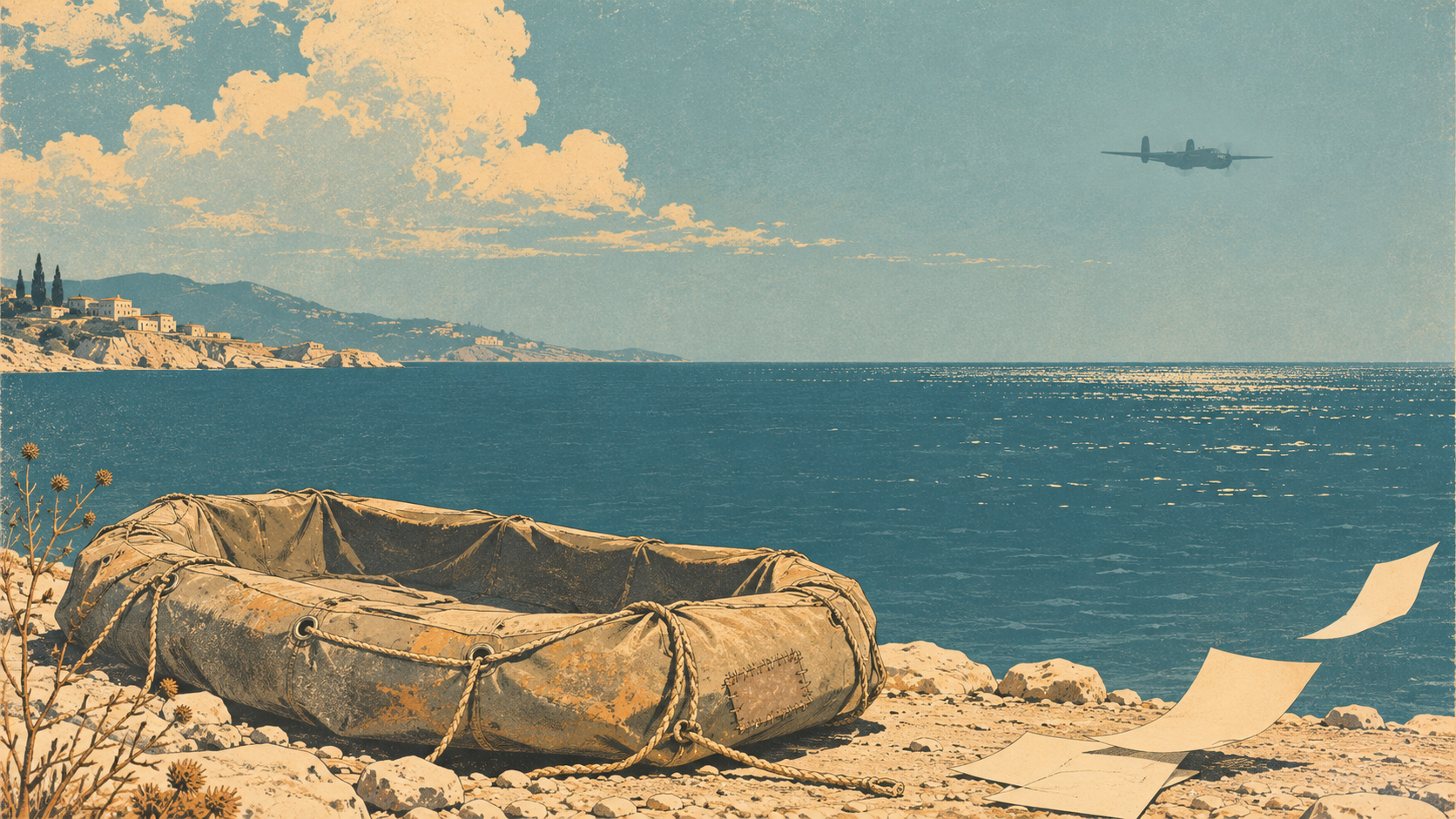
Captain Yossarian has discovered an agreeable peculiarity of military medicine. If the pain in his liver becomes jaundice, the doctors can treat him. If it goes away, they can discharge him. While it remains somewhere in between, they bring him meals and leave him in bed. For an American bombardier stationed on the Italian island of Pianosa during the Second World War, this amounts to a holiday. Joseph Heller begins Catch-22 here, with a man whose good health could get him killed. Yossarian would like to stay alive. Almost everyone he meets considers that a reasonable ambition until he proposes doing something about it.
The Hospital Gives Yossarian a Job He Can Enjoy
Safe in hospital, Yossarian has one official duty. As an officer, he must censor the letters that enlisted patients send home. He sets about it by inventing rules. On one occasion he takes against adjectives. Sometimes he interferes with a greeting or a signature. He signs censored letters with the name of the novelist Washington Irving. The work produces pages that have been properly inspected and whose intended meaning he has casually destroyed. He enjoys himself enormously.
It is a generous opening joke because Yossarian will shortly ask us to sympathise with a man suffering under other people’s arbitrary decisions. Give him a pen and a little authority, and he can be wonderfully arbitrary himself. Somewhere at home, a person who loves one of these patients will receive whatever is left of a private letter. The ward feels sheltered partly because the consequences of its little games travel elsewhere.
Yossarian eventually leaves because a relentlessly friendly Texan makes the hospital unbearable. Back with his squadron, he resumes an argument with his friend Clevinger about whether people are trying to kill him. Clevinger points out that enemy gunners shoot at everyone in the formation. Yossarian takes this as confirmation. He happens to be in the formation. What possible comfort is he supposed to derive from the gunner’s willingness to kill the man sitting next to him as well?
The disagreement gives us two ways of reading everything that follows. Clevinger understands why armies exist and why individual intentions have limited bearing on what happens in combat. Yossarian starts with the less sophisticated observation that the person in his seat will be personally dead. The view from headquarters can accommodate the loss of a percentage of an air group. A man in an aeroplane has only one life with which to supply his share of that percentage.
How Catch-22 Keeps the Men Flying
Yossarian consults Doc Daneeka about getting grounded. The doctor explains the rule through the example of Orr, Yossarian’s tentmate, a pilot whose aircraft have a remarkable habit of coming down in the sea. Would a man have to be mad to keep going out under those conditions? The doctor agrees that Orr could be grounded for insanity. All he would have to do is ask.
The request itself would disqualify him. A man who recognises the danger and asks to be excused from it has demonstrated a rational concern for his safety. Once judged sane, he can be sent back into combat. Meanwhile a man prepared to continue flying might fit the doctor’s understanding of insanity, but the process requires him to make the request. Yossarian has gone looking for a phrase he can say to a doctor. The trap lies in the fact that saying it changes what the doctor can conclude about him.
Catch-22 works in tandem with Colonel Cathcart’s mission quota. The men count completed sorties because a tour of duty is supposed to end. Cathcart keeps increasing the number required before they can go home. Airmen who have reached the previous figure can find themselves back on the schedule before their orders to leave come through. One extra mission would be dangerous enough. The colonel has also taken away their ability to know which goodbye might reasonably be their last.
Hungry Joe shows what that does to a man. During the periods when he has completed his quota and is waiting to leave, his nightmares become almost intolerable. He can sleep more easily once the number rises and he is flying again. Waiting for safety has become a peculiar form of torture. While he still has missions to fly, at least the following morning holds fewer surprises. The air force can look at a man functioning better on active duty and miss the fact that its own promises have made rest unbearable.
Cathcart sees an entirely different set of numbers. He wants promotion, and an unusually high mission requirement might distinguish him from other colonels. He keeps a running mental account of accomplishments likely to impress his superiors and embarrassments that might cancel them out. The men below him are also doing arithmetic. When the same figure goes up on the board, one man sees a better chance of becoming a general and another has to work out what to tell himself before breakfast.
The Dead Man in the Tent and the Officer Nobody Can See
Among the belongings in Yossarian’s tent are possessions left by a replacement airman called Mudd. On arriving at the base, Mudd was sent on a mission before he had formally reported for duty. He was killed. The squadron has the physical remains of his brief stay in the form of luggage that takes up space. Officially, however, it never acquired the man to whom those belongings could be returned. The air force managed to find him when it needed a body for an aircraft. Afterwards it cannot find a category in which to put his things.
That luggage is a particularly good example of how Heller gets a second, less comfortable laugh out of a joke. A dead man who was never there sounds like a piece of verbal ingenuity. A dead man’s belongings beside your bed are another matter. Yossarian has to live beside the portion of the absurdity that possesses weight and takes up room. The officers who might resolve the difficulty have the advantage of encountering it on paper.
Major Major Major Major has a related problem with existence. His father gave him three Majors for a name, and the army added the fourth as a rank. The title confers an authority for which he has little appetite and which makes it almost impossible for him to enjoy his former companions’ company. He arranges matters so that visitors seeking him in his office may be admitted only when he is out. From the visitors’ perspective, there is an impeccably administered procedure for entering the room and no procedure at all for seeing the man.
The chaplain, one of the few people who sincerely wants to help Yossarian, suffers under a less spectacular version of the arrangement. His rank gives him access to senior officers. His temperament and the expectations attached to his calling make it difficult to use that access. Cathcart briefly takes an interest in prayer before missions because he thinks it might attract favourable publicity. Questions about what the men believe, what prayer might mean to them and whether enlisted men would also be involved rapidly spoil the attraction. The chaplain comes prepared to discuss the people in his care. The colonel was picturing a photograph.
Why Bologna Terrifies the Squadron
A scheduled attack on Bologna frightens the airmen badly enough that rain becomes good news. While the weather keeps them on the ground, rumour can furnish the target with every danger they dread. The men follow the progress of the ground war on a map marked with a line. If the Allied advance has already taken Bologna, there should be no need to bomb it. Yossarian moves the line.
For a short time the alteration works. Men looking at the map experience the relief appropriate to an actual military advance. Nothing has happened to Bologna. The paper representation has changed in exactly the place where people consult it before deciding what to do. The prank belongs with the hospital letters, except that Yossarian is beginning to appreciate the life-saving possibilities of getting a false statement into the right hands.
When the squadron eventually goes, Yossarian finds a reason for his aircraft to turn back. The others encounter much less opposition than they had feared. Their safe return exposes him to the particular shame of having been conspicuously frightened of an apparently manageable danger. Then the men have to go again, and the next operation proves dangerous indeed. The people who came back unhurt were right about what happened on the first occasion. Their experience offered no guarantee about the next one. Command is able to spend yesterday’s good luck as though it were a permanent improvement in the odds.
Yossarian’s fear can obscure an important fact about his work. As bombardier he has a job that exposes the crew as well as himself. At Ferrara, when the target is missed on the first run, he directs another pass. The bridge is hit, but an American aircraft is lost and Kraft, a young airman, is killed with his crew. Yossarian understands that a decision he made helped determine who came home. His superiors handle the difficulty by giving him a medal. An embarrassing question about whether the second run should have happened can now be answered with an account of conspicuous bravery.
The decoration has an unexpectedly corrosive effect. Yossarian knows what went into earning it, so he also knows how little a medal settles. Silence in the face of authority gradually becomes harder for him because he has already discovered what an official tribute can conceal. A reader of The Remains of the Day may recognise the pressure to let professional distinction settle a private question of responsibility. Yossarian has to keep sharing a tent, an aircraft and a mess table with the people who may pay for the next distinction.
Milo Finds a Customer on Each Side
Milo Minderbinder, the squadron’s mess officer, has a gift for obtaining goods and a still greater gift for making other people’s resources available to his business. His trading syndicate promises benefits to everybody. The proposition is especially attractive when the immediate result is better food. An officer eating well has little incentive to enquire too closely into the flights, fuel and favours required to put breakfast on his plate.
Milo’s celebrated dealings in eggs sound impossible when reduced to two prices. He can buy eggs for more than he sells them and still turn a profit. The explanation involves the other transactions in the chain and the various positions he occupies along it. His listeners struggle to keep the accounting in their heads. Most can keep the taste of fresh eggs in mind perfectly well. That difference helps explain his success better than any particular piece of financial wizardry. The customer gets a benefit now. Tracking who provided the aircraft and absorbed the risk would take the rest of the morning.
A disastrous investment in Egyptian cotton puts the syndicate under pressure. Milo’s efforts to find a market eventually include taking a German contract to attack his own base. Men on Pianosa come under fire through the enterprise in which they supposedly own shares. The earlier promise of universal participation has acquired a monstrous precision. A man can be one of the people paying, one of the people being bombed and one of the shareholders invited to admire the accounts.
Milo survives the outrage once the financial return is understood. What makes him especially disturbing is his air of injured innocence. He believes other people should honour contracts and respect the integrity of commerce. Given a choice between breaking faith with a customer and exposing his countrymen to an attack, he can reason his way to keeping the customer. Cathcart needs a dead airman to look like an acceptable military loss. Milo can make the same man look like a business expense. Between them, they possess two respectable vocabularies in which virtually anyone on Pianosa can disappear.
When the Joke Comes Back Without the Laugh
Heller tells the story out of order, often giving us an odd consequence well before its cause. Yossarian has stood naked to receive a medal. The chaplain has glimpsed a naked man in a tree during a funeral. A young airman named Snowden keeps returning to Yossarian’s thoughts in unfinished pieces. At first these details compete for attention with dozens of other peculiarities. Gradually we discover that what looked like a collection of eccentric behaviours belongs to one man trying to get through the days following a particular death.
The same delayed understanding applies to Orr. In the tent he spends an exasperating amount of time improving their living arrangements and attending to small practical tasks. He tells Yossarian about putting crab apples in his cheeks as a boy and takes evident pleasure in how difficult his explanations are to follow. Yossarian can scarcely look at him without feeling affection and irritation at once. Orr repeatedly invites him to come flying. Given the frequency with which Orr’s crews end up in the water, Yossarian sees every reason to decline.
After one more ditching, Orr disappears at sea. The absence changes the texture of the tent. His irritating habits turn out to have provided much of what made it habitable. New occupants can shift things around and make themselves comfortable with an ease Yossarian finds shocking. To them it is accommodation. To him, a particular man patiently made it into a home and may never return to see what anybody has done with it.
Elsewhere, two friends die in an episode with no enemy involvement. McWatt flies low over the water and accidentally kills Kid Sampson, who is standing on a raft. After his other crew members get out, McWatt deliberately crashes his aircraft and dies. The loss is awful partly because low flying had previously belonged to McWatt’s repertoire of frightening jokes. He and Yossarian had disagreed about whether that sort of play was funny. Now there is no future occasion on which McWatt can concede the point.
Doc Daneeka was recorded as a passenger on McWatt’s aircraft, although he remained on the ground. The men can see him, hear him and, in some cases, address him directly. The authorities nevertheless count him among the dead. His wife receives the official news and the financial arrangements associated with widowhood begin to take effect. Where Mudd’s physical death could not overcome the absence of paperwork, Daneeka’s physical presence cannot overcome its completion. The two men’s stories fit together with comic perfection. Only one of them is alive to discover how little consolation there is in the symmetry.
What Yossarian Finds in Rome
As losses accumulate, Yossarian becomes less willing to accept assurances about who benefits from his continued service. Nately, his young friend from a wealthy American family, has fallen in love with a woman who sells sex in Rome. For a long time his earnestness seems to her mainly a nuisance. By the time she comes to love him, he has begun imagining a future that might include her and her younger sister. Then Nately is killed on a mission. No amount of rearranging the account of his service can tell Yossarian what to say to somebody waiting for him in another city.
Yossarian delivers the news himself. The woman attacks him and keeps trying to kill him when opportunities arise. On one level the recurring attacks continue the novel’s taste for an outrageous running joke. Yet her anger has attached itself to the one representative of the military organisation who cared enough to turn up. The officers who can give a reason for Nately being in the air that day are nowhere within her reach. Yossarian is there. His willingness to become the bearer of bad news makes him more vulnerable than the people who produced it.
When the women are driven out of their rooms, Yossarian worries about the younger sister. An old woman explains that the authorities invoked Catch-22 as their warrant for doing as they pleased. Nobody showed her the rule. Here the expression has travelled some distance from Doc Daneeka’s elegant paradox. There is no elaborate test of sanity to follow. Men with the power to evict people say that they have the right, and the people in the street have nowhere to take an appeal. Yossarian begins to appreciate that demanding to see the regulation would achieve very little against men able to enforce it in its absence.
He goes back to Rome to look for the girl. During his night in the city he encounters cruelty that no pun on a rank or regulation can make amusing. At the officers’ apartment, Aarfy has raped Michaela, a young maid, and killed her by throwing her from a window. Yossarian expects the arrival of the police to mean that somebody will answer for her death. The military police arrest him for being in Rome without a pass. Aarfy, confident throughout that no one will trouble a respectable American officer over an Italian servant, is left behind.
Michaela’s death puts the reader’s appetite for absurdity under considerable pressure. Once again, officers have attended to the smallest provable infraction while missing the human fact in front of them. The construction is as neat as anything in the opening hospital chapter. By now we know the name of the woman whose death goes unattended while the paperwork gets sorted out. There is scarcely any pleasure left in anticipating the punchline.
The Price of a Ticket Home
Yossarian has openly refused to fly further missions. This gives Cathcart and his more astute subordinate, Colonel Korn, a problem. An airman who can say no in public may give other men ideas. Punishing him carries risks too. An awkward proceeding might draw attention to the commanders’ conduct. They offer a solution that promises Yossarian everything he has spent the book asking for. They will send him home as a hero. In return, he must support them and speak well of them.
The proposed endorsement is the valuable part. A sick man leaving on medical orders would establish a medical exception. An exhausted man permitted to leave after completing enough missions might establish a precedent useful to everyone. A decorated hero returning to America as a friend of the colonels establishes neither. Yossarian can escape the quota provided he helps preserve it for the people who will still be getting up tomorrow morning to fly.
He accepts. After everything we have seen, it would be strange if he felt no temptation. He has spent months being invited to die for commanding officers who would prefer promotion to his continued acquaintance. The bargain offers a real country, real distance and the possibility of mornings when the weather holds no military significance. It also makes his safety depend on the silence of the one man who knows exactly what has been bought. Soon after he leaves the colonels, Nately’s bereaved lover attacks him again. He ends up back in hospital, where the novel finally gives us the whole of what happened to Snowden.
What Happened to Snowden?
On a mission over Avignon, Snowden is wounded in the back of the aircraft. Yossarian goes to him, sees a substantial wound in his leg and sets about treating it. He has something concrete to do with his hands. Although the conditions are dreadful, the existence of a recognisable injury gives him a sequence of useful actions. Snowden keeps saying that he is cold. Yossarian tries to comfort him and, for a little while, can believe that competent attention might be enough.
Then he opens Snowden’s flak suit and discovers a catastrophic second wound. The earlier passages have brought Yossarian and the reader repeatedly to the first injury. Only now do we understand why attending to it could never have saved him. Snowden has been dying while Yossarian did a reasonable, humane and wholly insufficient job on the damage he could see. The horror lies as much in the interval of hope as in what the opened clothing reveals.
Afterwards even a uniform is unbearable to Yossarian because his own has been fouled by Snowden’s death. Receiving a decoration naked and attending the funeral from a tree cease to look like performances staged by a flamboyant eccentric. He wants to be near the funeral. He cannot bring himself to participate in the ordinary manner. The chaplain’s earlier glimpse of him suddenly becomes a record of grief seen from too far away for recognition.
Snowden also explains the seriousness of Yossarian’s quarrel with Clevinger. Headquarters may understand what a mission achieves. A doctor may explain what fear proves about a man’s sanity. Yossarian has felt the weight of a dying crew member while all the purposes for which the aircraft was sent over Avignon became irrelevant to the work immediately in front of him. He cannot put Snowden back together. He can stop lending his name to an arrangement under which the men responsible for sending the next crew out get to call themselves his friends.
Why Does Yossarian Choose Sweden?
Back in hospital, Yossarian tells Major Danby that he cannot go through with the bargain. The order matters. He withdraws his consent while the available alternatives still look miserable. He might face a court martial. If he obeys, he might die. If he endorses the colonels, he can go home comfortably at the expense of the men he leaves behind. His decision precedes the news that will make a different course of action imaginable.
The chaplain arrives with that news. Orr has reached Sweden. His repeated ditchings take on a meaning Yossarian had failed to see while they shared a tent. Orr had been practising how to survive in the water. On the occasion when he disappeared, he was able to put that experience to use. Those exasperating invitations to come flying now sound painfully generous. Yossarian, who fancied himself unusually good at spotting danger, kept declining a place beside the man working hardest to find a way out.
Orr’s achievement cannot give Yossarian a guarantee or even an itinerary he can reproduce. Its value is that a man believed lost is alive somewhere beyond the colonels’ reach. Until now, every possible future has seemed to require a decision from a doctor, a commanding officer or a tribunal. Orr has done something none of them authorised. Suddenly it makes sense to ask where Yossarian wishes to go, a question almost nobody has had cause to put to him before.
Yossarian decides to desert and try to reach Sweden. The novel ends as he sets off, dodging one more attack from Nately’s lover. Heller never shows him arriving. Nor does the knowledge of Orr’s safety settle the fate of the missing girl in Rome or remove the danger facing the squadron. What Yossarian has acquired is responsibility for an uncertain next step. He accepts the risks of leaving without accepting the colonels’ terms for being allowed to leave.
Early in the book, Yossarian’s best idea for a tolerable future was to stay in a hospital bed and wait for someone else to remain undecided about his liver. At the end he gets out of bed with no certificate, no medal he wants and no promise that anyone will protect him. Somewhere in Sweden is a man who once sat opposite him in a tent, patiently fixing things while Yossarian wondered why he bothered. Of all the assurances Yossarian has received on Pianosa, that small, belated proof of another person’s competence is the one he can finally trust.
Sources
Simon & Schuster, Catch-22 by Joseph Heller — publisher’s edition, premise and opening excerpt. Simon & Schuster
Joseph Heller, Catch-22 — novel text used to check the sequence of disclosures, the Avignon episode and Yossarian’s final decision. shermankeene.com
SparkNotes, Catch-22, Chapters 38–42 — independent account of Rome, the colonels’ offer and the hospital scenes. SparkNotes
CliffsNotes, Catch-22, Chapter 42 — cross-check of when Yossarian rejects the bargain and when he learns what happened to Orr. cliffsnotes.com
Next Reads
The Remains of the Day: Stevens, Miss Kenton, Lord Darlington and the Cost of Duty — for another man weighing what personal loyalty has allowed his superiors to do.
The Seven Moons of Maali Almeida — for a wartime satire in which official explanations look especially peculiar from the victims’ side.
Crime and Punishment Explained: Raskolnikov’s Theory, His Choices and the Ending — for a different account of what happens when a persuasive theory meets a person who has to suffer its consequences.
