The Debts Behind Madame Bovary
The Ball Lasts One Night for Everyone Except Emma
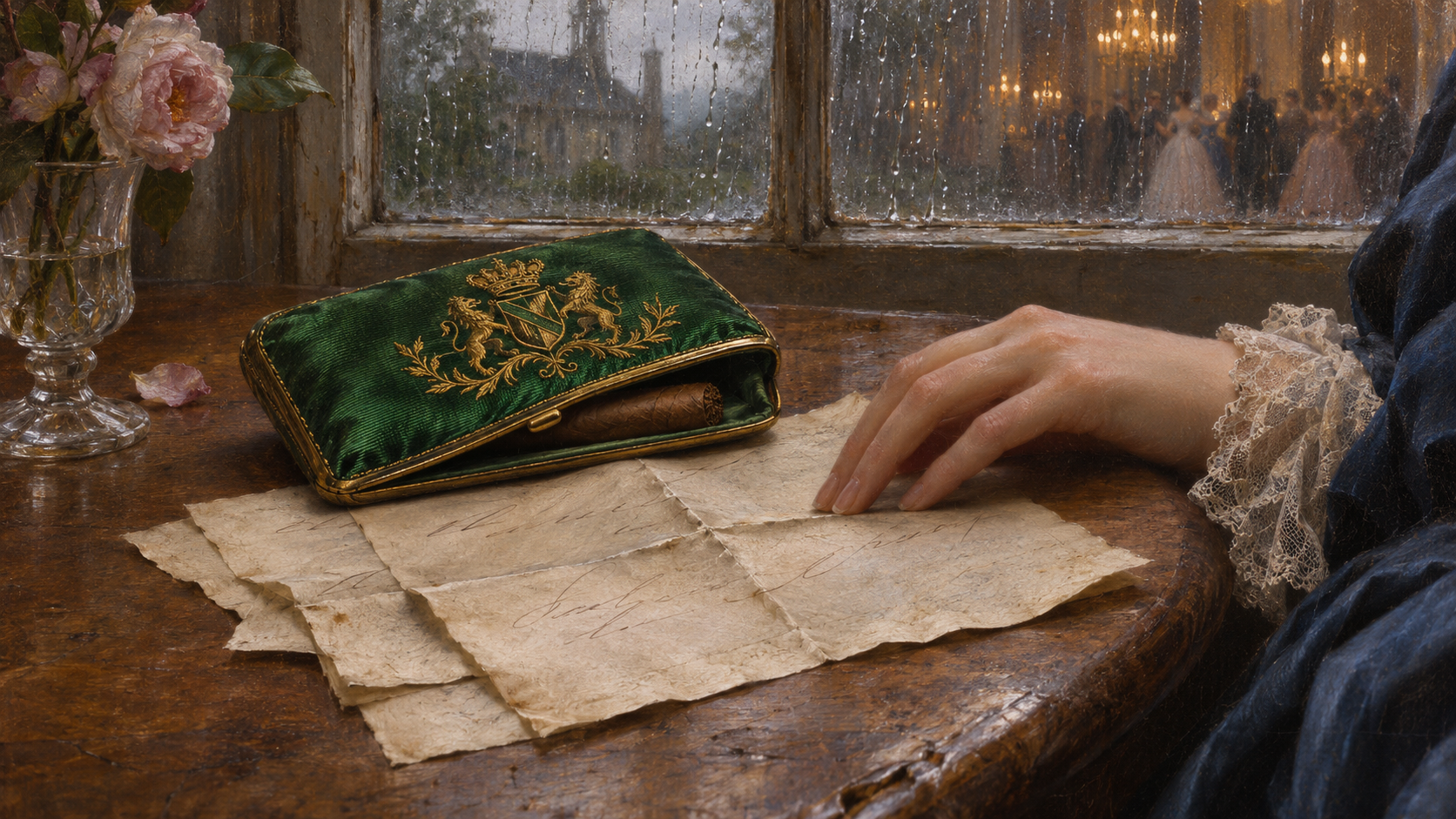
Emma Bovary keeps a green silk cigar case as a souvenir of a world she has visited exactly once. She cannot be sure who owned it. That hardly matters. She can furnish its owner with a lover, imagine the room where the silk was embroidered and follow the case all the way to Paris without leaving her house in Normandy. Gustave Flaubert understands the pleasure of this exercise well enough to let us share it. He also asks an awkward question. What becomes of a marriage when a stranger’s discarded possession can suggest a more intimate life than the man sitting opposite at breakfast?
Before Emma, There Is Charles
Madame Bovary opens in a schoolroom. A new boy has arrived wearing a cap so elaborately ugly that the narrator takes considerable trouble to describe its construction. He cannot work out what to do with it. When he tries to give his name, the other boys hear a muddle of syllables and turn it into a chant. This is Charles Bovary, introduced to us on one of those afternoons a person might spend the rest of his life hoping nobody remembers. Long before his wife finds him embarrassing, Flaubert has made us sit among the people laughing at him.
Charles grows into a provincial medical practitioner. His mother organises much of his life, including his marriage to Héloïse, a widow believed to possess a comfortable income. One night a summons takes him to the farm of Monsieur Rouault, who has broken his leg. Charles treats him successfully and finds reasons to keep visiting. Rouault’s daughter Emma is there. Charles notices the small particulars of her person with a concentration his professional duties rarely inspire. She can make an ordinary farm kitchen seem a place worth travelling some distance to enter.
Héloïse sees what is happening and objects to the visits. Then her financial position proves much less secure than Charles’s family had been led to believe. After a painful confrontation over money, she dies unexpectedly. Charles mourns her. That matters in a novel whose central marriage is still to come. His feelings have room for the woman who made him unhappy and the woman whose presence made him forget that unhappiness. He is capable of loving the person actually there, an ability Emma will find both exasperating and desperately useful.
When Charles asks for Emma, her father welcomes the match. Charles has a profession, the two families know one another and Rouault has debts of his own. Emma brings a different expectation to the marriage. She has encountered love extensively in books and expects to recognise it by its effects. Something extraordinary ought to happen to perception, conversation, perhaps even to the landscape. After the wedding, Charles has no difficulty identifying the change in his life. He is happy to wake up beside her. Emma wakes beside a happy man and wonders what the word happiness can possibly mean.
What the Invitation to La Vaubyessard Changes
Emma acquired her education at a convent, where religious devotion and clandestine reading fed one another. She loved the sensuous furnishings of faith as much as its teachings. Stories gave her moonlit meetings, handsome men, misfortune and women whose suffering commanded everybody’s attention. It would be easy to blame these books for what follows. Flaubert gives them a more interesting role. They supply Emma with a vocabulary for desires that her education has given her very little practical means of pursuing. She can picture a hundred possible lives in considerable detail. Her actual choices run to a much shorter list.
At Tostes, she tries to make marriage feel as she imagined it. She recites poetry and sings to Charles. He receives these offerings with uncomplicated affection. He has no suspicion that he is being auditioned for a part or that his response might determine whether the entire evening feels real to his wife. He can enjoy a meal, a warm room and the sight of Emma without needing the three things to signify anything beyond themselves. She wants the atmosphere to confirm something about who they are together. After a while, having to manufacture that atmosphere herself takes much of the pleasure out of it.
An invitation to a ball at La Vaubyessard briefly solves the problem. Here is a household in which the details seem to arrange themselves. Servants bring exquisite food. Clothes, manners and conversation suggest journeys and intimacies of which Emma knows almost nothing. A viscount guides her through a waltz. For a few minutes another person knows the steps and can carry her through them. It is hard to overstate the appeal of that sensation to a woman who has been trying to choreograph both halves of her marriage.
Then a servant breaks windowpanes to cool the ballroom, and Emma sees country people looking in from outside. She remembers the farm and her father. From the dancers’ side of the glass, her old life briefly seems as remote as the aristocratic one had seemed when she was at home. Nothing material has happened to lift her from one class into another. An invitation has put her in the right room for an evening. The following morning the distinction becomes brutally easy to understand.
On the journey home, Charles finds the cigar case. Emma keeps it and imagines it belongs to the viscount. She studies a map of Paris and follows fashionable life through print. In her imagination the ball can continue indefinitely because its participants need never grow tired, say something foolish or worry about their accounts. Charles has to go on existing at breakfast. The viscount enjoys the considerable advantage of never having to appear again.
As Emma becomes increasingly unwell and withdrawn, Charles decides that a change of surroundings may help her. He gives up his practice at Tostes and moves them to Yonville. He has identified a genuine need and made a sacrifice to meet it. What he cannot see is that he is among the things his wife would like a change of surroundings to change.
A Daughter, a Law Clerk and a Conversation That Fails
At the inn in Yonville, Emma meets Léon Dupuis, a young law clerk. While Charles and the local pharmacist, Homais, discuss practical affairs, Emma and Léon discover how much they agree about books, music and scenery. The arrangement of the dinner allows an intimacy to develop almost in plain sight. Two people can feel deliciously secluded when the people beside them are talking about something else.
Léon’s attraction also helps explain what Emma has missed. Charles adores her, but loving somebody does not automatically make a person an interesting companion. Léon can follow an allusion. He knows the pleasure of discussing an imaginary journey. He, too, feels that important things are happening elsewhere. Some of their opinions are second-hand, but the relief each feels at finding another person willing to entertain them is genuine. Flaubert allows us to recognise a cliché without assuming that a person who uses it must be insincere.
Emma gives birth to a daughter, Berthe. She had wanted a son. In imagining a boy’s future, she had been able to picture travel, independence and the power to act on a desire without first finding somebody willing to take him along. The disappointment tells us something about Emma’s understanding of her own situation. It also exposes a failure of imagination. She can see the injustice ahead of a girl in general more readily than she can sustain an interest in the particular girl who needs her now.
Berthe is sent to a wet nurse. When Emma visits, Léon accompanies her, and the walk becomes an opportunity for the adults to enjoy each other’s company. Flaubert keeps the nurse’s material circumstances in view. A child who can become the occasion for an almost romantic outing for Emma is also somebody else’s daily employment. It is an early example of the way a Bovary pleasure can depend on work performed just outside Emma’s attention.
Although Emma and Léon are drawn to each other, neither makes a declaration sufficient to change their situation. Distressed, Emma visits the priest, Monsieur Bournisien. She approaches indirectly, hoping he will recognise a suffering she cannot quite name. He understands requests for bodily assistance more readily and has children preparing for catechism to occupy him. Each gives the other an opening that goes unrecognised. It is a quietly painful scene because help is briefly imaginable. Emma has actually gone to someone and tried to speak.
Léon leaves for Paris to continue his legal training. His departure permits Emma to discover, retrospectively, how passionately she believes she loved him. A man who is safely elsewhere can be endowed with every quality his reserve left untested. She now feels deprived of a great love whose practical difficulties neither of them ever had to encounter. The next man to take an interest in her has rather more experience of what to do with an opportunity.
Rodolphe Makes His Case at the Agricultural Show
Rodolphe Boulanger, a prosperous local landowner, meets Emma when he brings a servant to Charles for treatment. He sees quickly that she is bored, attractive and married to a man she considers beneath her. He also begins calculating how tiresome it might eventually be to disengage. Flaubert gives us access to this calculation before Emma has heard a declaration from him. We can therefore understand why his words work on her while knowing how conveniently he selected them.
At the agricultural show, Rodolphe finds a place where they can sit together above the crowd. Public officials below deliver speeches and announce awards. Above them, he talks about people whose exceptional sympathies entitle them to disregard conventional restraints. Flaubert cuts between the two performances. A declaration of feeling lands beside some agricultural distinction. The joke works beautifully when read aloud because both speakers require a solemn pause for the listener to absorb the importance of what has just been said.
The awards ceremony also brings forward Catherine Leroux, an elderly farm worker being honoured for more than half a century of service. Her hands bear the marks of that labour. She scarcely understands what is expected of her when the officials call her up. Rodolphe has been describing the suffering of unusually sensitive souls to an audience of one. A few yards away stands somebody whose working life would be difficult for either lover to imagine. She gets a medal and a few moments of public attention before the proceedings move on.
Rodolphe later proposes riding as a remedy for Emma’s health. Charles actively encourages her to accept. He sees an opportunity to give his wife fresh air and an occupation she may enjoy. His trust makes the affair easier to begin and, in time, easier for Emma to despise. After she and Rodolphe become lovers, one of her strongest pleasures is the recognition that she now belongs to a category she once encountered in books. She has a lover. The fact itself seems briefly capable of giving every future day a new colour.
For Rodolphe, the familiar language of passion has ceased to give reliable information about the woman using it. He has heard declarations before and assumes that their resemblance tells him all he needs to know about the speakers. Here Flaubert turns the criticism usually directed at Emma back on her more sophisticated partner. Emma can confuse a well-worn expression with proof of an exceptional love. Rodolphe can hear the same well-worn expression and miss an actual person telling him the truth. Experience has made him a more efficient seducer and a less attentive listener.
A Patient Pays for Charles’s Ambition
For a time, Emma glimpses a different way to make her marriage bearable. Homais takes an interest in a procedure for correcting a clubfoot. Hippolyte, who works at the local inn, has such a foot. He has adapted to it sufficiently well to do demanding physical work. The proposed operation offers Homais a story about progress, Charles a professional distinction and Emma the possibility of being married to a remarkable man after all. Hippolyte is the only person whose existing ability to earn a living can be destroyed by the attempt.
Charles studies the procedure and undertakes it. At first the town celebrates. Homais supplies publicity before there has been time to establish a lasting result. Then Hippolyte’s condition deteriorates. A more experienced surgeon has to amputate his leg. Charles retreats into distress and humiliation. Emma, who had encouraged him, experiences his failure as a further personal indignity. She turns back towards Rodolphe with renewed conviction that she has married the wrong man.
The episode changes the balance of the book. Until now Charles’s limitations have chiefly been a source of comedy or frustration inside his household. Hippolyte will live with their consequences every day. Emma’s desire for romance and Homais’s enthusiasm for scientific prestige have proved unexpectedly compatible. Each has been able to picture the splendid scene that would follow success. Neither spent comparable time imagining an ordinary working day for Hippolyte if they were wrong.
Emma presses Rodolphe to take her away, with Berthe included in the plan. Preparations give the proposed elopement a highly persuasive appearance of reality. Things can be ordered. A departure time can be agreed. An imagined future acquires luggage. For Emma, every practical arrangement makes the commitment more binding. For Rodolphe, the same details make clearer how much inconvenience awaits him. Alone, he writes a farewell letter calculated to present his withdrawal as a sacrifice on her behalf. He sends it concealed in a basket of apricots.
He even considers what a tear on the paper would do for the effect and supplies a drop of water. Few details in the book are crueller. Emma will read the letter for evidence of what its author felt. Rodolphe has anticipated that desire so exactly that he can manufacture the evidence himself. After reading it she becomes dangerously ill. Charles nurses her through a long recovery without understanding what has brought it on. The man whose love she finds inadequate undertakes the prolonged, inconvenient care for which the great love of her life has declined to present himself.
What a Closed Carriage Makes Possible in Rouen
During her recovery, Emma turns again to religion. Charles eventually takes her to the opera in Rouen, hoping the outing will do her good. The performance gives her emotions an external shape at the very moment when she would like to believe that the stormiest part of her life is behind her. In the audience they meet Léon. He has acquired some worldly confidence since leaving Yonville. She has acquired experience he once lacked the courage to seek. Each encounters somebody familiar enough to trust and sufficiently changed to desire afresh.
They arrange to meet at Rouen Cathedral. Emma brings a letter intended to end the affair before it begins. The cathedral attendant’s determination to show them the building gives the meeting a wonderfully awkward third participant. Léon wants privacy, Emma wants to preserve the possibility that she has come to refuse him, and their guide has architectural features to point out. Eventually the pair leave together in a hired carriage.
The blinds come down. Instead of taking us inside, Flaubert follows the carriage through Rouen as the increasingly bewildered driver receives instructions to keep going. The route gives the encounter duration. Streets and landmarks let us feel how much public space the couple occupy while remaining invisible inside it. Fragments of torn paper flutter out. The letter with which Emma meant to define what could happen has become the only part of the meeting available for the city to see.
The affair settles into a weekly appointment. Emma says she is taking piano lessons and travels to Rouen, where she and Léon can occupy a hotel room almost as though it were a home. Once again Charles helps sustain an arrangement because he wants her to have something she enjoys. But the lie requires more than a single false statement. Lessons imply a teacher. A teacher can be encountered or asked about a pupil. Every ordinary acquaintance becomes somebody whose memory may need to be managed.
For a while the hotel room gains its intensity from the shortness of their time there. Eventually even stolen Thursdays develop habits. Léon has employers, prospects and an interest in how he is regarded. Emma wants him to sustain a degree of ardour that begins to feel like another appointment he is obliged to keep. She remains capable of writing passionately when an actual meeting has disappointed her. Indeed, the less the particular man resembles her ideal lover, the more necessary it becomes to conduct part of the affair on paper.
How Lheureux Turns Purchases Into an Eight-Thousand-Franc Demand
Alongside the love affairs runs a relationship Emma pays less attention to and ought to understand much better. Monsieur Lheureux sells goods on credit. His great skill is allowing a customer to experience buying something and paying for it as two almost unrelated events. When a fabric, a present or an article for a journey is desirable, he is there to supply it. When payment would spoil the occasion, he can suggest paper arrangements that move the unpleasantness into the future. He gets to appear considerate on both visits.
As bills come due, fresh agreements allow earlier obligations to be carried forward. A signature buys Emma time, which she repeatedly experiences as relief. The underlying obligation survives, and the sums grow. After Charles’s father dies, questions about family property give Lheureux an opening to encourage a wider power of attorney. Charles trusts his wife enough to give her authority to act for him. She can now conduct transactions that affect the household’s resources while he remains largely ignorant of their extent.
The piano lessons, journeys, gifts and hotel expenses matter, but it would be misleading to imagine that a single extravagant afternoon ruins Emma. What ruins her is the accumulation of enforceable promises, combined with her determination to keep each stage secret. A modest early admission might have produced a quarrel. A later admission would expose the lies used to conceal the previous bills. As the price of telling Charles rises, another signature can feel like the least painful choice available, even when it makes the eventual reckoning worse.
Lheureux also puts distance between himself and collection. The paper has passed to Vinçart, a businessman in Rouen. When Emma finally receives a demand for eight thousand francs, backed by a judgement and seizure of the Bovarys’ goods, Lheureux can point to another man’s rights. She believed she had an arrangement with a merchant whom she knew how to flatter, plead with or put off. The person who sold her the goods no longer needs to be the person entitled to demand payment. A notice announcing the sale of the household possessions makes the danger public before she can decide what version of events to tell her husband.
The articles being inventoried have acquired a final significance. A houseful of things once helped Emma picture the kind of woman she wanted to be. An official can walk through those rooms and describe the same objects according to what they might fetch. For sheer cruelty, the change of viewpoint rivals the broken ballroom window. Both times, Emma remains physically where she was while discovering that somebody looking from the other side can see an entirely different life.
Whom Can Emma Ask for Eight Thousand Francs?
Emma attempts to raise the money. Léon has neither the means nor the appetite for the risk she wants him to take. She presses him towards using money to which his employment gives him access. What had once been an attraction for him, her readiness to take desire more seriously than convention, now threatens the professional future he has been careful to preserve. He can offer assurances more readily than cash.
The notary Guillaumin understands her vulnerability and makes an advance. Emma leaves in disgust. The distinction she draws may surprise anyone who imagines that her affairs make all sexual choices interchangeable for her. She has wanted to give herself to someone she chose. A man treating her fear of public disgrace as an opportunity to purchase access to her body is proposing something she recognises immediately as degrading. Flaubert allows her that clarity even while most of her other distinctions are collapsing.
Finally she goes to Rodolphe. This visit requires her to step back into the emotional world of their affair and believe, for a little longer, in the man who once inhabited it. He receives her with some tenderness. When she asks for money, the encounter changes. He says he does not have it. The comfortable objects around him give Emma plenty against which to measure the answer, although possessions and ready money are different things. What emerges beyond dispute is that the man she expected to carry her into another life will assume no substantial burden to preserve this one.
With the sale imminent and no rescue secured, Emma goes to the pharmacist’s premises and takes arsenic. For much of the novel she has pictured intense experience through scenes that have already been arranged for an audience. Her death defeats that habit with terrible thoroughness. It is prolonged, frightening and witnessed by people who can neither understand the whole chain of events nor do what she most needs. Charles brings in medical help and stays beside her. Near the end of her life, the song of the blind beggar she has heard on the Rouen road reaches her room. A voice associated with the journey to Léon becomes one of the last sounds she hears.
Why Does Madame Bovary End With Homais?
Emma dies, but Flaubert keeps the household in view. Charles’s grief is lavish. He wants funeral arrangements worthy of the woman he believes he has lost, although the family is already financially ruined. There is a painful resemblance between them at last. Emma bought objects to give visible form to a love she wanted to feel. Charles now wants a funeral beautiful enough to express a love he undoubtedly does feel. Sincerity offers no special protection against an unpaid account.
Only afterwards does he discover the extent of the affairs through the letters Emma kept. Written words have served almost every purpose in this novel. A farewell letter allowed Rodolphe to avoid an encounter. Love letters helped Emma sustain a desired version of Léon. Signed bills preserved obligations she wanted to forget. Now the correspondence survives its author and reaches the one reader from whom it had to be concealed. Charles finally acquires intimate knowledge of his wife at the moment when he can no longer ask her a question.
When he encounters Rodolphe, Charles attributes what happened to fate. Rodolphe finds him rather contemptible. It is easier for him to respect a husband who might have demanded satisfaction than one who goes on loving Emma and cannot summon the expected hatred of her lover. Yet there is something evasive in Charles’s generosity too. Fate is a capacious explanation. It spares him the task of deciding what Emma chose, what Rodolphe chose and what he himself preferred not to notice. He dies in the garden, where Berthe finds him.
Berthe is the person on whom all the adult arrangements finally converge. With her parents gone and the family resources exhausted, she eventually goes to live with a poor aunt and works in a cotton mill. The girl whose birth prompted Emma to reflect on how little freedom women possess inherits less freedom still. For Emma, fabric had been something to touch, choose, wear or buy on credit. Her daughter enters the part of the economy where somebody has to make it. Few endings have used a change in a single family’s relationship to an ordinary material to such devastating effect.
The final distinction goes to Homais, who receives the Legion of Honour. He has cultivated influence, promoted his achievements and survived the damage done by his bad judgement. Flaubert leaves us with a public body successfully recognising exactly what Homais has worked to make visible. Hippolyte’s lost leg, Charles’s unmarketable devotion and Berthe’s working day carry no comparable distinction. The book began with a class of boys deciding what to make of Charles by looking at his cap. It ends with France pinning an honour on the man who knew how to dress for its approval.
Sources
Gustave Flaubert, Madame Bovary — Project Gutenberg. Complete novel in Eleanor Marx-Aveling’s translation, used for the sequence of events, shifts in viewpoint and final chapter. Project Gutenberg
Madame Bovary, Part III, Chapter VI — Wikisource. The specific chapter covering the financial demand and Emma’s confrontation with Lheureux, in the same translation. en.wikisource.org
Introduction to Madame Bovary — Vintage Classics. Editorial introduction covering the novel’s composition, serial publication and early reception. cdn.penguin.co.uk
Next Reads
The Remains of the Day: Stevens, Miss Kenton, Lord Darlington and the Cost of Duty — for another life shaped by the distance between what a person feels and what they can admit.
Crime and Punishment Explained: Raskolnikov’s Theory, His Choices and the Ending — for a nineteenth-century novel in which a shortage of money forces a cherished idea into contact with other people’s lives.
The Time Traveler’s Wife Explained: Henry, Clare, the Timeline and the Ending — for a different account of how much can remain unknown between two people inside a marriage.
