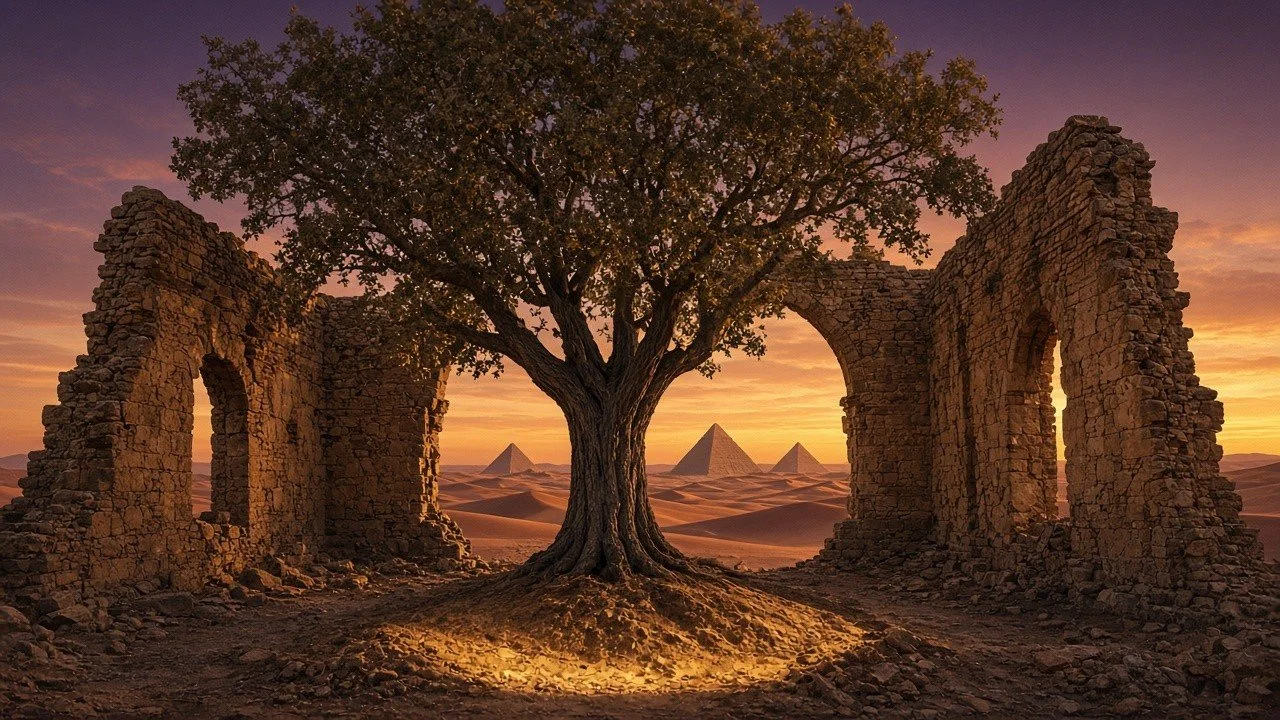
Santiago crossed a desert to find treasure at the pyramids. It was under a tree at home. We explain The Alchemist, its ending and why the journey still matters.
The Shepherd Who Crossed a Desert to Find What Was at Home
The Alchemist is one of the most widely read novels ever written, a short fable that has been taken up as a spiritual guide, a graduation present, a school text and a punchline. Paulo Coelho's story follows Santiago, a young shepherd from Andalusia in southern Spain, who dreams of treasure at the Egyptian pyramids and sets out to find it. On the way he meets a king, a crystal merchant, an Englishman, a woman in a desert oasis and the alchemist of the title. This guide explains the book spoiler-free first, then tells the whole story in order, before explaining the ending, its meaning and the criticisms worth knowing, with study notes for students.
Spoiler warning: the following summary discusses the plot, major twists and ending.
The Book at a Glance
The Alchemist was first published in Brazil in 1988 in Portuguese as O Alquimista. Its first publisher was a small house, Eco, which printed only 900 copies. The book did not take off at first. After Coelho moved to the larger Brazilian publisher Rocco, the novel was republished and began to sell, helped by the success of his next book, Brida, in 1990.
The English translation most readers know is by Alan R. Clarke. It was published in the United States in 1993 by HarperSanFrancisco, a division of HarperCollins, with an unusually large first print run of 50,000 copies for a Brazilian novel. The same Clarke translation is the one generally sold in the UK, including HarperOne's 25th-anniversary edition, which adds a foreword by Coelho. If you are studying the book, it is worth checking that your edition is Clarke's translation, because page numbers and some wording differ between editions.
The reach is extraordinary. Coelho's UK publisher describes The Alchemist as having sold more than 100 million copies in more than 80 languages, and some entertainment reports give higher figures. In 2009, it was recognised by Guinness World Records as the most translated book by a living author. Coelho has said he wrote it in about two weeks.
What Kind of Book Is It?
The Alchemist is a fable, a short story that teaches a lesson, often with symbolic characters and events. Its characters are types more than detailed portraits: the boy, the king, the merchant, the Englishman, the desert woman, the teacher. The language is simple, the chapters are short and the narrator frequently pauses to state the lesson outright.
Its central idea is the Personal Legend, Coelho's term for the purpose or destiny a person is meant to fulfil. The book suggests that everyone knows their Personal Legend when they are young, that most people abandon it out of fear, and that the world helps those who pursue it.
The plot follows an old folk-tale pattern known to scholars as "the treasure at home", in which a person travels far to find a treasure, only to learn it was close to where they started. Versions appear in the One Thousand and One Nights and in the poetry of Rumi, the 13th-century Persian poet and Sufi mystic. Coelho's novel retells that pattern as a spiritual journey.
The Prologue: Narcissus Reconsidered
Before Santiago's story begins, a brief prologue shows an alchemist reading a version of the myth of Narcissus, the youth who fell in love with his own reflection and drowned. In Coelho's version, the lake mourns Narcissus not because it loved him but because, when he looked into it, it could see its own beauty reflected in his eyes.
The little story sets the tone. The book is going to take familiar tales and turn them slightly, and it is interested in how people and the world reflect each other.
Santiago and the Recurring Dream
Santiago is a shepherd in Andalusia. His parents wanted him to become a priest, and he studied at a seminary, but he longed to travel, and he chose the life of a shepherd so he could see the world. He knows his sheep well and takes pride in that knowledge. He is on his way to a town where he hopes to see a merchant's daughter he met the year before.
One night he sleeps in an abandoned, ruined church where a sycamore tree grows from the place where the sacristy once stood. He has a recurring dream in which a child takes him to the Egyptian pyramids and tells him he will find treasure there. He always wakes before he learns exactly where.
In the town of Tarifa, he consults an old woman, described in the book as a gypsy, who interprets dreams. She tells him to go to the pyramids and find his treasure. Her fee is one-tenth of whatever he finds. Santiago leaves disappointed, thinking he has learned nothing new.
Melchizedek and the Personal Legend
In Tarifa, an old man sits beside Santiago and starts talking about his book and his life. He introduces himself as Melchizedek, the King of Salem, a figure taken from the Bible. He seems to know things about Santiago that no stranger could.
The king explains what he calls the world's greatest lie: the belief that at a certain point we lose control of our lives and fate takes over. He tells Santiago about the Personal Legend and says that when a person truly wants something, the whole universe conspires to help. He also tells him about the principle of favourability, the idea that beginners often have good luck because the universe encourages them at the start.
In return for this guidance, Melchizedek asks for one-tenth of Santiago's sheep. The boy pays with six of them. The king gives him two stones, Urim and Thummim, one black and one white, which can answer yes-or-no questions when he cannot read the omens. Omens, signs in the world that point a person towards their path, become one of the book's key ideas.
Before they part, the king tells a parable. A boy is sent to learn the secret of happiness from the wisest man in the world. The wise man gives him a spoon holding two drops of oil and tells him to walk around his palace without spilling them. The boy keeps his eyes on the spoon and sees nothing of the palace. When sent again, he admires the palace and spills the oil. The lesson is that happiness lies in seeing all the wonders of the world while never forgetting the drops of oil, meaning your own responsibilities and purpose.
Robbed in Tangier
Santiago sells his flock and crosses to Tangier, in North Africa. On his first day, a young man offers to guide him to the pyramids and takes his money. When Santiago turns around in a crowded market, the man and the money are gone.
Alone, in a country whose language he does not speak, Santiago has to choose whether to see himself as the victim of a thief or as an adventurer in search of treasure. He chooses the second, an early example of the novel's insistence that how you interpret events shapes what you can do next.
The Crystal Merchant
Santiago finds work with a crystal merchant whose shop sits at the top of a hill and has few customers. Santiago suggests a display case to attract passers-by and later proposes selling tea in crystal glasses to people climbing the hill. Business booms.
The merchant is a sympathetic but cautionary figure. He is a devout Muslim whose dream has always been to make the pilgrimage to Mecca. He has the means to go, but he chooses not to, because he fears that fulfilling the dream would leave him with nothing left to live for. He teaches Santiago the word maktub, Arabic for "it is written", the idea that some events are meant to happen.
After about a year, Santiago has earned enough to go home and buy a larger flock. He is tempted. But he realises he can always return to being a shepherd, while he may never again have the chance to reach the pyramids. He decides to continue.
The Caravan and the Englishman
Santiago joins a caravan crossing the Sahara to Egypt. On it he meets an Englishman who has spent years and much of his fortune studying alchemy, the ancient practice that sought to turn ordinary metals into gold and discover the secret of eternal life. The Englishman has come in search of a famous alchemist said to live at an oasis.
The Englishman reads constantly. Santiago watches the desert. The contrast is deliberate. The Englishman tells Santiago about the Emerald Tablet, a short text said to contain the whole of alchemy, about the Master Work and about the Soul of the World, the force that connects all things. Santiago, meanwhile, learns from the caravan, the camels and a camel driver, who teaches him to live in the present rather than worrying about the past or the future.
There is fighting between tribes in the desert, and the caravan travels carefully, at times by night.
Al-Fayoum and Fatima
The caravan reaches Al-Fayoum, a huge oasis, where it must stay until the tribal war allows travel to continue. The Englishman searches for the alchemist. Santiago, sent to ask questions at a well, meets Fatima, a young woman of the desert, and falls in love with her at once.
The book describes their bond as the Language of the World, a universal language understood without words. Fatima tells Santiago that she is a desert woman, used to waiting for men who travel, and that he must continue to pursue his Personal Legend. If their love is real, she says, it will not stop him.
The Hawks and the Warning
While walking in the desert, Santiago sees two hawks fighting and has a vision of an army riding into the oasis. Oases are traditionally treated as neutral ground, but he believes the vision is an omen.
He takes the warning to the tribal chieftains. They decide to arm their men. The next day, the attack comes, and the oasis is ready. Santiago is rewarded with 50 gold pieces and invited to become the oasis's counsellor.
The Alchemist Appears
After the vision, Santiago meets the alchemist himself, a mysterious figure in black on a white horse who tests the boy's courage by threatening him with a sword. Satisfied, the alchemist agrees to help.
He asks Santiago to find life in the desert. Santiago lets his horse lead and finds a snake, a sign of life. The alchemist then tells him to leave the oasis and continue to the pyramids. Santiago struggles to leave Fatima, but the alchemist warns that if he stays, he will one day regret it and resent her.
The Englishman, who came in search of the alchemist, does not become his student in the same way. He returns to his experiments. The book's point is that he has read about alchemy without living it.
Listening to the Heart
As they cross the desert together, the alchemist teaches Santiago to listen to his heart. The heart is afraid, it complains and it wants to go back. The alchemist tells him that the fear of suffering is worse than suffering itself, and that no heart has ever suffered when it goes in search of its dreams.
The lessons are some of the most quoted passages in the novel. They are also where the book most clearly turns into a guide to living rather than a story.
Turning into the Wind
The two are captured by a tribe at war. The alchemist hands over Santiago's money and tells the tribesmen that the boy is an alchemist who can turn himself into the wind. They are given three days for him to prove it, on pain of death.
Santiago has no idea how to do it. Over the three days, he speaks to the desert, the wind and the sun, asking each for help. Finally he speaks to the Hand That Wrote All, the force behind the Soul of the World, and realises that the Soul of the World is part of his own soul. A huge storm rises, a simoom, the hot sandstorm of the desert, and when it passes, Santiago has been carried to the far side of the camp. The tribesmen let them go.
Lead into Gold
At a Coptic monastery, the alchemist turns lead into gold. He divides it into four parts. He gives one to the monk, one to Santiago and keeps one himself. The fourth he leaves with the monk for Santiago, in case he needs it.
The alchemist then leaves Santiago to finish the journey alone.
At the Pyramids
Santiago reaches the pyramids at night. He weeps, and where his tears fall he begins to dig.
He is attacked by refugees from the tribal wars, who beat him and take his gold. When they hear he is digging for treasure, they are contemptuous. Their leader mocks him, saying he too once had a recurring dream about treasure: he dreamed of a ruined church in Spain where shepherds slept, and a sycamore growing from the ruins of the sacristy. He was not foolish enough to cross a desert for a dream.
Santiago understands at once. The treasure was where he started.
The Ending: The Treasure Under the Sycamore
In the epilogue, Santiago returns to the ruined church in Spain. He digs beneath the sycamore and finds a chest of old Spanish gold coins, jewels and gold masks. He adds the stones Urim and Thummim to the treasure.
He remembers that he owes the fortune-teller in Tarifa one-tenth of what he found. And as the wind blows from Africa, he catches the scent of Fatima's perfume and the touch of her kiss. The novel ends with him saying he is coming back to her.
The Alchemist Ending Explained
The ending reveals that the journey was the point. If Santiago had dug beneath the sycamore at the beginning, he would have found gold. But he would not have learned the language of the world, met Fatima, discovered his courage or understood what the alchemist taught him. The treasure at the end is a reward. The transformation along the way is the real treasure.
That is why the alchemist's demonstration of turning lead into gold is placed so late. Alchemy, in Coelho's version, is a metaphor for inner change. Santiago turns himself from a shepherd who knew only his sheep into someone who understands his place in the world.
The ending also completes the folk-tale pattern of the treasure at home. The pattern usually carries a gentle irony: people seek far away what was near. Coelho keeps the irony but insists that the journey was necessary. You can only see what is at home once you have left it.
The final lines tie the novel's threads together. Santiago keeps his promise to the fortune-teller, which shows integrity. The stones from Melchizedek return to the earth with the treasure, suggesting his need for external signs is over. And the wind brings Fatima's presence, reminding the reader that love and the Personal Legend are not opposites.
The ending has troubled some readers too. If the universe conspires to help anyone who truly pursues their dream, then those who fail must not have wanted it enough. Some critics, and LitCharts in its analysis, note that the logic implies unhappiness is the person's own fault. That is one of the most important points to discuss if you are studying the book.
Criticisms and Debates
The Alchemist has been loved by millions and dismissed by many critics. Kirkus Reviews, reviewing the first US edition in 1993, called it a "placebo" and "a bag of wind", criticising its lack of characterisation. In 2009, Gregory Cowles of The New York Times described it as "more self-help than literature".
The criticisms tend to focus on three things. First, the characters are symbols rather than people. Fatima, in particular, exists mainly to wait. Second, the book tells its lessons directly rather than allowing the reader to discover them. Third, its central promise that the universe helps those who pursue their dreams can be read as ignoring luck, poverty and injustice.
Defenders answer that the book is a fable, and fables have always been simple and direct. They argue that its message of courage and self-belief has helped readers make real changes, and that its simplicity is why it travels so well across languages and cultures.
A useful way to think about the debate is to ask what kind of book you expect. Read as a realistic novel, The Alchemist is thin. Read as a parable, its simplicity is the point.
How the Guides Fit Together
One way to read the novel is as a sequence of teachers, each offering a different piece of the same lesson. The gypsy woman interprets the dream but cannot explain how to reach it. Melchizedek names the Personal Legend and gives Santiago the tools to begin. The crystal merchant shows him what happens when someone keeps a dream at arm's length. The Englishman shows the limits of learning only from books. The camel driver teaches him to live in the present. Fatima teaches him that love need not be an obstacle. And the alchemist teaches him to listen to his heart and to the world.
The pattern is cumulative. Each guide gives Santiago something he needs for the next stage, and each stage tests whether he has absorbed the last lesson. By the time he faces the tribesmen and must turn himself into the wind, he has to draw on all of them at once.
It is also worth noticing who does not change. The crystal merchant stays in his shop. The Englishman returns to his experiments. They are not villains, but they show the cost of choosing safety over the journey. The novel's sympathy for them is real, which keeps it from being simply a lecture.
Is The Alchemist a Religious Book?
The novel draws on several traditions at once. Melchizedek and the stones Urim and Thummim come from the Hebrew Bible. The crystal merchant's dream of Mecca and the word maktub come from Islamic culture. The alchemist's lead and gold come from the old European and Arabic tradition of alchemy. The idea that the soul and the world are one echoes mystical traditions, including Sufism, the mystical strand of Islam associated with poets such as Rumi.
Coelho had written about his own spiritual journey before. His earlier book, The Pilgrimage, recounts his walk along the Camino de Santiago, the pilgrimage route across northern Spain. The Alchemist turns that kind of personal search into a fable that does not belong to any one faith.
That openness is part of its global appeal. Readers of different religions, and of none, can find something familiar in it. It is also part of why some critics find it vague: by drawing on everything, it can seem to commit to nothing.
Santiago's Choices at Each Turning Point
The plot is built around a series of choices, and each one repeats the same test. In Andalusia, Santiago can stay with his sheep and the merchant's daughter, or sell his flock. In Tangier, he can go home after being robbed, or work. In the crystal shop, he can buy sheep with his savings, or continue. At the oasis, he can stay with Fatima as a respected counsellor, or leave.
Every time, the safe option is attractive and reasonable. The book never pretends the alternatives are bad lives. What it argues is that Santiago would always wonder what lay beyond them. That is a useful idea to discuss: the novel is less about whether a choice is right than about whether a person makes it out of courage or out of fear.
Why Students Still Read It
The Alchemist appears regularly on US high-school summer reading lists and in classrooms, partly because it is short and accessible, and partly because it raises big questions in clear terms: what do I want, what am I afraid of, and what do I owe other people? It also invites debate. Students can argue about whether its philosophy is inspiring or naive.
If you are studying it, the most productive approach is to treat it as a set of ideas to test rather than a set of rules to accept. Ask whether Santiago's journey would work for the crystal merchant, for Fatima or for someone without his freedom to travel.
If you want other books about meaning, purpose and choosing a life, our guide to Man's Search for Meaning looks at a far darker answer to the same question, and The Midnight Library summary and analysis explores the lives we might have chosen. For a true story of leaving home to find yourself, see our Educated summary.
The Film Adaptation
A film version has been attempted more than once. In 2023, Legendary acquired the rights to develop a feature with Sony's TriStar Pictures and PalmStar, with Jack Thorne, the writer of Harry Potter and the Cursed Child and His Dark Materials, attached to write the script. In April 2025, Variety reported that Philip Barantini, the director of Adolescence, was in discussions to direct, and that Legendary was eyeing a 2026 production start.
As of 12 November 2026, no cast, filming dates or release date have been announced. The film should be treated as in development.
Themes
The Personal Legend is the novel's main theme: the belief that each person has a purpose and that pursuing it gives life meaning. Fear is the main obstacle, especially the fear of losing what you have. The crystal merchant embodies that fear.
Omens and the Soul of the World express the idea that everything is connected. Santiago learns to read signs in nature, in people and in his own heart.
Love is presented as something that should support a person's journey rather than stop it. Whether the novel achieves that balance, given that Fatima's role is to wait, is a fair question.
Finally, the book is about transformation. Santiago's journey from shepherd to someone who can speak to the wind is a metaphor for the inner change the alchemists sought.
The Alchemist ends where it began, with Santiago digging beneath a sycamore in a ruined Spanish church and finding treasure that had been there all along. The journey to the pyramids was not wasted, because it changed him. That is the heart of Coelho's fable: the treasure matters less than what the search teaches you. Whether you find that inspiring or too neat, it explains why so many readers, students and critics keep returning to it.
Study Notes
Key Quotations Explained
"Personal Legend": the book's central term for a person's purpose. The phrase appears throughout and frames every choice Santiago makes.
"The world's greatest lie": Melchizedek's name for the belief that we lose control of our lives to fate. It sets up the book's argument that people stop pursuing their dreams by choice.
"Maktub": Arabic for "it is written". The crystal merchant uses it to accept what happens, and it balances the Personal Legend with a sense of destiny.
The universe "conspires": Melchizedek's claim that when you truly want something, the universe helps you. It is the book's most quoted idea and its most criticised.
"I'm coming, Fatima": the novel's closing words, showing that Santiago's journey has not cost him love.
Characters and Conflicts
Santiago: an Andalusian shepherd who leaves home to pursue a dream. His main conflict is internal: courage against comfort.
Melchizedek, King of Salem: the first guide, who names the Personal Legend.
The crystal merchant: a man who keeps his dream at a distance out of fear.
The Englishman: a scholar who reads about alchemy but struggles to live it.
Fatima: a woman of the desert who supports Santiago's journey.
The alchemist: the teacher who shows Santiago how to listen to his heart and to the world.
The gypsy woman and the refugees' leader: figures whose interpretations of dreams frame the start and the end.
Common Misreadings
The treasure is not irrelevant. Santiago does find gold; the point is that the journey made him able to understand it.
The book does not literally claim alchemy works as chemistry. Turning lead into gold is a symbol of inner change.
Fatima is not simply abandoned. The novel presents her support as a choice, though readers can and do question that framing.
"Maktub" does not mean doing nothing. Santiago acts, then accepts what happens.
Form and Context
Genre: a fable or parable with elements of quest narrative.
First published: 1988 in Portuguese; English translation by Alan R. Clarke, 1993.
Sources: the folk-tale pattern of the treasure at home, found in the One Thousand and One Nights and in Rumi, alongside Biblical figures such as Melchizedek and Urim and Thummim.
Style: short chapters, simple language and an explicit, teaching narrator.
Sources
The Alchemist summary, epilogue and analysis, LitCharts
The Alchemist (novel by Coelho), Encyclopaedia Britannica (publication history, the Alan R. Clarke translation, the 1993 HarperSanFrancisco print run of 50,000)
The Alchemist (novel), Wikipedia
London Book Fair 2018: 30 Years After 'The Alchemist' Paulo Coelho is Still Making Magic, Publishers Weekly, 10 April 2018
Paulo Coelho author page, Pan Macmillan (more than 100 million copies; the 2009 Guinness World Record)
The Alchemist, Kirkus Reviews, 1 May 1993
Inside the List, Gregory Cowles, The New York Times, 18 October 2009
Question time: Paulo Coelho, The Guardian, 19 March 2009
The Alchemist: Legendary Takes Rights, Developing Movie At TriStar, Deadline, October 2023
The Alchemist Film Adaption in the Works From Legendary, Jack Thorne, Variety, 2023
The Alchemist Movie Eyes Adolescence Director Philip Barantini, Variety, 10 April 2025
