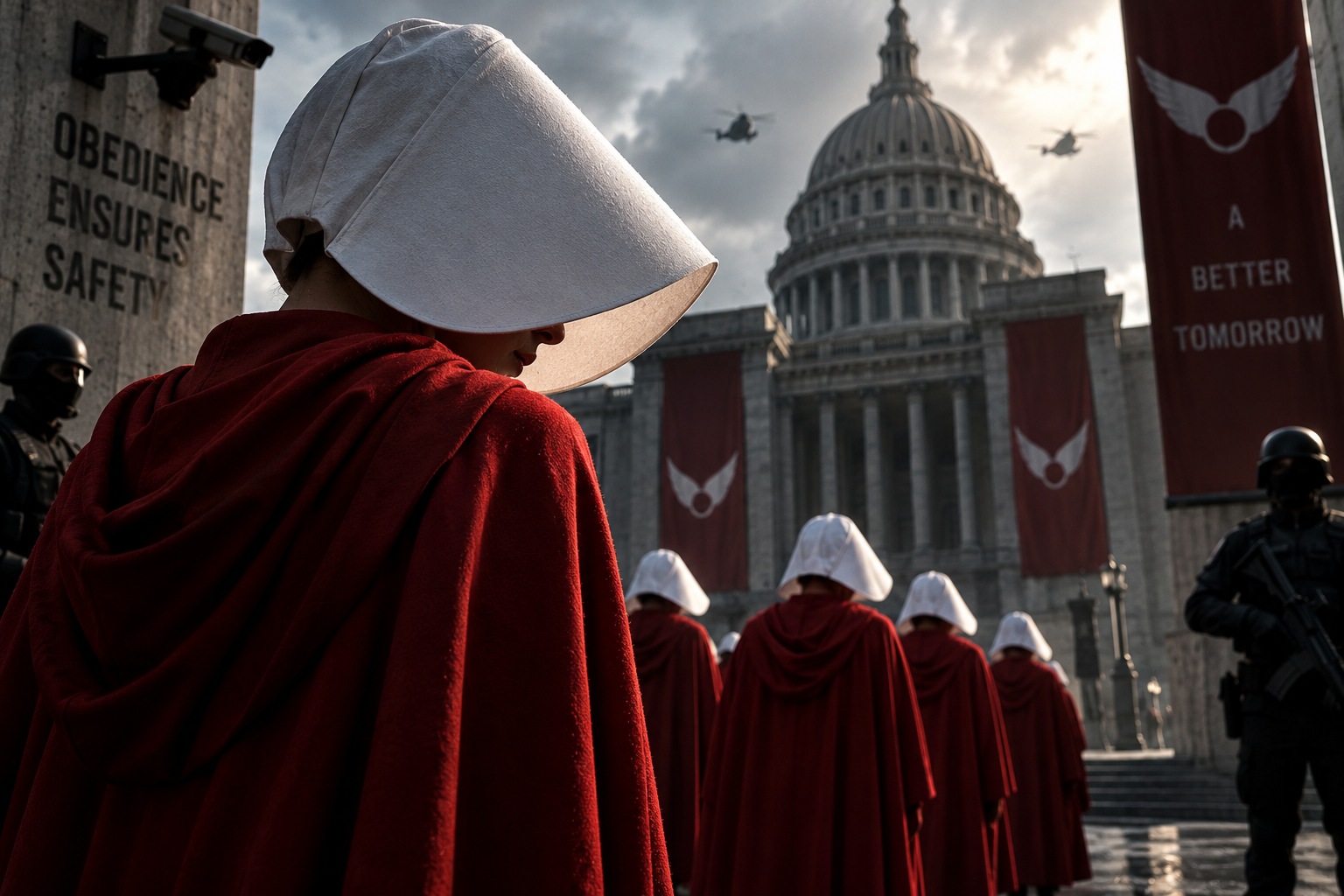
Could The Handmaid's Tale Really Happen? The Warning Behind Gilead
Are We Closer to Gilead Than We Think?
Margaret Atwood imagined a world in which women could no longer own property, control their finances, read freely or decide what happened to their bodies. Their identities were erased, their children taken away and their reproductive abilities placed under government control.
The most disturbing part of The Handmaid’s Tale is that Atwood did not invent these forms of oppression from nothing.
Published in 1985, her novel follows a woman known as Offred, who survives inside the Republic of Gilead, a dictatorship established after the violent overthrow of the United States government. Fertile women are enslaved and assigned to powerful households to produce children for the ruling class.
More than four decades later, the novel raises an uncomfortable question: could a society like Gilead actually emerge in the modern world?
To answer it, we need to understand what happens in Atwood’s original story, how Gilead acquires power, why ordinary people become complicit and what documented examples of reproductive control, authoritarianism and the removal of women's rights reveal about the novel's warning.
What Happens in The Handmaid’s Tale? The Rise of Gilead Explained
The world of The Handmaid’s Tale begins with a catastrophe that gradually becomes an excuse for political control.
Environmental pollution, disease and declining fertility have created widespread anxiety about humanity's future. Falling birth rates make reproduction a national concern, while social instability leaves the existing political order vulnerable.
An extremist movement exploits the crisis. Following a violent attack on the American government, the Constitution is suspended, democratic institutions are dismantled and a new theocratic state establishes itself across much of the former United States.
The Republic of Gilead claims that its purpose is to restore moral order, protect families and secure the survival of future generations.
Its methods reveal something very different.
Women's bank accounts are frozen, employment is prohibited and legal independence disappears. Men become the recognised heads of households, while women are reorganised into strictly defined social categories.
The regime does not immediately announce every consequence of its revolution. Restrictions accumulate, each one making resistance more difficult.
For ordinary women, the loss of financial independence is particularly devastating. Without access to money or legal authority, leaving an abusive household or resisting government orders becomes increasingly dangerous.
The novel reveals this transformation through Offred's memories of her former life.
Before Gilead, she was an ordinary American woman. She had a job, a husband named Luke and a young daughter. Her relationships, ambitions and everyday decisions belonged to her.
When the new government imposes its restrictions, the ordinary mechanisms of independent adulthood begin disappearing.
Offred loses her employment. Her access to money vanishes. Luke, as her husband, becomes the person through whom her remaining financial security must operate.
Eventually, the family attempts to escape across the Canadian border.
Their attempt fails. Offred is separated from Luke and their daughter, and she is captured by the regime.
The novel never provides a reassuring account of what happened to Luke after their separation. Offred is left with competing possibilities: he might be dead, imprisoned or somehow living beyond Gilead's control.
Her daughter's whereabouts are similarly withheld until Offred is shown evidence that the child is alive and has been placed with another family.
That uncertainty is central to Gilead's cruelty.
The government has taken away the people Offred loves, but it also controls the information that might allow her to know whether they are safe.
She cannot find them, contact them or determine what has become of them.
Her old identity is gradually replaced by the role the regime has assigned her.
She becomes Offred.
The name itself announces her new condition: she is attached to a Commander named Fred. Her identity is defined through a powerful man rather than through herself.
The story never definitively identifies her original name in the 1985 novel.
For Gilead, this loss of personal identity is intentional. The regime wants women to understand themselves through the functions they perform for the state.
Offred's function is reproduction.
Why Gilead Divides Women into Different Classes
Gilead's social hierarchy is built around the idea that every person must occupy a predetermined position.
Commanders hold political and military power. Their Wives enjoy elevated social status, although they remain subordinate to male authority.
Handmaids occupy a particularly disturbing position.
They are fertile women assigned to elite households where they are expected to become pregnant and surrender any children they bear.
Marthas perform domestic labour. Aunts supervise and indoctrinate Handmaids, exercising limited authority within the regime. Econowives undertake multiple household roles in lower-status families.
Other women face punishment, exile to dangerous labour colonies or death if they are classified as unacceptable.
Gilead also enforces racial, religious and sexual persecution. Its hierarchy is not simply a division between men and women; it is a broader political system in which identity, status and perceived usefulness determine survival.
The clothing assigned to each female category reinforces those distinctions.
Handmaids wear red garments and white head coverings that restrict their field of vision. Wives wear blue or blue-green clothing, and Marthas wear green.
These colours make social position immediately visible.
An individual can be identified, monitored and judged before speaking.
The Handmaids' uniforms perform another function: they make the women interchangeable.
A Handmaid's individual history matters less to Gilead than her reproductive capacity.
Her body is treated as a national resource. Her personal identity is treated as something that can be removed.
The Ceremony: How Reproduction Becomes State-Enforced Sexual Violence
The central institution governing Offred's life is the Ceremony.
At prescribed times, the Commander attempts to impregnate her through a ritual of sexual violence carried out in the presence of his Wife, Serena Joy.
Gilead claims biblical justification for the practice, drawing selectively on the story of Rachel, Jacob and Bilhah.
The ritual is presented as a sacred obligation rather than an act of coercion.
Offred has no meaningful ability to refuse.
The Ceremony is therefore not an ordinary sexual relationship or a consensual arrangement. It is institutionalised rape, authorised by the regime and enforced through its threats of punishment.
Serena Joy's role is also revealing.
Although she occupies a privileged position, she is required to participate in a system that humiliates her and makes another woman's body central to her marriage.
Gilead gives Serena status while denying her independent authority.
The arrangement produces resentment between the women, although the principal responsibility belongs to the coercive institutions that force them into these positions.
The regime insists that reproduction is too important to be left to personal choice.
Yet it applies that principle almost exclusively to women.
Male infertility is politically unacceptable as an explanation for unsuccessful conception. Women bear the blame when a pregnancy does not occur.
This contradiction exposes the distance between Gilead's stated concern about fertility and its actual distribution of power.
A government genuinely interested only in improving reproductive health would have reason to investigate all potential causes of infertility.
Gilead instead preserves the authority and reputation of powerful men.
Its reproductive system serves the hierarchy as much as its declared demographic objectives.
Offred's Resistance: Forbidden Memories, Secret Relationships and Survival
Offred's resistance is quieter than the rebellion typically associated with dystopian fiction.
She is not leading an army or organising a revolution.
Much of her defiance takes place inside her own mind.
She remembers ordinary freedoms: shopping, working, choosing what to wear, reading, speaking without rehearsing every sentence and spending time with the people she loves.
These memories are painful because they remind her of what has been taken.
But they also prevent Gilead from completely rewriting her understanding of herself.
She remembers being a person before she became a Handmaid.
Her memories are particularly important because the regime controls language, information and the official explanations of history.
Women are forbidden to read, making independent access to written information almost impossible.
Even everyday objects become significant when written words are removed from public life.
Reading is dangerous because it allows individuals to encounter ideas beyond the authorised interpretation supplied by the state.
It also offers access to records, histories and alternative explanations that the regime cannot easily control.
Offred's personal narrative becomes an act of preservation.
She may not have the power to overturn Gilead, but she can retain an account of life that contradicts its ideology.
The Commander and His Forbidden Privileges
Although the Commander occupies a position of authority within a regime claiming strict religious morality, his private behaviour repeatedly contradicts its public rules.
He begins inviting Offred into his study, where they play Scrabble.
In another society, the activity would be unremarkable.
In Gilead, it is dangerous because women are forbidden to read.
The Commander later allows Offred access to forbidden reading material and takes her outside the household's approved routines.
These encounters reveal the hypocrisy of a system that treats literacy and personal freedom as threats when exercised by women, but as privileges when authorised by powerful men.
The Commander enjoys the ability to suspend rules for his own satisfaction.
Offred cannot.
His attention gives her temporary access to things she has been denied, but it also places her in an increasingly precarious position.
What appears to be personal indulgence is inseparable from the enormous imbalance of power between them.
The Commander can expose Offred to punishment, even when he has initiated the prohibited behaviour himself.
His private relationship with her never becomes an equal relationship.
It demonstrates how selective exceptions reinforce authoritarian authority: those with power can break rules that continue to bind everyone else.
Serena Joy, Nick and the Risk of Intimacy
Serena Joy suspects that the Commander may be unable to father a child.
Concerned about the consequences of Offred's failure to conceive, she arranges for Offred to have sex with Nick, the household's chauffeur, hoping that a pregnancy will result.
The arrangement begins under pressure, with Offred's reproductive function again taking priority over her independence.
But Offred subsequently develops a private relationship with Nick.
Their connection creates a space in which she can experience intimacy beyond Gilead's official rituals.
For Offred, the relationship offers comfort, emotional attachment and an escape from the impersonality of the Ceremony.
It also creates danger.
Nick's loyalties are initially uncertain. He may be connected to Gilead's secret police, to the resistance or to both worlds.
In a society constructed around surveillance, trusting another person becomes an act with potentially fatal consequences.
Offred increasingly depends on moments of personal connection while knowing that intimacy can expose her to punishment.
This tension is one of the novel's most psychologically convincing features.
A repressive state does not have to eliminate the human desire for love.
It only has to make that desire dangerous enough that people become afraid of acting on it.
Ofglen and the Underground Resistance
Offred's shopping companion, Ofglen, initially appears to be another woman obediently performing her assigned duties.
Their conversations are constrained by the knowledge that either might be an informer.
Gradually, Offred discovers that Ofglen has connections to Mayday, an underground organisation resisting Gilead.
This discovery changes her understanding of the society around her.
The regime appears almost universally obedient because people have powerful reasons to conceal their real beliefs.
Outward compliance does not necessarily indicate genuine loyalty.
Ofglen's participation suggests that organised resistance exists beneath the appearance of total submission.
Nevertheless, Offred remains cautious.
Joining a resistance movement would introduce risks she cannot fully calculate, particularly while she continues to hope for information about her husband and daughter.
Later, she discovers that the original Ofglen has died by suicide after the authorities moved against her.
A replacement appears, occupying the same assigned identity.
The ease with which one woman disappears and another assumes her designation reveals the regime's treatment of people as replaceable functions.
Offred's caution becomes even more understandable.
She has witnessed what may happen to those who challenge the system.
Her limited resistance reflects the circumstances of someone whose survival depends on judging which risks can be endured.
The Handmaid's Tale Ending Explained: Does Offred Escape?
The final chapters leave Offred facing the possibility that her secret activities have been discovered.
Serena Joy confronts her about her forbidden association with the Commander, including his visits with her to the illicit club Jezebel's.
Offred understands that her position is becoming extremely dangerous.
Soon afterwards, a vehicle arrives to take her away.
Men associated with the Eyes, Gilead's secret police, enter the household.
Nick tells Offred that the men are connected to Mayday and that she should trust him.
But Offred cannot verify his claim.
She has no reliable way of determining whether the vehicle represents rescue, interrogation or execution.
The Commander and Serena Joy react with alarm as she is taken away.
Offred enters the vehicle without knowing what will happen to her.
The main narrative ends without definitively revealing whether she reaches safety.
This uncertainty is deliberate.
The reader experiences the same fundamental lack of reliable information that has shaped Offred's life.
She must choose whether to trust Nick despite having no independent proof.
Her decision occurs in a world where the consequences of being wrong may be irreversible.
What the Historical Notes Reveal
The novel does not finish with Offred's departure.
It contains an additional section, the Historical Notes, presented as an academic discussion taking place in the year 2195.
Scholars are examining surviving evidence from the Gileadean period.
They explain that the narrative attributed to Offred was reconstructed from a collection of audio recordings discovered long after the events described.
This revelation changes the reader's understanding of the preceding story.
Offred's account has survived.
Her experiences have become historical evidence, despite the regime's efforts to silence people like her.
The conference also establishes that Gilead is no longer the ruling political order in the scholars' world.
The dictatorship, which seemed almost permanent within Offred's narrative, has become an object of historical study.
However, the surviving documents do not establish Offred's ultimate fate.
The scholars cannot conclusively determine her later movements or final circumstances.
The Historical Notes support the possibility that Nick arranged her removal through the resistance, but they do not provide a complete record of a successful escape and subsequent life.
That distinction matters.
The strongest conclusion is that Offred was given a possible route out of Gilead, not that the original novel definitively confirms her safety.
Why the Final Academic Conference Is So Important
The Historical Notes also contain a quieter criticism of how suffering is remembered.
Professor Pieixoto, one of the academics examining Offred's recordings, approaches her account primarily as a historical artefact.
He is interested in reconstructing the political structures of Gilead and identifying the powerful figures mentioned in the tapes.
The resulting discussion contains moments of detachment and humour that sit uncomfortably beside the experiences Offred describes.
The scholars have access to her voice, yet their methods risk reducing her suffering to an object of academic curiosity.
The effect is deliberate within the novel's structure.
Even after an oppressive regime disappears, later generations may fail to appreciate the human consequences of its institutions.
They may become more interested in the identities of powerful men than in the people those men controlled.
Offred's testimony therefore has two forms of significance.
It is evidence about a vanished dictatorship.
It is also the record of an individual who struggled to preserve her humanity inside that dictatorship.
The fact that Gilead eventually became history does not automatically mean everyone who studies it understands what its victims endured.
That is the novel's final complication.
A society can survive authoritarianism without fully overcoming the attitudes that once helped sustain it.
Could Gilead Really Happen? The Historical Evidence Behind Atwood's Fiction
Margaret Atwood has explained that she deliberately avoided inventing forms of oppression without historical precedent.
When developing The Handmaid's Tale, she drew on documented practices involving forced reproduction, restrictions on literacy, the seizure of children, political persecution and the denial of women's legal independence.
Her method was to combine elements of history within a single fictional political system.
That does not mean Gilead is an accurate description of any one historical society.
It means its institutions were constructed from actions that human governments and institutions had already carried out.
This distinction is essential when comparing the novel with the modern world.
A restrictive reproductive law does not automatically make a country equivalent to Gilead.
Nor does evidence of authoritarianism establish that a society will inevitably develop every institution described in Atwood's fiction.
The more useful question is whether particular mechanisms of control resemble practices that have existed in reality.
Several historical examples make that comparison possible.
Romania: When the Government Attempted to Control Births
One of the most direct historical comparisons is communist Romania under Nicolae Ceaușescu.
In 1966, the Romanian government introduced Decree 770, sharply restricting access to abortion and contraception.
The policy was intended to increase the country's birth rate.
The state treated women's reproductive decisions as matters of national demographic policy rather than individual choice.
The restrictions were accompanied by intrusive systems of enforcement and placed enormous pressure on women, families and medical professionals.
Instead of eliminating unintended pregnancies, the policies contributed to dangerous conditions in which many women sought illegal abortions.
Research published after the dictatorship's collapse documented the severe public-health consequences.
Romania recorded a maternal mortality rate of 159 deaths per 100,000 live births in 1989, with researchers estimating that approximately 87% of those deaths resulted from unsafe illegal abortions.
The figures show how a government programme intended to increase childbirth could produce substantial harm to the people expected to fulfil that objective.
There are important differences between Romania and Gilead.
Romania did not operate a system of Handmaids assigned to Commanders through religious ceremonies. Its ideological justification was rooted in state demographic and political objectives rather than Gilead's invented theology.
Nevertheless, the common mechanism is striking.
Both systems subordinate individual reproductive decisions to a government-defined population objective.
The consequences demonstrate that state control over reproduction is not merely a speculative literary device.
It has been attempted through actual law, surveillance and medical restrictions, with documented human costs.
The Historical Removal of Children
Atwood's depiction of Offred losing her daughter draws on another pattern found across different historical settings.
Governments and institutions have separated children from their parents for reasons associated with ideology, ethnicity, social status and political control.
Such policies have appeared in different forms, including programmes of forced assimilation and child removal.
Gilead's distinctive version links the seizure of children to its reproductive hierarchy.
The regime claims that children should belong to approved households capable of raising them according to its ideology.
Biological parenthood is subordinated to political classification.
Offred's daughter becomes inaccessible because the state claims the power to decide which family should raise her.
This is one of the novel's clearest demonstrations of how authoritarian control reaches beyond public institutions.
It changes intimate relationships and determines which forms of family life are permitted to exist.
Why the Religious Justification Matters
Gilead's ruling ideology relies on a selective and coercive interpretation of scripture.
Its leaders present their policies as expressions of divine authority, yet their private lives repeatedly contradict the morality they impose.
The Commander participates in forbidden activities while occupying a position within the government that condemns them.
The regime's ideological language helps it portray political decisions as religious obligations that ordinary citizens should not question.
This is not an argument that religion inevitably leads to authoritarianism.
Religious communities have also played important historical roles in protecting persecuted people and challenging oppressive governments.
The relevant distinction is between voluntary religious belief and the coercive use of state power to impose one authorised interpretation on everyone.
In Gilead, dissent is treated as both political disobedience and moral corruption.
That combination makes opposition more difficult because the government claims authority over law, conduct and conscience simultaneously.
Women's Rights in 2026: Where the Real World Resembles Gilead
The most significant modern parallels concern particular rights and restrictions rather than the existence of a complete Gilead-like society.
Laws governing abortion, education, employment, public participation and freedom of movement vary substantially around the world.
Some countries protect extensive individual liberties through constitutional rights, independent courts and democratic institutions.
Others impose restrictions that remove fundamental areas of independence from women.
Understanding the differences is essential.
Afghanistan: The Removal of Education, Employment and Public Freedom
Afghanistan provides one of the clearest contemporary examples of a government dramatically restricting women's participation in public life.
Following the Taliban's return to power in August 2021, the authorities introduced extensive restrictions on education, employment, movement and public behaviour.
By August 2026, UN Women reported that more than 100 decrees affecting women and girls had been issued since the takeover.
Women and girls faced severe limitations on access to education, paid work, public spaces and aspects of healthcare.
UN Women also reported that half of the Afghan women it surveyed left home only once or twice each month, reflecting the extent of restrictions on movement and public participation.
UNICEF has warned that the exclusion of girls from education and women from employment threatens the country's future workforce, including its supply of female teachers and healthcare professionals.
These policies are materially different from Gilead's fictional reproductive slavery.
Afghanistan does not operate the Handmaid caste system described in Atwood's novel.
However, there are clear comparisons in the mechanisms through which women's independence can be reduced.
Education becomes restricted. Employment opportunities disappear. Public participation becomes conditional. Enforcement of behavioural rules limits ordinary daily choices.
The results affect more than individual freedom.
When women are excluded from education and professional work, societies also lose expertise, income, medical capacity and future opportunities.
The Afghan experience demonstrates that substantial rights can be removed through government decisions within a relatively short historical period.
The United States: Abortion Law and Reproductive Autonomy
The United States offers a different and more politically contested comparison.
In June 2022, the US Supreme Court overturned Roe v. Wade through its decision in Dobbs v. Jackson Women's Health Organization.
The ruling removed the federal constitutional protection for abortion previously recognised under Roe and returned substantial regulatory authority to elected lawmakers and state governments.
As of September 2026, the Guttmacher Institute reported that 13 US states enforced total abortion bans, subject to limited exceptions, while 28 others imposed restrictions based on gestational duration.
Abortion remained legally available under different rules elsewhere, and access continued through mechanisms including interstate travel and telehealth where permitted.
The legal landscape remained contested in October 2026, including disputes involving abortion medication and the extent to which providers in one state could serve patients in another.
Supporters of abortion restrictions commonly argue that the state has a legitimate interest in protecting prenatal human life and that elected legislatures should determine applicable limits.
Opponents argue that restrictive laws interfere with bodily autonomy, medical decision-making and access to healthcare, especially where patients cannot readily travel or obtain treatment.
Those disagreements are substantial and involve competing moral, legal and constitutional claims.
The comparison with Atwood's novel concerns the extent to which the government may exercise authority over reproductive decisions.
It is not evidence that the United States operates Gilead's system of reproductive enslavement.
The country's federal structure, elections, courts, civil society organisations and differing state laws represent major institutional distinctions from Atwood's one-party dictatorship.
Nevertheless, the debate demonstrates that reproductive autonomy is not a politically settled issue and that the legal position can change through major judicial and legislative decisions.
A right regarded as constitutionally protected for decades may be reconsidered or replaced within a different legal framework.
That possibility is relevant to the novel's broader concern with the durability of established freedoms.
Why the Differences Matter
Comparing every abortion restriction or conservative religious belief with Gilead risks obscuring what makes the fictional regime distinctive.
Gilead combines several extreme features simultaneously: the destruction of democratic government, the abolition of women's independent legal status, compulsory reproductive servitude, systematic political terror and severe restrictions on education and expression.
A society may contain one or more restrictive policies without possessing that entire institutional structure.
In the same way, a country may experience democratic backsliding without inevitably becoming a theocracy.
The novel is most useful when it encourages precise scrutiny of institutions and coercive mechanisms rather than treating every contemporary political disagreement as proof of an approaching dictatorship.
How Ordinary People Become Part of an Authoritarian System
One of the novel's strongest arguments concerns the relationship between dramatic political change and everyday adaptation.
Gilead maintains control through violence, but violence alone cannot explain its apparent stability.
The regime also depends on cooperation, incentives, fear and the gradual normalisation of restrictions.
Different characters illustrate these mechanisms.
The Commander benefits directly from the hierarchy and privately enjoys privileges denied to others.
Serena Joy exercises limited power over Offred while remaining subject to the same wider patriarchal system.
The Aunts enforce rules against other women, presenting submission as a necessary or honourable duty.
Ordinary citizens perform approved identities while concealing forbidden thoughts.
Each person operates within a different combination of belief, coercion and self-interest.
This complexity matters because authoritarian governments rarely consist only of a small number of leaders issuing orders.
They also require institutions to administer regulations, personnel to enforce them and populations whose behaviour becomes constrained by the expectation of punishment.
Fear Can Make Opposition Invisible
Offred's relationship with Ofglen illustrates how fear distorts public perceptions of political support.
For much of their relationship, neither woman knows what the other truly believes.
They speak cautiously because a single dangerous remark could lead to denunciation.
When Offred discovers Ofglen's connection to resistance, she learns that apparent conformity may conceal opposition.
This creates an important distinction between genuine consent and obedience produced by fear.
A crowd that appears supportive of an authoritarian system may include individuals who are privately terrified of challenging it.
Silence cannot automatically be treated as approval.
The regime benefits when citizens cannot distinguish committed supporters from frightened participants.
That uncertainty discourages cooperation among potential opponents.
People become isolated even when they share the same objections.
The Normalisation of Lost Freedom
Offred repeatedly contrasts her present circumstances with memories of life before Gilead.
The difference between the two worlds is enormous.
Yet the process through which freedom disappears involves more than a single announcement.
Her loss of financial access and employment precedes her complete subjugation.
Each restriction alters the options available when the next restriction arrives.
Once a person has lost access to money, the means of organising resistance or escape may already have become limited.
Once independent institutions have been weakened, challenging further restrictions becomes harder.
Once people have been separated into approved and disapproved groups, collective opposition becomes more difficult.
This is not a universal formula by which every dictatorship develops.
It is the particular pattern through which Atwood makes Gilead's establishment intelligible.
The novel demonstrates how restrictions can become mutually reinforcing.
By the time the full structure of repression is visible, many of the means that might have prevented it have already been weakened.
Why Controlling Language, Memory and Women's Bodies Gives Gilead Power
Atwood's fictional government controls far more than childbirth.
It controls the categories through which people understand themselves.
A woman becomes a Wife, Martha, Aunt, Econowife or Handmaid.
Her assigned role determines clothing, permitted behaviour, social standing and legal treatment.
These categories turn an individual's complex identity into an officially approved function.
Offred's name is particularly significant because it represents the replacement of personhood with possession.
Her memories challenge that replacement.
She remembers a life in which the government did not define her exclusively by reproductive ability.
Those memories allow her to recognise the gap between the regime's claims and its actions.
Gilead also manipulates the language of protection.
The authorities argue that women are safer under the new system because conventional sexual freedom and social disorder have supposedly been removed.
But the protection they offer requires the surrender of personal independence.
The regime presents obedience as the price of security.
It creates circumstances in which the government claims responsibility for protecting women from dangers while simultaneously denying them the authority to make decisions about their own lives.
This contradiction exposes a broader political question.
When does the state's claim to protect citizens become a justification for limiting their choices?
There is no single answer applicable to every law or society. Governments routinely regulate behaviour in pursuit of public health, security and competing rights.
The distinctive problem in Gilead is that those restrictions are enforced without democratic accountability, meaningful individual consent or independent institutions capable of limiting state power.
The regime offers no effective route through which Offred can challenge her assigned status.
She cannot vote it away, appeal to an independent court or seek protection from a free press.
Her body has become an instrument of government policy, and the government has eliminated the institutions through which she might contest that policy.
What The Handmaid's Tale Gets Right About Power — and Where the Analogy Has Limits
Atwood's novel is especially effective at showing how apparently contradictory ideas can coexist within an authoritarian state.
A regime can publicly praise motherhood while treating individual mothers as disposable.
It can claim to defend moral purity while permitting powerful officials to violate the rules in private.
It can emphasise family values while separating children from their families.
It can describe its restrictions as necessary for safety while making everyday life dangerous for anyone who fails to conform.
These contradictions are important because political institutions are not always best understood through their declared objectives.
Their effects also depend on who exercises authority, who bears the costs and who receives exceptions.
The Commander illustrates the distance between official ideology and privileged behaviour.
Offred's experiences reveal what the same ideological system means for someone without political power.
The novel also shows why individuals do not always respond to oppression in predictable ways.
Some resist. Others collaborate. Many try to survive without making decisions that would endanger themselves or those they love.
Offred does not become less important because she fails to lead an organised rebellion.
Her circumstances reveal how limited choice becomes when political power can reach into every aspect of private life.
But the novel should not be treated as a precise forecast.
It does not establish that declining birth rates inevitably produce authoritarianism, that religious belief inevitably becomes coercive or that modern political disputes will necessarily culminate in dictatorship.
Atwood designed Gilead as an imagined combination of historically recognisable practices.
The originality lies in bringing those practices together and considering what life would feel like for someone trapped inside them.
Real societies possess different institutions, histories and political possibilities.
They can also reverse restrictions, expand rights and hold authorities accountable.
The Historical Notes make that distinction particularly significant.
Gilead does not last forever.
The Final Warning: Could The Handmaid's Tale Become Reality?
The answer depends on what is meant by reality.
A society identical to Atwood's Gilead is not an inevitable destination for any modern country.
Its combination of religious dictatorship, reproductive enslavement, caste hierarchy and political terror remains fictional.
Yet the individual practices from which Atwood constructed that society have real historical precedents.
Governments have restricted reproductive decisions, separated parents from children, denied women access to education, limited economic independence and persecuted people for political or religious nonconformity.
Contemporary evidence also demonstrates that access to basic rights can differ sharply between countries and can change substantially over time.
The novel's enduring relevance lies in the relationship between those restrictions.
A government that limits one freedom may also weaken the practical ability to exercise another.
Financial independence can affect whether a person can leave a dangerous situation. Education can affect access to information. Freedom of expression can affect the ability to challenge laws. Independent courts can affect whether arbitrary decisions can be contested.
Gilead removes those safeguards together.
Offred's story reveals the human consequences.
She does not simply lose the right to make reproductive decisions. She loses control of her name, work, relationships, movements and access to her own child.
Her world becomes one in which the most personal aspects of life are governed by institutions she cannot challenge.
Yet the novel's final perspective also contains a crucial qualification.
Gilead eventually becomes history.
Offred's testimony survives the government that attempted to erase her identity.
The dictatorship's apparent permanence is revealed as an illusion.
The Handmaid's Tale is therefore both a study of how authoritarian control can be constructed and a reminder that even entrenched systems can end.
Its deepest warning is about the fragility of freedom when the institutions protecting it are dismantled.
Its final source of hope is that the institutions of oppression do not necessarily outlive the people who remember what freedom meant.
Sources
The Handmaid's Tale — Penguin Random House — Publisher's description of the original novel, its characters and the Republic of Gilead.
Haunted by The Handmaid's Tale — Margaret Atwood — Atwood's first-hand explanation of the book's historical influences, writing and political premises.
The Handmaid's Tale: What Does the Ending Mean? — SparkNotes — Explanation of the ambiguous ending and Historical Notes.
The Handmaid's Tale: Chapters 45–46 and Historical Notes — SparkNotes — Further discussion of the conclusion and the reconstruction of Offred's testimony.
Reproductive Health in Romania: Reversing the Ceausescu Legacy — PubMed — Historical research on Romania's reproductive policies and maternal mortality.
State Bans on Abortion Throughout Pregnancy — Guttmacher Institute — US state abortion restrictions as of September 2026.
Five Years After the Taliban Takeover — UN Women — August 2026 reporting on restrictions affecting Afghan women and girls.
Restrictions on Girls' Education and Women's Employment in Afghanistan — UNICEF — Research on the consequences of education and employment restrictions.
Next Reads
1984 (George Orwell) Summary — Surveillance, political control, language and the destruction of independent thought.
Brave New World Summary: Plot, Themes, and What It Really Means — A different dystopian society organised around conformity, pleasure and engineered behaviour.
The Testaments (Margaret Atwood) Summary — Atwood's sequel and the later history of Gilead.
Fahrenheit 451 Summary & Review — Plot-First Breakdown — Censorship, intellectual independence and a society that suppresses books.
