What the Five Stone Objects Mean
The King Needs His Captive to Look Like a Queen
Sybil Delling could ruin her wedding simply by telling the guests how she came to be the bride. Unfortunately, King Benedict has spent rather more time preparing for that possibility than he has thinking about married life. He controls what Sybil drinks, who stands beside her and what the people of Traum have heard about the fall of Aisling Cathedral. In Rachel Gillig’s The Knave and the Moon, the concluding novel of the Stonewater Kingdom duology, his grandest idea is to take the wedding celebrations on tour. It sounds like another cruelty for Sybil to endure. Then the king makes a mistake familiar to anyone who has ever organised a sporting event. Once the competition begins, the crowd can choose its own favourite.
What Survived the Fall of Aisling Cathedral?
By the end of The Knight and the Moth, Sybil had good reason to believe she knew what had gone wrong in Traum. The abbess who raised her had taken children, called them Diviners and repeatedly drowned them in the spring beneath Aisling Cathedral. The visions they experienced gave the abbess authority over people who came seeking answers. Five beings known as the Omens received the reverence due to gods. Sybil had lived close enough to the centre of this arrangement to consider her place in it a privilege. Getting outside the cathedral allowed her to see what the privilege had cost.
Benedict Castor III, or Benji, helped Sybil and the knight Rodrick Myndacious bring down that order. He therefore knows who destroyed the cathedral. When he tells the kingdom that sprites did it, he can speak with the authority of someone who was there. That is a particularly difficult kind of liar to expose. An honest witness might remember a detail differently or admit that part of the night passed in confusion. Benji can offer something more satisfying to a frightened population. He has a culprit, a surviving Diviner and five holy objects he can put on display.
He gives the objects that belonged to the Omens to his knights. The arrangement lets the public keep much of what it already believes. There is still magic in the world. It still favours a select few. People who wish to see its wonders can gather around men who enjoy the blessing of the crown. For anyone whose sense of order disappeared with the cathedral, this is a considerably easier proposition than hearing what happened to children in the spring.
Sybil presents a difficulty because she can speak. A stone inkwell will never contradict the account given by the man who holds it. The last Diviner might. Benji’s solution is to marry her, keep her drugged and use the old name Six when addressing her. Even his choice of name economises on the work of domination. Someone else has already taught Sybil to answer to a number. All he has to do is keep saying it.
A Wedding Wound Changes Sybil’s Plan
At the wedding, Benji secretly arranges an attack by tree sprites. He wants the danger in his story to come obligingly to life before witnesses. He gets a spectacle, although events soon escape his direction. Under the influence of the sedative ox-eye, Sybil speaks of a kingdom breaking apart. A spear thrown by the knight Tory Bassett strikes her in the abdomen. The woman Benji needs the kingdom to admire has acquired a wound that could kill her in front of everybody.
Years in the tor spring have changed Sybil’s body. Limestone has formed around her organs, and it helps her survive the spear. Survival leaves her in considerable pain. For the rest of the journey, the scar gives the book a second way of keeping time. The tournament can move on to a fresh town, announce another event and invite everybody to celebrate again. Sybil carries the wedding into each new place in the state of her abdomen. Whenever she tries to lift, fight or simply endure another appearance, an earlier act of violence comes due.
Her answer to Benji has a terrible neatness. She will smash the five objects through which his champions claim the inheritance of the Omens. Then she intends to die herself. Benji treats her as a sixth holy possession, and she has begun to count in the same way. Six things allow the king to command belief. Remove all six and he loses them forever.
It is possible to appreciate the intelligence of her assessment and still see the error in her arithmetic. Sybil has friends to whom the destruction of the inkwell and the death of Sybil Delling would mean entirely different things. At this point she has little reason to think those friends are alive. Gillig makes that isolation part of the reasoning behind her plan. From inside captivity, the king’s list looks horribly complete. The reader gets to leave the room before Sybil does.
A Knight Wakes Without His Name
Rodrick, usually called Rory, opens his eyes on the tor. Benji killed him. Maude Bauer, his fellow knight, has used water from the spring to bring him back. The man who wakes has pale stone eyes and cannot remember the people attending him. Maude and Bartholomew, the small stone gargoyle who accompanies them, have the awkward business of introducing a man to his own life. Among the things he must take on trust is the news that he loves a woman held captive by the king.
For a romance, this is a rather exacting experiment. Most lovers in fiction can privately consult the evidence for their feelings, however unreliable their interpretation of it. Rory has two people telling him that an experience belonged to him. He can believe them, feel grateful for their care and agree to help Sybil. None of those responses quite amounts to remembering what it was like to be in love with her. There is something generous in allowing the gap to remain open for a while. Sybil deserves more than a man loyally reciting what his friends have told him to feel.
His body supplies evidence of another kind. When he has to fight, he can do things he could never have explained a moment earlier. His ability to handle danger has survived the loss of his personal history. That makes him a credible entrant in the king’s tournament, which offers a route to Sybil. It also gives the title’s change from knight to knave some bite. Strip a knight of his name, his affiliation and the people prepared to vouch for him, and the very same skills can make him look decidedly suspicious.
Maude knows that the Heartsore Weaver’s loom stone can restore his memories. It is one of the five objects Sybil means to destroy. Their interests have converged on a wonderfully small margin of time. Sybil has every reason to break the stone as soon as she can reach it. Rory needs the chance to touch it first. At the joust at Coulson Faire, Maude creates an opening by crashing into the royal viewing box. Rory gets his hand to the stone. Sybil crushes it beneath her heel. To anybody watching the royal party, the most consequential thing to happen that day would have been very easy to miss.
What Sybil Hears Beneath the Knave’s Helmet
By the time the tournament reaches the Seacht, a competitor of uncertain origins can give the audience something Benji’s champions cannot. Nobody knows what he will do. Rory defeats Dedrick Lange in the melee and reveals his stone eyes. The public has learned to recognise eyes like those as a sign of holiness. Benji now has to explain why the sign has appeared in a man outside his chosen company, immediately after that man has beaten one of his knights in fair view of the crowd.
The king’s dilemma resembles the one Suzanne Collins gives the organisers in Sunrise on the Reaping. A regime invites people to care about a contest because their attention makes the occasion politically valuable. Caring also gives them a stake in what happens to the contestants. Benji could quietly dispose of an unknown traveller. Disposing of the remarkable man everybody has just watched would leave him with an awkwardly large number of people wanting to know where their favourite went.
Sybil has a more intimate problem of identification. A voice can sound familiar under a helmet. Earrings and the details of a man’s appearance can tell her that this is the body she remembers. His claim to have lost his memory remains plausible because it was once true. Rory and Maude have chosen to keep its recovery secret. Sybil needs to know whether the man in front of her recognises the life they shared, and Benji is almost the last person with whom she would like to discuss it.
She performs a Divination on Rory. The king sees an approved ritual being used to judge a potential champion. Within it, the two lovers find room for a private exchange. Rory repeats a promise he made to Sybil before he died. What persuades her is the combination of the words, the man saying them and a past to which the watchers have no access. Benji knows the ceremony well enough to supervise it. He knows rather less about the people taking part.
The scene also yields a discovery Sybil can feel immediately. A drop of Rory’s blood temporarily eases her pain. The spring water that brought him back has left something active in him, just as years in the spring left limestone in her. The relief has a limit. Her wound will trouble her again. For the moment, though, the lover who remembers her can give her a little time in which pain ceases to determine what she can do.
A Hammer Changes Hands
When Sybil tells Rory what she wants from the tournament, the answer is almost comically practical. She needs a hammer. Winning the melee would be one way to get her hands on one. A partner prepared to hand his over works just as well. For all the elaborate magic attached to the Omens’ possessions, the second book turns on the discovery that a sacred object can suffer the same fate as a poorly placed piece of crockery. Someone has to get close enough and be willing to swing.
The exchange also gives Rory a useful answer to a familiar difficulty for a returning romantic hero. Sybil has spent enough time in the company of people who know what to do with her. Rory could easily become another man with a plan for where she ought to go and what role she ought to play. Giving her the hammer requires him to listen to what she has already decided. Later, when he learns everything she means to do, he will have grounds to argue with her. His willingness to help precedes any assurance that they agree.
Meanwhile, the promise of tournament glory has begun to turn sour for Dedrick. The knight Rory defeated had counted on the prize money. When he learns enough about the spring to threaten Benji with exposure, the king stabs him. Amid an earthquake and the confusion that follows, Sybil smashes the Harried Scribe’s inkwell. Dedrick pulls her into the water as he falls. This time the person who comes to her rescue is a gargoyle in a pink robe.
Bartholomew’s appearance changes the emotional temperature in a way that a second handsome knight could scarcely manage. His clothes are funny. The danger of drowning is real. Sybil can experience the ordinary, overwhelming pleasure of discovering that a ridiculous and dearly loved friend is still alive at the very moment she needs his help. Much of the kingdom’s ceremonial life depends on dressing people appropriately for important occasions. Bartholomew’s pink robe does absolutely nothing to diminish his qualifications for this one.
What the King’s Grandfather Saw in a Dead Sprite
As the group travels onwards, Bartholomew produces a notebook that belonged to Benji’s grandfather. An observation recorded in it gives Sybil a new way to think about the tor. A water sprite, on dying, left behind limestone like the rock of the hill where Aisling stood. She has known that hill as the site of a building, the source of a spring and the centre of a religion. For the first time she has grounds to consider it as the remains of a creature.
The difference between those possibilities is enormous. People can quarry a hill or build on it without ever wondering what the hill experienced. A body demands another set of verbs. It can hurt, remember, stir under a weight. Sybil cannot yet know which of those words apply. The grandfather’s observation belongs to a single dead sprite. Its value lies in the better question it allows her to ask when she next takes ox-eye and sees something that happened long before her birth.
The drug itself comes from gowan flowers associated with the tor. Benji’s grandfather developed it while trying to reproduce the properties of the spring. His preparation can dull pain and bring on visions. It lacks the spring water’s power to restore the dead. Even the visions depend on who takes it. Maude tries the draught without experiencing what Sybil describes. Rory, whose resurrection has left him with stone eyes, sees the cathedral. Their different responses narrow the possibilities. The same dose can encounter a different history inside the body that receives it.
This is one of Gillig’s better uses of the two lovers. A second witness can give Sybil something that even an entirely devoted partner could never supply through reassurance alone. Rory can see part of what she sees. Maude’s failure to share the vision proves equally valuable. Together their experiences begin to prise apart two ideas the abbess profited from confusing. An extraordinary experience can be genuine while the religious explanation imposed on it is profoundly wrong. Sybil once had to trust the person charged with interpreting her visions. She now has the beginnings of a way to investigate one.
A Gargoyle Enters the Feats of Strength
The Fervent Peaks bring Sybil another offer of marriage. Avice Fischer is willing to help her move against Benji if she marries Avice’s son Hamelin. The terms are revealing. Someone can recognise that a king deserves to fall and still consider it perfectly reasonable to negotiate for possession of his wife. Sybil already knows what it feels like to have a public role make a private refusal inconvenient. She turns the offer down.
Outside, people are hungry. Sprites have been killed and displayed. An entire mountain has disappeared in the upheavals shaking the region. Against that background, the resources devoted to arranging a swimming race take on a grim absurdity. A spectator might reasonably want an afternoon’s pleasure in a frightening time. A ruler who keeps the whole procession moving owes his subjects a rather better account of his priorities. Each new venue gives the tournament a fresh start long after the people along its route have lost that luxury.
Bartholomew enters the feats of strength against Hamelin. During the swim, the knight uses the Ardent Oarsman’s magical oar to raise waves in his favour. Imagine trying to explain the fairness of that result to a child on the bank. One contestant has swum across the lake. The other has enlisted the lake’s assistance. The oar is an excellent advertisement for the surviving power of the Omens and a dreadful advertisement for the sporting merits of the man wielding it. Benji has asked the event to demonstrate two things that cannot comfortably be demonstrated together.
When the competition turns to breaking and lifting stone, the gargoyle comes into his own. Hamelin strikes him with the oar. Bartholomew catches it and snaps it. The third object goes the way of the loom stone and the inkwell, although this time Sybil has never had to lift her hammer. Hamelin turns on the gargoyle, Sybil intervenes and Benji uses the Artful Brigand’s coin. Its explosive force kills Hamelin. Avice, whose co-operation had seemed available for the price of a marriage, now has to receive the king who killed her son.
Bartholomew, meanwhile, is shedding pieces of himself. A stone creature can withstand a blow that would ruin a human body. It is tempting to watch him survive such a blow and assume he can go on doing it. Gillig gives the injuries an accumulating physical presence. Dust and broken limestone tell a story his good humour might otherwise allow his friends to overlook. The one contestant who could reasonably claim to have been made for this event will carry away damage that winning could never justify.
What Sybil Sees in the Burning Wood
By the hunt in the Chiming Wood, the fiction of a wedding celebration has worn very thin. Benji intends a birke, one of the tree sprites, to kill Sybil. His knight Samuel Eichel turns against him. Fire races through the grove, Samuel dies and Sybil breaks the Faithful Forester’s chime. Bartholomew carries her out. Anyone keeping count of the objects can mark down a fourth success. Anyone looking at the friend who has just got her to safety would find it hard to call the day a victory.
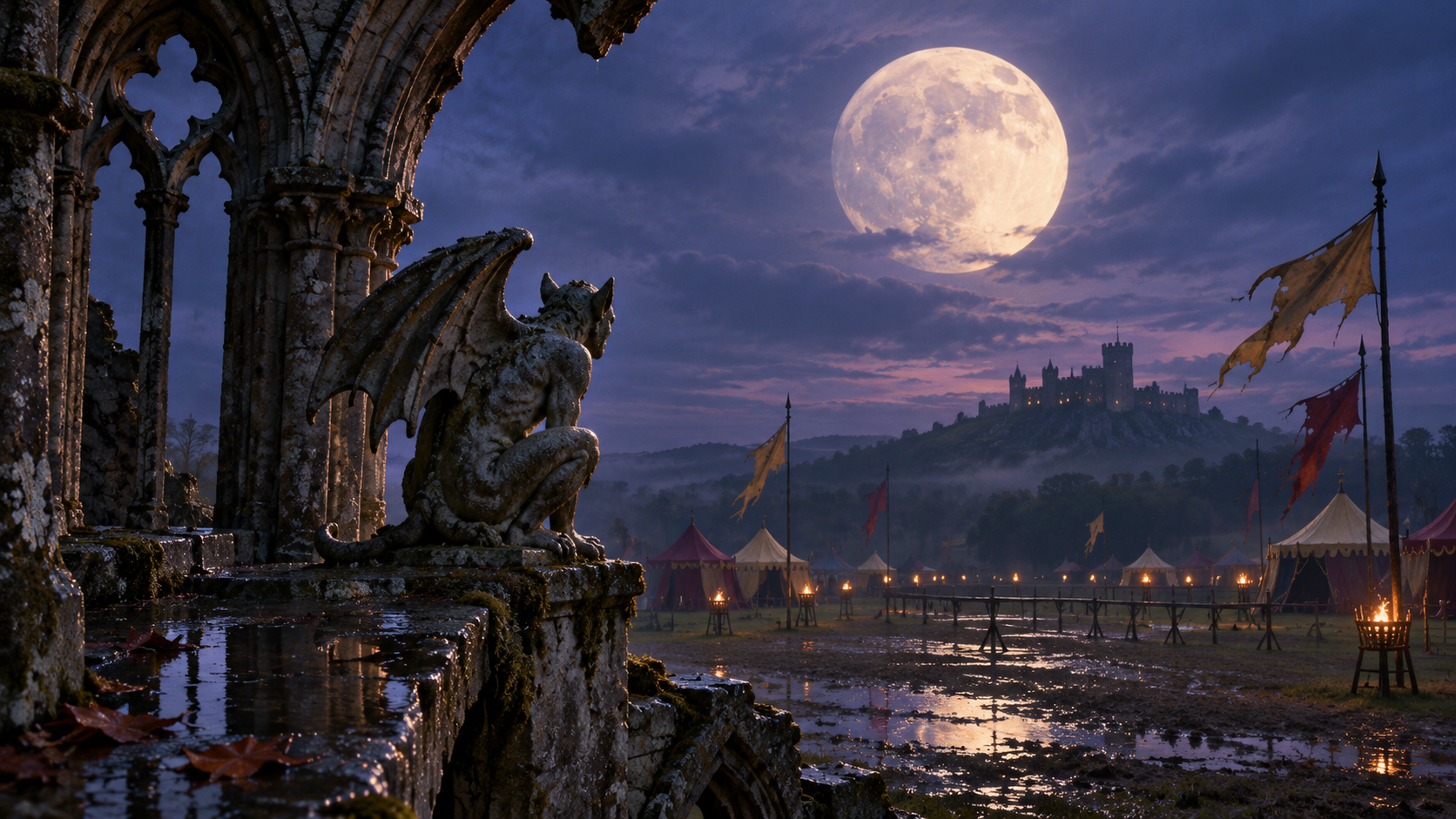
At Petula Hall, the group lays the injured gargoyle on a wool mattress. It is a small domestic image worth pausing over. Until now, much of the comedy has come from putting a creature made of stone into situations designed for softer bodies. After the fire, a mattress makes perfect emotional sense. His friends can see the stone coming away from him. Giving him something soft to lie on is one of the few things they know how to do. The book lets it count, even while everyone wants a cure.
Sybil takes an old preparation of ox-eye and sees the Diviner children in the spring. She also sees Bartholomew drawing them out, tending them and singing. The abbess organised what happened there and controlled the story told about it afterwards. That gave her a commanding position in Sybil’s memory. It never gave her exclusive ownership of everything that happened to those girls. Someone was there when they came out of the water. Someone noticed how frightened they were. Even his shortcomings as a singer have become precious evidence of who was present and what he tried to do.
Sybil also glimpses the girl she once was, promising her companions a future beyond the cathedral. That encounter gives her an answer to the despair she confessed to Rory. He can tell her that the kingdom would be poorer without her. Here she can hear what her younger self wanted for the people she loved, back when the world available to her was desperately small. It is harder to finish Benji’s inventory by erasing herself once she remembers that this hopeful child is among the people who would disappear.
The visions finally explain the upheavals beneath Traum. The tor is the body of an ancient sprite, Der ewige Mond, the Eternal Moon. The creature lives. With the cathedral’s weight lifted, it is stirring, and the earthquakes register its movement. The spring and the visions come from this older life. For generations, worshippers climbed towards the cathedral and attributed the wonders they found there to the beings honoured inside it. They had been walking on the source of those wonders all along.
Why Winning the Duel Cannot Settle the Ending
The royal party reaches the Cliffs of Bellidine to find people gathered on the beach for a funeral. Maude has brought the nobles together against Benji. They have dead children to account for, homes damaged along the route and ample opportunity to judge the character of the man who organised the tour. They take away his crown and name Maude ruler. The final duel goes ahead, with Sybil stepping forward to face him herself.
Notice the order. The political judgement comes before the fight. Sybil does not have to establish the truth of the families’ losses by proving herself better at hitting a man with a hammer. Nor could Benji earn back the trust of the bereaved through superior swordsmanship. Holding the two events so close together lets the reader feel the excitement of the duel without having to accept the rather dubious principle on which the tournament was founded, that winning a fight qualifies somebody to rule.
Sybil defeats Benji and has the opportunity to kill him while he lies unconscious. She carries him out alive. It is an astonishingly inconvenient decision for everybody who must deal with what he does next. He recovers the Brigand’s coin, whose other power allows him to escape, and heads for the spring. He intends to use its water to secure an enduring life for himself. Sybil and her companions have to follow him back to the tor.
There is a temptation to treat her earlier hesitation as a puzzle with one correct moral answer. Had she killed him on the beach, she might have prevented the losses still to come. Yet the people around the duel have already decided what kind of ending they wish to witness, and Sybil has spent much of her life completing ceremonies to other people’s satisfaction. Carrying an unconscious enemy out alive is one of the few decisions she makes that offers her neither advantage nor applause. It belongs to her, right down to its dreadful consequences.
At the spring the situation has changed. Sprites stand between Benji and the water. He still possesses the coin and is willing to use it against them. Sybil strikes him a fatal blow. Before he dies, he throws the coin at a mountain sprite. Maude puts herself in its path. Her intervention saves the creature and costs Maude her life. When Benji asks Rory for spring water, the man he once killed refuses him. He dies in reach of the miracle he wanted.
Maude’s death carries particular weight because the nobles have only just entrusted her with the kingdom. Gillig briefly allows us to imagine what kind of ruler this resourceful, difficult, loyal woman might become. Then Maude sees a creature under immediate threat and spends that whole imagined future to save it. Her family’s history of hunting sprites gives the choice a precise object. She cannot undo what earlier hunters did. She can decide whether this particular sprite will live long enough to leave the tor. For the creature concerned, it is the largest decision a ruler could make.
Why Sybil Takes Up the Hammer Again
Bartholomew bites through the coin and destroys the last of the Omens’ objects. His damaged body is giving way. He enters the spring and breaks apart, and Sybil goes into the water after him. Once again a Diviner drowns on the tor. For the first time in the story of her life, it is easy to understand why she went in without asking what information anyone hoped to obtain. Her friend was in the water.
In the vision that follows, the Eternal Moon takes the form of a great ox. Sybil learns how to give Bartholomew a body again. The limestone must come from the tor itself, the living stone from which he can be remade. The knowledge arrives as a gift from the being to whom that stone belongs. Earlier generations managed to extract wonders from the hill without troubling to ask what lived there. Sybil gets an answer because, at last, somebody is listening.
She has to do the carving herself. Gillig could have had the spring return the gargoyle intact, just as Rory might once have hoped that touching a stone would settle every difficulty between him and the people he loved. Instead, time and labour enter the miracle. Sybil has to know the shape of her friend well enough to give it back to him. The hammer Rory handed her during the tournament, so useful because it could break holy things, now does work for which a more violent swing would be a considerable disadvantage.
Bartholomew wakes with his memories. Recognition completes what craftsmanship began. A figure might resemble the old gargoyle in every visible detail and leave Sybil wondering who had opened his eyes. The creature who comes back knows his friends. After a novel in which a king used a woman’s familiar appearance to tell strangers a lie about her life, there is real satisfaction in a reunion whose meaning the people involved can establish for themselves.
Maude stays dead. Her friends bury her, and the people of the Chiming Wood scatter birch seeds over her grave. Leaving that loss in place prevents the spring from becoming an easy answer to bereavement. The survivors can honour her, tell people what she did and care for the creatures she died protecting. They still have to live through the ordinary cruelty of having something to tell Maude and discovering, yet again, that she is the one person they cannot tell.
What the Final Visit to the Tor Means
A hundred years later, Sybil, Rory and Bartholomew are together on the tor. The changes to Sybil and Rory have given them lives that can span several human generations, although they are slowly turning to stone. Visitors still climb the hill. Among them is a king. What people find at the top is a group of witnesses prepared to tell the history of the place, including the parts a former monarch and a former abbess would have preferred to lose.
The continuing pilgrimage is a more interesting outcome than an empty hill. People once came to Aisling because they were frightened, curious or eager to learn what might happen to them. Those impulses were understandable. Their exploitation was the crime. A visitor can now climb the same slope, encounter something marvellous and leave with a story about the people who paid for the old miracles. Even a monarch arriving here has to occupy the relatively modest position of a listener.
Gillig has said she wanted the glimpse a century later while leaving much of the kingdom’s religious future open. The choice suits the scale of the ending. A new official doctrine would tell us what the descendants of Traum’s citizens are expected to believe. One visit tells us something more modest and, for Sybil, more valuable. She can choose what she will say. There is no abbess waiting to interpret her words for the visitor and no husband standing next to her to explain what his queen meant.
Then there is Bartholomew, who has spent two books addressing an unreasonable proportion of the population as Bartholomew. An abbess gave children numbers to make them interchangeable. A king kept calling a woman Six because the name suited what he wanted to do with her. The gargoyle extends his own name to practically anybody who comes within conversational range. By the end, the joke feels like an invitation. A name once peculiar to one little creature has room in it for strangers.
That is why the novel needs the gargoyle on the hill as much as it needs the lovers. Sybil and Rory can tell a visitor how a cathedral fell and what happened to the king who tried to take its place. Bartholomew can greet the next arrival. After everything people used to demand of a child who came to Aisling, there is something lovely about being allowed up the hill simply because someone is glad to see you.
Sources
Little, Brown Book Group — The Knave and the Moon gives the UK publication date, series context and opening premise.
SuperSummary — The Knave and the Moon covers the tournament, the five objects and the resolution at the spring.
Your Summary — The Knave and the Moon by Chapter provides a second account of the discoveries, duel, losses and epilogue.
Harper’s Bazaar Malaysia — Rachel Gillig on Her Gothic Fantasy The Knave and the Moon discusses Sybil’s changing sense of self, Rory’s return and Bartholomew’s humour with the author.
Swooon — Rachel Gillig Breaks Down the Sequel’s Ending explores the century-long leap, the gargoyle’s fate and the questions Gillig chose to leave open.
