When Following the Rules Becomes the Problem
Everyone Knows the Rules. Who Questions the Reason?
Tessie Hutchinson arrives late to a village gathering, joking about the housework that delayed her. Around her are neighbours, familiar officials and families who have assembled for an annual tradition. Everyone understands what is expected. That shared understanding is precisely what makes Shirley Jackson’s “The Lottery” so unsettling.
First published in 1948, this short story asks how a community can remain recognisably ordinary while accepting something appalling. Its people have jobs, children, friendships and routines. Their behaviour becomes frightening through the ease with which those everyday relationships accommodate the lottery.
Understanding the story means looking beyond its famous final revelation. Jackson also exposes the habits of thought that allow a terrible institution to continue without requiring everyone involved to defend it.
A Village Gathers Around an Unanswered Question
The action takes place on 27 June in a village of approximately three hundred people. Children gather first, with boys collecting stones. Adults follow, exchanging ordinary conversation before assembling with their families.
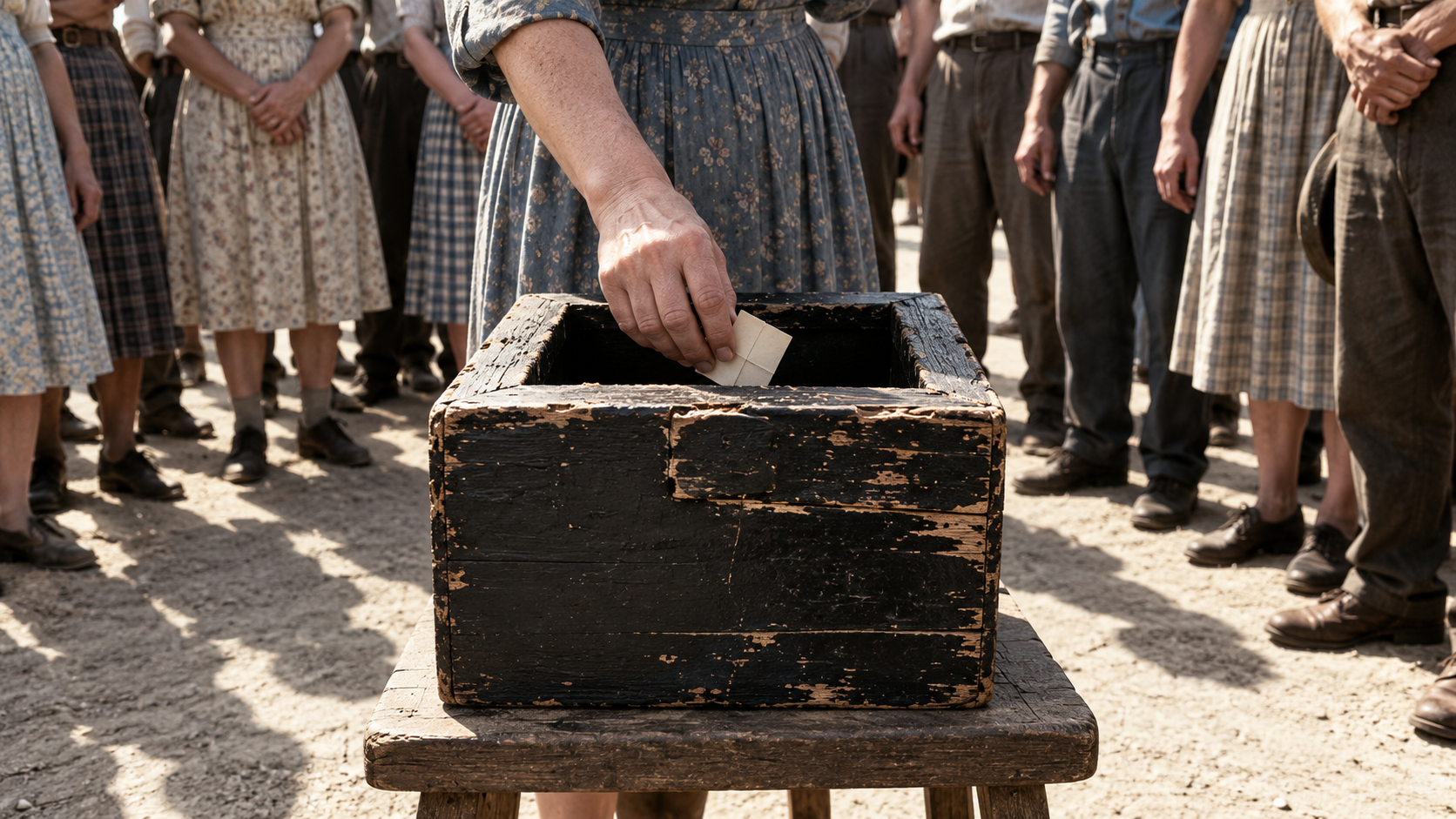
Mr Summers conducts the lottery. He brings a shabby black box containing the slips used for the draw, while the postmaster, Mr Graves, assists.
Jackson establishes the organisation of the event before explaining its purpose. Readers encounter preparations, social arrangements and familiar gestures without receiving the information that would tell them how to judge the occasion.
That gap creates the story’s central reading experience. We can follow what people are doing while misunderstanding what their actions mean.
The word “lottery” helps sustain that uncertainty. It commonly suggests an opportunity to receive something desirable. Jackson allows the reassuring association to remain available while supplying details that increasingly disturb it.
The villagers’ nervousness complicates the apparent normality. Their familiarity with the ceremony has not made them comfortable. Yet discomfort does not interrupt participation.
This is an important distinction. People can recognise that an event threatens them while still treating attendance as compulsory. Fear alone does not necessarily produce opposition, particularly when everyone nearby appears to accept the same obligation.
The gathering therefore contains two kinds of knowledge. The villagers understand the practical stakes but largely accept the institution. The reader questions the atmosphere while lacking the knowledge needed to understand its cause.
Jackson keeps those positions separate until the closing movement.
The Black Box Preserves Authority Without Explanation
The box’s age gives it significance beyond its practical function. Replacing it would be easy, but the villagers resist disturbing an object associated with their predecessors.
Meanwhile, other parts of the ceremony have changed or disappeared. Paper has replaced wooden slips, and elements of the older ritual have fallen out of use.
Tradition here is selective.
The community has already demonstrated that alteration is possible. Its refusal to reconsider the lottery cannot simply mean that every inherited detail is sacred. Some changes are tolerated because they help the event continue.
That distinction offers a useful way of understanding the box. It represents continuity even when the continuity is incomplete. Its presence allows the villagers to feel connected to a past they no longer fully understand.
An institution can gain authority from that feeling without providing a convincing explanation of its purpose. The object becomes evidence that something has lasted, and longevity is quietly treated as evidence that it deserves to last.
Those are different claims.
A practice may survive because it benefits people, but it may also survive because questioning it is difficult, because responsibility is dispersed, or because each generation assumes that an earlier generation knew what it was doing.
Jackson leaves the lottery’s full origin unexplained. That absence limits what we can responsibly claim about its beginnings. It also directs attention towards the present: whatever first established the custom, the people gathered now are choosing to continue it.
Old Man Warner Makes Change Sound Dangerous
During the drawing, the Adamses mention that other villages are considering abandoning the lottery or have already done so. Old Man Warner responds with contempt.
He associates the custom with agricultural prosperity and treats its rejection as foolishness.
His position turns the burden of proof upside down. Instead of explaining why the lottery should continue, he demands that change justify itself against the authority of the past.
The possibility of reform becomes associated with decline. Someone who questions the ceremony can therefore be dismissed as reckless before the actual objection receives consideration.
Warner’s argument also offers a form of emotional protection. If the lottery is necessary for the community’s survival, participating in it can be understood as a duty. Refusing it can be described as endangering everyone else.
However, the story provides no demonstration that the ritual improves the harvest. Warner’s belief should not be confused with a confirmed rule of Jackson’s fictional world.
That separation matters because supernatural necessity would produce a different moral problem. If the village faced a demonstrable catastrophe whenever the lottery stopped, the story would concern a terrible exchange under extraordinary conditions.
Instead, the alleged necessity remains unsupported.
The reference to other villages is especially damaging to Warner’s certainty. An alternative already exists within the story’s world. Abandonment is not beyond imagination.
Jackson does not give us detailed accounts of those communities, but their existence prevents the local custom from appearing universal. The villagers are preserving one possible arrangement while speaking as though it were the only arrangement available.
Tessie Challenges the Drawing When It Reaches Her Family
The lottery begins with representatives drawing for their families. When Bill Hutchinson receives the marked slip, his wife, Tessie, protests that he was not given enough time to choose.
Until this point, she has participated readily. Her objection emerges when the result places her own family in danger.
The contrast makes her a more uncomfortable central figure than a straightforward dissenter. She has not arrived intending to challenge the institution. Her resistance begins inside its accepted framework.
At first, she disputes the administration of the draw.
That is a narrower complaint than rejecting the lottery itself. It suggests that a properly conducted drawing would have been acceptable, provided the result had been different.
Yet recognising this limitation should not become a reason to dismiss her. A person can participate in injustice and later become its victim. Earlier complicity does not make the subsequent harm deserved.
Tessie’s position exposes the weakness of relying on personal danger to awaken moral opposition. By the time someone urgently needs an exception, everyone else may feel relieved that the threat has moved away from them.
Her neighbours answer her objection by appealing to the shared chance they have taken. Within their reasoning, participation establishes fairness.
But sharing exposure to a rule cannot establish that the rule is defensible.
A procedure can distribute harm consistently while remaining unjust in its purpose. Fairness requires questions about what is being done, as well as questions about how the person affected is selected.
That distinction is the central failure of the village’s reasoning.
The Second Drawing Narrows the Circle
Because Bill has no additional household within the selected family group, the next drawing involves his household: Bill, Tessie and their three children.
Five slips go into the box. One carries the mark.
The structure changes the emotional meaning of the gathering. An event involving the whole village becomes a decision concentrated within a single family.
The rules supply a clear next step, and that clarity helps the ceremony proceed. Nobody needs to invent a course of action. They only need to complete the action already prescribed.
This is one reason the story’s administrative details matter. Instructions can make a situation feel manageable even when the situation itself should be rejected.
There is a difference between knowing what comes next and having a good reason to do it.
Jackson’s lottery removes uncertainty about the former while leaving the latter almost untouched.
The household structure also reveals how the ceremony incorporates existing social authority. Families enter through recognised representatives, and marriage determines where a daughter belongs for the drawing.
The procedure does not suspend the village’s everyday hierarchy. It uses that hierarchy to organise participation.
As the family draws, suspense becomes intensely personal. The reader no longer watches a general custom. Individual people occupy the available places within it.
The formal simplicity makes the absence of a humane alternative more visible. There is a method for selecting someone, but no corresponding mechanism for asking whether anyone should be selected at all.
What Happens at the End of “The Lottery”?
The other household members reveal blank slips. Tessie holds the marked one.
The villagers collect stones and converge on her. Her young son is given pebbles. Tessie protests as a stone strikes her, and the story closes with the crowd attacking.
The intended outcome is her death by stoning. Jackson ends during the assault rather than supplying a separate aftermath.
The lottery has selected a victim for communal killing.
This revelation changes the meaning of the opening preparations. What initially looked like children’s play was helping to supply the violence. The gathering’s ordinary arrangements were the arrangements of an execution.
The final scene also destroys any assumption that familiarity offers protection. People who know Tessie personally participate in the attack.
Her identity has not changed. Her official position has.
Before the drawing, she belongs among the villagers. Afterwards, the result permits them to treat her as someone against whom their collective violence may be directed.
That transformation is social rather than supernatural. A mark on paper has no inherent power to remove a person’s claim to protection. The villagers give it that power by acting together.
The ending offers no rescue, reversal or successful appeal. Tessie speaks, but her neighbours continue.
Her objection reaches the people who could stop the killing. They do not stop it.
Why Do Ordinary People Accept the Lottery?
The village sustains the lottery through several overlapping forms of acceptance. Habit makes attendance normal. Official procedure makes participation orderly. Warner’s defence gives continuity a language of necessity. The drawing allows everyone spared to understand themselves as fortunate.
These pressures need not produce identical beliefs.
A community can preserve a harmful practice even when its members support it for different reasons. Some may defend it passionately. Others may dislike it while assuming resistance would fail. Others may avoid examining it at all.
Jackson gives us behaviour more reliably than private explanations, so assigning one hidden motive to every villager would go beyond the story.
The stronger conclusion is that agreement about purpose is unnecessary when enough people agree to continue.
The lottery also separates responsibility into stages. Preparing materials, conducting a draw and following instructions can each appear to be a limited task. Yet their combination produces the final violence.
This invites a question larger than whether each small action looks ordinary: what does completing it help make possible?
The comparison with The Long Walk is useful here. Both works make the rules easy to understand while exposing the moral inadequacy of treating compliance as justification. Jackson’s village, however, places responsibility especially close to home. The people maintaining the custom are also the neighbours who carry it out.
The ending’s involvement of children extends that responsibility into the future. Participation becomes something learned through adults’ example.
A child does not need to receive a sophisticated defence of the lottery to learn that helping is expected. Approval, instruction and imitation can establish a pattern before anyone has developed the language to question it.
That makes the village’s continuity more disturbing than Warner’s speeches alone. The practice is being taught through action.
Tessie Does Not Need to Be Innocent of Everything
Tessie’s earlier acceptance makes the story harder to turn into a reassuring division between good people and bad people.
If she had opposed the lottery from the beginning, readers could identify with a principled outsider and locate the village’s failure safely elsewhere. Instead, the person who finally protests has previously fitted into the community.
Her suffering still matters.
Indeed, requiring perfect consistency before recognising someone’s mistreatment would reproduce another route to indifference. People harmed by institutions often have complicated relationships with them. They may once have trusted, defended or benefited from the arrangements that later expose them.
That history can deserve criticism without becoming a justification for what happens next.
There is also a limit to what Tessie’s last protest proves. It is possible to read it as a widening moral recognition, but the story does not give us an interior account establishing a complete change in her beliefs.
She does not have time to develop a political argument.
The immediate demand is simpler: the people around her should stop.
Readers therefore need not settle whether she has become a fully principled opponent before judging the attack. The wrongness of the violence does not depend on the intellectual completeness of her objection.
This is one of the story’s most demanding implications. Compassion cannot be reserved only for people whose earlier conduct makes them easy to admire.
What the Story Can Tell Us About the Present
“The Lottery” remains useful because it separates the legitimacy of a procedure from the legitimacy of its purpose.
That distinction can be applied without pretending that every unpleasant modern institution is equivalent to ritual killing.
Consider a hypothetical organisation that humiliates new members because earlier members endured the same treatment. Its defenders might describe participation as equal, insist that it creates belonging, or argue that abandoning it would dishonour the past.
The relevant comparison concerns the reasoning. Previous suffering is being used to authorise further suffering.
Similarly, an institution may offer a clear route for appealing an individual decision while making it difficult to question the policy behind that decision. The permitted conversation becomes “Was the rule followed?” when the necessary conversation is “Should this rule exist?”
Jackson’s story makes that difference unusually visible.
The comparison with The Hunger Games raises a related question about public rituals: how does an organised event acquire the appearance of legitimacy? The differences remain important. Jackson concentrates on a small community’s participation rather than constructing a detailed national system of coercion.
Her narrow focus is both the story’s strength and its limit. It offers an exceptionally concentrated examination of collective behaviour, not a complete sociological explanation of how such a society would function.
The absence of extensive world-building keeps attention on the decision immediately before the villagers.
They could refuse to continue. The existence of villages that have abandoned the custom makes that possibility part of the story itself.
What fails is the movement from possible refusal to collective action.
Why the Ending Leaves No Comfortable Distance
The story prompted an extraordinary response on publication, including bafflement, anger and threats to cancel subscriptions. Some readers even asked whether such lotteries actually existed.
Its disturbing power does not depend entirely on surprise. Knowing the outcome changes the reading experience, but it does not remove the problem Jackson constructs.
On a rereading, the question shifts. Instead of wondering what the lottery is, we watch how many familiar actions help it happen.
That makes the ordinary details more troubling rather than less. The community’s social competence survives alongside its moral failure. People can organise, cooperate and recognise their obligations to a group while accepting an appalling definition of those obligations.
“The Lottery” ends with a neighbour’s voice failing against a shared custom. The box cannot throw a stone, and the drawing cannot carry out its own result. The villagers must supply the action. Jackson leaves them at precisely that point of responsibility, where an inherited rule still requires a living person to obey it.
Sources
“The Lottery” — Shirley Jackson — Original story; used to check the ceremony, narrative structure and final scene.
The Lottery: Full Plot Summary — Corroboration of the principal events and two-stage drawing.
The Lottery: Full Plot Analysis — Critical context for the collective conflict and narrative progression.
The Lottery: Main Ideas — Supporting discussion of tradition, selective change and complicity.
Tessie Hutchinson Character Analysis — Context for Tessie’s participation and subsequent protest.
“The Lottery” Letters — Ruth Franklin — Publication history and documented reader responses.
