What Happens When Convenience Becomes Control?
She Can Contact Everyone Except the Son Who Needs Her
Vashti can summon music, food and conversation without leaving her chair. She knows thousands of people, delivers lectures to distant audiences and lives inside a system designed to remove almost every inconvenience. Then her son asks her to visit. She cannot understand why seeing her face through a device should be insufficient.
E. M. Forster published The Machine Stops in November 1909. This short story imagines an underground civilisation whose inhabitants receive their necessities, entertainment and relationships through an immense technological network. Its resemblance to life through screens is striking. Yet its sharpest insight concerns what happens when convenience becomes the standard by which people judge everything—including whether another person deserves their physical presence.
A Mother, a Son and an Unreasonable Request
The story begins with an interruption. Vashti is listening to music when her son, Kuno, contacts her from the other side of the world. She can spare him a few minutes before delivering a lecture.
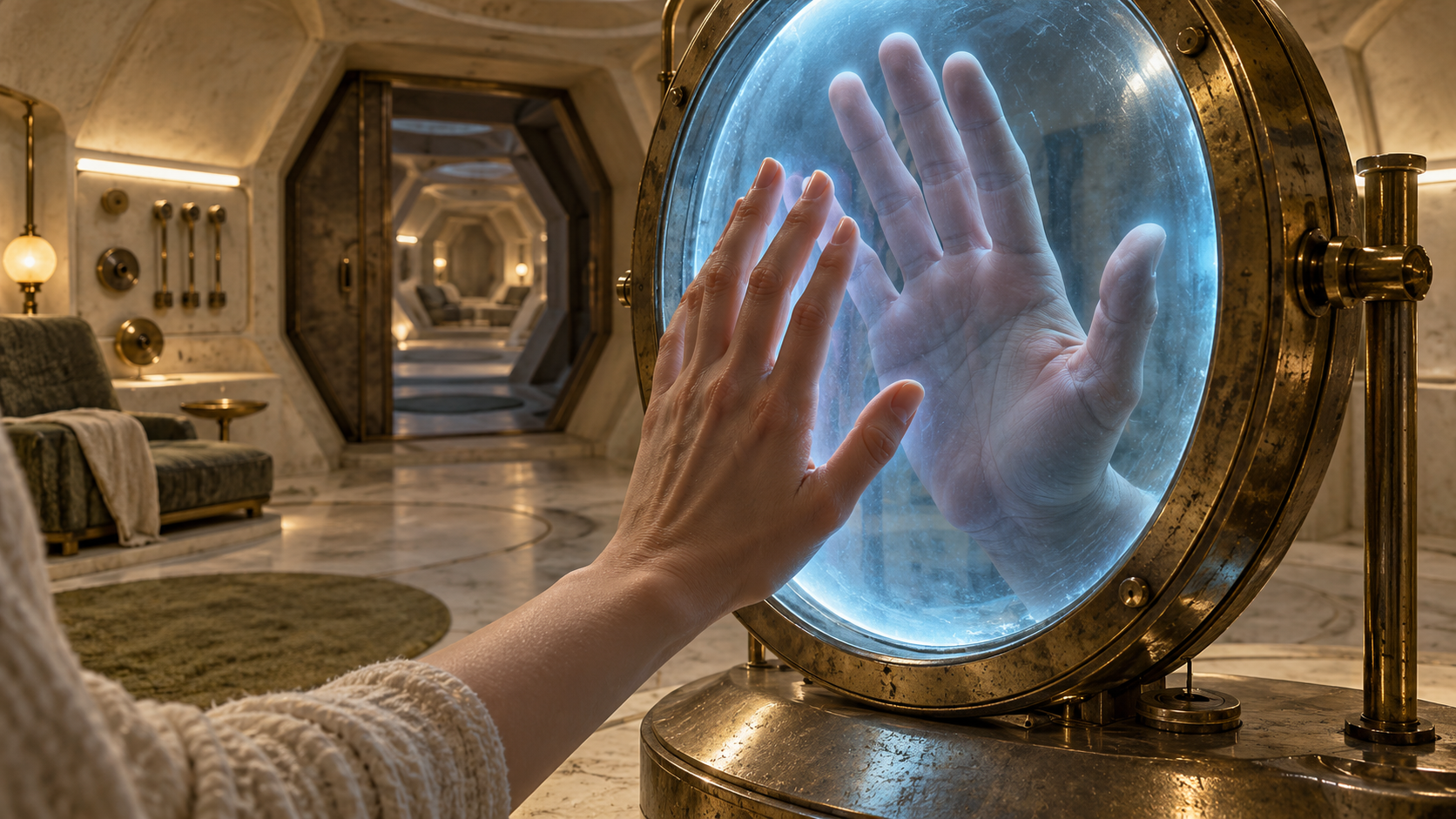
Their conversation takes place through a glowing plate that transmits their images. Kuno wants her to come and see him. Vashti points out that she can already see him.
This disagreement establishes the story’s central conflict before Forster explains much about its civilisation. Vashti considers the successful transmission of an image sufficient for a meeting. Kuno believes something essential disappears when their relationship passes through the Machine.
The device cannot reproduce every nuance of expression. When Kuno seems sad, Vashti cannot be certain. She accepts this limitation because the representation meets her practical requirements. The trouble is that her son’s emotional needs exceed those requirements.
Kuno also wants to visit the surface of the Earth. He has seen stars from an airship and recognised a human figure in their arrangement. He wants to encounter them from the ground, as earlier generations did.
Vashti finds this desire disturbing. The outside world offers her little intellectual stimulation. She prefers the ideas circulating through the network to the objects and experiences that might generate new ones.
Forster makes their disagreement more complicated than a confrontation between affection and indifference. Vashti initially smiles when she recognises her son. She possesses maternal feeling, but her habits have trained her to treat that feeling as something best accommodated within a crowded schedule.
The Machine has not removed her capacity to love. It has supplied a language in which love’s inconvenient demands seem unreasonable.
Kuno refuses to explain everything remotely. His insistence creates the first disruption in Vashti’s carefully managed existence. To hear what he has to say, she must undertake the activity her civilisation has made increasingly unnecessary: go somewhere.
A Comfortable Room With Almost No Outside
Vashti’s room is a small hexagonal cell. Artificial systems provide its light and air. Buttons summon food, clothing, music and other services. Furniture appears when required, allowing the room to remain almost empty while meeting its occupant’s needs.
The contrast between limited physical space and extensive access gives the setting its peculiar force. Vashti is confined geographically but connected socially. She can reach people across the planet while scarcely moving her body.
This is why calling the Machine an early smartphone misses its scale. It is also housing, transport, medical provision, communications and life support. The interface in Vashti’s room is the visible edge of a civilisation organised around one vast system.
Her apparent independence rests on dependence she rarely notices. She does not need to ask a neighbour for help, carry supplies or negotiate ordinary domestic tasks. However, she has little practical control over the arrangements that make this freedom possible.
Forster also makes the society coercive. Children are raised through public institutions, and the Machine assigns accommodation. Reproduction is subject to permission. Physical characteristics that do not suit the established way of life can become grounds for exclusion.
The system therefore does more than satisfy existing preferences. It helps determine which kinds of people and desires are acceptable.
The comparison with Brave New World is useful here. Both stories examine societies that reduce conflict by shaping people to fit their arrangements. Forster gives particular attention to the everyday habits through which inhabitants come to defend those arrangements themselves.
Vashti does not experience her room as a punishment. It contains nearly everything she has learned to value. Leaving it means accepting conditions she cannot control, including unfamiliar sensations and the unpredictable behaviour of other people.
Her reluctance to travel is therefore psychologically coherent. A life organised around removing discomfort has made ordinary discomfort feel intolerable.
The Journey That Makes Reality Feel Wrong
Vashti eventually agrees to visit Kuno. Memories of him as a child help overcome her resistance, although she continues to regard the journey as an interruption to more valuable activities.
The trip exposes the difference between knowing something through representation and encountering it bodily. The airship is not quite like its transmitted image. It has a smell. Reaching it requires walking. Other passengers can look at her without first being summoned.
These details are small, but they explain why direct experience unsettles her. A representation can arrive within familiar surroundings. An encounter changes the surroundings and makes demands that cannot always be dismissed with a switch.
When a passenger drops his Book of the Machine, the incident creates confusion. In their rooms, mechanisms would lift it from the floor. Here, the expected response does not happen.
The Book is both an instruction manual and an object of reverence. Its helpless owner has access to directions for civilisation but struggles when a routine action requires an unscripted bodily response. Forster makes the scene absurd before allowing its implications to become frightening.
Vashti also recoils when an attendant touches her to prevent a fall. The gesture offers practical care, but she experiences it as an intrusion. Her society has made physical contact so unusual that assistance can feel like a violation.
Sunlight provides another disturbance. Instead of welcoming the view, she wants the blind adjusted. The external world keeps entering her experience without permission.
The journey also reveals how thoroughly places have become standardised. Travel once promised access to difference. Now, rooms and routines are so similar that moving across the world often means exchanging one version of the same surroundings for another.
Forster’s irony is precise: a transport system capable of connecting humanity has helped produce a civilisation with fewer reasons to travel.
By the time Vashti arrives, she feels that the trip has wasted her time. Kuno’s room resembles her own. She sees sameness where he hoped she would recognise presence.
Kuno Learns to Measure Distance With His Body
Kuno tells his mother that he has been threatened with Homelessness. In this society, expulsion from the underground system is understood as a death sentence.
He has reached the surface without following the approved route.
His account begins with an apparently modest experiment. He walks along railway platforms until he becomes tired. Through exertion, he rediscovers the difference between somewhere his body can reach easily and somewhere machinery can deliver him quickly.
Forster gives rebellion a physical beginning. Kuno does not acquire independence simply by holding an unpopular opinion. He practises capacities his surroundings have allowed to weaken.
The exercise changes what he notices. Once he thinks of the underground city as a constructed place, he begins asking how its builders worked. Earlier workers needed access to the outside air. Their ventilation shafts might still exist.
This reasoning supplies his route towards discovery. He combines historical inference with inspection, searching near the upper railway tunnels where an old shaft could plausibly remain.
Eventually, he finds an opening behind the tiles.
His greatest initial obstacle is partly psychological. Entering a railway tunnel feels improper because the Machine has not provided for such behaviour. He must act without the reassurance that his action belongs to an approved routine.
He strengthens his arms before attempting the climb. The preparation matters: his success depends on effort, observation and an available structure, rather than sudden heroic ability.
Kuno also describes feeling encouraged by the generations who lived before him. These apparent ancestral voices belong to his account of the experience; they do not establish a separate supernatural explanation. They express his growing sense that humanity extends beyond the civilisation he knows.
That historical connection has a personal cost. His request to become a father has been refused because the authorities do not want his type reproduced. As he imagines past workers and future generations, he is confronting a system that has denied him an ordinary place in that continuity.
His movement upwards therefore becomes more than escape. He is trying to recover membership of a human story larger than the Machine.
What He Finds Beyond the Approved World
At the top of the shaft, Kuno encounters a stopper separating the underground atmosphere from the surface. He jumps, catches its handle and sets the mechanism in motion.
Pressure blows the stopper out, carrying him into the open.
His arrival is painful and precarious. He loses his respirator and initially depends on artificial air escaping from the shaft. It collects in the hollow around him, allowing him some movement while he struggles with the unfamiliar atmosphere.
This detail prevents an easy interpretation of his rebellion. He has reached the outside, but he still relies on the system he criticises. His body cannot instantly undo a lifetime of dependence.
He sees the hills of Wessex and responds to them as something living. The landscape gives him a sense of scale and continuity that lectures have failed to provide.
Yet the story does not make acquired knowledge completely useless. Information from a lecture helps him understand where he is and the circumstances of the approaching darkness. Learning becomes valuable when brought into contact with experience.
That is a more demanding argument than simply declaring that books, teaching or mediated information are inferior. Kuno needs inherited knowledge. He also needs opportunities to test and extend it.
His freedom ends when the Mending Apparatus responds to the breach. Mechanical, wormlike devices emerge, seize him and drag him back underground.
The repair system treats his escape as damage to be corrected. From the Machine’s perspective, restoring normal operation includes removing the person who has opened a route beyond it.
Kuno then reveals a further disturbance to Vashti’s understanding. A woman appeared on the surface and tried to help him. The apparatus killed her.
Vashti has believed that higher forms of life cannot survive outside. Kuno offers direct testimony against that belief, but she questions him through the authorities she already trusts. Has an airship reported such people? Has a lecturer discussed them?
Her questions expose a closed method of deciding what counts as evidence. Information must be recognised by the system before it can challenge the system.
She leaves without accepting what he has told her. Their encounter has supplied her with unfamiliar evidence, but accepting it would require rebuilding too much of her world.
When Ideas Stop Answering to Experience
Years pass. The civilisation becomes more restrictive while describing its changes as progress.
Respirators are abolished. Surface visits, already considered vulgar or pointless, lose the equipment that made them possible. People who want information about the Earth are directed towards recordings and transmitted images.
Even lecturers who initially object discover that existing lectures can supply material for new ones.
Forster develops this tendency through an absurd intellectual argument: ideas supposedly improve as more intermediaries separate them from direct observation. A celebrated lecturer praises layers of commentary that remove the disturbance of actual events.
The target is a culture in which interpretation no longer needs to answer to anything outside itself.
That makes the passage relevant to modern online publishing without requiring a claim that Forster foresaw a particular platform. Imagine an explanation assembled from several summaries, each of which relies on another summary. If nobody returns to the underlying evidence, agreement may reflect repetition rather than verification.
Adding fluent language or more references does not necessarily repair that chain. The missing element is contact with something capable of proving the circulating account wrong.
The same question can be applied to AI-assisted writing as an editorial test. Does the tool help a person reach and examine evidence, or provide an answer that the person accepts without checking? This is a modern application of Forster’s argument, not a technical prediction contained in the story.
The connection with Fahrenheit 451 lies in the habits that make intellectual control easier. A culture can weaken its relationship with knowledge before every source is formally prohibited.
There is an uncomfortable implication for summaries themselves. A good explanation can prepare someone to read a work more attentively. It can also become a substitute that conceals its omissions.
Forster’s story asks whether mediation remains a route towards fuller understanding or becomes a reason never to look beyond the version already supplied.
The Machine Becomes Too Sacred to Question
Alongside the retreat from direct observation comes an increasingly explicit worship of the Machine.
Vashti has already treated its Book reverently. Now private habits become public rituals. People praise the system that feeds, houses and connects them. Different parts of the machinery attract particular devotion.
The society continues to describe itself as opposed to superstition. Its confidence in its own rationality makes the contradiction harder for its inhabitants to recognise.
The Book undergoes a crucial change in function. Instructions should help users operate and question a device. Here, the manual becomes a source of reassurance independent of whether its machinery works.
Forster does not attribute the entire development to a calculating ruler. The Central Committee announces changes, but the narrator presents broader pressures and habits as part of their origin.
That choice makes the society more unsettling. There is no single villain whose removal would restore independent judgement. Citizens, lecturers, officials and technicians participate in arrangements that exceed any one person’s control.
Meanwhile, technical understanding fragments. Individuals master their assigned duties while losing knowledge of neighbouring functions. Nobody understands the entire Machine.
Specialisation itself is not the villain. Complex achievements require different skills. The danger in Forster’s construction is that the society combines fragmented knowledge with the conviction that its collective system cannot fail.
This gives the modern comparison a more useful focus than screen time alone. The question is who can explain a service, challenge its decisions, repair it or provide an alternative when it stops working.
A person need not become an expert in every technology they use. But a civilisation needs more than satisfied users and assurances that somebody else understands.
In Vashti’s world, dependence has become a reason for reverence precisely when it should be a reason for scrutiny.
The First Failures Become the New Normal
Kuno later contacts Vashti with a warning that the Machine is stopping.
He has been moved to a room near hers, but geographical closeness has not restored their relationship. His warning meets laughter and disbelief.
The first visible problems seem manageable. Music develops unpleasant interruptions. Vashti complains and receives assurances that repairs will follow.
When she tries to escalate her complaint, she discovers that access to higher authority runs through the committee handling the original problem. Asking whether others have complained does not produce useful transparency.
The episode turns customer frustration into a political problem. Vashti can request a service, but she cannot effectively investigate its failure or hold the responsible structure to account.
As defects persist, people adjust their expectations. What once seemed unacceptable becomes something they are encouraged to tolerate. Accommodation gradually replaces repair.
The failure of the sleeping apparatus makes the deterioration harder to dismiss. Beds no longer appear when summoned. People become angry, and some imagine a saboteur attempting to seize power.
That explanation preserves their faith. If an enemy is responsible, the Machine itself remains beyond criticism.
Then the authorities acknowledge that the Mending Apparatus needs mending.
The admission exposes the system’s central vulnerability. The mechanism intended to correct failures has become another failing component. There is no adequate independent capacity ready to take over.
Instead of demanding an answer, influential voices urge gratitude and patience. Past service becomes an argument against present criticism. People should accept deprivation because the Machine has previously treated them well.
Air and light also deteriorate. Temporary improvements encourage hope without restoring the former standard.
Forster shows how disaster can advance through changing expectations. Each smaller concession appears survivable. Together, they create a society that has tolerated the loss of the conditions on which survival depends.
What Happens When the Machine Stops?
The communications system fails while Vashti is lecturing.
At first, she interprets the missing response socially. Her audience has become silent; perhaps a friend can provide sympathy. She tries to contact people and receives nothing.
Only gradually does the absence acquire its true scale.
The cessation of the Machine’s familiar hum is terrifying. It has accompanied her entire life, so silence feels like an assault rather than peace. What readers might imagine as relief arrives as the disappearance of her world’s most constant reassurance.
Vashti opens her door. It still works because its hinge is independent of the distant central power station.
This small mechanical fact is one of the story’s sharpest details. A simple local mechanism continues functioning when the comprehensive system fails. Vashti briefly misreads this as evidence that the Machine has recovered.
Outside, the passages are full of frightened people. They struggle for air, try to summon transport and reach for services that no longer answer.
She retreats into her room. The presence of other bodies, which might have offered solidarity, initially compounds her fear.
As the machinery breaks apart and the light fades, she continues pressing buttons and appealing to the Book. Eventually, she opens the door again and encounters Kuno.
Their reunion provides the human resolution that the technological collapse cannot. They touch, speak directly and grieve for what their civilisation has done to itself.
Kuno is dying. There is no rescue for them.
He tells Vashti that people still live on the surface. He has seen them, spoken to them and loved them. The society’s assumption that expulsion means inevitable death has concealed another possibility for human existence.
Vashti fears that someone will eventually build the Machine again. Kuno insists humanity has learned its lesson. The narrative offers no future scene confirming his confidence.
An airship crashes into the underground structure, tearing through it. Before mother and son die, they glimpse the sky.
The civilisation’s enclosure breaks open at the moment when they can no longer use the opening.
What the Ending Changes About the Warning
The ending gives Vashti recognition without giving her survival.
That distinction prevents the story from becoming a simple account of a brave dissenter saving everyone. Kuno identifies real dangers and develops capabilities his neighbours lack, but he cannot restore the system or evacuate its population.
Their achievement is smaller and more intimate. They recover the relationship that the opening conversation could not accommodate.
Earlier, Vashti considered an image of her son sufficient. At the end, contact with his injured body makes his presence impossible to reduce to transmitted information. The story completes an emotional movement from efficient communication to shared vulnerability.
The collapse is also broader than the failure of a device. Humanity has allowed several kinds of independence to deteriorate together: practical competence, bodily confidence, intellectual verification and the ability to imagine life outside its institutions.
Forster’s image of civilisation as something humanity has made and become trapped inside allows an important qualification. The arrangements were once beneficial. Their danger grows when people can no longer step beyond them.
There are limits to the story’s proposed alternative. The surface community remains largely unseen, and Kuno offers no detailed model for maintaining medicine, shared knowledge or material security outside the Machine.
Forster’s treatment of bodies is also deliberately harsh. His descriptions sometimes make physical weakness stand for cultural decline. A modern reading should separate the defence of embodied experience from any suggestion that strength determines human worth or that reliance on assistance makes a life less meaningful.
The meaningful distinction is whether support expands a person’s possibilities or becomes a justification for removing their choices.
Kuno’s confidence that the survivors will avoid repeating the disaster remains a hope. Vashti’s final doubt gives the ending its unresolved historical question: people may remember suffering without agreeing on what caused it.
Did Forster Really Predict Life Through a Screen?
Yes—if the claim concerns recognisable patterns of living.
Forster imagined people speaking through visual devices, addressing remote audiences, receiving entertainment on demand and finding themselves perpetually busy while physically isolated. Most strikingly, he imagined the social reversal through which meeting in person becomes the unusual request that requires justification.
These similarities support the headline. They do not mean he predicted the internet’s technical architecture, particular companies or every feature of contemporary digital life.
His Machine is an encompassing system with committees, mechanical services, transport infrastructure and religious authority. It is not explicitly a modern generative AI, nor does the plot require a conscious machine deciding to exterminate humanity.
The story is more disturbing when human responsibility remains visible. People repeatedly accept, defend and extend arrangements that diminish their ability to judge those arrangements.
There is also a major difference between Forster’s civilisation and the present: a screen can open access to the world. It can sustain a distant friendship, make a text available, support someone who cannot travel or help organise a meeting that would otherwise never occur.
The relevant question is what the connection enables.
A conversation through a device can deepen a relationship. Trouble begins when its convenience becomes a reason to dismiss every need it cannot satisfy. Likewise, mediated knowledge can enlarge understanding unless the mediation becomes immune to correction.
Forster captures that danger through a mother who believes she is already giving her son everything he reasonably needs. Her error is personal before it becomes civilisational. She mistakes the service she can summon for the full extent of the life available to her.
The story’s most enduring image is therefore not its glowing plate. It is Vashti’s hand reaching towards another person after years of reaching towards controls. A system that once made connection easier has become the boundary of her imagination. Only when it fails does she recognise how much remained beyond it—and how little time she has left to respond.
Sources
E. M. Forster, The Machine Stops — York University — Original story text supporting the narrative, fictional mechanisms, character relationships and ending.
The Machine Stops — University of California, Davis — Alternative primary-text copy identifying first publication in November 1909; used to cross-check wording and opening details.
“Nov. 1, 1909: ‘The Machine Stops’” — WIRED — Publication context and an example of the story’s reception as an anticipation of electronically mediated life.
