Who Changes Most in The Metamorphosis?
Gregor Samsa Has Already Missed His Train
Gregor Samsa wakes up in an unfamiliar body and looks at the clock. That second action tells us almost as much about him as the first. He is a travelling salesman, his samples are waiting, and somebody at the office will already know he failed to catch his train. Perhaps he can take a later one. To manage that, he first needs to get out of bed with legs that move in bewildering directions whenever he tries to use them. Franz Kafka’s The Metamorphosis begins with an impossible event and a perfectly recognisable calculation: how late can a person be before someone else gets to decide what his lateness means?
The Morning the Office Comes to Gregor
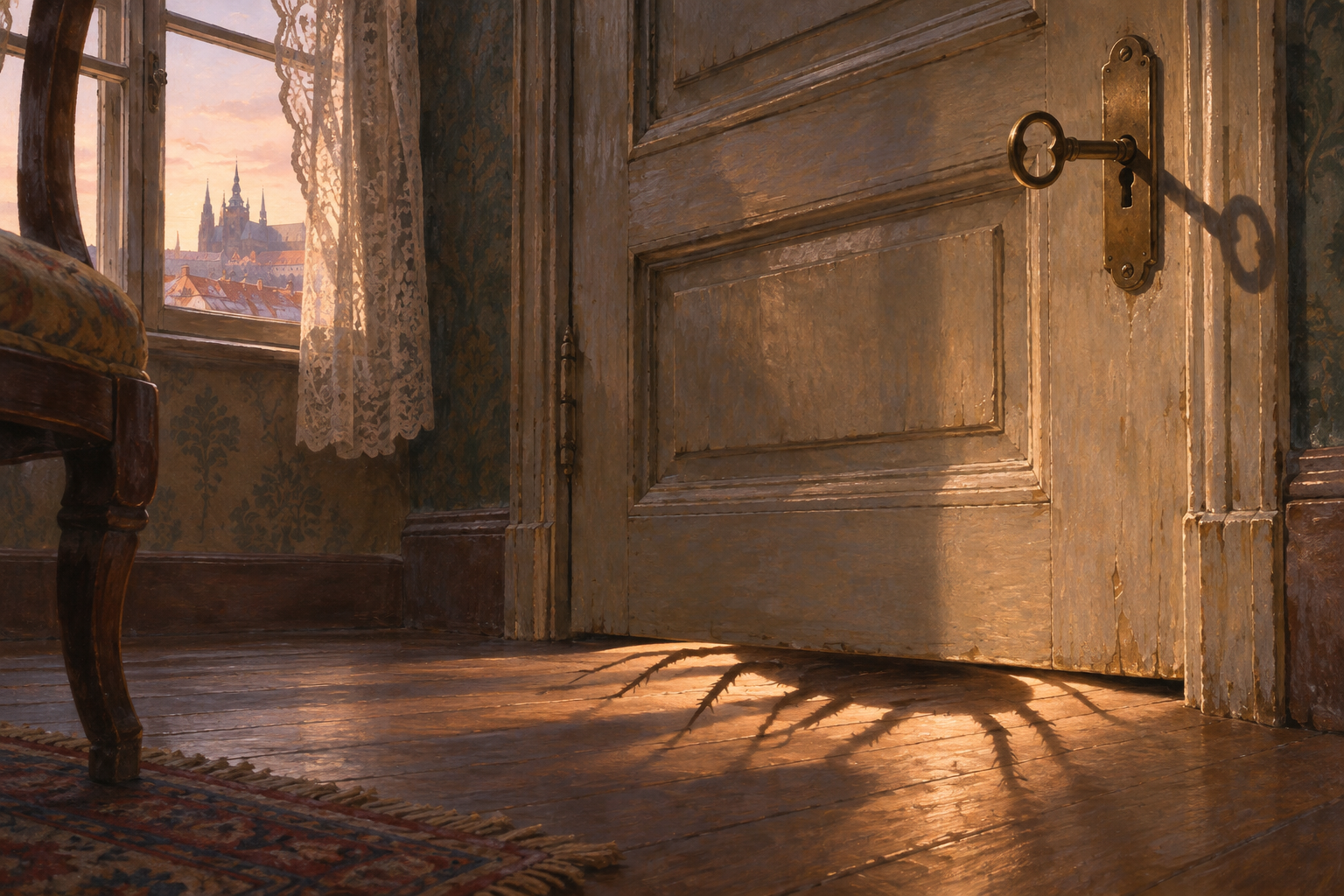
Gregor’s first attempts to move are genuinely funny. He knows how getting up ought to feel. He can picture throwing off the bedding and swinging his feet to the floor. The harder he tries to translate that familiar intention into movement, the more independently his many legs seem to operate. Rolling his whole body over might work, although he worries about the noise he will make when he lands. Even alone behind a locked door, with excellent reasons to panic, Gregor is considering the people in the next room.
What has he become? Kafka’s German word Ungeziefer identifies him broadly as vermin. Gregor has a hard back, a curved brown belly and numerous thin legs. Kafka gives us enough anatomy to understand why the bed, the key and the doorway present difficulties. He leaves the precise species open. Calling Gregor a cockroach produces a memorable mental picture, but it settles something the opening deliberately leaves less comfortable. Most people know what they would do on finding an enormous pest in their bedroom well before they could identify it. Gregor has the misfortune to encounter that reflex from the pest’s side.
His thoughts turn to his employer. Gregor dislikes travelling, hurried meals and acquaintances who disappear as soon as he moves on to the next town. He would dearly like to tell his boss what he thinks of him. His parents, however, owe the man money. Gregor expects to spend years clearing their debt before he can afford the satisfaction of resigning. For him, leaving an intolerable job has always belonged to a future in which he has first finished looking after everybody else.
His mother knocks. His father and younger sister Grete call to him from other doors. Then the chief clerk comes to the flat. The speed of the visit gives substance to a fear that might otherwise sound like Gregor’s private anxiety. One missed departure has been enough to bring management to his family home. His mother tries to defend him by explaining how completely work occupies his life. Even when he spends an evening at home, he studies timetables. She offers it as proof that he is a good employee. It is also a rather sad account of an evening.
There is a close affinity with Kafka’s The Trial. Josef K. and Gregor both have extraordinary reasons to miss a morning’s work, yet the opinions of junior staff and superiors still matter while strangers gather near the bedroom. Kafka understands something peculiarly embarrassing about having a crisis before breakfast. Everyone else is dressed, has somewhere to be and would like you to explain why you are keeping them.
What the Family Hears Through the Door
Gregor gives a lengthy account of himself. He disputes the suggestion that his work has deteriorated, asks the clerk to spare his parents and promises to get moving. From inside the bedroom, his meaning is clear. We have been following much the same thoughts since he woke. Outside, the listeners hear sounds they can scarcely recognise as speech. Gregor believes he is conducting a difficult conversation for some time after his ability to participate in one has gone.
This is the decisive rule of his new life. He understands what people say about him. They have no reliable means of knowing that he understands. A family inclined to patience might experiment with signals, simple questions or a way of indicating yes and no. The Samsas never establish one. Consequently, every important decision about Gregor will depend on what somebody thinks his movements mean. We have access to evidence his family lacks because Kafka lets us stay inside the room.
Gregor turns the key with his mouth, hurting himself in the effort. Opening the door feels like an achievement. He has answered the demands to be let in and can finally demonstrate that something serious has happened. The chief clerk recoils. Gregor’s mother collapses, and his father first shows distress, then sets about getting the creature out of sight. Each has received the same new evidence. None draws the conclusion Gregor hoped for: that this employee has an unusually good reason for being late.
The retreating clerk presents a last chance to save his position. Gregor tries to follow him, still convinced that if he can only make the man understand, his professional record ought to count in his favour. His father uses the clerk’s walking stick and a newspaper to drive him backwards. Turning round in the doorway is difficult in his new body. The final shove that sends him into his room leaves him injured.
Kafka has brought the story a considerable distance without settling why the transformation happened. An illness, curse or punishment might give Gregor a course of action to pursue. Instead, he has a wounded side, a closed door and an immediate need for somebody to discover what he can eat. Once those needs become pressing, the family can spend the rest of their lives dealing with the effects without getting any nearer the cause.
Grete Learns What Her Brother Can Eat
When Gregor wakes again, he finds milk with bread in it. Milk used to be a favourite of his. Somebody has remembered that fact and acted on it, making this one of the household’s first attempts to recognise a continuous person inside the changed body. Unfortunately, the milk now disgusts him. Grete notices that the bowl has barely been touched and tries an assortment of foods. Gregor goes for scraps and old cheese that he would previously have rejected.
Grete succeeds because she allows his behaviour to correct a loving assumption. She could have insisted that she knew what her brother liked. Instead, she changes what she brings. Where the chief clerk interpreted one absence in the light of everything he already suspected about employees, she treats one untouched meal as a reason to learn. For a while, an experiment with leftovers brings brother and sister closer to mutual understanding than any speech Gregor delivered through the door.
The arrangement costs Grete something. Entering the room frightens her. Gregor retreats under the sofa so she can clean and put out food without looking directly at him. When he realises she can still see part of his body, he labours to arrange a sheet over the exposed area. This is an act of consideration she can receive without ever discovering how much work it required. The cleaner and more tolerable the room appears to its human visitor, the less visible its occupant must make himself.
Gregor listens to family conversations about money. Before the transformation, he handed over most of what he earned. Bringing home his first substantial payments had once caused excitement. As the arrangement continued, contributions that had been greeted with gratitude became part of the household’s ordinary income. Gregor enjoyed providing for the family, but he also had one plan that went beyond keeping the bills paid. Grete plays the violin. He hoped to announce at Christmas that he would send her to the conservatoire.
There is affection and a little vanity in the Christmas he imagined. He would listen to Grete play, recognise a talent the others treated as a pleasant pastime and make a grand announcement despite their parents’ objections. Gregor’s work bought him very little pleasure of his own. It did allow him to picture the pleasure of giving somebody else a future. Nothing he has yet managed to communicate through his door comes close to explaining that ambition.
Listening now, Gregor discovers that his father preserved some money after the failure of his business and saved part of the wages Gregor brought home. He is pleased that there is a reserve. He had understood the family to be in worse circumstances, and some of that money might have reduced the debt tying him to his employer. Both responses deserve room. His father has made a prudent provision against disaster. His son has spent years making decisions about his working life without knowing the full position of the household he supports.
Why Gregor Tries to Save a Picture
Gregor begins to discover pleasures in his changed body. He can crawl over the walls and hang from the ceiling. For a creature that spent its first morning unable to roll out of bed, there is considerable satisfaction in finding a surface on which it can move freely. Grete sees what he does and arrives at a reasonable proposal. If she and her mother remove some furniture, he will have more space.
His mother thinks of what an emptied room might communicate. If Gregor comes back to himself, will he find that they have already given up on his recovery? Until she says this, Gregor has been enjoying the prospect of more room to crawl. Hearing another person speak of his future as a man brings the desk, chest and familiar possessions back into focus. He once did his homework here. A room can be splendidly adapted to what a creature does today while quietly cancelling what its owner might want tomorrow.
As the women carry things out, Gregor tries to preserve a framed print of a woman dressed in fur. It is a picture he cut from a magazine and put in a frame himself. Kafka has introduced it early enough for us to remember seeing it before anybody knew the room would have to be defended. Its modest origins matter. A family portrait or a great work of art would carry a claim that anybody coming through the door might recognise. Gregor’s print has value because he once chose it and put it there. His body is now the only means he has of saying it belongs to him.
He climbs onto the picture and presses himself against it. His mother sees him and faints. Nothing in his posture explains the history of the object underneath him. To someone opening the door, a large creature has climbed the wall and terrified an ill woman. Gregor moves again as Grete tries to help their mother. The more urgently he wants to assist, the more frightening his movements look.
His father comes home from his new job wearing a uniform. Gregor remembers a man who had difficulty rousing himself from a chair and leaned on others when he went out. The upright employee before him can move with alarming purpose. Once the household lost Gregor’s wages, his father proved capable of a working life neither had expected him to resume. It might have been an encouraging discovery under different circumstances. Gregor encounters this restored strength while trying to get away from it.
His father throws apples. One becomes embedded in Gregor’s back. His mother intervenes, pleading with her husband to spare their son. The apple stays lodged in the wound, seriously impairing Gregor’s movement. Arguments about what the fruit symbolises can easily skip the plainest thing it does. Before this attack, crawling was a pleasure and a means of choosing where to go. Afterwards, moving across the room costs him. A quarrel over how much space Gregor needs for movement ends with his father damaging his ability to move at all.
How a Bedroom Becomes a Storeroom
The injury briefly moderates the family’s conduct. Gregor is sometimes allowed to look into the living room through the open door. He sees his father fall asleep wearing the uniform in which he serves others all day. His mother earns money sewing. Grete works in a shop and studies in the evening to improve her prospects. Gregor’s disappearance from paid employment has put three other people into it. They can keep the household going, though the exhausted family he watches has little time for the childlike sister and retired father he remembers.
To say they only ever loved his money would make the story easier and considerably less observant. His mother still wants to see him. Grete undertook unpleasant work when nobody else knew how. Their circumstances have also made his care a succession of extra tasks performed at the edges of long working days. An unwelcome smell, a dish left untouched or a room that needs cleaning can call for an ordinary kindness every day. A person who would make a dramatic intervention once may still begin neglecting those smaller duties by Thursday.
Grete increasingly regards the room as her particular business and resents her mother’s attempts to clean it. Her early expertise has acquired a less generous consequence. Since she knows Gregor’s requirements best, she can also decide how little he requires. He eats less. Dust accumulates. A charwoman who comes to help is considerably less frightened of him than the family, but easy familiarity has its own indignities. She can treat him as a curiosity because she has no memory of the man who chose the picture on the wall.
Taking in three paying lodgers changes the flat more thoroughly than removing Gregor’s furniture ever did. The lodgers bring possessions and expect order. Objects the family can no longer accommodate migrate into Gregor’s room. The proposed clearing had at least been motivated by a belief about his needs. The new clutter arrives because everyone else’s needs have somewhere more important to be met. Eventually Gregor shares his space with things for which the household has no present use and which nobody has quite decided to throw away.
The lodgers occupy an especially bitter position at the dining table. Gregor’s earnings once paid for an evening meal he frequently missed because he was travelling. Now the men whose payments help maintain the flat can eat where the family once gathered, while its former provider watches from the threshold. Kafka rarely needs to explain who has authority. Watch who receives a plate, who carries it and who must keep out of sight until it has been taken away.
What Gregor Hears in Grete’s Violin
One evening Grete plays the violin. The lodgers hear her and invite her to perform in front of them. The family responds as though it has received an honour. Once Grete begins, however, the men’s attention soon wanders. Gregor, listening from his room, is deeply affected. He moves towards the player. For anyone trying to decide how much of him remains human, his response to music seems unusually promising evidence.
Yet the scene is more interesting than a test in which liking music proves possession of a soul. Gregor had never considered himself especially musical. What he hears now is partly the life he planned for Grete and partly his own hunger for something that the food slid through the door has failed to supply. The thought of telling her about the conservatoire returns with extraordinary force. She might finally learn that, through all those tedious sales journeys, somebody was listening closely enough to think she should have a different future.
There is a troubling element to the reunion he imagines. He would like Grete to come into his room, play for him and remain there. He pictures himself guarding the entrances against interruption. The brother who once hoped to use his wages to send his sister into the world now imagines using his frightening body to keep a little world for the two of them. His longing is tender, possessive and painfully impractical. Having access to Gregor’s thoughts allows us to recognise his humanity in the mixture, including the parts of it that do him little credit.
The lodgers see an entirely different performance. A dirty creature has emerged while the daughter of the house is playing. The family’s anxiety gives away how desperately it needs the arrangement to continue. The leading lodger declares that he will leave and contests what he owes. At just the moment when Gregor is wondering whether he might still give his sister something, his appearance seems to have cost her family another source of income.
Grete speaks. She says they must get rid of the creature and refuses to go on identifying it as her brother. Her reasoning depends on a devastating assumption: if this really were Gregor, he would understand what his presence was doing to them and leave of his own accord. Her brother has spent his adult life anticipating what he ought to do to prevent discomfort or financial loss to the family. Grete now takes that very readiness to sacrifice himself as the standard by which she will decide whether he exists.
He hears her. The family has never acquired a comparable ability to understand him. From their side of the door, they have endured a long ordeal without hearing Gregor make one recognisable expression of concern. From his side, the sheet over the sofa, his retreat from their company and countless painful efforts to get back into his room have all been attempts to express exactly that concern. Both accounts can exist together because only the reader has been permitted to cross the threshold freely.
What Happens to Gregor and Grete at the End?
Gregor turns himself around and makes the slow journey back into the bedroom. He is weak, badly injured and scarcely eating. Grete closes the door behind him. During the night he thinks about his family with affection and accepts even more firmly than his sister that he ought to disappear. Towards morning he dies. Kafka establishes a prolonged physical decline and a final withdrawal. Assigning a single medical cause, or claiming Gregor simply chooses the moment of his death, would make a neater diagnosis than the story supplies.
The charwoman discovers his body. His thinness surprises the family when they see him clearly. It is a small, crushing discovery to make at this stage. For weeks they have known in principle that he eats very little. Looking at his body makes them recognise what the information added up to. There is nobody left for whom a better meal might now be prepared.
Mr Samsa orders the lodgers out. Their intimidating spokesman, who appeared to hold the family’s future in his hands during the concert, leaves with the others. All three Samsas write to their employers to take the day off. On the morning Gregor’s life collapsed, he could hardly contemplate reporting sick. Now his relatives accomplish together, in a few ordinary letters, what the salesman with the excellent attendance record had found almost unthinkable. The ease of the action belongs to the ending’s uneasy sense of relief.
They take a tram out of town. In daylight, away from the flat, their situation looks more promising than it has for months. Each has work. A smaller home could be cheaper and better suited to them. Gregor chose their present flat when he was providing for everybody. Moving will mean giving up one more piece of the life he arranged. It will also be a reasonable decision for three working people with no further need for a room that must always be kept closed.
The parents notice how Grete has grown. Watching their daughter stretch at the end of the journey, they begin to imagine finding her a husband. It would be excessive to hear only a threat in that thought. Grete has worked, studied and cared for someone whose appearance frightened her. A future of her own ought to be possible. Yet her parents’ pleased assessment has a familiar quality. One child’s capacity to earn once furnished the family with a plan. They have now spotted a different kind of promise in the child who remains. Grete’s own opinion about marriage receives no more space here than Gregor’s private opinion about selling cloth received at the breakfast table.
Why does this bright ending hurt so much? Kafka has spent most of the novella teaching us to translate movements nobody else understands. We know why Gregor works the key, why he hides under the sheet and what draws him towards the violin. On the tram, for the first time, the people whose movements we watch have every opportunity to explain themselves to one another. Gregor once wanted to give Grete the chance to play. His parents have begun planning a future in which she might marry. The one thing nobody asks during the outing is what she would like to do.
Sources
Die Verwandlung — Franz Kafka, German text. Original wording of Gregor’s transformation and the German text of the novella. gutenberg.org
Metamorphosis — Franz Kafka, translated by David Wyllie. Complete English text used for the family finances, Gregor’s intentions for Grete, the injury, the violin scene and the ending. Project Gutenberg
The Metamorphosis: Full Book Summary — SparkNotes. Independent reference for the sequence of events across the novella’s three parts. SparkNotes
