What the Father Teaches and What the Boy Decides
A Father Has to Explain the Sea
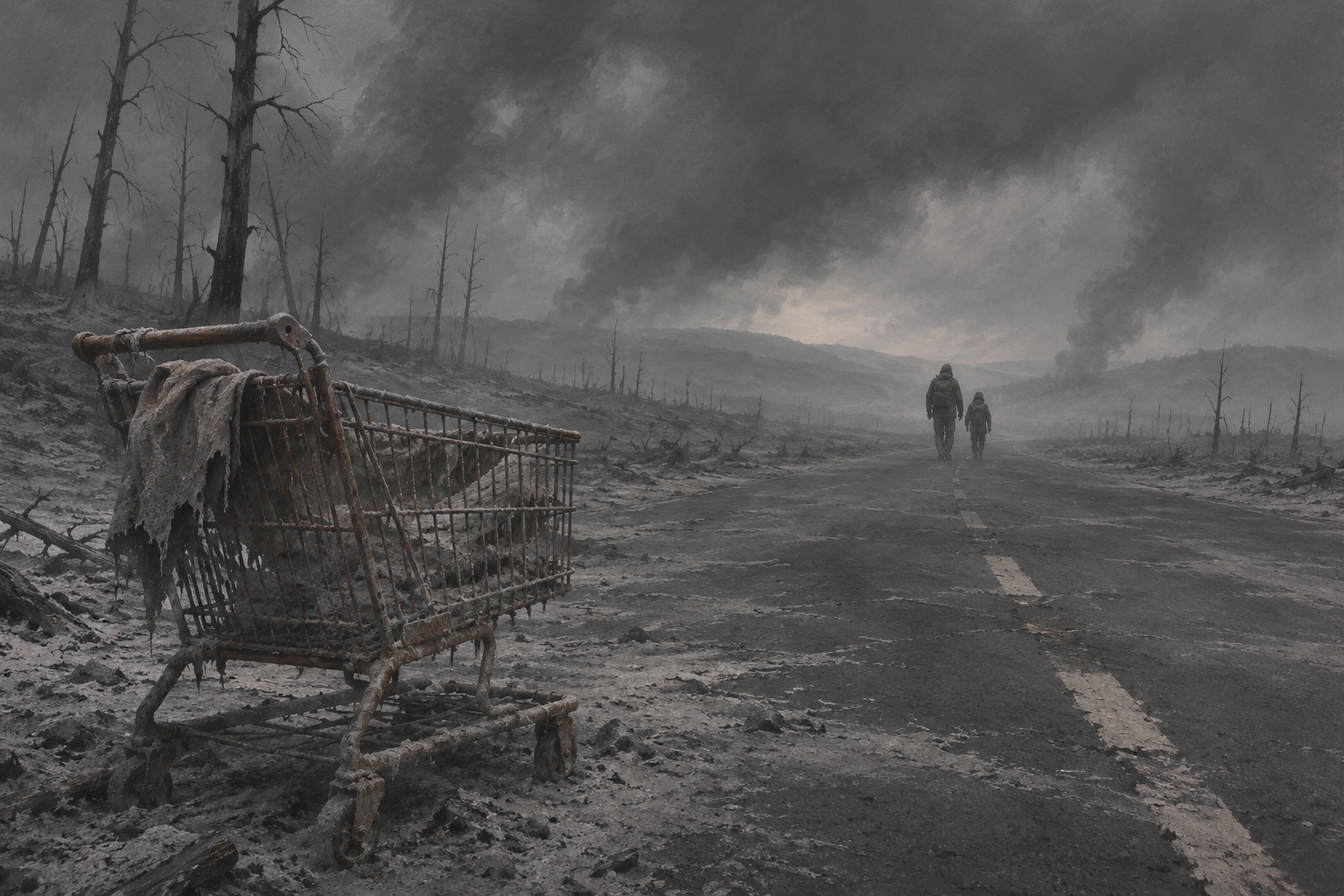
A man is taking his son south towards the sea. He has a map that still shows the roads, a shopping trolley to carry their possessions and memories of a time when arriving at the coast meant something. The boy has the map and his father’s word for the rest. He has never seen a blue ocean. In Cormac McCarthy’s The Road, that difference between the travellers matters as much as the distance they cover. The father wants to deliver his child to a place where he might live. Along the way, the child begins asking what kind of life they are keeping themselves alive to lead. Some days his father has an answer. On others, he has only enough food for another day.
What Happened to the World in The Road?
McCarthy never identifies the catastrophe. The father remembers a sudden disturbance in the night and the practical steps he took when he realised that something enormous had happened. The family eventually lost the conditions under which a house, a job or money might offer security. By the time we meet father and son on the road, ash obscures the sky, the cold is worsening and much of what they eat was sealed in tins before the boy was born.
An explanation involving war or an environmental disaster might satisfy a reader’s curiosity. It would be of little use to the child. He needs to know whether they can drink particular water, whether there is somebody in a house and how far they can walk before his shoes give out. Some of the adult’s knowledge has become urgently valuable. An enormous amount has become almost impossible to pass on. A father who remembers birdsong can describe it, but he cannot arrange for his son to hear what he means.
Their possessions tell a similar story. A supermarket trolley once belonged to a system in which people selected food, paid for it and left the trolley behind for the next shopper. The trolley has outlasted the shop. It now carries everything the pair can afford to keep, provided the surface under its wheels remains passable. The road itself presents the same bargain on a larger scale. It gives them a direction and allows them to move supplies. It also makes them visible to anybody else travelling along it.
South is a reasonable choice because winter threatens to kill them. The coast is a more complicated promise. The father can identify it on the map and remembers the quality of the light there. He has no recent information about what awaits them. His son often asks questions to which a truthful adult answer would be that nobody knows. Continuing to walk requires the father to make a destination feel rather more definite than the evidence warrants.
What the Boy Can Taste and His Father Remembers
In an abandoned supermarket the man finds a can of Coca-Cola and gives it to his son. The boy urges him to have some. He grasps something the father would rather leave implicit: being offered this particular pleasure probably means there will never be another can. It is an extraordinarily economical exchange between two people who love each other. The father gets to introduce his son to a taste from his own childhood. The son immediately understands what the gift costs.
If the drink were merely a symbol of vanished consumer culture, the scene could end when the can opened. What makes it moving is the boy’s desire to share it. The father thinks a parent expresses love by giving the child the whole thing. The boy would like the experience of drinking it together. Both understand generosity, but they have different ideas about who ought to be allowed to practise it.
The father’s former home tests another kind of inheritance. He can recognise rooms and recall domestic details through the building’s decay. To his son it is one more empty structure in which there might be something dangerous. He wants to leave. A place that confirms the father once had an ordinary life provides the child with no comparable comfort. The visit makes a modest claim on behalf of children whose parents long to show them where they grew up: a remembered home belongs partly to the people who once made it safe to enter.
Memories of the boy’s mother enter the narrative in fragments. She lived long enough after the catastrophe to know what hunger and human predators might do to the three of them. She came to believe that the family faced suffering from which the man could never reliably protect them. She chose to end her life. Her husband argued against the decision and continued caring for their son. He cannot tell the boy a comforting story in which his mother simply misunderstood the danger. He has seen some of the same things and fears much of what she feared.
Their disagreement survives her because it becomes part of his daily task. To keep a child alive is to expose him to another day on which something terrible could happen. To deny him that day would also deny him anything good the father has failed to foresee. Neither adult had certain knowledge of the future. The difference between them was what each felt entitled to decide on their son’s behalf. The father’s choice means that, for the time being, the boy gets a future about which he can eventually form an opinion of his own.
The First Time the Father Has to Use the Gun
An armed group travelling with a vehicle forces the man and boy to hide. One member comes close enough to discover them and seizes the child. The father shoots him. There is little room here for retrospectively inventing a safer choice. A stranger has his hands on the boy, the threat is immediate and the father possesses a means of stopping him. Afterwards he has to clean the traces of the killing from his son.
It is the aftermath that changes the relationship. The father knows the circumstances under which he fired and can explain them. The boy has felt a stranger’s grip and had a human being killed against him. His experience cannot be reduced to the proposition that his father did the right thing. Safety has arrived through an event from which the person who made him safe cannot shield him.
Their conversations about being the good guys have a particular urgency from here onwards. A conventional adventure gives a child visible ways to tell one side from the other. Looks, uniforms, companions and destinations can all identify the people who should be trusted. A stranger seeing this pair from the road would see a hungry armed man who conceals his movements, enters other people’s properties and is capable of shooting somebody. Some of the people he fears could describe themselves in very similar terms.
The father therefore gives his son rules. They will keep going. They will stay together as long as they can. There are things they will never do to other human beings, however hungry they get. The boy takes those undertakings seriously enough to keep asking whether particular actions are consistent with them. His questions can sound repetitive until one notices how often the circumstances have changed since the last answer. A child is trying to discover whether the promises are rules he can use or names his father attaches to whatever they have already done.
When the boy thinks he sees another little boy, he wants to go back. His father refuses. Neither can establish who else was there or what a search might expose them to. For the father, that uncertainty settles the matter in favour of departure. For the son, the possibility that another child is alone is already a reason to stay. Each imagines what could go wrong. Only one of them is imagining it from the other child’s position.
What Lies Beneath Two Ordinary Houses
Hunger brings the pair to a house where the father opens an enclosed space despite his son’s fear. Below are captives being kept as a source of food. The father and boy escape as the people who control the house return. Their survival depends on moving quickly, remaining concealed and leaving the captives behind. The child has now seen what the particular prohibition on eating people means in practice. He has also learned that people can live together, organise a household and make preparations for the future while doing precisely what his father considers unforgivable.
The discovery cuts close to the practical intelligence the novel has taught us to admire. The father is good at judging how long provisions will last. He can improvise shelter, conceal valuable supplies and keep others from discovering them. Behind that cellar door are people who have applied foresight and co-operation to ends that make those talents horrifying. For this reason the father’s ethical distinctions matter even where they fail to answer every question the boy asks. The ability to survive has no moral content by itself.
Later they discover another entrance below ground. This time it leads to a bunker stocked with food and supplies. The resemblance between the entrances makes the boy’s fear entirely reasonable. Experience has taught him that lifting a door can uncover something so awful that surviving the discovery will not put it behind him. His father has to investigate because they are starving. The difference between correct caution and a mistake that could cost their lives is hidden on the other side of the door.
In the bunker they can eat properly, wash and rest. The boy wants to thank the people who stocked it. He knows almost nothing about them. They may have intended to keep every tin for themselves. They may have died before they could reach the place. What he can establish is that strangers once did work from which he and his father are now benefiting. He finds a way to acknowledge that obligation even though nobody is present to hear him.
The father eventually decides that remaining there is too dangerous. Whoever else comes upon the entrance may be armed, and underground there is little prospect of escape. The road has repeatedly threatened them, yet it gives them the ability to see some dangers approaching and choose another direction. For the child, leaving also means giving up an experience of home that he can understand on his own terms. The abandoned house of his father’s childhood meant little to him. A place where he has eaten with his father and gone to sleep warm is another matter.
Why the Boy Wants to Feed Ely
The old man they encounter on the road offers the name Ely and later acknowledges it is not his real one. Withholding a name is a small precaution available to someone who lacks most other means of defending himself. The boy wants to give him food. His father suspects danger and knows exactly how much weight in provisions each meal represents. Eventually they share a meal and part with some of what they have.
Ely is poor material for a consoling tale about kindness rewarded. He brings no reliable intelligence about the road ahead. He offers no persuasive reason to hope the world will recover. He is willing to receive help without pretending that he would have done as much for them. The conversation gives the father grounds for considering his suspicions vindicated. It also clarifies what his son meant by wanting to feed someone. A meal offered only to a person who can pass a character test or repay it later would have been a different transaction.
The child’s generosity has a real cost borne by somebody else. His father has searched dangerous buildings and pushed the weight of those supplies over difficult ground. It is easier for the boy to offer food because the man has undertaken much of the work and fear involved in obtaining it. McCarthy allows that objection its force. He also lets us see the reverse arrangement. The father can continue to describe their journey as morally different from the conduct of other survivors partly because his son insists on recognising claims they might honour at some expense to themselves.
The two are making a life between them, and the work is divided unevenly. The father usually determines whether there will be a meal tomorrow. The boy changes what is possible at the meal tonight. Ely goes away fed. The achievement is small enough to state exactly, which is part of its dignity in a book where large promises are becoming difficult to believe.
What the Father Finds at the Coast
The sea is grey. Reaching it brings no change of climate dramatic enough to solve their problems and no visible community towards which they might appeal. The father knows the boy would have liked it to be blue. His disappointment contains an element the boy cannot share: he has led his child a very long way to show him something that existed when the journey began in his imagination and may already have disappeared when they took their first step.
Yet an old skill still has value. The man swims out to a stranded vessel and brings back useful supplies. For a while, the sea presents a practical problem of the kind he can solve. The boy, waiting ashore, must experience these expeditions quite differently. His protector repeatedly goes where he cannot follow, and the distance back to land is one his father must cover under his own power. As the man’s cough worsens, the limits of that power become harder to ignore.
At the shore they lose their provisions when someone steals their trolley and its contents. The man tracks down the thief. With his gun and the advantage of surprise, he recovers their property. Up to that point, his purpose is readily understood. The supplies are essential, and taking them could leave his son to die. Once the goods have been recovered, however, the thief is still standing there and the father is still angry. He makes the man surrender his clothes and leaves him exposed.
This is the judgement the child has been learning to make. He does not dispute that the thief wronged them or that taking the supplies back was justified. He objects to what his father does after he has recovered them. The father regards the punishment as a lesson in what it means to leave somebody with nothing. His son understands it as an act with a probable outcome, regardless of the explanation offered by the person holding the gun.
The father relents enough to go back and leave clothes for the man. They cannot find him. The delay matters more than an apology could. Earlier, uncertainty about a stranger was frequently a sound reason to keep away. Now the boy must live with uncertainty created by his own family’s actions. They cannot establish that the man survived, just as they cannot know for certain that he died. Calling themselves good carries the new obligation of remembering someone they may have abandoned too late to help.
What Happens to the Father and Son?
The father sustains a further injury and his health continues to deteriorate. His cough has long made it clear that the journey will eventually exceed his strength. The novel supplies no firm diagnosis that would turn his decline into a medical puzzle. What the boy needs to know becomes plain without one. There comes a point when the man who has always found another place to camp cannot get up and travel another day.
The father tells the child to continue and to keep carrying the fire. There is no last cache, trustworthy address or set of directions that can discharge his responsibility. He can tell his son that the quality they have tried to preserve is already within him. He must leave him with the additional burden of deciding what that means when he has nobody familiar to consult. The man dies, and the boy stays beside his body for three days.
When another armed man approaches, the son must make the first decision of his new life. He asks about the stranger’s family, whether there are children and whether the man belongs to the people his father taught him to call good. He asks about the fire. The stranger does not initially understand the expression. Of course he does not. What sounded to the boy like a universal name for decent people was part of the intimate language of one household. He has to translate it into questions a person outside that household can answer.
The man invites him to join a family that includes children. The boy accepts. The woman who receives him speaks to him about God, and he continues to speak inwardly to his father. The ending gives evidence that he has found human company and care. It makes no promise about how long their provisions will last or what the weather will do next winter. His achievement is immediate and considerable. A child taught by experience to fear approaching strangers has retained the ability to recognise an offer worth accepting.
What does carrying the fire mean? For the father, it kept a moral distinction alive when the visible signs of civilisation had disappeared. For the boy, it has become a practice: feeding someone, looking for another child, objecting when a punishment continues past the point of defence, asking a stranger questions and listening to the answers. He honours his father most fully by doing something his father often found impossible. He puts his life in the hands of people whose goodness he cannot prove in advance.
McCarthy closes with brook trout once living in mountain streams. After a story in which nearly every object has been assessed for food, fuel or shelter, the markings on a fish receive attention for their own sake. The boy’s rescue cannot restore that water or teach him from experience what swam in it. For a paragraph the reader is allowed to see something he may never see. His father spent the journey trying to give him a future. The last page lets us feel how much of the past even a loving father could never carry there.
Sources
The Road — Penguin Random House. Publisher’s description and English-language edition information. PenguinRandomHouse.com: Books
The Road: Plot Summary — LitCharts. Reference for the journey, the coastal encounters and the final movement from the family to the trout. LitCharts
The Road: Full Book Summary — SparkNotes. Independent plot reference for the father and son’s encounters and separation. SparkNotes
