The Map, the Mirror and the Missing Book
The Abbot’s Horse Is Easier to Find
Before William of Baskerville reaches the abbey, he tells a party of anxious monks which way their missing horse has gone. He can describe the animal, explain why it belongs to the abbot and even supply its name. To Adso of Melk, the young novice travelling beside him, it looks as though his master can recover an entire story from a few marks in the snow. That is an encouraging talent in a man about to investigate a death. It is also a dangerous first impression. Umberto Eco opens The Name of the Rose with a small mystery that comes out beautifully, then gives William seven days to discover how much more difficult it is to be right about people.
What the Abbot Wants William to Explain
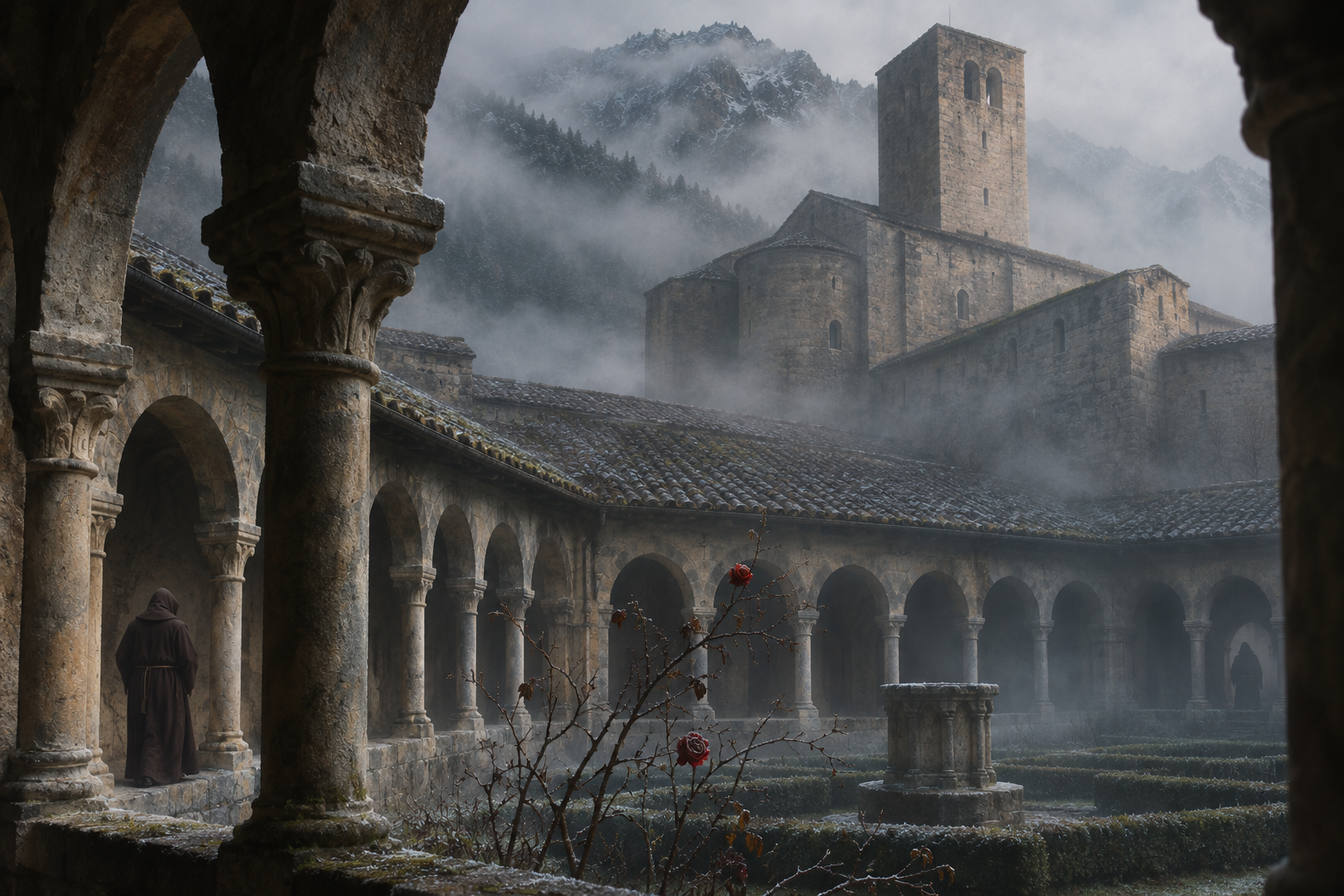
The year is 1327. William, an English Franciscan friar and former inquisitor, has come to a wealthy Benedictine abbey in northern Italy for a delicate meeting. Representatives of his order will debate members of a papal delegation over whether Christ and the apostles owned property. The question has immediate consequences for institutions that own land, employ servants and store considerable wealth. A delegation preparing to discuss apostolic poverty could hardly have chosen more uncomfortable surroundings than this magnificent house of religion.
The abbot, Abo of Fossanova, has a more pressing difficulty. Adelmo of Otranto, a gifted young illustrator of manuscripts, has been found dead below the abbey’s great tower. Abo would like William to establish what happened before the delegations arrive. He gives him considerable freedom to question the community. There is one substantial exception. William may visit the scriptorium where the monks copy, translate and decorate manuscripts. The library above it remains forbidden.
The distinction sounds peculiar because the abbot describes the collection with such pride. Scholars come from far away to work here. A manuscript can survive for centuries through the labour of people who copy it by hand. Yet the person qualified to translate a particular work may never be allowed to see the shelf on which it stands. Requests go through the librarian, Malachi, and his assistant, Berengar. Knowing that a book exists, finding it in the catalogue and obtaining permission to hold it are three different privileges.
William’s performance with the horse already looks a little less supernatural on inspection. Tracks and broken vegetation gave him evidence about the animal’s movements and appearance. The behaviour of the search party told him that a particularly valuable horse had gone missing. For its name, he drew upon the conventional name a learned monk might consider appropriate for an exemplary horse. He read a landscape, then made an educated guess about the taste of the man who owned it. The guess worked. Adso is much more likely to remember the correct name than the difference between the two operations.
We hear the story from Adso late in life. He can still describe the force with which the abbey’s architecture struck him as a boy. His admiration for William has also survived, although he now knows what their investigation cost. Eco adds another uncertainty by presenting Adso’s account through a succession of manuscripts and translations. Before anybody enters the forbidden library, the reader has already accepted a book on the strength of an editor’s distinctly complicated story about where it came from.
A Disagreement About What Makes Monks Laugh
Adelmo’s gift was for filling the margins of serious works with extraordinary creatures. In the scriptorium, his strange little figures still have the power to make the monks laugh. That sound draws an objection from Jorge of Burgos, an elderly blind monk of immense intellectual standing. To Jorge, an image that makes the grotesque attractive or solemn things ridiculous can lead a reader away from the truth the manuscript ought to serve.
William enjoys disputing the point. A ridiculous image can expose a bad argument. An exaggerated likeness may let someone recognise an absurdity that a solemn explanation would leave undisturbed. The disagreement has more bite because of where it happens. These men are responsible for passing knowledge to people they will never meet. A drawing in a margin might stay in a reader’s mind long after a carefully transcribed sentence has slipped away. Jorge understands that possibility at least as well as William does. It alarms him.
Venantius, a translator who knows Greek, has taken an interest in an earlier exchange about comedy and the philosopher Aristotle. Berengar appears anxious about where the conversation is going. Other monks know parts of the argument, but their accounts differ according to which colleague they admire, what position they hope to obtain and what they fear William might discover about their own curiosity. The room is full of professional readers. That has done very little to make them candid witnesses.
William begins to doubt the assumption that Adelmo was pushed from the tower. The position of a body after a fall need not identify the exact point from which the fall began. Weather and terrain matter. So does the young monk’s distressed behaviour before his death. Testimony draws William towards a secret involving Adelmo and Berengar, whose position gives him access to knowledge other monks want. The possibility of suicide changes the question. William now needs to know what Adelmo believed he had done and why he found the thought of living with it so unbearable.
Then Venantius is found dead in a vat of pigs’ blood. This discovery is so spectacular that it almost supplies its own interpretation. Someone appears to have devised a grotesque punishment and chosen the perfect place to display it. William has a more elementary question to settle first. Is this where Venantius died, or merely where somebody wanted the brothers to find him?
Why the Library Has to Be Read From Outside
Venantius has left notes, including writing William must decipher. A nocturnal visit to examine his work becomes a pursuit, and William loses his spectacles. For Adso, his master’s lenses are another of the marvels he carries about with him. Their loss matters for a more prosaic reason. The abbey is full of writing, much of it small, some of it unfamiliar or deliberately concealed. A brilliant investigator who cannot bring the page into focus must wait for practical help from someone who understands glass.
William and Adso enter the library against the abbot’s orders. From below, the great building looks regular enough to yield its secrets to someone who counts its towers and windows. Inside, one chamber resembles another. Doorways that appear to promise a straightforward route lead the visitors away from their intended direction. A mirror distorts what they see. Strange air and disorientating effects give the place something of the terror its guardians cultivate. A frightened visitor who escapes can be relied upon to discourage the next unauthorised reader.
The breakthrough comes from accepting that a person lost inside a building is poorly placed to draw its plan. From outside, William can establish the shape of the structure and count features which remain fixed however often an occupant turns around. Back inside, the investigators record the arrangement of rooms, their connections and the letters associated with inscriptions. Put together, those letters identify regions of the known world. The library has a geography. A monk admitted to it could still spend years learning where his predecessors chose to place a particular body of knowledge.
The map reveals something a locked door alone could never tell them. There ought to be space where the routes they have traced allow them no entry. A concealed room known as the finis Africae, the end of Africa, begins to take shape as a real architectural possibility. William has identified the room by accounting for the space around it. He still has no idea how to get through the wall.
The achievement draws a revealing comparison with the book burning in Fahrenheit 451. At Eco’s abbey, a manuscript can be copied, catalogued, protected from the weather and praised as evidence of an institution’s greatness while remaining effectively unavailable. The stone walls perform several duties at once. One generation built a home for books; another acquired the power to decide who would ever read them.
What Adso Learns From a Girl Whose Name He Never Knows
Adso has his own encounter in the abbey kitchens. He meets a poor local girl who has come in search of food. Their sexual encounter leaves him overwhelmed by desire, religious guilt and tenderness. Remembering it decades later, he can find passages of Scripture through which to describe how beautiful she seemed. He cannot tell us her name.
That imbalance is among the cruellest things in the novel. Adso knows a great deal of language in which to preserve his own experience. The girl has little opportunity to leave any account of hers. She belongs to the impoverished population around an establishment that debates the moral standing of property while controlling access to substantial stores of food. Men who can enter the kitchens without explanation have opportunities she lacks. Any account of the encounter as a young monk’s romantic awakening has to reckon with the reason she came into the building.
Adso tells William, who responds with greater gentleness than his pupil expects. Confession can establish what the novice believes he has done wrong. It cannot establish what the girl felt, whether she is safe or what she will have to do the next time her household needs food. The distinction will become painful when men with official authority take an interest in her. They possess categories in which to place her and almost no curiosity about her life.
Meanwhile, Berengar disappears. He is found dead in a bath, and his body yields a detail that the spectacle of the pigs’ blood might have encouraged everyone to overlook. Dark discolouration on fingers and tongue connects his case with that of Venantius. Severinus, the abbey herbalist, can help William consider what might have produced it. There is reason to suspect poison. Identifying a common substance would still leave an awkward question. Why should a translator and an assistant librarian have received it on the same parts of their bodies?
The order of discovery is important. William has one apparent fall, one body in blood and another in water. An elderly monk, Alinardo, thinks in terms of the trumpets in the biblical Book of Revelation. Images of destruction involving blood, water and celestial portents suggest that somebody might be arranging deaths in an apocalyptic sequence. Once William entertains that possibility, a new incident can do two quite different things for him: provide fresh evidence or merely remind him of a verse.
The Inquisitor Has a Solution of His Own
The visiting delegations arrive. Their dispute turns on a question that sounds narrow until one considers its implications. If Christ and the apostles possessed nothing, what example does that set for the Church? Can somebody use a robe, food or shelter without owning it? A Franciscan defending poverty as a religious vocation may intend a claim about how Christians ought to live. An opponent can hear a challenge to the authority of wealthy churchmen. Both understand how much depends on the wording of an apparently small concession.
The papal party includes Bernard Gui, an inquisitor. Unlike William, Bernard has the resources to turn an interpretation into an official finding. The cellarer Remigio and his assistant Salvatore have histories connecting them to the movement associated with Fra Dolcino, whose followers were condemned as heretics. Their past gives Bernard a genuine fact upon which to build an accusation. It also gives them excellent reasons to hide things from an investigator, even if those things have nothing to do with the dead monks.
Salvatore is caught with the girl from the kitchens amid circumstances Bernard can interpret as witchcraft. No explanation Adso might offer about hunger, exploitation or desire would carry comparable institutional weight. The reader knows her as a person at least well enough to recognise the inadequacy of the charge. To the men conducting the inquiry, she makes an unusually convenient suspect precisely because she lacks the means to dispute the story they tell.
Severinus then tells William that he has found a strange book. Before William can secure it, Severinus is killed in the infirmary, struck with a heavy astronomical instrument. Here is another death that seems to fit the language of Revelation: an object representing the heavens has literally fallen on a man. There is also an urgent practical difficulty. The promised volume is no longer where William expects it to be. A searcher who assumes that a Greek work must announce itself as Greek may pass over a volume containing several texts bound together.
Remigio is discovered at the scene and taken into custody. Under Bernard’s questioning and the threat of torture, he confesses to crimes that the evidence does not establish he committed. Bernard can now offer the abbey something William cannot: an identifiable culprit, a confession and a case ready for public consumption. For the men preparing reports to their superiors, that is an impressive result. It is rather less impressive to anybody interested in what happened to Severinus’s book.
Remigio, Salvatore and the girl are taken away. Adso fears what awaits her, but he never sees her again and cannot give us an eyewitness account of her death. It is an important distinction in a novel about confident verdicts. The absence of certainty gives her little protection. It does, however, prevent the reader from claiming knowledge of her fate that nobody with a voice in the surviving account actually possesses.
How William Opens the Hidden Room
Malachi, the librarian, collapses during worship. The dark marks appear again. His death makes nonsense of the reassurance Bernard’s confession might have supplied. A prisoner can be made to accept responsibility for yesterday’s events. He cannot conveniently explain why another monk has just died in front of the assembled community with the same signs on his body.
Abo’s patience runs out. William’s investigation has penetrated matters the abbot would prefer to manage himself, without restoring order to the house. He orders the visitors to leave. William now has very little time, a map that leads to a blank and a note whose wording seems impossible. The clue refers to the first and seventh of four. Read as an instruction to count four objects, it fails before the search has begun. There is no seventh member of a group of four.
A remark from Adso helps William change what he is counting. The Latin word for four, quatuor, contains seven letters. Its first and seventh letters are q and r. The word appears in the inscription by the mirror. Pressing the corresponding letters releases the concealed entrance. The mechanism is satisfying because the missing knowledge was never a more obscure fact about theology. The investigators had to notice the difference between a number and the word on the wall that named it.
It also gives Adso a real share in the discovery. William has supplied much of the learning, but the master who has spent days searching the abbey’s intellectual history needs an accidental prompt from his pupil to see what a schoolboy could count on his fingers. The solution follows the correction that solved the map. When a problem becomes impossible from one position, it may repay the inconvenience of looking at it from another.
Behind the mirror they find Jorge. For all the authority exercised by the abbot and the office held by Malachi, the blind monk has understood this part of the building better than either. His apparent disadvantage made him easy to underestimate in a library. William has repeatedly needed light, lenses and legible ink. Jorge has had years to learn routes by touch, remember where things belong and discover which subjects his colleagues can be trusted to avoid.
What Is the Book, and Why Has It Killed Its Readers?
The volume contains what the novel imagines to be the lost second book of Aristotle’s Poetics, devoted to comedy. This is Eco’s fictional solution to the mystery. The work in Jorge’s hands matters because of the name attached to it. Medieval scholars already know that people laugh. They encounter jokes, comic tales and grotesque drawings without travelling to a secret chamber. What Jorge fears is a serious philosophical argument for laughter bearing the authority of Aristotle.
William has anticipated a danger in the physical book and protects his hands. The page edges have been poisoned. As readers separate the resistant leaves, the habit of moistening a fingertip transfers the substance from hand to mouth. The marks on fingers and tongue now have a common explanation. The victims did not need to eat the same meal or be visited separately by someone carrying a cup. They shared an occupation, an appetite for forbidden knowledge and an ordinary reader’s gesture.
The earlier deaths can now be disentangled. Adelmo, distressed by his sexual bargain with Berengar for privileged knowledge, took his own life. Venantius learned enough about the secret to reach the volume and read it. He died elsewhere; Berengar moved his body into the vat because an inquiry threatened to expose his own involvement. The blood that seemed to proclaim an elaborate murder was the work of a frightened man trying to disguise a death he had neither planned nor understood.
Berengar handled the book himself and succumbed after taking it to the infirmary. That is how the volume came within Severinus’s reach. Once the herbalist announced his discovery, there was an interval in which somebody could get to him first. Jorge manipulated Malachi into acting against Severinus. Malachi killed him with the object at hand. The astronomical instrument made the event look grandly symbolic afterwards. Its immediate attraction to the attacker was that it was heavy and available.
Benno, another monk hungry for access to the collection, helped the volume pass back into the library’s keeping. Malachi’s own curiosity then exposed him to the same danger as the earlier readers. The librarian held the official post, but he too wanted to know what somebody else had decided he should never see. Finally, the abbot tried to intervene through another entrance to the chamber. Jorge trapped him in the passage. The man charged with protecting the abbey has been caught in an architectural secret on which its prestige depended.
Did Jorge plan the whole sequence? He deliberately made the book dangerous, concealed it and manipulated others when concealment began to fail. That is substantial responsibility. Yet he did not dictate Adelmo’s despair, Berengar’s choice of a hiding place for a corpse or every subsequent movement of a volume desired by several independent people. William’s apocalyptic model brought him close to the truth because blood, water and stars made memorable landmarks. It misled him whenever he treated those landmarks as proof that a single traveller had laid the whole road in advance.
Why Is Jorge Afraid of Laughter?
Jorge’s position is subtler than a conviction that every joke must be stamped out. Common people can laugh at a festival and still go back to their accustomed places afterwards. A monk can suppress a smile in the scriptorium. Such laughter passes. A philosophical account might teach people to use ridicule deliberately, including against those who claim the authority to pronounce on truth. It might even make the ability to laugh at an argument a mark of an educated mind.
Aristotle is especially dangerous to Jorge because the abbey’s scholars already take him seriously. A comic poet praising comedy could readily be dismissed as a tradesman advertising his wares. A philosopher of recognised authority explaining what comedy can teach would have to be copied, translated, discussed and answered. Keeping one manuscript from a handful of Greek readers is just about possible. Controlling the questions raised by generations of students would be a different undertaking.
Fear matters to Jorge’s understanding of religious order. Someone frightened by an image of the devil may obey the person who offers protection. Someone who can also see what is ridiculous in that image has acquired a little distance from both the fear and its interpreter. William values precisely that interval. If a solemn proposition can survive examination, nobody has lost anything by examining it. The man most likely to suffer from a joke is the one whose authority requires everyone else to keep a straight face.
Yet Adso notices an uncomfortable intimacy in the confrontation. Both men relish a formidable intellectual opponent. William has worked out much of a lost text from traces in other writings. Jorge has devoted extraordinary ingenuity to preventing anyone from doing what William has just accomplished. Between them lies a manuscript both value, and around them are the bodies of people whose motives were messier than either scholar’s argument. The brilliance of the debate cannot bring any of those people back.
What Survives the Library Fire?
Jorge begins tearing out and eating the poisoned pages. He is destroying the text in the one place where William might have saved it. In the ensuing pursuit, their lamp overturns and the library catches fire. The design that kept intruders out now frustrates rescue. People below lack routes, time and equipment. The abbey has invested generations in controlling who may enter the collection and almost nothing in enabling a crowd of ordinary men to save it in an emergency.
The fire spreads beyond the secret chamber and consumes the library and much of the abbey. William has found the manuscript, identified the man who poisoned it and reconstructed the relationships among deaths that had seemed inexplicable. As a set of answers, the achievement is considerable. As an intervention intended to preserve life and knowledge, it has come disastrously late. Even the false pattern has had consequences: once a possible sequence becomes known, somebody can begin to act in accordance with it. An explanation may help create the very order it claims merely to have discovered.
Years afterwards, Adso returns to the ruins and gathers fragments of manuscripts. From these scraps he assembles a little collection. A few surviving words may allow him to identify a familiar work. Other pieces survive by pure accident, giving a sentence that happened to escape the flames more influence over his memory than whole shelves once considered indispensable. His smaller library has a principle of selection as arbitrary in its way as Jorge’s, although nobody chose it.
The title acquires its particular force here. The closing Latin line associates a vanished rose with the name that remains. It does not assign a single secret identity to the rose. The lost library is an obvious possibility: William can name the book he could not preserve. The girl from the kitchens offers a harder case. Adso can remember the sensation of being near her after a lifetime in religious orders. Of all the things lost at the abbey, the person he most wants to remember is the one for whom he never had a name.
That difference takes us back to the horse. A young man once watched his master name an animal he had never seen and thought himself in the presence of almost miraculous knowledge. In old age he can name authors, books, regions of the library and men who died there. He can still describe a face in a kitchen. The limits of what he knows become clearest at the point where his memory is most tender, and where a less honest storyteller would simply have supplied the missing word.
Sources
The Name of the Rose — Umberto Eco, HarperCollins edition and preview. Publication history and edition information for Eco’s novel, originally published in Italian in 1980. Google Books
The Name of the Rose: Plot Summary — LitCharts. Reference for the seven-day narrative, the delegations, the trial and Adso’s retrospective account. LitCharts
The Name of the Rose: Sixth Day — LitCharts. Corroborates the mirror mechanism, the inscription and the letters used to enter the hidden room. LitCharts
The Name of the Rose: Seventh Day — LitCharts. Detailed reference for the manuscript, the physical evidence, Jorge’s argument and the limits of William’s reconstruction. LitCharts
