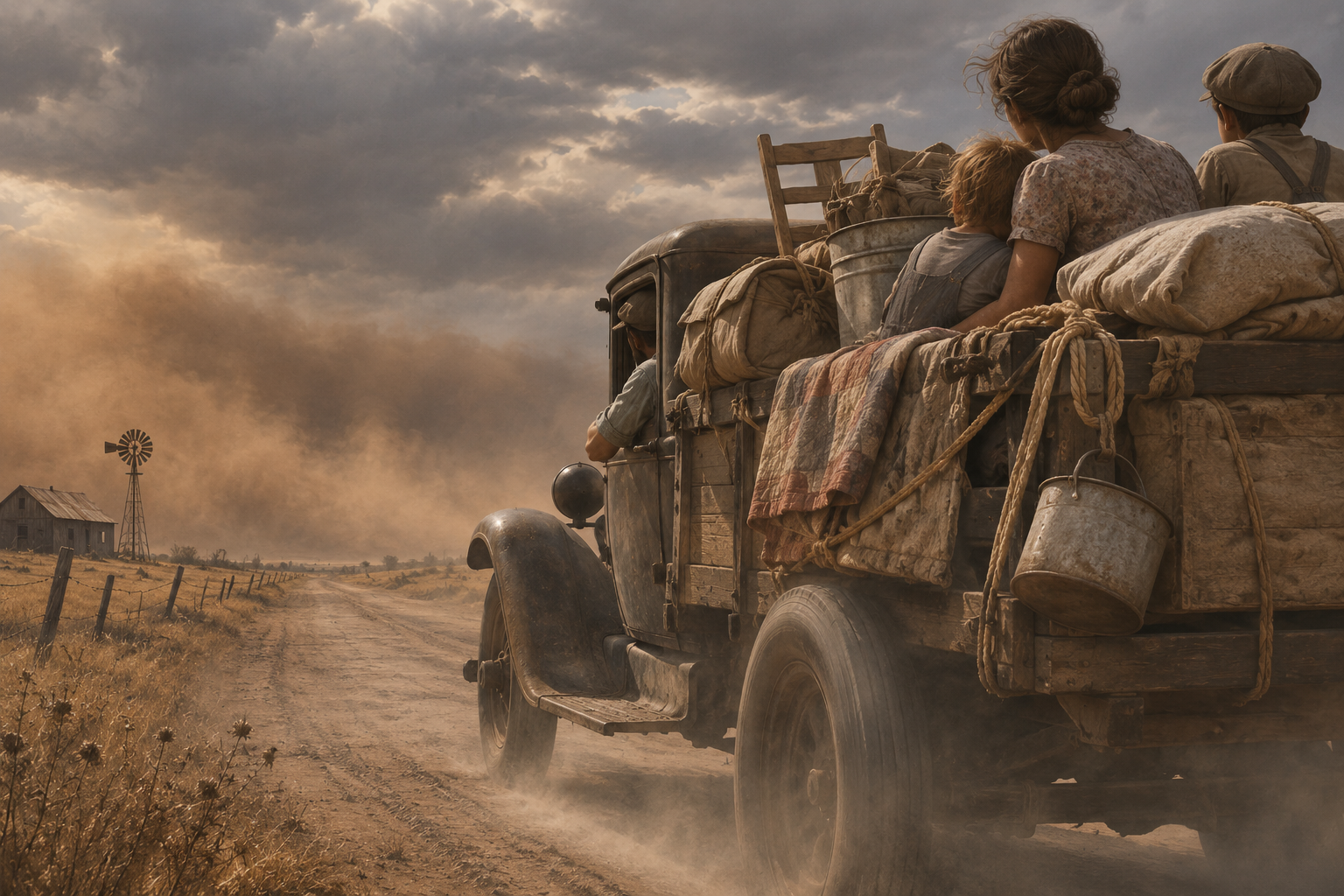
Why Are People Hungry in a Land of Plenty?
The House Is Empty Before Tom Gets Home
Tom Joad has spent four years in prison with a fairly definite idea of what coming home will mean. He knows the road, the people and the house where he expects to find his mother. What he has missed during his absence is a change in the meaning of ownership. A family can plant a field, bury its dead nearby and know where to put a hand in the dark to find the door, yet still be given notice to leave. John Steinbeck’s The Grapes of Wrath begins in Oklahoma with Tom trying to find out where everybody has gone. The answer takes him to California, where an even stranger question awaits him. How can people go hungry in a place that grows so much food?
What Happened to the Joad Farm?
Before Tom appears, Steinbeck gives the first chapter to the people watching the weather. Dust settles over the corn. Men examine the damage while women watch the men, trying to judge whether they can recover from what they see. Children study the adults for the same reason. Nobody has a reliable forecast. What the family can establish, by looking from one face to the next, is whether anybody has given up. Long before we know Ma Joad’s name, we know something about the work she does.
Tom comes back on parole after killing a man in a fight. He is frank about the circumstances and has little interest in making the episode more dramatic for a stranger who gives him a lift. Near home he meets Jim Casy, the former preacher who baptised him. Casy has left the pulpit because he can no longer honestly divide his experience into the sacred and the sinful as neatly as his sermons once required. He still has the habits of a preacher. If someone gives him a question and a stretch of road, he will talk it through. Tom, whose education in prison included learning how to get through one day at a time, makes an occasionally impatient audience.
They find the Joad house deserted and damaged. A neighbour, Muley Graves, supplies the missing history. The Joads were tenants. Drought and poor returns made their position precarious, and those who control the land have found it more profitable to work large tracts with machinery. A tractor can cross in an afternoon boundaries that once distinguished one family’s living from another’s. The incoming driver may himself be a local man with children to feed. That is cold comfort to someone who recognises him as he comes through the yard.
Steinbeck gives the dispossessed farmers a serious question about responsibility. A tenant who wants to stop the destruction asks, in effect, whom he should confront. The driver takes orders from someone else. The land company answers to a bank. The bank’s representatives speak of what the bank requires, as though they too were tenants of a creature whose feeding habits nobody can alter. Each individual can offer a plausible account of why he went to work that morning. Between them they can remove a whole neighbourhood.
Muley has remained behind while his family went west. He knows where to obtain food and how to avoid being caught sleeping on land from which he has been evicted. His intimate knowledge of the place, once an ordinary qualification for living there, now makes him good at hiding. Tom finds his own family at Uncle John’s, preparing for departure. For Ma, seeing her son again brings one immediate anxiety to an end. Then she studies him for signs of a more lasting injury. She wants to know whether prison has made him someone who needs to hurt others because he has been hurt. The question will outlast Oklahoma.
Why the Family Believes the California Handbill
California has sent an invitation of sorts. Printed handbills advertise work picking crops. The Joads know how to work, and the paper is genuine. Their mistake is an understandable one: they read the number of jobs advertised without knowing how many copies of the advertisement have been distributed. One family can make a sound calculation about its chances only if it has some idea how many other families are making exactly the same calculation.
Getting to the promised work requires them to become poor in a different way. Farm tools, furniture and household possessions are worth something to people who can use them. Once the buyers know the sellers must leave, the same objects fetch very little. Ma sorts through her private keepsakes and burns much of what she cannot take. One unusual cruelty of the clearance is that she has to do the selecting herself. A stranger could throw away a box. Only Ma knows which piece of a life disappears with each item she puts into the fire.
The family packs a converted Hudson truck. Tom’s younger brother Al prizes his knowledge of vehicles, and for once the opinions of a teenage boy carry considerable weight. A fault in the engine could leave three generations stranded. People will look to Pa and the older men when a family council meets, but they listen for Al’s judgement when the truck makes a noise. Authority has started to move towards whoever knows what to do next.
Tom will be breaking the conditions of his parole by leaving Oklahoma. Staying behind would mean separating himself from the family almost as soon as he has found it. His pregnant sister Rose of Sharon and her husband Connie have an attractive picture of their future. Connie will learn a trade; they will have a home where the baby can thrive. Plans are cheap enough to carry west, and every adult on the truck has a slightly different idea of the life for which they have sold their possessions.
Casy wonders whether there is room for him. The family is already heavily loaded, and nobody can calculate how many meals they can afford. Ma nevertheless treats the idea of leaving him behind for want of a precise food budget as absurd. Her decision seems, at first, an expression of inherited hospitality. Further along the road it will become clear that sharing with people outside the family is also one of the few practical forms of security available to it.
What Route 66 Takes and What It Gives
Grampa has looked forward to reaching California and eating grapes. When departure becomes immediate, he refuses to go. His earlier enthusiasm was real enough while California was a pleasure he could imagine from Oklahoma. Now his family intends to lift him into a truck and separate him from the only place in which being Grampa Joad has ever meant anything. They give him a sedative and take him. Early in the journey he suffers a stroke and dies.
A couple named Ivy and Sairy Wilson give the family the use of their tent. The Joads cannot afford the official arrangements for a burial, so they bury Grampa themselves and leave a written account with his body explaining who he was and how he died. It is a small precaution with a considerable history behind it. They know strangers may one day dig there. They would like the stranger who finds an old man’s bones to have something better than guesswork on which to judge his family.
The Wilsons have helped the Joads when there was nothing to be gained from doing so. The Joads have people who can mend a vehicle. Travelling together makes both households more capable, until illness eventually prevents the Wilsons from going on. Steinbeck repeatedly pauses the Joads’ story to describe what happens in overnight camps. Families arrive as strangers, work out where to draw water and how to behave around other people’s children, and leave in the morning. By the next evening, some of that knowledge has travelled a hundred miles. A population whose former communities have been broken apart is learning how to make a temporary one before dark.
Ma also has to decide when keeping the family together justifies a fight. When a breakdown produces a proposal to split the party, she takes up a jack handle and makes her opposition unmistakable. Until then, the men have been able to treat a family decision as something they reach while Ma makes the decision bearable for everyone else. Here she claims a voice in what the truck will actually do. She has understood a danger the others are discounting. People who separate on the assumption that they will easily find one another later may never have the money or the address to do it.
Near the Colorado River, Tom’s older brother Noah decides to stay behind. He believes he can live by fishing and that the others will manage without him. Tom cannot talk him out of it. Soon afterwards comes the desert crossing. Granma is desperately ill. When officials stop the truck, Ma insists that they must be allowed through so the old woman can receive help. Only afterwards does the family learn that Granma was already dead and Ma had lain beside her through the crossing.
It is tempting to call this strength and leave it there. The precise cost is that Ma cannot do the first thing a grieving person might want to do: call the others close and tell them what has happened. She judges that getting everyone across the desert depends on keeping the knowledge to herself. The family has reached California partly because one woman went without the comfort of her family for a night.
The First Question a Worker Must Never Ask
The view into California seems to vindicate the handbills. After the dust, distance and punishing climb, there is fertile land on a scale almost beyond the travellers’ experience. What the view leaves out is any indication of who may pick the fruit, who sets the price of the picking and where a family is supposed to sleep between harvests. The Joads have crossed the continent to discover that seeing abundance and having a claim on it are separate matters.
At a makeshift camp, hungry children gather around Ma as she cooks. There is too little stew to feed all the watching children properly and barely enough for her own people. The episode registers a limit to hospitality that the decision about Casy never reached. Ma could make room for one more person on a truck. Here another mother has to watch her child wait for scraps from a stranger. Giving something away can relieve immediate hunger while exposing both households to a humiliation neither intended.
A contractor comes looking for pickers. One of the migrants, Floyd Knowles, asks what the work will pay and wants the offer put in writing. From the employer’s point of view, naming a wage now would surrender an important advantage. Get enough people to travel to the job first and they will have spent the petrol required to look elsewhere. With hungry children beside them and more applicants arriving, many will take what is offered on the spot.
A deputy moves against Floyd. Violence follows, and a bystander is shot as the deputy attempts to stop the fleeing man. Tom intervenes, as does Casy. With Tom at risk of being identified as a parole violator, Casy takes responsibility and lets himself be arrested. The former preacher has been wondering what his next vocation might be. In this instance he does not need a vocation. He knows which of the two men is likely to pay the higher price if the police take him away.
Connie also disappears. California looks different from the place in which he imagined studying and providing for a wife and child. His departure leaves Rose of Sharon waiting for a man who once spoke fluently about the future and has proved incapable of telling her when he means to leave. The Joads must move again. Their first experiences of the promised state have cost them a companion to the authorities and a son-in-law to a quieter form of flight.
Why the Government Camp Matters
At the government camp commonly called Weedpatch, the Joads find proper washing facilities, toilets and residents who participate in running the place. The physical comforts matter enormously. So does the experience of being greeted by people who assume that a migrant family can be trusted to use them. After being watched, moved on and spoken about as a threat, Ma has to get used to the simple fact that somebody can knock at her door without having come to order her out.
The camp tests an accusation the migrants have heard repeatedly. Roadside settlements are dirty, so outsiders conclude that dirt is characteristic of the people living in them. Give the same people clean water, sanitary facilities and some control over their surroundings and the supposed defect of character proves remarkably responsive to plumbing. Steinbeck can make that point without stopping for a lecture. A child encountering a flushing toilet for the first time provides all the comedy and evidence the scene needs.
The residents also organise a Saturday dance. Men hostile to the camp want an incident that would give deputies a pretext to enter. Warned of the plan, the campers watch for the men sent to start a disturbance and prevent the fight from developing. Their success is a considerable political achievement disguised as an uneventful evening. Anyone arriving just afterwards would see people dancing and have no reason to know how much judgement it took to keep them there.
Yet a well-run camp cannot create a crop ready for picking or require a grower to pay a living wage. As the family’s money dwindles, Ma presses for departure. Her insistence can seem harsh after all they have endured to reach a place fit to live. She is the person who sees what remains in the food supply. To stay because the camp embodies a better society would require her to serve the children an idea for supper.
The title gains force in the chapters about what happens to produce that cannot profitably be sold. Fruit is destroyed while hungry people are prevented from taking it. A grower may be able to explain why picking, packing and transporting a crop would cost more than its sale price. A parent looking at edible fruit being deliberately spoiled has grounds for an anger that outlives the explanation. The book’s wrath ripens in that distance between two perfectly intelligible accounts of the same field.
How the Peach Strike Changes What Tom Knows
The Joads hear of work at a peach ranch. The approach is unsettling. There are guards and angry people outside, but the family needs a wage immediately. Inside, they are offered five cents for each box they pick. It takes the efforts of several people to earn enough for a meal, and the company store gives Ma little room to make those earnings stretch. The adults are tired, the children have worked and the purchases still seem pitifully small.
Tom goes outside the ranch and finds Casy among the strikers. In jail, Casy learned something from an apparently minor grievance over food. Individual complaints could be ignored. When the men made the complaint together, somebody paid attention. On release, he began organising workers. His old interest in what human beings share has acquired a specific application. A man offering his labour alone and a group able to withhold theirs are different parties to a negotiation.
Casy explains why the ranch is paying the Joads five cents. The earlier workers had faced a cut to two and a half cents and gone on strike. To break it, the grower temporarily offers newcomers the higher rate. Once enough people are picking and the strike collapses, the employer can cut their wage too. The shouting at the gate sounded to the Joads like hostility towards people trying to feed their families. From the other side, hungry newcomers were being used to remove the only leverage workers with equally hungry families possessed.
The explanation puts Tom in a genuine bind. Walking out would mean asking Ma to give up the money with which she has just bought supper. Staying would help ensure that the next supper costs twice as much labour. Nothing about discovering who is right supplies the household with an extra day’s food. The ranch’s advantage rests on its ability to wait longer than the families can.
Men come upon the organisers. One strikes Casy in the head with a pick handle and kills him. Tom retaliates, striking down the attacker and killing him. Tom is injured in the encounter, leaving a visible facial wound that makes concealment difficult. His friendship with Casy has changed the range of things he can see. It has also brought him to another killing, years after the fight that put him in prison. His anger is immediate and personal. What he will do with Casy’s understanding of collective action remains open.
The rate for picking falls, just as Casy predicted. The adjustment in pay achieves what no speech could do for the Joads. They can now test his explanation against their own earnings. The five cents that looked like a promise was a temporary expense incurred to defeat the people outside the gate. When it has served that purpose, it disappears.
What Tom Means When He Says Goodbye to Ma
The family moves on to cotton work and finds shelter in a disused railway boxcar shared with the Wainwrights. Al grows close to their daughter Aggie, and they plan to marry. For a brief period the adults can pick, pool earnings and think about a future that includes something other than the next journey. Tom remains in hiding nearby. Ma brings him food, allowing him to stay within reach without endangering everyone by sleeping among them.
The arrangement depends on the youngest children keeping a secret whose consequences they can scarcely comprehend. In a quarrel with another child, Ruthie boasts that her brother has killed men and is hiding. She wants to frighten an opponent and regain standing after a humiliation. In another setting the remark would be a piece of playground cruelty forgotten by evening. Here a child’s loose tongue makes it unsafe for a grown man to remain near his mother.
Ma goes to warn Tom and to say goodbye. Their conversation is often remembered for the breadth of the future Tom imagines. What gives it force is how little reassurance he can give the woman actually standing beside him. He cannot supply an address, promise a visit or say when she will hear his voice again. Instead, he tries to explain what Casy taught him about one life belonging to others, and the sorts of struggles in which he now wants a part.
When hungry people demand food or workers resist mistreatment, he tells her in effect, she can associate him with what they do. He has gone from concentrating on the piece of road immediately in front of him to imagining a commitment that extends beyond the Joads. Ma is proud of him, frightened for him and still has to return without her son. The book never establishes where Tom goes next or what he achieves. His farewell is an intention, and his disappearance leaves the family to meet the winter without the man readers might once have expected to save them.
Why the Novel Ends in a Barn
Rain comes after the cotton work. In Oklahoma the family’s trouble began when scarcely anything would fall from the sky. In California the rain will not stop. Men try to build an embankment to protect the boxcar camp. Pa gets others to work with him, and for a while there is something useful his experience can accomplish. A tree carried by the current breaches their defences. Competent, collective effort has bought time. It cannot make a railway siding fit for a family to live in through a flood.
Rose of Sharon goes into labour and gives birth to a stillborn child. Uncle John takes the little body away in a box and sets it on the floodwater. He wants it to carry evidence to people who have been able to keep the misery of the camps outside their field of vision. Earlier, the family left a note with Grampa because they wanted strangers to understand what had happened to him. Uncle John now wants strangers to confront the fact that something has happened at all. The novel gives no assurance about where the box goes or who sees it.
When the rising water finally drives Ma and the others to higher ground, they take shelter in a barn. A boy is there with his father. The man has gone without food and given what little he had to his son. He has reached the point where he cannot manage solid food. The boy understands enough to ask for milk. It is the sort of request that might have been easily answered on the farm the Joads left. Here they have neither a cow nor money nor a shop to visit.
Ma looks at Rose of Sharon. Her daughter understands and agrees. Once the others give them privacy, Rose of Sharon nurses the starving man with the milk her own child cannot take. Steinbeck ends with her face and her smile. He does not tell us whether the man survives, where the family sleeps the following night or whether Tom ever meets them again.
Why does Rose of Sharon feed him? The immediate answer matters most. He needs nourishment he can swallow, and she can give it. Throughout the novel other people have advised her about pregnancy, frightened her over her unborn child or made promises about how she will live once the baby comes. In the barn she makes a decision whose meaning she understands for herself. Ma recognises the possibility and clears the room. The final action belongs to her daughter.
The scene carries grief within its generosity. The stranger receives milk because a child has died. Nothing about the gift makes that death worthwhile or turns one person into a replacement for another. What has changed since the early chapters is the answer to a question the Joads ask whenever someone needs room, food or protection. How far does the family extend? In Oklahoma they found room on the truck for a preacher they knew. In the barn, after losing nearly everything the truck once carried, Rose of Sharon offers what she has to someone whose name she never learns.
Readers who remember John Ford’s 1940 film may expect Ma’s declaration of endurance to close the story. The film gives its final emphasis to the family travelling onwards and to Ma’s confidence in people like them. Steinbeck’s novel ends in stillness, with an act that needs privacy. The film allows us to hear what the Joads stand for. The book leaves us beside a sick man who cannot eat a speech.
Rose of Sharon began the journey imagining a little home for herself, Connie and their baby. It was an ordinary and generous ambition. In the barn, the husband and the baby are gone, and the building belongs to somebody else. She still has the power to offer shelter of a kind. For the first time in a story full of contracts, prices, handbills and demands for proof that people deserve to eat, the person who has food and the person who needs it are left alone together.
Sources
A Teacher’s Guide to John Steinbeck’s The Grapes of Wrath — Penguin. Publisher’s guide to the novel’s structure, the camps, agricultural economics and the family’s final displacement. assetbucketpublic.7169.prh.com
The Grapes of Wrath: Full Book Summary — SparkNotes. Plot reference for the migration, Casy’s role, Tom’s departure and Rose of Sharon’s final action. SparkNotes
The Grapes of Wrath Study Guide — Minnesota Opera. Includes literary discussion of the original novel, the failed embankment and the barn scene. Cover
The Grapes of Wrath (1940) — AFI Catalog. Film reference for the change to the closing scene in John Ford’s adaptation. catalog.afi.com
