From the Moscow Ball to Tolstoy’s Final Page
Anna Comes to Moscow to Save a Marriage
The first husband caught having an affair in Anna Karenina has one particular regret. When his wife confronted him with the evidence, he smiled. It was an involuntary, thoroughly unfortunate smile, and Stepan Oblonsky would dearly love to take it back. He has rather less desire to reconsider the conduct that produced the crisis. With his wife threatening to leave and their children wandering through a disordered house, he sends for the person most likely to make everybody feel understood: his sister, Anna. Before Leo Tolstoy asks us to judge her conduct as a wife, he lets us see what a welcome sight she is to a woman whose husband has been unfaithful.
The Woman Everybody Is Pleased to See
Stepan, usually called Stiva, has been sleeping with his children’s former governess. His wife Darya, known as Dolly, has discovered a letter. She is exhausted by childbearing and the daily work of keeping a large household going. The discovery makes even her memories feel unreliable. While she was pregnant, nursing or ill, did the two people to whom she entrusted her children exchange looks of amusement at her expense? Stiva would like forgiveness for an affair. Dolly first needs somebody to understand what the affair has done to the rooms she lives in.
Anna arrives from St Petersburg, where she lives with her husband, Alexei Karenin, and their young son, Seryozha. In Moscow she remembers the names and concerns of Dolly’s children and gives her sister-in-law the chance to speak without tidying up her feelings first. She also pleads her brother’s case. She persuades Dolly that Stiva loves her, feels ashamed and can distinguish in his own mind between a passing affair and the woman with whom he has made his life. Whether Dolly finds that distinction satisfactory matters rather less, for the moment, than hearing it from someone who takes her injury seriously.
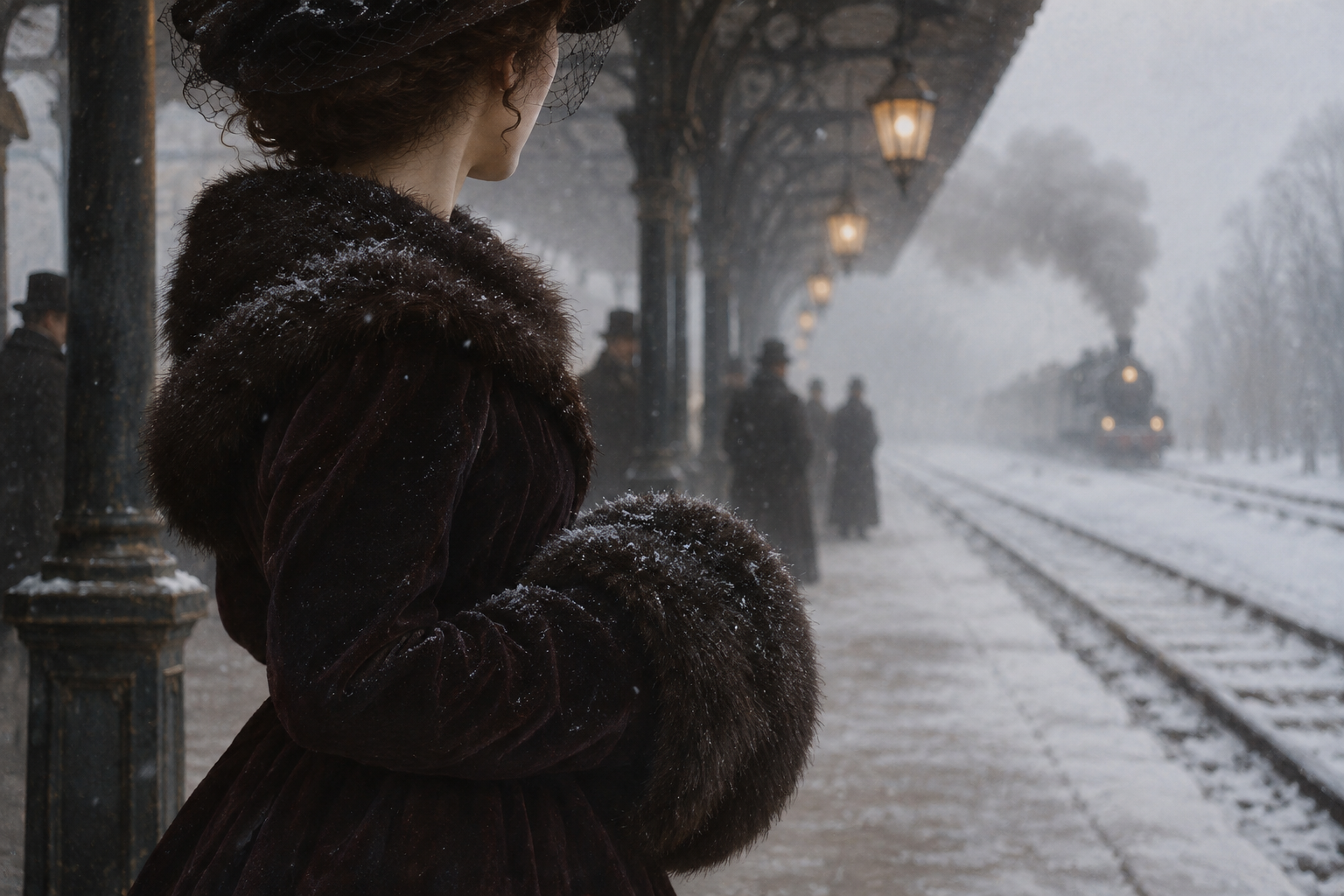
On arriving at the railway station, Anna has met Count Alexei Vronsky, a young cavalry officer there to collect his mother. The older woman has spent the journey talking to Anna and speaks warmly of her. As the party prepares to leave, a railway worker is killed by a train. Vronsky gives money for the man’s widow, a generous gesture performed where Anna can learn of it. She is badly disturbed by the accident. An event that most of those present can assign to another family’s misfortune stays with her.
The coincidence places several kinds of attention together. Anna is alert to suffering, Vronsky is alert to Anna, and both are surrounded by people observing whether a handsome officer and an attractive married woman have noticed one another. At this stage, each look can still be explained quite innocently. What makes the attraction legible is the speed with which each begins to notice what the other has noticed.
What Kitty Sees at the Ball
Dolly’s younger sister, Kitty Shcherbatskaya, expects Vronsky to propose. He visits, dances with her and plainly enjoys her company. Her mother approves. For Vronsky, an agreeable young bachelor, this is a delightful way to spend a season. Kitty has considerably more at stake. She must decide how to answer another man who has travelled to Moscow expressly to ask her to marry him.
Konstantin Levin is a landowner and an old friend of the Shcherbatsky family. He feels at home discussing cattle or agricultural improvements and acutely uncomfortable in rooms where everybody else seems to have received private instruction in how to behave. On the skating rink with Kitty, his awkwardness briefly disappears. They can move together. Asking whether she wants to spend her life with him proves harder, and hearing that she cannot accept him sends him back to the country convinced that he has understood her answer for all time.
Kitty goes to the ball anticipating the dance that will make her future clear. Tolstoy lets her discover what is happening through the small professional accomplishments of a well-brought-up girl. She knows where her partner ought to stand. She can tell when a man’s expression changes as another woman approaches. She admires Anna’s black dress because it lets Anna herself command attention. Then she sees that the same pleasure passes across Anna’s face whenever Vronsky speaks to her. Kitty understands the evening long before anybody has done anything she could reasonably complain about.
Anna leaves Moscow earlier than planned. On the journey back, she encounters Vronsky, who makes it plain that he has followed her. The attention she meant to interrupt by going home has travelled with her. At the station in St Petersburg, her husband comes to meet her, and one of the first things she notices is the way his ears protrude. Karenin’s appearance has scarcely altered during her absence. The shock belongs to Anna. Without having intended to make a comparison, she now sees a familiar man through eyes accustomed to looking for somebody else.
Karenin Watches the Crowd While Anna Watches the Race
Back in St Petersburg, Anna and Vronsky encounter one another in the circle of Princess Betsy Tverskaya. Its members have a sophisticated tolerance for affairs conducted with discretion. Under its rules, a husband who creates a scene can be more embarrassing than a wife who gives him cause. Karenin, a senior government official, initially regards jealousy as beneath a civilised man. Other people’s reactions eventually do more to alert him than anything he has observed at home.
When he speaks to Anna, his argument moves through propriety, marriage and the consequences of careless behaviour. She answers him with a lightness that makes the conversation almost impossible to pursue. There is an ugly convenience in being able to dismiss a husband’s stilted speech as evidence that he has no feelings. Karenin has spent years learning how to express himself without exposing a vulnerable thought. That habit now leaves him poorly equipped to ask his wife a simple question whose answer he fears.
The affair becomes sexual. Anna has imagined union with Vronsky as the fulfilment of an overwhelming desire. In the immediate aftermath she feels shame, and Vronsky finds that possessing what he wanted has given him a responsibility for suffering he barely understands. They can promise themselves a common future, but Anna still has to return to her house, see her son and answer her husband at dinner. A declaration that settles everything between two lovers may settle remarkably little about the following morning.
At an officers’ steeplechase, Vronsky rides a mare named Frou-Frou. Anna has told him she is pregnant. He is anxious about what she will do and eager to distinguish himself in the race. A mistake in his movement at a jump brings the mare down with a fatal injury. The sequence works first as an unbearable sporting accident. Vronsky loves the animal, knows how to ride her and wants desperately to do well. None of that can undo a single badly timed movement by the person she is carrying.
Anna watches from the stands. When Vronsky falls, her distress exposes her to everyone who cares to look. Karenin is watching her. On the journey home he again raises the question of appearances, and this time she tells him directly that she loves Vronsky and is his mistress. For months, Karenin’s indirect manner allowed Anna to evade an answer. Now it is Karenin who has to decide what to do with an answer neither of them can take back.
Levin Finds Work He Can Do With His Hands
In the country, Levin tries to find an arrangement between landowner and labourer that makes sense both economically and to the men doing the work. He draws up schemes, explains innovations and grows exasperated when people whose habits he means to improve decline to share his enthusiasm. He owns the land, has access to books and can afford an experiment that fails. The men he employs have good reasons to care precisely how an experiment will affect their wages and the length of their working day.
The famous mowing scene gives Levin a different way to approach them. He takes a scythe and joins the men in a meadow. At first he is preoccupied with how he looks and whether he can keep up. Gradually he finds a rhythm in which the blade meets the grass cleanly. When he stops consciously directing each movement, he works better. There is food to share, a stretch of field to finish and the relief of lying down after doing enough work to be tired.
Nothing about this day cancels the difference between owning a meadow and being paid to mow it. Levin can go indoors when he chooses. What the work gives him is a few hours during which the question of how to live has an answer his body can understand. Later, when prosperous married life leaves him tormented by that same question, it matters that we have already seen him experience meaning before he can formulate a theory about it.
Kitty also goes away to recover. Humiliated by Vronsky’s preference for Anna and ashamed of having refused Levin, she accompanies her family to a German spa. There she admires Varenka, a young woman who seems able to spend herself in caring for others without worrying about her own standing. Kitty tries to imitate her. An awkward misunderstanding with an invalid and his family teaches her that wanting to become a generous person and perceiving what a particular sick person needs are different accomplishments.
On returning to Russia, Kitty has lost some faith in performances of virtue, including her own. Levin has acquired no great confidence in his attractions. Their second opportunity comes at a dinner arranged by Stiva, whose gift for bringing people together survives every piece of evidence against trusting him to look after them afterwards. With chalk on a table, Levin writes the initial letters of a question about Kitty’s refusal. She understands what he means and answers in the same fashion. This time they have enough shared knowledge to say in a few marks what neither could manage in a formal proposal.
What Happens at Anna’s Bedside?
While Levin and Kitty move towards marriage, Anna’s household reaches a crisis. Karenin has considered divorce, consulted a lawyer and discovered how humiliating the process of producing acceptable evidence could become. He also knows how effectively he can hurt Anna by invoking his rights over Seryozha. Although his wife has left him little reason to trust her, his deliberations move between a wish to protect the boy and a wish to use what she loves most against her.
After giving birth to Vronsky’s daughter, Anna becomes gravely ill. She sends for Karenin, expecting to die. He arrives prepared for an encounter with his unfaithful wife and finds a desperately ill woman begging his forgiveness. Vronsky is there, exhausted and ashamed. Anna wants the two men to face one another. For a short time, the possibility of her death makes jealousy feel less urgent than the suffering already in the room.
Karenin forgives her. He also extends compassion to Vronsky and takes an interest in the newborn child. This is one of the novel’s most disorientating changes of perspective. Anna’s earlier view of a dry, emotionally inadequate man had considerable evidence behind it. Yet the official who could only speak in formulas proves capable of generous action precisely when the younger, more passionate man can scarcely bear to show his face. An affair can disclose a capacity for love in the person the lovers have excluded from their account of it.
Vronsky attempts suicide and survives. Anna recovers too. Recovery creates a problem for which the reconciliation at her bedside supplied no lasting answer. Karenin could forgive a dying woman wholeheartedly. Anna must now contemplate living beside a man whose goodness reminds her of her debt to him and whose presence she still finds intolerable. Vronsky has to discover whether his devotion can sustain an ordinary day after surviving an extraordinary one.
Anna goes abroad with Vronsky and their daughter, leaving Seryozha in Karenin’s household. She goes without a completed divorce. This unresolved fact will determine who can introduce her as a wife, what social occasions she can attend and how securely she can claim any children she has with Vronsky. The lovers have secured the freedom to live in the same rooms. They have acquired no power to make the rest of the world call those rooms a marriage.
Two Households Discover What Love Cannot Arrange in Advance
In Italy, Anna and Vronsky can spend time together without constantly encountering people who knew them in St Petersburg. Vronsky takes up painting. He has taste, leisure and the money to equip himself handsomely. Meeting the professional artist Mikhailov makes the limits of those advantages apparent. Mikhailov sees something in Anna’s expression that Vronsky, despite having every opportunity to study her face, has been unable to put on canvas. Recognition and possession turn out to be different things. One man lives with her; the other has looked long enough, in a particular way, to paint her.
Back in Russia, marriage costs Levin some illusions of his own. The wedding service moves him, but married life includes interruptions, expenses and quarrels whose trivial beginnings make the vehemence of his feelings more embarrassing. Having imagined happiness as the reward for obtaining Kitty’s consent, he now has to consult another person about what that happiness will consist of. She occasionally has quite different plans for the day.
When Levin learns that his brother Nikolai is dying, Kitty insists on going with him. Levin would rather spare her the visit and preserve a private relation with his brother. On arrival he is appalled by the sickroom and does not know where to begin. Kitty can see that the linen needs changing, the patient needs washing and the woman caring for him needs help. She gives Nikolai some physical ease while allowing him to retain more dignity than Levin’s horrified sympathy could offer.
Kitty has grown since the spa. At the bedside there is little opportunity to look like Varenka and little time to wonder whether her motives are perfectly pure. A sheet needs straightening. A dying man might be more comfortable if somebody attended to him without first showing him how distressing it is to enter the room. Levin’s love for his brother is sincere. He learns something about his wife by watching her accomplish the tasks his own love has made him too frightened to attempt.
For Anna, the return to St Petersburg means being in the same city as her son without being allowed an ordinary part in his life. Countess Lydia Ivanovna, who has attached herself to Karenin’s household, treats the separation as a moral necessity. Anna gets into the house early on Seryozha’s birthday. The boy has hoped his mother would come. For a few minutes she can hold him, see how he has grown and talk to him with the old intimacy. Then she must leave him again. The visit answers the question of whether he still loves her and makes the fact that she cannot bring him home harder to bear.
She also goes to the opera, despite Vronsky’s misgivings. In a box, dressed for public attention, she exposes exactly how the rules operate. Men who know her can pay their respects. Vronsky can move in society. A woman nearby makes a conspicuous point of objecting to Anna. A private visit might be tolerated by people who refuse to be seen offering a greeting in public. The opera has become a place where the audience watches itself, and the punishment depends on everyone knowing which woman can safely be made to feel alone.
What Dolly Notices on Anna and Vronsky’s Estate
The country estate where Anna and Vronsky settle appears to solve several problems. They have a beautiful house, a nursery, guests, horses and absorbing improvements to the property. Vronsky has undertaken the construction of a hospital. Dolly comes to visit, leaving behind the exhausting practicalities of her own family life. On the journey she allows herself to imagine what an alternative to that life might once have looked like. Stiva has claimed pleasures outside marriage without giving up its comforts. For an afternoon, Dolly lets herself wonder what she has received for observing the rules he breaks.
The visit is one of Tolstoy’s fairest tests of the reader. Dolly sees genuine beauty and affection. She also notices the work required to keep them visible. Anna studies whatever interests Vronsky, attends closely to her appearance and knows how to make a day pass pleasantly for guests. He can go out and return with news from a world where he has an independent standing. She has good reason to feel that much depends on how pleased he is to come home.
Vronsky speaks privately to Dolly about the need for a divorce. He wants Anna to marry him, partly because their children’s legal position troubles him. A child born while Anna remains Karenin’s wife belongs in law to the existing marriage. Vronsky can maintain a household and provide for his daughter without being able to give her the family position he regards as hers. He hopes Dolly can persuade Anna to act. Anna knows that regularising one family may close off the possibility of recovering her son from another.
Dolly returns to her children with no simple verdict on the woman she visited. Her own house is untidy, money is short and her husband continues to disappoint her. Yet the children can demand her attention without requiring her to be charming. Anna’s comparative freedom has come with a form of compulsory vigilance. For every evening when Vronsky chooses her company, there are hours in which she knows he could have chosen otherwise.
The Evening Anna and Levin Finally Meet
By the time Anna and Levin meet in Moscow, the reader has spent much of the novel moving between them. It is surprisingly easy to forget that they lack this advantage. Levin knows the outline of a scandal. Anna knows him largely through Stiva and Kitty. An evening in Anna’s company overturns the ready-made figure Levin brought into the room. She listens, has read widely and draws out his opinions without making him feel like a country visitor being indulged by fashionable people.
He comes home full of admiration. Kitty, pregnant and waiting for him, hears what that admiration sounds like from the other side of a marriage. The evening faintly echoes the Moscow ball. Once again Anna has the ability to make a man feel unusually interesting and a woman elsewhere feel the consequences. The attraction does not have to be a calculated attempt at seduction for Kitty’s distress to be intelligible. Nor does Kitty’s distress cancel what Levin saw accurately: Anna is intelligent, hospitable and more generous in conversation than gossip had prepared him to believe.
Kitty gives birth to a son. Through the long labour, Levin prays almost in spite of himself. Watching his brother die had brought him to the edge of what he could bear without revealing what death meant. The arrival of a child produces another overwhelming experience and, afterwards, a baby about whom he initially feels anxious and protective rather than instantly transported. Tolstoy allows fatherhood to begin with uncertainty. It leaves room for Levin to discover what he feels through living with his son.
Meanwhile, Stiva tries to advance Anna’s divorce. Karenin is now deeply under Lydia Ivanovna’s influence, and an approach that ought to settle a practical matter becomes entangled in the pronouncements of a spiritualist favoured by her circle. The divorce remains out of reach. Stiva can talk his way into almost any drawing room in the book. He cannot obtain for his sister the second chance she once secured for him in a disordered nursery.
What Can Anna Still Believe About Vronsky?
Anna and Vronsky’s quarrels come to turn on incidents too small to bear the weight she places on them. He has business with his mother. Plans for a departure change. A young woman his mother considers a desirable match is somewhere in the family’s orbit. Anna reads these details for signs that Vronsky regrets his sacrifices and intends to leave. The novel gives ample evidence of impatience, frustration and wounded pride between them. It never establishes the new betrayal Anna increasingly regards as certain.
Her dependence gives the fear a rational starting point. Vronsky has an income, a name, relatives and public occupations that continue to exist beyond their relationship. Anna has lost daily contact with her son, the security of a recognised marriage and much of her former society. A cool farewell can therefore mean a difficult afternoon to him and a threat to the structure of her life to her. As she presses for reassurance, he guards what independence remains to him more closely. His withdrawal then appears to confirm the suspicion that provoked it.
Tolstoy brings us closer and closer to the movement of her thoughts. A passing face or overheard remark becomes fresh evidence of vanity, hostility or disgust. An interpretation that would once have competed with several others takes possession of the whole scene. This is where narrative closeness matters most. We can understand why each inference feels convincing to Anna while remembering conversations she never heard and possibilities she can no longer hold in view.
After a quarrel and a succession of messages, she sets out to reach Vronsky. At the railway station, the worker’s death on the day of their first meeting comes back to her. Love, humiliation and the wish to make him understand what he has done become entangled with a desperate wish to escape her own suffering. She dies by suicide beneath a train. In the final instant she is horrified and wants to live. That reversal matters. To say simply that she chose death to punish her lover would give one terrible moment the consistency of a settled intention that Tolstoy does not give it.
The railway has joined households, carried Anna towards her brother’s family and brought Vronsky after her. It has also exposed strangers to the consequences of lives passing at speed. The worker killed at the beginning had a widow. Anna noticed her when most of the company wanted to move on. Now the question is what happens to those left behind, and Tolstoy has an entire part of the novel still to tell.
Why Does Levin Get the Last Word?
In Part Eight, Vronsky leaves Russia to volunteer in the fighting in Serbia. The public has a story ready for men boarding that train: patriotic feeling, sacrifice and support for a cause. For Vronsky, the prospect of danger has become attractive because his own life feels expendable. He remains haunted by his last sight of Anna. There is no later scene in which the novel confirms his death in battle. We leave him as a grieving man going to war, accompanied by people who can see what he is doing and have varying ideas about why.
Levin, by contrast, has obtained almost everything he once considered necessary for happiness and cannot explain why being alive is worthwhile if everyone he loves must die. This is why the remaining chapters belong to him. A comfortable estate, a wanted marriage and a healthy child have not supplied an argument capable of defeating despair. The ease with which one family might be classified as happy and the other as ruined has become a poor guide to the inner lives of either.
The change begins with a conversation about two men and the different principles by which they conduct their affairs. A peasant named Fyodor describes one as living for his own advantage and another as attending to his soul and remembering God. Levin has heard such language all his life. What strikes him now is that he already understands the difference Fyodor means. Nobody has had to prove it to him. He recognises it from choices he admires, meannesses he regrets and acts of kindness whose value has never seriously been in doubt.
This recognition does not resolve every religious question or transform him into a uniformly patient husband. A storm soon gives the discovery a practical test. Fearing for Kitty and their child, he experiences the force of attachments that have grown while he was busy demanding proof that his life had meaning. When his family is safe, ordinary irritation remains possible. He will still misunderstand people. What has changed is his belief that a good action must wait for a satisfactory theory of existence.
Giving Levin the last word can initially feel like taking something away from Anna. The book bears her name, and her intelligence and distress have commanded a remarkable degree of attention. Yet Levin’s insight sends us back to her first visit to Dolly. Before anybody at a ball desired her or anyone at an opera shunned her, Anna sat beside a humiliated woman and understood what hurt. Levin takes eight parts of a novel to recognise the value of a good he cannot prove. Anna was already capable of doing it on the morning we met her.
Sources
Anna Karenina — Leo Tolstoy, translated by Constance Garnett. Complete English text, including Anna’s final journey and Levin’s reflections in Part Eight. www.gutenberg.org
Anna Karenina — Oxford World’s Classics. Publisher’s overview of the novel’s 1870s setting and eight-part structure. Oxford University Press
Anna Karenina: Full Book Summary — SparkNotes. Supporting reference for the parallel family stories and Vronsky’s departure. SparkNotes
