Why the Windmills Are Only the Beginning
A Knight Makes One Improvement Too Many
Before Don Quixote goes looking for giants, he has a more immediate problem. His ancestral armour is missing part of its helmet. He fashions a replacement out of cardboard, draws his sword and tests his handiwork. One blow destroys a week’s labour. He makes another version, reinforces it with iron and takes considerable satisfaction in the result. This time he is careful to leave it untested. Miguel de Cervantes gives us the whole man in that small domestic victory. Here is someone ingenious enough to recognise a difficulty, industrious enough to solve it twice and sufficiently attached to his solution to know exactly when to stop asking questions.
How a Country Gentleman Becomes Don Quixote
The man inside the armour is a gentleman of modest means in La Mancha. He lives with his niece and housekeeper, keeps a horse and has developed a passion for romances of chivalry. He sells productive land to buy more books and spends so many nights reading that the adventures of knights, enchanters and wronged princesses come to seem more authoritative than the evidence of ordinary experience. Eventually he decides that Spain could use a knight of its own. People still suffer injuries. Someone ought to ride out and redress them.
Getting started requires surprisingly little expenditure and a great deal of naming. His elderly horse becomes Rocinante. He adopts the title Don Quixote de la Mancha. A knight also needs a lady, so he chooses Aldonza Lorenzo, a young woman from nearby El Toboso whom he once admired, and names her Dulcinea. He can now dedicate victories to a woman who has had no say in whether she wants them. The distance between Aldonza and Dulcinea will eventually present a harder problem than the missing part of his helmet.
He rides out alone. At an inn he sees a castle, addresses the women outside as noble ladies and takes the innkeeper for the lord of the establishment. His books have left him with one technical difficulty. He has yet to receive the order of knighthood and therefore lacks the standing to undertake properly knightly adventures. The innkeeper recognises the sort of customer he has acquired. After a vigil over his armour leads to trouble with muleteers who need to use the watering place, the host conducts a brisk improvised ceremony. Sending a satisfied knight on his way is considerably easier than accommodating an aspiring one overnight.
The first person Don Quixote tries to help is a boy named Andrés. A farmer has tied him to a tree and is beating him over the loss of some sheep. The boy says his master owes him wages. Don Quixote orders the farmer to release him and settle the debt. While a mounted man with a lance stands nearby, the farmer agrees to everything. Don Quixote rides off delighted. Andrés is left alone with an employer who has just been publicly humiliated and still possesses the tree, the reins and the boy. The beating resumes with greater ferocity.
That episode deserves to be as famous as the windmills. Don Quixote correctly identifies the victim and has quite enough force to interrupt the abuse. His error concerns what will happen five minutes after he leaves. The romances have taught him the authority of a knight’s command and the obligations contained in a solemn promise. Andrés already understands his employer rather better. He tries to tell his rescuer what the promise is worth. Don Quixote’s pleasure in doing justice prevents him from listening to the person who must live with its consequences.
Why Don Quixote Charges the Windmills
An encounter with merchants ends the first expedition. Don Quixote demands that they acknowledge Dulcinea’s incomparable beauty. When one asks to see her portrait, the knight treats the request for evidence as an insult. Rocinante stumbles during the ensuing charge, and Don Quixote ends up stranded on the ground in his armour, where a mule driver beats him. A neighbour finds him and brings him home. The first man in the novel to carry out a thoroughly successful rescue manages it with a patient animal and considerable familiarity with the road.
At home, the local priest and barber inspect the knight’s library. They condemn numerous works and spare others they happen to consider excellent. Cervantes lets them enjoy literary criticism even as they carry out what amounts to an emergency intervention. The household blocks up the entrance to the room. When Don Quixote asks where his library went, he is given a story about an enchanter. People hoping to cure him of belief in enchantment have found it convenient to furnish him with an excellent example.
For his second expedition, he recruits Sancho Panza, a married labourer from the village. Sancho hears that a successful knight may conquer an island and appoint his squire to govern it. That is a remarkable offer to a man whose social position gives him little prospect of exercising authority over anything larger than his own household. He has questions about provisions and payment, and he brings his donkey. His appetite for advancement is quite compatible with a sound understanding of what a traveller needs for lunch.
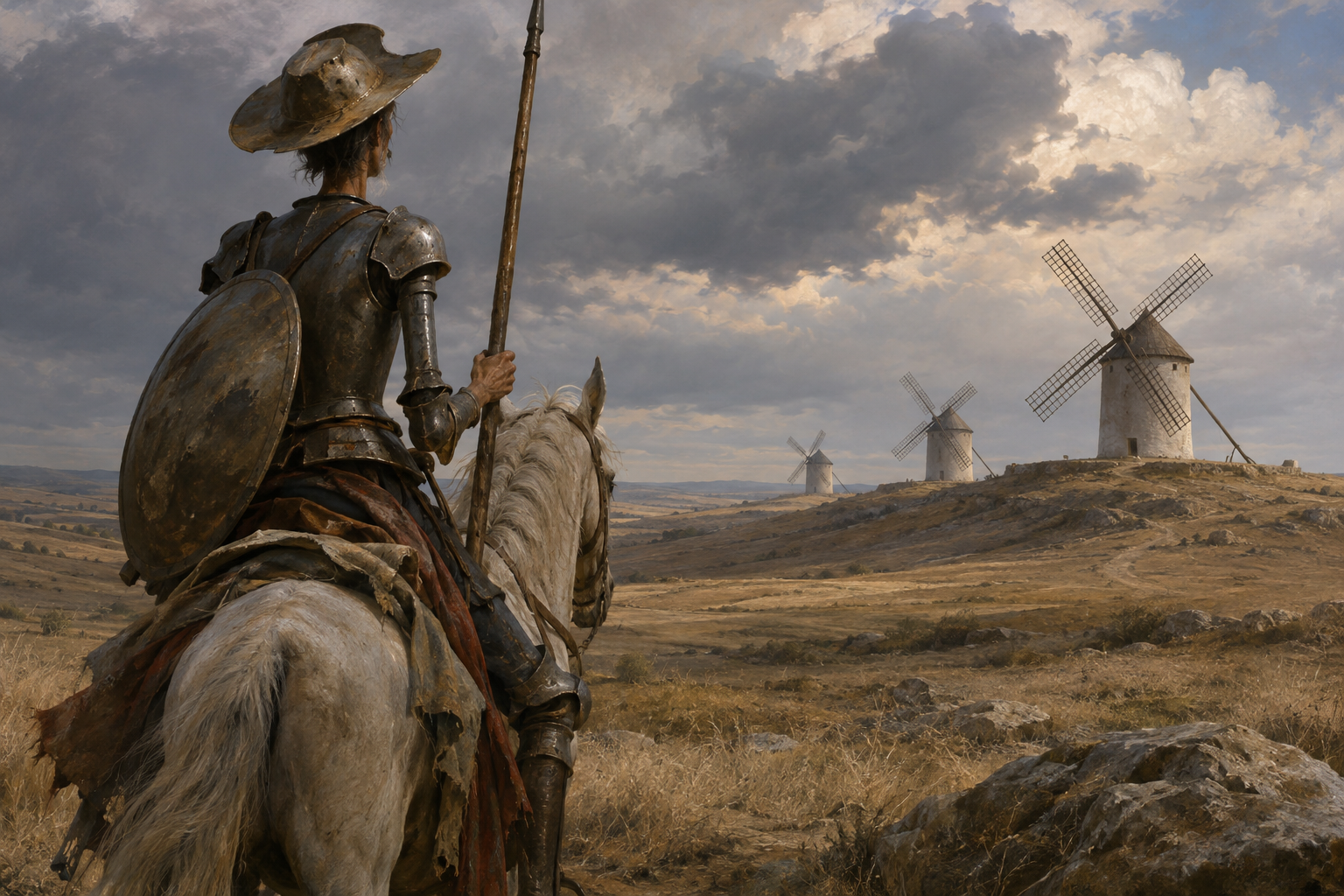
When the pair come upon windmills, the disagreement is beautifully precise. Don Quixote sees giants with long arms. Sancho can identify the sails and explain that wind turns them to drive the millstones. They have the same view and ample time to compare accounts. Don Quixote interprets his companion’s correction as inexperience, lowers his lance and rides forward. The moving sail catches the lance and brings horse and rider down.
What keeps the adventure alive is the explanation he gives afterwards. The enchanter who carried off his library must have turned the giants into windmills to deprive him of glory. Don Quixote can now agree with Sancho about what stands before them. Their remaining disagreement concerns what stood there just before the impact, when the enchanter supposedly intervened. No closer inspection of the mill will settle that. Sancho can help his master up, however, and this division of labour will sustain them through a surprising number of disagreements.
Sancho is sometimes treated as if his sole purpose were to supply common sense on a donkey. Yet he has just witnessed what happens when his master promises an adventure and rides at the nearest structure. He continues to expect an island. His judgement is excellent where he has experience, and much more accommodating where he has hopes. Readers of Taylor Tailored’s The Platform analysis may recognise why the film gives its protagonist a copy of Don Quixote. The uncomfortable question in both works is how to tell a necessary act of courage from a gesture whose costs will fall on somebody else.
The People Who Refuse Their Assigned Parts
Just as Don Quixote and a Basque opponent raise their weapons, the account breaks off. The narrator claims to have run out of source material. Fortunately, he later finds an Arabic manuscript for sale in Toledo, recognises an illustration of the very encounter and commissions a translation. The supposed historian responsible is Cide Hamete Benengeli. From here, adventures reach us through a historian, a translator and an editorial voice perfectly willing to question the reliability of the man on whom its entire enterprise depends.
The joke arrives at exactly the right moment. Suspended between two raised swords, we are inclined to accept almost any explanation that will allow the fight to continue. That puts the reader rather closer to Don Quixote than we might like. A man determined to enjoy an adventure has just been handed an improbable story about how an authentic record of it happened to turn up in a market. Anyone laughing at the knight’s willingness to believe a convenient account can spend a moment considering how badly they want to know who wins.
Some people the travellers meet have already suffered from being assigned parts in other people’s stories. At the funeral of a young man named Grisóstomo, his companions blame the beautiful shepherdess Marcela for his death. He loved her, she did not return his love, and his friends have converted his suffering into an accusation. Marcela appears at the burial and answers on her own behalf.
Her defence is exact. She did not choose the appearance that pleased him. She made no promise to love him. She chose to live independently and gave him no reasonable grounds for believing perseverance would alter that decision. The mourners’ grief is real, but it cannot create an obligation she would otherwise never have incurred. Don Quixote forbids anyone to pursue her. For once his impulse to defend a lady works rather well because he has heard the lady say precisely what she wants: to be allowed to leave.
The contrast with Dulcinea is hard to miss. Don Quixote can recognise Marcela’s right to control her own story while organising a substantial part of his life around an imaginary relationship with Aldonza Lorenzo. The book does not require us to settle whether he is a fool or a defender of freedom before assessing anything he does. We have to judge each encounter, and occasionally change our minds about him twice in the same chapter.
A chain of prisoners on their way to the galleys gives him a more dangerous opportunity. Don Quixote asks the men about their sentences and hears accounts shaped by self-interest, jokes and genuine grievances. He objects that they are being taken by force and attacks their guards. Once free, the prisoners receive instructions to present themselves before Dulcinea and acknowledge his service. They have excellent reasons to scatter before they are recaptured. When he presses the demand, they turn on their liberator and pelt him with stones.
His mistake goes beyond trusting criminals. He objects to men being compelled to go somewhere against their will, releases them and immediately supplies a different compulsory destination. His code is generous about liberty until free people begin choosing what to do with it. Sancho, meanwhile, has the practical task of explaining why they ought to get off the road before officers of the law arrive.
Sancho Comes Home With a Message He Never Delivered
In the Sierra Morena, Don Quixote decides to perform a penance inspired by his reading. The great lovers of chivalric romance have withdrawn into wild places, suffered spectacularly and demonstrated their devotion through extraordinary conduct. An obvious objection occurs to Sancho. Dulcinea has given his master no cause for jealousy or despair. Don Quixote regards this as an improvement on the precedent. If he can do so much without provocation, imagine what he could accomplish with a good reason.
Sancho is supposed to take a letter to Dulcinea. Learning the identity of the woman behind the grand title, he recognises Aldonza as a local woman of conspicuous physical vigour. His account of her gives her a body, a voice and a capacity for hard work. Don Quixote has supplied heraldry and superlatives. Each man knows something the other lacks, although neither has taken the precaution of asking what Aldonza thinks about the assignment.
The message never reaches her. Sancho encounters the priest and barber, who have come looking for their neighbour. Eventually he gives Don Quixote an invented account of the visit, representing Dulcinea as engaged in thoroughly ordinary work. His master can interpret the disappointing particulars as evidence of an imperfect observer or magical interference. Sancho learns that an inconvenient question about a lady can be answered by borrowing the vocabulary of enchantment. He will remember the lesson.
Meanwhile the mountains have brought them into contact with Cardenio and Dorotea, whose injuries involve a wealthy young man named Don Fernando. Unlike an enchanter, Fernando has entirely recognisable means of bending other people’s lives to suit his wishes: rank, money and the presumption that those beneath him will have difficulty making him keep his word. Dorotea, who has considerable difficulties of her own to resolve, proves an accomplished improviser. She agrees to pose as Princess Micomicona, a distressed royal petitioner whose affairs require Don Quixote to accompany her.
The plan works because she understands the rules of his profession. An instruction to return home would invite resistance. A princess with a proper grievance has a claim he considers binding. Soon the rescuers are supplying invented adventures almost as industriously as the man they hope to bring back to his senses. Their intentions are kinder than the farmer’s were towards Andrés. Their confidence in deciding what another person needs is beginning to look familiar.
When Andrés himself reappears, he supplies the ending Don Quixote never stayed to witness. The intervention made his punishment worse. Far from asking for another demonstration of knightly power, the boy begs Don Quixote to leave him alone if they ever meet in similar circumstances. It is one of the few occasions on which a beneficiary gets to review the service. No theory about enchanters can quite dispose of the embarrassment of a living witness.
Part One brings the knight home in a cage on an ox cart, persuaded that enchantment accounts for his captivity. Sancho recognises people behind the disguises and raises sensible objections about what enchanted prisoners ought to need. Yet he attends his master all the way back. To neighbours in the village square, it is an undignified homecoming. To the two men who have spent the journey arguing, something worth leaving home for has taken shape between them.
What Changes When the Characters Have Read Part One?
Cervantes published the first part in 1605 and the second in 1615. Far less time has elapsed for the characters. During Don Quixote’s convalescence, the young graduate Sansón Carrasco brings astonishing news. A history of the knight and his squire is in circulation, and people have opinions about it. Sancho wants to know how he comes across. Don Quixote cares about the reputation of chivalry. Both are disconcerted to discover that an audience can enjoy an episode for reasons its participants find quite unsatisfactory.
Fame changes the mechanics of the next expedition. In Part One, strangers generally had to work out for themselves what sort of travellers had arrived. Now a reader can recognise Rocinante, anticipate Sancho’s ambition and prepare exactly the sort of adventure Don Quixote expects. The two men have acquired something like celebrity without receiving its most elementary warning. A stranger who knows everything about you may simply have enjoyed your book.
One difficulty must be confronted almost immediately. Don Quixote wants to visit Dulcinea in El Toboso. Sancho, who claimed to have visited her before, ought to be able to locate the lady and her residence. Instead of admitting the earlier deception, he selects a group of approaching peasant women and declares one of them to be Dulcinea in her splendour. This time it is Don Quixote who sees an ordinary countrywoman on an ordinary mount. Sancho elaborates on the magnificence visible to his supposedly superior eyes.
The knight concludes that enchantment has prevented him from seeing his lady as she truly is. His capacity for taking disappointment seriously makes the scene more painful than a successful practical joke. Sancho wanted an escape from a particular lie. He has created a lasting obligation to free Dulcinea from a spell. He knows perfectly well how little magic went into putting her under it. He has yet to discover what other people will make him pay to take it off.
Sansón also tries to turn the knight’s beliefs towards a practical end. Disguised as a rival knight, he challenges Don Quixote in the expectation that victory will allow him to order the defeated man home. Don Quixote wins. Finding Sansón’s familiar face beneath the disguise creates a problem for the rescuers rather than for him. Once impersonation and enchantment have both been admitted as explanations, a familiar face can prove almost anything. Sansón will have to try again.
The Duke and Duchess Know How to Give a Reader What He Wants
When a duke and duchess meet the travellers, they know their history and possess something earlier readers generally lacked: a household large enough to stage it. Don Quixote receives the formal welcome he has always considered his due. Servants understand their parts. Ceremonies take place on cue. From his point of view, years of reading have finally prepared him to behave correctly in a recognisably chivalric world. From the household’s point of view, the better he behaves, the better the entertainment.
A procession presents a supposed remedy for Dulcinea’s enchantment. Sancho must administer 3,300 lashes to himself. His master has consistently offered to perform extraordinary feats for his lady. The organisers of this adventure have cleverly transferred the physical cost to a man who never offered to perform anything of the kind. Don Quixote takes the terms seriously because he believes Dulcinea is suffering. Sancho knows the original enchantment was his invention, but saying so now would mean confessing how long he has allowed his friend to grieve over it.
A wooden horse called Clavileño supplies another demonstration. Blindfolded, the travellers mount it for what they believe will be a flight through the air. The household produces wind and heat to suggest movement through different regions of the sky. The people operating the effects know exactly where the horse is. The men on its back have sensations to interpret and an audience eagerly awaiting their account. Afterwards, Sancho offers observations of the heavens considerably more detailed than his blindfold should have permitted.
There is a compact between the friends here that matters more than deciding which of them believes which adventure. Don Quixote has earlier descended into the Cave of Montesinos and emerged with a marvellous account that even Sancho finds difficult to credit. If the knight is willing to entertain Sancho’s report of the sky, Sancho might extend a little courtesy to his master’s account of the cave. They have spent so long arguing about the evidence of their senses that they have discovered a more companionable way of being uncertain.
The duke even grants Sancho the governorship he has been promised. The place is called Barataria and presented to him as an island. It is a settlement under ducal control, and people have been instructed to play along. For Sancho, however, real petitioners or convincing substitutes will stand before him and await decisions. The joke requires the household to hand a labourer some of the outward forms of authority. Nobody has quite accounted for the possibility that he may be good at using them.
One dispute concerns money a borrower claims to have repaid. The man briefly gives his staff to his creditor to hold while he swears an oath, then takes it back. Sancho has the staff broken open. The money is inside. The borrower could swear that he had placed the sum in the creditor’s hands because, for the duration of the oath, that was literally where the coins had been. Sancho spots the unnecessary movement of the staff and asks what purpose it served. The squire whose master once charged a windmill proves an exceptionally attentive observer when someone else is doing the storytelling.
The household keeps him hungry, exhausts him and stages an attack. Encumbered with defensive equipment, Sancho can scarcely move and is trampled in the confusion. He resigns. Part of the satisfaction of his governorship lies in the decisions he makes while he holds office. A larger part lies in his discovery that he can give the office back. The duke knows how to confer a title on a poor man for a joke. Sancho knows the price of a good meal, a sound night’s sleep and the freedom to sit comfortably on his own donkey. He is now qualified to compare the two arrangements.
Why Don Quixote Changes the Road to Barcelona
Late in the second part, the travellers encounter readers discussing another book about Don Quixote. This poses a different problem from the circulation of their earlier adventures. In 1614, before Cervantes had published his own continuation, a sequel appeared under the name Alonso Fernández de Avellaneda. Cervantes brings the existence of that rival book into the invented world of his own. His characters can inspect a future that a competing author has already tried to assign them.
The discrepancy that particularly affronts Don Quixote concerns his fidelity to Dulcinea. Readers of the rival version have encountered conduct he repudiates. He has spent years mistaking other people for characters in books. Now he knows the peculiar injury of having strangers prefer a printed version of somebody to the living person standing before them.
He had intended to go to Zaragoza. Since his rival has already sent the other Don Quixote there, he heads for Barcelona instead. It is one of the best reasons any fictional traveller has found for changing a road. His younger self went out to make the landscape resemble what he had read. The older knight must go somewhere a book says he did not go in order to establish who he is. An invention he despises has still managed to determine his itinerary.
Barcelona brings him to the sea and to a printing house. Seeing a book in production gives the authorship dispute a material setting. Somebody must set the type, correct the sheets and calculate the prospects of selling the result. A knight may feel that honour resides in his own conduct. His public honour now depends partly on what a compositor puts on a page and which volume a bookseller happens to stock.
What Does the Knight of the White Moon Demand?
On the beach at Barcelona, the Knight of the White Moon challenges Don Quixote. Their agreement gives the winner authority to impose terms. This time the challenger defeats him. With his life at the victor’s disposal, Don Quixote still refuses to make a declaration against Dulcinea’s beauty. He is willing to acknowledge that another man rides and fights better than he does. He sees no reason why the outcome of a collision between two horses should settle what can be said about the woman he serves.
The victor requires him to withdraw to his village and abandon knight-errantry for a year. Behind the disguise is Sansón Carrasco, finally bringing off the plan that failed on the earlier expedition. He succeeds through a binding obligation his neighbour recognises. Don Quixote could explain away most physical setbacks by appealing to enchantment. He cannot disregard a condition to which he gave his word without damaging the identity he wishes to preserve. His own understanding of honour gets him home where other people’s better grasp of reality repeatedly failed.
Sancho now has to sustain a man whose greatest pleasure has been taken from him. They consider becoming shepherds during the enforced retirement. Pastoral literature offers names, costumes, occupations and familiar conventions almost as readily as chivalric romance once did. The idea also offers a practical comfort: whatever the new profession requires, it would allow the two friends to go out together again.
On the road home, Sancho agrees to undertake the lashes associated with Dulcinea’s release in return for payment. Don Quixote hears blows during the night. Sancho finds that tree bark will bear much of the punishment while the sounds of exertion still reach his anxious employer. His dishonesty is real, as is his master’s concern that he might injure himself by doing too much at once. At the start, Sancho followed because he wanted an island. By now the two men have enough affection to worry about one another even in the course of an elaborate fraud.
Why Does Don Quixote Give Up His Name?
At home Don Quixote falls ill. After a long sleep, he announces that his understanding has returned. He identifies himself as Alonso Quixano the Good, rejects the romances of chivalry and asks to confess and make his will. His friends have spent much of the book trying to bring about precisely such a recovery. Now that it has arrived, they find themselves reaching for the inventions they hoped to take away.
Sancho’s response supplies the emotional truth of the ending. He begs his master to get up. They can still be shepherds. Perhaps somewhere beyond the village there is another adventure, another account of what went wrong, another way to begin. The man who spent the first expedition identifying windmills correctly is willing to offer his friend an entire imaginary future if it will keep him alive. He has learned what an invention can be worth to somebody, and he chooses his moment to offer one with rather more kindness than the duke or duchess ever managed.
Alonso makes provision for Sancho and acknowledges the goodness that made him so welcome a companion. He puts his affairs in order and dies. By making the death explicit and witnessed, Cervantes also settles a publishing question that the false sequel had made unexpectedly pressing. Another writer could always invent more adventures for a knight left riding towards the horizon. The man who has recovered his name, made his will and died among his neighbours is harder to send out again.
Does Alonso’s recovery mean that the whole enterprise was worthless? Andrés would have good grounds for wishing the knight had stayed at home. Marcela might remember a man willing to hold back a crowd while she exercised the freedom it begrudged her. Sancho has governed, travelled and been listened to by a friend who found him exasperating almost every day. Returning to his first name allows Alonso to repudiate books that did him harm. It cannot undo the life two people made while one of them answered to another name.
At their first windmill, Sancho knew what the sails were for and Don Quixote needed someone to get him off the ground. At the bedside, each still has something the other needs. Alonso can tell Sancho what his companionship has meant. Sancho can imagine a morning on which his friend gets up. The saddest fact in the book is one they understand equally well by the end: there will be no such morning.
Sources
Don Quixote — Miguel de Cervantes, translated by John Ormsby. Complete text of both parts, including the return of Andrés, the governorship, the rival sequel and Alonso’s final illness. www.gutenberg.org
Hispanica: Literary Works — University of Glasgow Library. Publication history of the two parts and the 1614 continuation attributed to Avellaneda. gla.ac.uk
Don Quixote: Full Book Summary — SparkNotes. Supporting reference for the principal journeys, characters and turning points. SparkNotes
