The Wager Explained: Shipwreck, Mutiny and the Fight for Truth
Who Has Authority After a Shipwreck?
When the Ship Sinks, Who Still Gives the Orders?
A British warship carries its crew towards an enemy’s wealth, but its men will face a more immediate struggle: deciding whom to trust when obedience and survival begin pulling in different directions. Officers possess rank, sailors possess indispensable skills, and everyone depends on a vessel that cannot protect them from every danger.
David Grann’s The Wager: A Tale of Shipwreck, Mutiny and Murder, published in 2023, reconstructs an eighteenth-century naval disaster through surviving records and competing personal accounts. It is narrative non-fiction, with real people whose explanations do not always agree. Understanding it means following both the struggle to stay alive and the struggle to establish what happened. This summary traces the expedition, its fractured leadership and its aftermath before examining the ending’s questions about responsibility and historical truth.
An Expedition Built Around Imperial Ambition
The Wager sails from Britain in 1740 as part of a squadron commanded by Commodore George Anson. Britain and Spain are at war, and the expedition aims to strike Spanish interests overseas. Capturing valuable shipping offers the possibility of weakening an enemy while enriching the men who carry out the attack.
The treasure associated with this mission gives the voyage an attractive purpose. Yet the prospect of wealth depends on a complicated undertaking: taking ships across enormous distances, keeping crews alive and maintaining enough fighting strength to attack when an opportunity appears.
Grann places those ambitions beside the conditions required to pursue them. Naval service involves confinement, exhausting labour and severe discipline. Some men are compelled into service. The expedition also receives older and infirm soldiers whose condition makes them poorly suited to the demands ahead.
These are consequential weaknesses. A ship depends on collective physical effort. Sails, pumps, rigging and repairs require enough men capable of working together, often in dangerous conditions. Every illness reduces the ship’s ability to cope with the next emergency.
The Wager itself carries additional disadvantages. Originally a merchant vessel, it has been adapted for naval service and loaded with supplies for the squadron. Its cargo makes it useful to the expedition, but the heavily burdened ship must navigate the same seas as vessels better suited to the task.
David Cheap eventually becomes its captain following changes in command. For him, the appointment offers responsibility and advancement. He understands his duty through the expectations of the navy and the importance of rejoining Anson whenever the squadron becomes separated.
Alongside him stand two figures whose perspectives help shape the story. John Bulkeley, the gunner, brings practical experience and an increasingly independent assessment of leadership. John Byron, a young midshipman from an aristocratic family, enters the voyage with a very different position and outlook.
Byron is the future grandfather of the poet Lord Byron. Here, however, he is a junior officer learning what naval life demands. His family background cannot remove the dangers of the ship, although it influences the loyalties and assumptions he carries into them.
Cape Horn Tests the Limits of Command
As the squadron moves towards the southern end of South America, the expedition’s weaknesses become harder to contain. Illness and exhaustion undermine the crews before the ships have accomplished their military purpose.
The passage around Cape Horn exposes them to violent weather and punishing seas. Damage to a mast or sail creates further work for men already approaching their limits. Repairs become harder precisely when they become more urgent.
Scurvy adds another destructive pressure. Grann describes a maritime world in which sailors can deteriorate severely during long voyages. Whatever courage or experience a man possesses, a failing body may prevent him from climbing, hauling or even moving to safety.
The Wager becomes separated from its companions. Alone, damaged and short of effective manpower, it must find a way back to the expedition while avoiding a coastline whose dangers its officers cannot confidently chart.
Cheap remains determined to fulfil his orders. The supplies and weapons aboard his ship are intended to support the squadron’s operations. From his perspective, abandoning the expected rendezvous risks compromising the mission entrusted to him.
Bulkeley and other men see a more immediate danger. The ship is approaching land under conditions that make escape from the coast increasingly difficult. Their objections arise from the relationship between the vessel’s condition, the weather and the limited number of men available to handle it.
This disagreement deserves more care than simply calling Cheap foolish and Bulkeley sensible. Cheap’s concern about his orders is real. The problem is that he treats those orders as an insufficiently flexible answer to circumstances that are rapidly changing.
A command can have a rational purpose when issued and become dangerous when followed without adjustment. Cheap’s responsibility includes the mission, but it also includes judging whether his ship remains capable of performing it.
Byron’s later account makes that tension explicit. He recognises the importance Cheap places on the expedition while describing the stubbornness with which the captain dismisses warnings. Loyalty to a commander does not prevent him from recording failures of judgement.
As the weather closes in, opportunities to correct the situation diminish. The argument about navigation becomes a physical emergency that rank alone cannot resolve.
The Wreck Leaves Its Hierarchy on the Shore
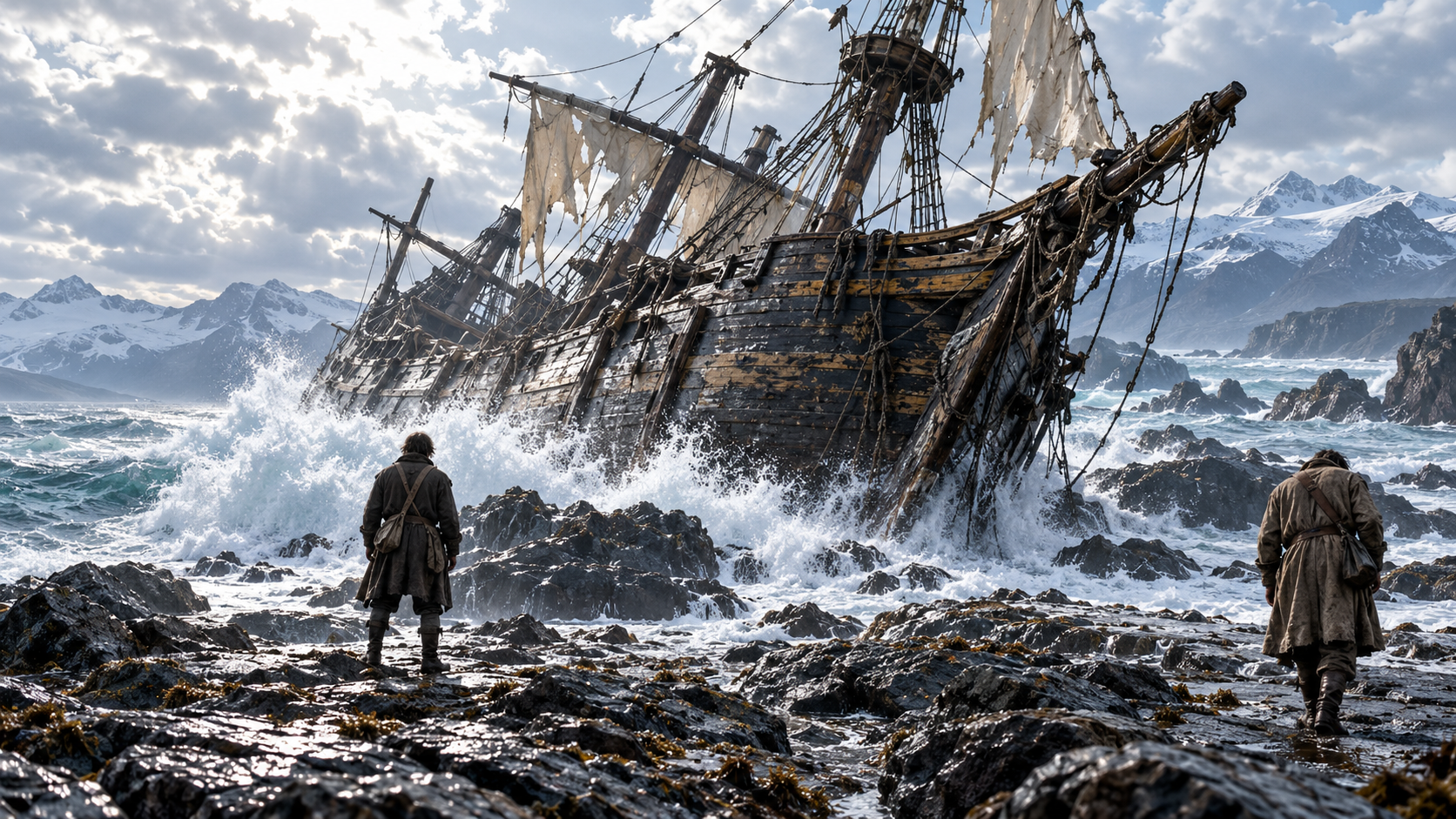
In May 1741, the Wager strikes rocks off Patagonia. The damage, rough seas and crew’s weakened condition turn the wreck into a struggle to get people ashore.
Some sailors remain capable of purposeful action. Others are overwhelmed, incapacitated or unable to escape from below decks. Byron’s account records markedly different responses within the same disaster, from composure and assistance to panic and desperation.
That variation matters. The wreck does not reveal a single hidden nature shared by everyone aboard. It exposes how differently people act when confronted with the same danger, and how much their chances depend on strength, position and help.
Those who reach land find themselves on the island that becomes known as Wager Island. Surviving the immediate destruction of the ship brings no reliable supply of food, no comfortable shelter and no obvious route home.
The remaining wreck becomes essential. It contains provisions, materials and equipment that might keep the castaways alive. Retrieving them requires repeated exposure to dangerous water and unstable wreckage.
The men build shelters and organise expeditions to find food. They gather shellfish and search for other edible resources. Weather repeatedly interrupts their efforts, making even basic subsistence uncertain.
Cheap continues to regard himself as captain. To him, the destruction of the vessel does not dissolve the authority under which its men sailed.
For others, that assumption becomes questionable. Their ship is gone, their immediate task has changed, and the man who expects obedience is associated with the decisions that brought them here. The question of command now depends on more than an appointment made before the disaster.
This does not mean the castaways can survive without organisation. Food must be shared or guarded, materials recovered and collective labour directed. The island makes cooperation more necessary even as it weakens the institution that previously enforced it.
The resulting conflict is therefore about which form of authority can organise survival. Cheap relies on the continuity of naval rank. Men increasingly drawn towards Bulkeley judge leadership through competence, consultation and practical results.
Both approaches must operate among frightened, hungry people who cannot afford endless disagreement.
Hunger Changes the Meaning of Cooperation
The island community begins to fracture. Some men remain close to the captain, others organise around more practical centres of influence, and some separate themselves from the larger group.
Their differences are sharpened by scarcity. A missing portion of food can mean more than an unfair distribution. It can threaten someone’s ability to work or survive. Suspicion grows around stores because access to provisions has become a form of power.
Bulkeley’s importance increases through his usefulness. He participates in the work required to keep the men alive and becomes a figure around whom an alternative plan can develop.
The carpenter, John Cummins, is similarly indispensable. His expertise provides a possible means of escape. Whatever arguments occur over command, no declaration of authority can replace the ability to turn available timber and damaged boats into a seaworthy craft.
Meanwhile, the castaways encounter Indigenous people with knowledge of the region that the British lack. Grann identifies the Kawésqar among those whose skills and assistance challenge the sailors’ assumptions about their surroundings.
To the British, the coast appears almost impossible to inhabit. To people familiar with its waters and food sources, it is a demanding environment that can nevertheless be navigated and used.
The distinction exposes the limits of the castaways’ expertise. Experience aboard a large naval vessel does not automatically provide the skills required to live along this shore. Their helplessness is partly a mismatch between what they know and what their situation requires.
The British do not consistently respond to assistance with respect. Mistreatment helps drive away people whose knowledge and food could benefit them. Their assumptions of superiority persist even when their dependence should make those assumptions difficult to sustain.
Byron’s own descriptions require critical reading here. His account preserves valuable observations, but its language also reflects the prejudices of his background. A witness can record useful facts while misunderstanding or demeaning the people involved.
As divisions deepen, the island becomes a collection of competing arrangements for survival. Shared suffering does not automatically produce solidarity. Cooperation has to be maintained through behaviour, and each act of theft, intimidation or contempt makes that work harder.
A Shooting Makes the Dispute Irreversible
The death of Henry Cozens becomes a decisive event in the breakdown of Cheap’s authority.
Cozens, a midshipman, has already come into conflict with the captain. Drinking and confrontations contribute to the hostility surrounding him. These details establish a troubled relationship, but they do not settle whether the violence that follows is justified.
During an altercation near the provisions, the purser fires a pistol at Cozens and misses. Cheap hears the disturbance, emerges with his own weapon and shoots Cozens in the head.
In Byron’s account, the captain acts without first establishing what has happened. The belief that he is confronting mutiny helps explain the shooting, but that belief is not equivalent to proof of an organised attempt to overthrow him.
Cozens survives the initial wound and dies afterwards. The interval prevents the event from being reduced to a momentary flash of violence. The men must live alongside the consequences of their captain’s action.
Byron’s treatment of the episode is especially significant because he remains attached to Cheap. He describes the captain’s conduct as rash and recognises its damaging effect on the crew. The criticism does not come only from someone seeking to justify rebellion.
Cheap’s attempt to assert control therefore produces the opposite result. Men who already doubt his judgement now have reason to fear his exercise of authority.
The shooting also changes the arguments available to his opponents. Their objections no longer concern only navigation, food or personality. They can claim that the captain himself should answer for a killing.
This creates a dangerous symmetry. Cheap can accuse men who reject his orders of mutiny. They can accuse him of murder. Each side can present its conduct as a defence of legitimate order against the other side’s wrongdoing.
There is still a difference between explaining those competing positions and treating them as morally interchangeable. Cozens’s misconduct does not make the shooting self-evidently lawful or necessary. Equally, anger at the shooting does not settle every question about the decisions the other men will make.
What it establishes is that trust has been damaged at the point where collective agreement is most urgently needed.
Two Escape Plans Divide the Survivors
While the dispute over command intensifies, Cummins and his helpers work on the longboat. They lengthen and adapt it, using the materials available to create a vessel capable of carrying a substantial party away from the island.
The resulting craft, named the Speedwell, gives the men something more concrete to debate. Escape is becoming possible, but they cannot agree on its direction or purpose.
Cheap favours travelling north. His thinking remains connected to the expedition and the possibility of rejoining its operations. Bulkeley supports a route south through the Strait of Magellan, followed by passage into the Atlantic towards Brazil.
These plans embody different understandings of duty. Cheap continues to regard the original mission as an obligation. Bulkeley treats the destruction of the Wager and the crew’s condition as grounds for making survival and return the governing objectives.
A disagreement over geography therefore becomes a disagreement over who can decide that a mission has ended.
The men opposing Cheap seek to document their position. This matters because they do not imagine themselves beyond the reach of Britain. If they survive, they may have to explain why they disobeyed their captain.
Cheap is placed under restraint, with Cozens’s killing used as grounds for holding him accountable. Yet plans to take him away do not produce a lasting settlement. When the departing party leaves, Cheap remains behind.
Byron initially joins the larger group. His subsequent return to the captain is an important complication. The division is not a clean separation between men who always supported Cheap and men who always opposed him.
In his own telling, Byron has expected Cheap to accompany the departing boats. Discovering otherwise helps prompt his decision to return when an opportunity arises.
His loyalty should not be mistaken for agreement with everything Cheap has done. He can recognise the captain’s failures while still believing that abandoning him is something he should not accept.
By October 1741, the community has broken into separate journeys. Each party must now test its plan against weather, hunger and the practical limits of its boats.
Escape Creates New Responsibilities
Bulkeley’s party heads towards the Strait of Magellan. The Speedwell offers movement, but it cannot reproduce the protection or capacity of the lost warship.
The men face a long voyage in a small, crowded craft with inadequate provisions. Going ashore may provide food, yet approaching land can also expose them to dangerous surf. Remaining at sea avoids some coastal hazards while extending hunger.
The route becomes a sequence of choices between competing threats. Bulkeley has rejected Cheap’s leadership, but he must now confront the difficulty of keeping a desperate group together.
Men die during the journey. Others are left behind. The departure of the Speedwell from a party ashore on the Atlantic coast complicates any simple picture of its leader as a rescuer whose decisions consistently protect everyone.
The fact of abandonment matters even where the explanation is disputed or shaped by the survivors’ later accounts. The people who reach safety cannot, by their arrival alone, settle what was owed to those who did not travel with them.
In January 1742, thirty survivors reach Brazil after a voyage of more than a hundred days. Their achievement is extraordinary. It also leaves open the question of how that achievement should be judged.
Meanwhile, Cheap’s party attempts the northern route. Byron’s account describes repeated failures to make progress, boats exposed to dangerous seas and returns to places they had hoped to leave.
Losing a boat reduces their options further. Every setback consumes strength and provisions, making the next attempt harder.
The contrast between the two groups does not produce a straightforward demonstration that one commander has everything right. Bulkeley’s route delivers survivors to safety at a terrible cost. Cheap’s determination carries his companions into prolonged difficulty.
For both parties, an escape plan has value only when it works under the conditions they actually encounter. A shorter line on a chart or a more honourable intention cannot substitute for food, navigable water and enough strength to continue.
The sea imposes limits that neither rank nor agreement can negotiate away.
The Northern Journey Depends on Other People
Cheap and his remaining companions eventually depend on Indigenous assistance to move through the region towards Spanish settlements.
This part of the story changes what survival means. They cannot simply persist until their own abilities become sufficient. They need people who understand routes, food sources and methods of travel unavailable to them.
Byron describes canoes designed to be taken apart and carried across land before being reassembled. Their construction answers the particular demands of waterways interrupted by difficult coastal passages and overland crossings.
The British have arrived with the equipment and confidence of an imperial naval expedition. They now depend on a different body of technical knowledge, developed for the environment in which their own expedition has failed.
That dependence does not erase disagreements or unequal treatment. Byron records generosity, hostility and distinctions in how members of the party receive food and help. His account should not be flattened into a picture of uniformly benevolent rescuers any more than its prejudices should be accepted without examination.
Cheap continues to receive deference unavailable to some of his companions. Byron is capable of noticing that the captain’s insistence on distinction can worsen the position of others who are also starving.
The surgeon, Elliot, dies during this struggle. Four members of Cheap’s party eventually reach Spanish-controlled settlement: Cheap, Byron, marine lieutenant Thomas Hamilton and midshipman Alexander Campbell.
They have escaped the immediate threat of the wilderness, but Britain and Spain remain at war. Their arrival makes them prisoners rather than free travellers.
The change nevertheless brings them into a world of shelter, food and recognisable institutions. People designated as enemies by the expedition’s purpose become part of the process through which its survivors remain alive.
Eventually, Cheap, Byron and Hamilton return to England in 1746. Their reappearance changes the position of the men who left the island under Bulkeley’s leadership.
The captain is no longer an absent figure whose account can only be imagined. He can answer the explanations already circulating and present accusations of his own.
Back in Britain, Survival Becomes a Public Argument
Before Cheap’s return, Bulkeley has already recognised that reaching home does not guarantee security.
He and Cummins publish an account of their experiences. Bulkeley’s journal becomes a means of establishing a public version of events and defending the decisions made after the wreck.
A written record has particular force in this situation. It can preserve dates, describe discussions and present actions as responses to circumstances. It gives a reader the sense of following events as they unfolded.
Yet a contemporary record is still written by someone with a position in those events. Its value does not eliminate the need to ask what it emphasises, what it omits and how its author explains his own conduct.
Cheap’s return sharpens the conflict between accounts. To him, the men who departed without his authority have committed an offence against command. To his opponents, his conduct provides the reason they could no longer safely obey him.
Byron supplies another perspective, including criticism that complicates the division into opposing camps. His loyalty does not make his testimony identical to Cheap’s self-defence.
Grann’s prologue introduces the spectacle of survivors returning with incompatible stories. The book therefore announces the problem of competing testimony before retracing the expedition. Its suspense concerns how those accounts arise and what institutions will do with them.
A further contrast emerges through Anson. The wider expedition eventually captures the Spanish treasure galleon and returns with a success that can be celebrated.
The same undertaking now supports sharply different narratives: military achievement and national prestige on one side, wreckage and accusations on the other. Their relationship becomes central to Grann’s interpretation of the aftermath.
Public storytelling is not merely decoration added to completed events. It influences reputations and the terms in which responsibility is discussed. Calling someone a resourceful survivor or a mutineer directs attention towards different aspects of the same journey.
The approaching court-martial appears to offer a place where those competing descriptions can finally be tested.
What the Court-Martial Actually Decides
The court-martial takes place in April 1746. Given the accusations surrounding the survivors, it seems positioned to investigate both the overthrow of Cheap’s authority and the killing of Cozens.
Instead, the proceedings concentrate on the loss of the Wager.
That restriction is the crucial feature of the ending. The court does not conduct the comprehensive reckoning with the island’s events that the preceding conflict leads readers to anticipate.
Cheap is cleared in relation to the loss of his ship. Lieutenant Robert Baynes receives an admonishment concerning failures around the approach to the wreck. The proceedings do not result in punishment for the central accusations of murder and mutiny.
It would therefore be misleading to say the court proves that everyone behaved properly. Questions excluded from an inquiry are not answered by the outcome of that inquiry.
Nor does the result establish that every survivor’s account is equally accurate. The contradictions remain, because the institution has not resolved them through a full examination of the matters that generated them.
Grann interprets the narrow proceedings in relation to the interests of the British Empire. A searching investigation could expose conduct difficult to reconcile with the moral authority and discipline through which imperial power presented itself.
That is the book’s historical interpretation of the outcome. It should be distinguished from the directly observable fact that the court confines its attention and leaves the central island accusations substantially unexamined.
The survivors also have reasons to avoid pressing claims that could provoke accusations against themselves. A hearing can become less revealing when several participants benefit from restraint, even if they disagree profoundly about the past.
The ending consequently turns on the scope of judgement. Authority survives the disaster, but its restoration does not guarantee that suffering will receive an adequate account.
The navy can close the case of a lost ship while leaving the people involved, and later readers, with unresolved questions about what happened after it sank.
Whose Account Becomes History?
The final significance of The Wager lies in the distance between surviving an event, explaining it and having that explanation preserved.
Bulkeley’s practical achievement does not erase the people left behind. Cheap’s endurance does not justify the shooting of Cozens. Byron’s candour does not remove the class loyalties and cultural prejudices visible in his account.
Each perspective can contribute evidence without becoming a complete moral authority.
The surviving record is also unequal. Some people have the opportunity to publish accounts, preserve papers and establish reputations. Others appear principally through descriptions written by people with more power.
Grann draws attention to John Duck, a Black sailor whose experience includes enslavement after being left ashore. His story disrupts the assumption that the survivors all share a common path from danger back to freedom.
It also exposes a limit of the archive. A missing first-person account is not evidence that a person’s experience mattered less. It means later understanding depends on fragments and on testimony produced by others.
The Indigenous people who help the castaways face a related problem of representation. Their knowledge is essential to the British survivors, yet the written accounts often interpret them through categories that deny their expertise equal standing.
Anson’s success supplies a more convenient national story. Treasure, endurance and victory can be arranged into a celebration of British achievement. The Wager supplies evidence that makes such confidence harder to sustain.
Grann’s argument is not that every account is fiction or that truth is impossible. The wreck, the shooting, the departures and the court proceedings are events that can be investigated. The difficulty lies in separating those events from the explanations that seek to justify them.
That distinction gives the book its force as narrative history. It asks readers to remain attentive both to what the evidence establishes and to the purposes a convincing story might serve.
The Wager disappears beneath the sea, but its hierarchy, accusations and competing loyalties continue travelling with the survivors. Their final struggle is over whether getting home also gives them the power to decide what everyone else will remember.
Sources
The Wager — Official Publisher Page — Publication details, historical premise and the survivors’ contrasting returns.
Byron’s Narrative of the Loss of the Wager — A survivor’s historical account, consulted for the wreck, Cozens’s shooting, the separation and the northern journey. Its perspective and prejudices require critical reading.
The Wager: Full Book Summary & Analysis — Corroboration of Grann’s narrative structure, central figures and treatment of Indigenous assistance.
The Wager: Part Five & Epilogue Summary & Analysis — The published accounts, Anson’s success, John Duck and the book’s concluding interpretation.
Book Review: The Wager — The Army Lawyer — Discussion of the evidence, competing perspectives and restricted court-martial proceedings.
Wager Mutiny — Supporting chronology for the Speedwell’s voyage and the court-martial’s treatment of Baynes.
Next Reads
Moby-Dick Explained: Ahab, the White Whale and the Ending — Another voyage in which a captain’s purpose places the people beneath him under increasing pressure.
Lord of the Flies by William Golding: What Happens When Civilisation Collapses? — A fictional examination of survival, contested authority and violence within an isolated community.
An Inspector Calls Explained: The Birlings, Responsibility and the Ending — Responsibility, self-defence and the difference between escaping consequences and answering for conduct.
