Moby-Dick Explained: Ahab, the White Whale and the Ending
The Chase and Its Meaning
Call Me Ishmael
Ishmael wants distance from a life ashore that has become oppressive. A whaling voyage promises work, movement and a world larger than his own troubled thoughts. But the ship he joins has a captain whose purpose reaches beyond bringing home a profitable cargo.
Herman Melville’s Moby-Dick; or, The Whale, first published in 1851, follows that encounter between a restless sailor and a man determined to confront the creature that injured him. Its adventure grows through friendship, dangerous labour, strange predictions and arguments about what people can know. Understanding the novel means following the hunt while noticing the relationships and possibilities that exist outside it.
Ishmael Finds a Companion Before He Finds a Ship
Ishmael introduces himself as someone who goes to sea when his mood darkens and ordinary life becomes difficult to endure. He has sailed before, but a whaling voyage offers a new experience. He wants to encounter the whale itself and the distant places associated with its pursuit.
His journey takes him to New Bedford, Massachusetts, where he needs somewhere inexpensive to sleep before continuing to Nantucket. At the Spouter-Inn, limited accommodation means sharing a bed with a harpooneer who has not yet returned.
The arrangement unsettles him. When Queequeg arrives, Ishmael initially reads his tattoos, unfamiliar religious practices and appearance through fear. He imagines danger before he has properly encountered the person.
Their actual relationship quickly undermines those assumptions. Queequeg proves considerate, composed and generous. Ishmael discovers that sharing a room with someone outside his religious and cultural world can feel safer than remaining among people whose respectability he takes for granted.
Their friendship becomes physically affectionate and emotionally important. The language surrounding it sometimes resembles marriage, presenting companionship as a chosen bond rather than a connection guaranteed by nationality or belief.
This opening matters because the novel establishes trust before it establishes Ahab’s authority. Ishmael can revise a judgement when another person’s conduct contradicts it. Queequeg does not have to become familiar in every respect before friendship becomes possible.
Before leaving New Bedford, Ishmael also hears Father Mapple preach about Jonah. The sermon connects a voyage with disobedience, responsibility and the difficulty of acknowledging a power beyond oneself.
It does not provide a simple key that unlocks everything afterwards. It does, however, introduce questions that will accompany the voyage: what happens when a person resists correction, and what would it mean to accept responsibility rather than flee from it?
Ishmael and Queequeg continue together to Nantucket. Their decision gives Ishmael’s search for escape a new foundation. He is no longer merely leaving something behind; he is beginning a venture with someone he trusts.
The Pequod Offers Work Under an Unseen Captain
In Nantucket, Ishmael chooses the Pequod, a whaling ship whose decorations include whale teeth and bones. Before the voyage begins, the vessel already carries evidence of the creatures its business requires it to kill.
The owners, Peleg and Bildad, negotiate Ishmael’s share of the profits. Payment depends on the voyage’s success rather than an ordinary fixed wage. This arrangement gives the crew a common financial interest, although their shares differ sharply according to position and skill.
Queequeg’s ability with a harpoon earns him better terms. His expertise also complicates the owners’ religious assumptions. Their commercial enterprise depends on workers whose beliefs do not match their own.
Captain Ahab remains out of sight. Ishmael learns that a whale took his leg during an earlier voyage and that he has been affected by the experience. Peleg nevertheless insists on his competence and suggests that his severity does not exhaust his character.
The captain therefore enters the story through other people’s explanations. Ishmael signs on without meeting the man who will exercise authority over him at sea.
A stranger named Elijah then approaches Ishmael and Queequeg with unsettling remarks about Ahab and their agreement to sail. His warnings are obscure enough to dismiss, but they leave an uneasiness that ordinary preparations cannot entirely remove.
The Pequod departs on Christmas Day. Its departure brings together men from many places under a hierarchy that will determine whose decisions count.
Starbuck, the chief mate, is experienced, religious and cautious about unnecessary danger. Stubb, the second mate, meets difficulty with humour and an air of unconcern. Flask, the third mate, approaches whales more directly as creatures to overcome.
The principal harpooneers include Queequeg, Tashtego and Daggoo. Their skill is essential to the ship’s work, even though command belongs to others.
For a time, the vessel functions without Ahab appearing on deck. That delay gives his eventual presence unusual weight. The crew already belongs to his command before it has fully encountered his purpose.
Ahab Turns a Commercial Voyage Towards Revenge
When Ahab finally appears, his body makes his history visible. He stands on an artificial leg made from whale jawbone, and a pale scar runs down his face and neck. His movements suggest experience, pain and relentless concentration.
He is capable of commanding the ship. The danger comes from the purpose to which he intends to put that competence.
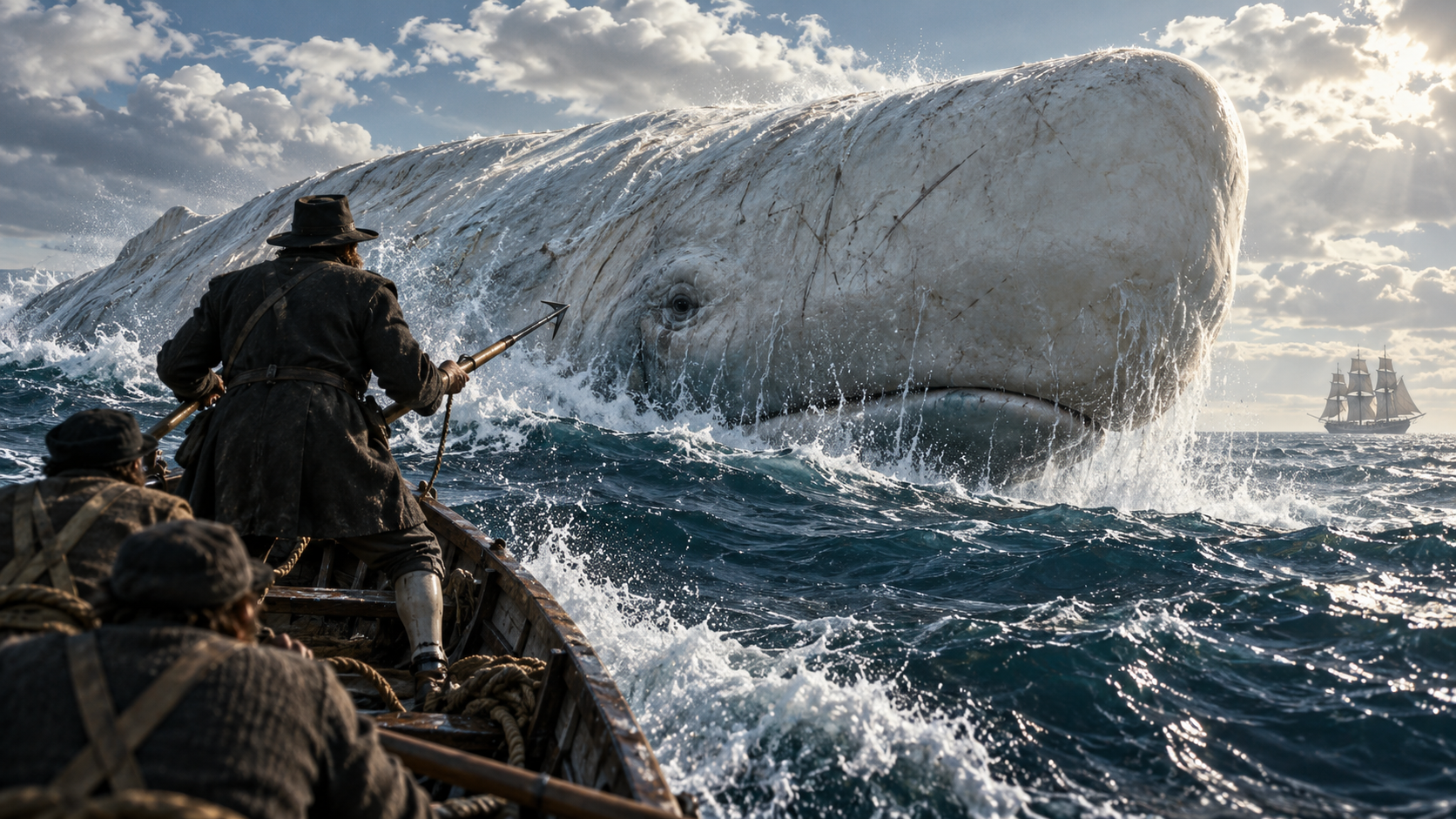
Ahab gathers the crew and nails a gold doubloon to the mainmast. He promises it to whoever first sights a particular white whale, identifiable by its distinctive features. The harpooneers recognise the description: the creature is Moby Dick.
Ahab then confirms that this is the whale that took his leg. He intends to find and kill it.
Starbuck immediately recognises the change in the voyage. The men have come to obtain whale oil and earn money. Their captain is asking them to participate in a personal campaign whose success cannot be measured by the cargo it brings home.
Their disagreement also concerns responsibility. Starbuck sees an animal acting according to its nature. Ahab experiences the injury as an expression of something hostile behind the visible world.
For Ahab, the whale has become the surface through which he hopes to strike at the power responsible for suffering. His anger gathers many grievances into one body that he can pursue.
This makes his aim larger than ordinary revenge and harder to satisfy. Killing an animal cannot clearly answer the questions he has attached to it, yet he treats the hunt as though it could settle them.
The crew responds to his performance. The gold offers a tangible reward; his speech offers excitement, solidarity and a shared enemy. Drinking and ritual turn his intention into a collective oath.
Ishmael acknowledges his own participation. He is drawn into the enthusiasm and accepts the hatred that Ahab gives them. His later account therefore includes an uncomfortable recognition: the captain does not create collective commitment through orders alone.
Starbuck objects, but the gathering does not become a sustained challenge to Ahab’s command. The voyage retains its familiar ranks, equipment and work while acquiring another controlling purpose.
The ship still looks like a commercial whaler. Its captain has begun to make it an instrument of his grievance.
Ishmael’s Whale Keeps Escaping a Single Explanation
After Ahab’s declaration, Ishmael explains the stories surrounding Moby Dick. Whalemen associate the creature with extraordinary strength, destructive encounters and an apparent ability to survive repeated attacks.
Reports accumulate into legend. The whale becomes more than a difficult animal to catch because each account reaches the next listener through fear, memory and exaggeration.
Ishmael is especially troubled by its whiteness. He considers how white can suggest beauty, sacredness or authority while also producing terror through pallor, emptiness and unfamiliarity.
The colour does not supply a stable moral answer. Its associations contradict one another. That uncertainty helps explain why the whale can carry so many meanings without becoming fully understandable.
Ahab responds to uncertainty by concentrating it into an enemy. Ishmael responds by collecting more perspectives.
This difference shapes the novel’s unusual structure. The pursuit repeatedly gives way to discussions of whale anatomy, pictures, classification, history and the practical organisation of whaling.
These chapters can feel like interruptions if the book is approached solely as a chase. Yet they establish how much activity and knowledge surround the creature Ahab wants to reduce to one purpose.
Ishmael tries to organise whales into categories while admitting that his system remains unfinished. He examines representations and finds that images can distort what they claim to show. Even a skeleton cannot reproduce the full presence of a living animal.
His efforts are serious, comic and speculative by turns. The resulting uncertainty does not make inquiry pointless. It makes complete possession of the subject impossible.
The narrative itself also stretches beyond ordinary eyewitness recollection. It includes dramatic scenes, speeches and private thoughts that Ishmael could not straightforwardly have overheard.
Melville allows the account to move between a sailor’s experience, theatrical tragedy and an attempt to gather an entire world into writing. Readers should therefore resist treating every passage as if it were a conventional report.
Ahab wants one decisive encounter. Ishmael’s book keeps discovering additional subjects, voices and connections. The form makes room for everything that the captain’s narrowing attention excludes.
The Crew’s Ordinary Work Reveals Its Dependence on Others
The Pequod continues hunting other whales. Ahab understands that his private purpose cannot entirely replace the crew’s expectations of employment and profit. Ordinary whaling helps keep the ship functioning while he searches.
During an early pursuit, men previously concealed aboard emerge as Ahab’s own boat crew. Among them is Fedallah, a Parsee harpooneer whose close relationship with the captain encourages suspicion among the sailors.
Their appearance reveals another way Ahab has prepared for a voyage different from the one publicly offered. His personal arrangements have travelled aboard without the wider crew understanding them.
For the sailors, whaling requires intense coordination. Small boats approach animals capable of smashing them. Harpoons fasten ropes to moving bodies, creating connections that can pull a boat forward or drag a person under.
The danger belongs as much to the equipment and organisation of the hunt as to the whale. A loose line can become lethal almost instantly.
Once a whale is killed, the work continues. The crew cuts away blubber, handles immense weights and processes the material in the ship’s furnaces. The apparent adventure rests on exhausting labour.
Ishmael repeatedly notices how this labour binds people together. In the monkey-rope episode, he is connected by a rope to Queequeg, who works on the slippery body of a dead whale beside the ship.
His friend’s movements can endanger him, while his own attention helps protect Queequeg. Their connection turns an abstract idea about mutual dependence into a practical situation involving balance, strength and trust.
Other episodes reinforce the importance of shared skill. When Tashtego falls into a whale’s head, Queequeg’s intervention saves him. Survival depends on someone acting for another person within the machinery of work.
The novel also exposes the violence supporting the ship’s profits. Whales appear as living creatures with vulnerability and social relationships before their bodies become useful products.
Ishmael participates in the industry and takes pride in its expertise. His attention nevertheless makes its costs difficult to ignore. The whale can be an object of knowledge, a source of income and a suffering creature within the same account.
Pip’s Ordeal Exposes What the Hunt Can Cost
Pip, a young Black member of the crew, usually remains aboard while others go out in the boats. When he temporarily replaces an injured oarsman in Stubb’s boat, the work puts him under pressures for which he is poorly prepared.
During a pursuit, he panics and jumps overboard. He becomes entangled in the whale line, forcing the crew to cut it and lose the whale to save him.
Stubb responds with anger and a warning against jumping again. He also compares Pip’s monetary value under slavery with the value of a whale.
The remark makes the ship’s racial and commercial assumptions brutally clear. A frightened person is being assessed against the income his rescue interrupts.
When Pip jumps again on a later occasion, Stubb continues the pursuit. The narration suggests he expects other boats to collect the boy, but those boats turn after whales of their own.
Pip remains alone in the open sea until the Pequod eventually rescues him.
He returns profoundly changed. The crew describes him as having lost his reason, while Ishmael’s language suggests an encounter with depths that ordinary social understanding cannot accommodate.
His speech becomes fragmented and strange. The book gives that speech imaginative force without removing the suffering that produced it.
Ahab responds with unexpected tenderness. He recognises something in Pip’s distress and offers a closeness he withholds from much of the crew.
This relationship complicates the captain’s character. His capacity for affection remains active. He can recognise another person’s vulnerability even while directing a voyage that places others in danger.
The contradiction becomes sharper because Pip can interrupt his concentration on revenge. Ahab senses that continued contact might draw him away from his fixed purpose.
Meanwhile, encounters with other ships offer competing examples of how to live after injury. Captain Boomer of the Samuel Enderby has lost an arm in an encounter with Moby Dick.
Boomer has no desire to repeat the experience. He can acknowledge the whale’s danger and accept that pursuing it again would be foolish.
Ahab encounters a man with a comparable wound who has chosen another response. The meeting prevents injury alone from explaining the captain’s decisions. Suffering has shaped him, but it has not prescribed only one possible future.
Starbuck Challenges the Direction of the Voyage
As the voyage continues, Ahab’s pursuit increasingly conflicts with his responsibilities to the owners and crew.
When oil is found leaking, Starbuck wants the casks examined. The request concerns the cargo on which everyone’s payment depends. Ahab initially resists the delay and threatens him with a musket.
Starbuck does not answer with force. He warns the captain to beware of himself.
Ahab ultimately orders the necessary work. The narrator leaves his exact motive uncertain: it may involve a moment of honesty, practical concern about opposition, or some combination.
The concession shows that resistance can still reach him. It also demonstrates how unstable the limits on his authority have become. A routine concern about preserving cargo has required the chief mate to withstand a threat.
During the work below decks, Queequeg becomes dangerously ill. Expecting death, he asks the carpenter to make a coffin that resembles the canoe burial he remembers from home.
He tries it for size and prepares for its use. Then he recovers, explaining that he has remembered unfinished business requiring him to remain alive.
The coffin becomes a storage chest. Its function changes because the future for which it was built has failed to arrive.
Ahab moves in the opposite direction, treating predictions as guarantees. Fedallah tells him that before his death he must see two hearses upon the sea: one not made by human hands and another made from American wood.
Fedallah also says he will die before Ahab and appear to him again. Finally, he declares that only hemp can kill the captain.
Ahab interprets hemp as the gallows. Since hanging appears irrelevant to his voyage, the prediction strengthens his confidence.
His reading depends on selecting meanings that reassure him. Rope is everywhere aboard a whaling ship, but he does not allow that ordinary presence to disturb his interpretation.
Later, after a typhoon, Starbuck finds himself outside the sleeping captain’s cabin with a loaded musket. He considers whether killing Ahab could save the crew.
He also considers restraining him, but cannot imagine successfully maintaining that control through a long voyage. His position has become morally intolerable: obedience may endanger everyone, while violent resistance would make him responsible for an immediate killing.
He puts the weapon back.
The decision preserves his refusal to murder, but leaves Ahab in command. Understanding the danger has not given Starbuck a means of stopping it.
Ahab Is Offered Reasons to Turn Home
The approach to the final hunt contains repeated opportunities for Ahab to recognise another claim upon him.
After the ship loses its lifebuoy, Queequeg’s unused coffin is sealed and adapted to replace it. The object prepared for one man’s death becomes equipment intended to save a person overboard.
Ahab finds the transformation disturbing. Around him, objects and relationships continue to acquire meanings outside the fixed pattern he wants to impose.
Then the Pequod meets the Rachel. Its captain, Gardiner, has recently encountered Moby Dick, and a boat from his ship is missing.
Gardiner’s son is among those aboard the lost boat. He asks Ahab to join the search.
The request creates a direct conflict between following the whale and helping people who may still be alive. Gardiner even offers payment for the Pequod’s time.
Ahab refuses.
This decision makes the cost of his priorities concrete. He has information suggesting that the whale is nearby, and he will not sacrifice that advantage to another father’s search.
His own wife and child remain ashore. Gardiner’s appeal therefore invokes responsibilities that Ahab can understand personally, even as he rejects them.
The Pequod subsequently encounters the Delight, whose recent meeting with Moby Dick has left men dead and a boat destroyed. Another ship’s experience gives the crew visible evidence of the danger ahead.
Still, Ahab’s commitment briefly loosens during a quiet conversation with Starbuck. In the chapter called “The Symphony”, he reflects on decades at sea and how little time he has spent at home.
He remembers his wife and the child he has scarcely known. Starbuck urges him to return to them and responds as someone who also longs for his own family.
Ahab weeps. He can still recognise the life he has neglected.
Yet recognition does not become a change of course. He wonders what force drives him and speaks as though his actions belong to a necessity beyond his control.
The moment leaves a difficult distinction. Ahab feels compelled, but the narrative has repeatedly shown choices being presented to him. His language of destiny grows alongside his refusal of those choices.
The White Whale Comes Within Reach
Ahab finally sights Moby Dick himself. After so much report, interpretation and anticipation, the whale appears as a living creature moving through the sea.
The boats are lowered, and Ahab leads the pursuit.
On the first day, Moby Dick destroys Ahab’s boat. The captain survives, and the Pequod recovers the men. The encounter demonstrates the whale’s power without giving Ahab the result he seeks.
He treats survival as permission to continue.
This response reveals how difficult it has become for experience to correct him. A warning can be interpreted as a challenge; rescue can become evidence that his purpose remains protected.
On the second day, the boats attack again. Lines become entangled, the whale strikes, and the equipment intended to secure the animal contributes to the confusion and destruction.
Ahab’s artificial leg breaks. When the company is mustered, Fedallah is missing. Stubb reports seeing him dragged beneath the water in the line.
The disappearance gives Fedallah’s earlier words a new significance. His prediction that he would go before Ahab now presses upon the captain’s attempt to feel invulnerable.
Starbuck renews his objections. They have pursued the whale for two days and suffered repeated destruction. Continuing risks turning the whole ship’s company into casualties of one man’s determination.
Ahab answers by asserting that the action has already been decreed. He presents himself as acting under the orders of fate.
That claim protects his purpose from argument. If the chase is ordained, practical warnings and moral appeals can be dismissed as irrelevant.
The crew prepares replacement boats and weapons through the night. Their expertise continues to make another attack possible.
This is part of the tragedy’s mechanism. Skilled labour, loyalty and resilience keep repairing the damage caused by a decision that those same qualities cannot overturn.
By morning, the ship possesses the means to resume the pursuit. Ahab has accepted neither defeat nor a limit.
The Third Day Tests Every Promise
On the third day, Ahab again goes out after Moby Dick. Starbuck remains aboard the Pequod, still pleading against the decision.
When the whale rises and the boats close, Fedallah’s body becomes visible, bound against the animal by the tangled lines.
Ahab recognises the first hearse. It is the whale itself, a bearer of the dead that no human hand constructed. Fedallah has died before him and appeared once more, fulfilling another part of the prediction.
The apparent reassurance begins to reveal its other meaning.
Even now, the whale’s movement does not establish Ahab’s belief in a personal campaign against him. At one point Moby Dick swims onward, and Starbuck calls attention to the fact that the captain is the pursuer.
Ahab continues.
After further attack, Moby Dick turns towards the Pequod. The whale strikes the ship’s bow, breaking the hull and letting water pour inside.
Ahab recognises the second hearse: the ship, built from American wood, is becoming a vehicle of death.
His interpretation of Fedallah’s promises collapses, but he does not abandon his final effort. As the vessel sinks, he throws another harpoon.
The line runs out at speed and catches. Ahab bends to clear it. A moving loop catches him around the neck and pulls him from the boat into the sea.
Hemp kills him through the rope of his own pursuit.
The ending does not show a victorious captain defeating his enemy. Moby Dick is not shown being killed. Ahab’s attempt to destroy the whale instead destroys the expedition placed under his care.
The Pequod sinks, and its vortex takes the remaining boat and surrounding wreckage down with it. Starbuck, Stubb, Flask, Queequeg and the rest of the ship’s company disappear.
Tashtego remains at the mast, hammering a flag into place as the vessel goes under. The last activity aboard continues the habits of work and obedience even when they can no longer preserve the ship.
Then the sea closes over the scene. Its continuing movement gives no assurance that the human catastrophe has altered the world beyond it.
The Epilogue Changes the Meaning of What Remains
The epilogue establishes that Ishmael alone survives.
He has been thrown from Ahab’s boat and left behind the immediate action. When the sinking ship’s suction reaches him, it has weakened enough for him to remain afloat.
Queequeg’s coffin-lifebuoy rises beside him. Ishmael clings to it for almost a day and a night before a ship approaches.
That ship is the Rachel, still searching for its missing people.
The rescue joins two relationships that Ahab’s pursuit has marginalised. Ishmael survives through an object associated with Queequeg, his closest companion, and through a search that Gardiner continues because he refuses to give up on others.
Neither element makes the loss acceptable. Queequeg has not deliberately sacrificed himself to save Ishmael, and the Rachel does not recover its missing child through this encounter.
The ending preserves grief alongside rescue. Finding Ishmael gives Gardiner someone to save without granting the recovery he wanted.
It also answers the practical question raised by the narration: how can someone tell the story of a ship apparently swallowed with everyone aboard? Ishmael’s position outside the final concentration of destruction, the floating coffin and the continuing search make his account possible.
Ahab’s death is equally specific. The whale does not simply bite or swallow him. The rope connecting hunter to hunted catches his neck. The mechanism belongs to whaling itself, making the pursuit physically inseparable from its consequence.
Fedallah’s predictions come true through meanings Ahab has refused to consider. Their fulfilment gives the ending a fatal pattern, but it does not prove that the captain lacked opportunities to stop.
Starbuck’s appeals, Boomer’s example, Gardiner’s request and Ahab’s own memories all establish alternatives. His belief in necessity helps him reject them.
The whale remains harder to settle. Ahab assigns it deliberate evil; Starbuck challenges that interpretation; Ishmael surrounds it with competing accounts and associations. Its destructive actions are established, while its ultimate significance remains open.
That openness separates the narrator’s achievement from the captain’s ambition. Ahab demands a final answer that can be secured through force. Ishmael creates a story capable of holding uncertainty, affection, violence, labour and loss together.
His survival does not make him innocent of the enthusiasm that helped the hunt begin. Telling the story includes remembering his participation as well as the people whom Ahab’s purpose absorbed.
Moby-Dick ends with a solitary man supported by his friend’s repurposed coffin and found by another man’s continuing search. After Ahab has made one enemy the measure of everything, Ishmael’s life depends on connections that reach beyond that obsession.
Sources
Moby Dick; or, The Whale — Herman Melville. Public-domain original text used for the voyage, characters, whaling chapters, predictions and final pursuit.
Moby-Dick, 1851 US Edition: Epilogue. Original epilogue establishing Ishmael’s survival, the coffin-lifebuoy and the Rachel’s rescue.
Moby-Dick — Herman Melville. Publisher information confirming authorship, original publication year and the novel’s central premise.
