Great Expectations Explained: Pip, Estella, Ambition and the Ending
How Shame and Social Class Shape Pip’s Choices
Money, Friendship and Moral Growth
In Charles Dickens’s Great Expectations, a boy begins to believe that becoming a gentleman will make him worthy of the life and love he wants. Pip is an orphan growing up beside the Kent marshes, where affection, fear and dependence shape his earliest understanding of himself. An encounter with a fugitive and an invitation to a wealthy woman’s house expose him to worlds he barely understands.
When an unexpected opportunity offers escape from the forge where he expects to work, Pip finds it easy to imagine a purpose behind his good fortune. This summary follows that belief through the relationships and discoveries that test it, before explaining the published ending and Dickens’s different, earlier conclusion.
A frightened child on the marshes
Pip lives with his older sister, Mrs Joe Gargery, and her husband Joe, a blacksmith. His sister treats raising him as a grievance for which he must continually apologise. Joe supplies the kindness missing from her discipline, although his gentleness does not prevent her violence.
At his parents’ graves, Pip encounters an escaped convict wearing a leg iron. The man threatens him and demands food and a file. Pip steals supplies from home and brings them out onto the marshes, terrified both of the stranger and of being discovered.
Yet fear is not his only response. Watching the man eat, Pip also recognises hunger and suffering. His act begins under coercion, but it contains an impulse of sympathy that reaches beyond the frightening appearance before him.
Soldiers subsequently enlist Joe to repair their handcuffs, and Pip accompanies the search for escaped prisoners. They find two convicts fighting. The man Pip helped has caught the other and is determined to have him taken back, even at the cost of his own freedom.
Before being returned to custody, Pip’s convict claims that he stole food from the blacksmith’s house himself. His admission protects the child from discovery. Joe responds generously to the idea that a hungry man needed feeding, without knowing what Pip has done.
Pip remains burdened by secrecy. The episode establishes a pattern in his childhood: he feels guilty before he can properly distinguish wrongdoing from compassion. Adults often make him responsible for their anger, leaving him poorly equipped to judge his own worth.
Satis House changes what Pip wants
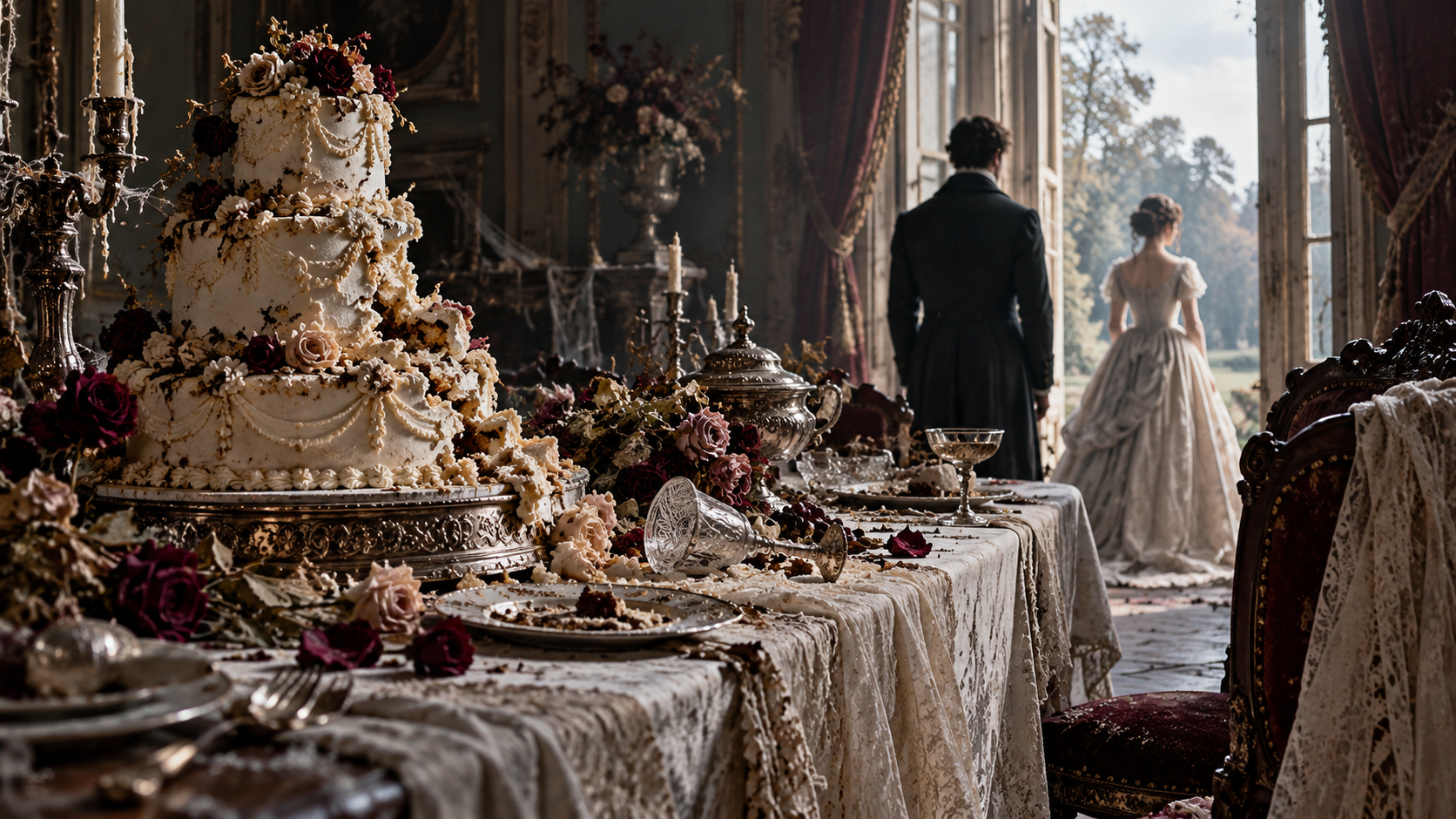
An invitation to visit Miss Havisham introduces a different kind of authority. She is wealthy, secluded and still dressed in the bridal clothes of a wedding that never took place. At Satis House, stopped clocks and the remains of a wedding feast keep an old catastrophe present.
Miss Havisham instructs Pip to play with Estella, the girl she has adopted. Estella mocks his rough hands, thick boots and unfamiliarity with her social rules. Pip has previously accepted the forge as his future. After meeting her, he starts to experience it as evidence of inferiority.
His humiliation becomes an ambition. He wants education and refinement because he wants Estella to stop looking down on him. Her judgement acquires an authority that Joe’s affection cannot counter: being loved at home no longer seems sufficient if he remains contemptible elsewhere.
Miss Havisham encourages his attachment. She watches the children and urges Estella to break male hearts. Pip is too young to understand the arrangement fully, but he learns to associate beauty and social advantage with the power to cause pain.
He also fights a pale young gentleman in the grounds and defeats him. Estella allows him a kiss afterwards. The encounter gives Pip a small experience of approval within a household where attention is unpredictable and often humiliating.
Eventually, Miss Havisham supplies money for Pip’s apprenticeship to Joe. The decision disappoints his hope that visits to Satis House might lead somewhere grander. Instead, he returns to the work he now wants to escape.
Biddy, an intelligent young woman from his village, helps him learn. She can understand his dissatisfaction without endorsing his belief that Estella’s contempt should govern his life. Pip nevertheless treats the person who listens to him as less desirable than the person whose approval he struggles to obtain.
Trouble also enters the household through Joe’s journeyman, Orlick, who resents Pip. After a violent quarrel between Orlick and Mrs Joe, Joe fights him. Later, Mrs Joe is found badly injured following an unexplained attack.
She survives with severe impairments, and Biddy comes to care for her. The weapon is a convict’s leg iron, which makes Pip’s old secret return as a source of guilt. He connects the attack with his stolen file, although he does not know who struck his sister.
An unexpected offer gives ambition a direction
The London lawyer Mr Jaggers arrives with news that Pip has great expectations. An unnamed benefactor intends him to receive property and be educated as a gentleman. He must retain the name Pip and refrain from trying to discover the benefactor’s identity.
For Pip, the conditions make mystery feel like confirmation. Jaggers is associated with Miss Havisham, and Pip assumes that she is arranging his advancement. He further imagines that Estella belongs within this plan.
Neither assumption is an actual promise. Pip takes a collection of suggestive circumstances and turns it into a personal destiny. Because the interpretation fits what he wants, he gives little weight to what he has never been told.
His behaviour changes before he leaves. New clothes and money alter how others treat him, while he becomes increasingly sensitive to Joe’s manners. The friendship that sustained him begins to seem awkward beside the position he expects to occupy.
Joe refuses payment for releasing him from the apprenticeship. He does not convert affection into a financial claim, even when presented with the opportunity. Pip’s imagined rise therefore begins with a generosity he already possesses but cannot yet value properly.
In London, Pip discovers that his new companion, Herbert Pocket, is the pale young gentleman he fought at Satis House. Herbert bears no grudge. He helps Pip learn unfamiliar manners without reproducing Estella’s contempt.
Herbert also supplies the history behind Miss Havisham’s household. A man courted her, obtained money from her and abandoned her on their wedding day. Her withdrawal and her treatment of Estella develop from that betrayal.
The explanation makes the stopped clocks intelligible. Miss Havisham has organised her surroundings around an injury she cannot release, and she brings children into that arrested world. Estella’s education turns another person’s future into an instrument of revenge.
Pip becomes a pupil of Herbert’s father, Matthew Pocket. He has access to instruction and money, but no clear occupation. The benefactor’s arrangement permits him to live as a gentleman without making him decide what useful work his adult life will contain.
London exposes the cost of becoming a gentleman
Pip and Herbert grow close, yet their friendship takes place within an expensive way of living. They accumulate debts and periodically try to organise their finances. Their efforts produce a sense of responsibility without adequately controlling their spending.
Herbert hopes to establish himself in business and marry Clara, whose circumstances make the match inconvenient to his family. His ambition has a practical object: the means to support a shared life. Pip’s ambition remains attached to an image of himself and to Estella.
Other acquaintances separate social standing from personal merit. Bentley Drummle is wealthy and well connected, but also sullen and unpleasant. Pip dislikes him, while continuing to pursue the social world that gives such a man an advantage.
Jaggers’s clerk, Wemmick, introduces another contrast. At work, Wemmick is guarded, calculating and preoccupied with material security. At home, in his small castle-like property, he cares affectionately for his elderly father.
Pip encounters warmth where professional behaviour has concealed it. The distinction complicates his habit of reading people through their surfaces. A coarse occupation need not exclude tenderness, while an impressive manner need not establish kindness.
When Joe visits London, Pip is embarrassed by his clothes and speech. Joe recognises the discomfort and leaves with his dignity intact, explaining that they belong more naturally together at the forge. He does not demand that Pip perform affection before an audience.
The pain of the visit comes from Pip’s awareness that Joe has done nothing to deserve rejection. His embarrassment expresses the values he has absorbed, rather than any failure in the man who raised him.
Pip also returns home after his sister dies. Biddy questions whether he will maintain contact with Joe, and Pip resents her doubt. His resentment is easier than examining the distance he has already allowed to grow.
His conduct is not uniformly selfish. Wanting to help Herbert, he secretly uses money to secure his friend a place with the merchant Clarriker. Wemmick assists him privately, outside the official habits of Jaggers’s office.
This generosity matters because it benefits Herbert without requiring recognition. Pip can already act on a better understanding of friendship. The difficulty is that this understanding coexists with his continuing shame about home and his dependence on Estella’s approval.
Estella, meanwhile, warns him that she cannot respond as he wants. Miss Havisham continues to encourage his devotion, and Pip interprets his suffering through the hope that persistence will eventually be rewarded. He hears Estella’s warnings, but his imagined future remains more persuasive.
A visitor unsettles Pip’s expectations
When Pip is twenty-three, a stranger arrives at his London rooms. Pip gradually recognises the convict he helped on the marshes. The man is Abel Magwitch, and his affection makes Pip uncomfortable before he understands why he has come.
Magwitch has prospered in Australia. He now explains that he supplied Pip’s money and employed Jaggers to oversee the arrangement. His knowledge of the allowance and the lawyer confirms the connection.
Pip’s gentlemanly life has been financed by the person whose touch and appearance repel him. Miss Havisham has not been preparing his inheritance, and his fortune supplies no evidence that Estella is intended for him.
The discovery destroys the story Pip has used to explain his life. It also exposes a contradiction in his disgust: he has enjoyed the money while imagining a source that would flatter him. Its practical effect is unchanged, but its origin makes him feel degraded.
Magwitch’s project combines gratitude with pride. Pip’s childhood kindness has sustained him, and making the boy a gentleman becomes a purpose around which he organises his labour. He also wants to demonstrate that a despised convict can create the sort of man society admires.
His generosity therefore carries expectations of its own. Like Miss Havisham, he has invested in a young person’s future as an answer to his past. Unlike her cultivation of cruelty, his ambition grows from remembered kindness, though he cannot initially imagine Pip’s horror at the gift.
Magwitch has returned unlawfully and faces death if caught. Pip and Herbert must protect him while deciding what to do. Pip cannot accept the easy option of turning away without confronting the danger his visitor has entered for his sake.
Magwitch describes his earlier life of poverty, crime and exploitation by a polished criminal named Compeyson. At their trial, Compeyson’s education and appearance helped distinguish him favourably from his rougher associate. Magwitch received the heavier sentence.
Compeyson is also the second convict from the marshes. Herbert then identifies him as the man who betrayed Miss Havisham. The histories Pip has treated as separate converge through a person whose gentlemanly exterior conceals calculated harm.
Love and responsibility pull Pip in different directions
Pip visits Miss Havisham and Estella before making plans to leave England. He confronts Miss Havisham about allowing him to believe that she was his benefactor. She has encouraged his misunderstanding because it suited her purposes.
Estella tells him that she intends to marry Drummle. Pip protests, recognising the cruelty and contempt in the man she has chosen. Yet recognising a danger gives him no authority to decide her future.
Estella explains that she will not deceive Drummle about her feelings. Her position is consistent with the emotional education she received, although that consistency cannot make the marriage safe. Pip’s anguish also forces Miss Havisham to see the suffering her arrangements have produced.
Back in London, Wemmick warns Pip that Magwitch is being watched. Herbert helps conceal him near the river, in the house where Clara lives. The friends prepare to take him downstream and transfer him to a departing steamer.
Pip’s attention gradually shifts from the disgrace of the connection to the vulnerability of the man. Spending time with Magwitch allows affection to replace his first revulsion. Protection becomes a responsibility he chooses, rather than a debt he merely resents.
Other discoveries unsettle his assumptions about Estella. At Jaggers’s house, he notices a resemblance between her and Molly, the housekeeper. Wemmick explains that Jaggers once defended Molly against a murder charge and secured her acquittal.
When Pip next visits Miss Havisham, she is remorseful. She recognises that she has damaged Estella by shaping her around bitterness, and asks Pip’s forgiveness. Pip directs her towards helping Herbert, securing the money needed to complete his friend’s business arrangement.
Miss Havisham explains that Jaggers brought Estella to her as a small child. Pip has begun to reconstruct the girl’s origins, but he still lacks the whole account.
As he prepares to leave, Miss Havisham’s dress catches fire. Pip smothers the flames, burning his own hands and arms. The rescue interrupts their conversation with an immediate duty of care: understanding her wrongdoing does not prevent him from trying to save her.
While nursing Pip afterwards, Herbert passes on more of Magwitch’s history. Magwitch once had a little daughter. The child’s mother, a jealous woman tried for murder, threatened to destroy her, and Magwitch believed the girl dead.
Pip connects this account with Molly’s history and Estella’s resemblance. He realises that Magwitch is Estella’s father. When he confronts Jaggers, the lawyer’s guarded explanation confirms how the child was placed with Miss Havisham.
The discovery overturns the social distance Pip has imagined between Estella and the convict. Her upbringing has concealed her origins while giving her the manners through which she judged his. Magwitch does not know that his daughter survived, and Estella does not know the parentage Pip has uncovered.
The attempt to leave England
Before the escape, an anonymous letter draws Pip back to the marshes with an offer of information about Magwitch. There, Orlick traps him in an isolated sluice-house and threatens to kill him.
Orlick admits attacking Mrs Joe, while blaming Pip for grievances of his own. His accusation does not establish Pip’s responsibility. It reveals the way Orlick converts resentment into permission to hurt people.
Herbert, Startop, another of Matthew Pocket’s pupils, and Trabb’s boy arrive in time to rescue Pip. Herbert has found the letter and followed him. The intervention returns Pip to the escape plan, still injured but alive.
Pip, Herbert and Startop row Magwitch down the Thames, intending to meet a continental steamer. Their preparations depend on passing as ordinary river travellers until they can reach the vessel.
As the steamer approaches, an official boat intercepts them. Compeyson is aboard to identify Magwitch. Magwitch seizes his old enemy, and both men go into the water as the boats collide and Pip’s boat is overturned.
Magwitch is recovered badly injured. Compeyson drowns. The novel does not establish a simple, witnessed account in which Magwitch deliberately murders him; their struggle and the collision create a confused disaster.
The escape has failed. Magwitch is arrested, and his property will be forfeited to the Crown. The expected inheritance cannot provide Pip with the future around which he has organised his life.
Pip nevertheless remains with him. He petitions for mercy and attends him through imprisonment and declining health. His loyalty now survives the loss of any financial advantage, making it different from the relationship Magwitch first came home to celebrate.
Magwitch is tried and sentenced to death, but his injuries are already killing him. Beside his bed, Pip tells him that his daughter lives, that she is beautiful and a lady, and that Pip loves her.
Magwitch responds with affection and dies. Pip cannot reunite father and daughter, rescue the fortune or reverse the sentence. He can relieve one grief before the man’s death, using the knowledge he has acquired to offer comfort.
Pip returns to the people he has neglected
After Magwitch dies, Pip falls seriously ill while threatened by debt. Joe comes to nurse him, restoring the practical care Pip has repeatedly undervalued. His presence makes dependence possible without turning it into humiliation.
During his recovery, Pip learns that Miss Havisham has died following her injuries. Her late remorse has produced some acts of repair, including help for Herbert, but it has not undone the lives already shaped by her conduct.
Joe also settles the debt for which Pip faced arrest. As Pip recovers, Joe grows more reserved and eventually leaves. The return of Pip’s independence brings back the social discomfort between them.
Pip resolves to go home, ask forgiveness and propose to Biddy. He imagines a modest domestic future after the collapse of his grander plans. Yet this new picture still assumes that another person will occupy the place he has assigned her.
When he arrives, he discovers that Joe and Biddy have married. Their happiness has developed beyond his attention. Biddy has a life and attachment of her own; she has not remained available as a reward for Pip’s change of heart.
Pip responds by asking their forgiveness and accepting the marriage. He must acknowledge their independent happiness without making his disappointment its centre. That acceptance gives his repentance a practical consequence.
He joins Herbert’s business abroad, beginning as a clerk and eventually becoming a partner. He works, lives economically and repays his debts. The business succeeds respectably without becoming a spectacular source of wealth.
Herbert eventually learns that Pip secretly financed his opportunity. The revelation strengthens their friendship. Pip’s earlier generosity has helped create the employment through which he can rebuild his own life, although he did not arrange it as a bargain.
His recovery therefore does not require him to reject education, ambition or financial stability. It requires a different relation to them. Work becomes a contribution he can make, and friendship becomes something sustained through conduct rather than social display.
The final meeting and the two endings explained
Eleven years later, Pip returns to Joe and Biddy. They have children, including a son named Pip. The familiar home offers continuity without allowing him to recover his childhood or step into a life he previously ignored.
He has heard that Estella’s marriage was unhappy and that Drummle treated her cruelly. Drummle has since died following an accident connected with his ill-treatment of a horse.
Pip visits the site of Satis House, where the buildings have been demolished. Estella is there too. She still owns the land and has returned before it is built upon.
Their conversation establishes a change in her understanding. She acknowledges that suffering has taught her to recognise feelings she formerly dismissed. She remembers Pip differently and asks for his friendship.
Pip takes her hand, and they leave the ruined grounds together. His final observation is that he sees no shadow of another parting from her.
The ending invites hope for a continuing relationship, but it does not narrate a marriage. Estella has spoken of remaining friends apart, while Pip’s concluding perception suggests a future without separation. Those statements leave room between reconciliation and a confirmed romantic union.
A romantic reading gives weight to their joined hands, their changed understanding and the final sentence. A more restrained reading sees a moment of forgiveness whose emotional completeness need not guarantee marriage. The text supports renewed closeness more directly than it establishes a particular domestic future.
The setting helps explain why the reunion differs from Pip’s early dream. Satis House no longer governs their meeting as an enclosed world of judgement and manipulation. They can recognise one another amid its remains, with neither the promised fortune nor Miss Havisham’s design supplying their relationship’s meaning.
Estella’s account of suffering also deserves care. Her greater empathy does not justify Drummle’s abuse or establish that cruelty was a necessary education. The ending describes a change after mistreatment; readers need not endorse mistreatment as the proper means of producing that change.
Dickens originally wrote another conclusion, which he replaced before publication after advice from the novelist Edward Bulwer-Lytton. In that earlier version, Pip encounters Estella in London after she has married a doctor following Drummle’s death.
She briefly mistakes Joe and Biddy’s child for Pip’s. Their meeting assures Pip that she can now understand what he once felt, but it does not open a shared romantic future. Recognition arrives after their lives have taken separate directions.
The two versions should therefore remain distinct. The abandoned ending gives greater finality to separation; the published ending permits a hope that it does not fully specify. Neither version restores the untouched childhood dream.
Across both, Pip’s moral development is more firmly established than his romantic future. He has cared for Magwitch without an inheritance, accepted Joe and Biddy’s happiness without a claim upon it, and learned to sustain himself through work.
Great Expectations ultimately gives Pip a harder standard of judgement than the one Estella first teaches him. A person’s worth becomes visible through the care they give when admiration, status and reward no longer explain the act.
Sources
Great Expectations — Charles Dickens. Public-domain novel text, labelled the 1867 edition; the primary basis for the plot, relationships, river escape, aftermath and published final scene.
Discovering Dickens — Notes on the Novel: Issue 18. Stanford’s account of the revised conclusion, its publication context and contemporary disagreement over its implications.
The Original Ending of Great Expectations as First Published in John Forster’s Life of Charles Dickens. The earlier ending, reproduced separately from the published narrative.
