Macbeth Explained: Ambition, Lady Macbeth and the Ending
How Ambition Becomes Dangerous
Fate, Free Will and the Price of Power
Macbeth begins with a man who already has honour, status and the gratitude of his king. William Shakespeare’s tragedy places that successful soldier under a different kind of pressure when three witches suggest that a greater future awaits him. Suddenly, loyalty competes with an ambition he cannot comfortably admit.
The conflict becomes more dangerous when Lady Macbeth learns what the witches have said. Husband and wife must decide what they are prepared to do with a prediction that promises power without explaining how to obtain it.
This summary follows the play’s essential events in order, exploring Macbeth’s decisions, Lady Macbeth’s influence and the changing meaning of the prophecies before reaching the final confrontation and explaining the ending.
A soldier hears a different future
Scotland is at war, and King Duncan receives reports of Macbeth’s courage against rebellion and invading forces. Macbeth and his fellow commander, Banquo, have helped defend the kingdom. Before Macbeth appears, other people establish his reputation as someone whose violence serves his country.
Duncan also learns of the Thane of Cawdor’s betrayal. A thane is a Scottish nobleman, and Duncan orders the traitor’s execution while awarding his title to Macbeth. Macbeth does not yet know about this promotion.
Returning from battle, Macbeth and Banquo meet three witches. They greet Macbeth by his existing title, Thane of Glamis, then call him Thane of Cawdor and future king. Banquo receives a different prediction: he will father kings, although he will not become one himself.
The distinction creates two possible futures. Macbeth hears a promise about his own elevation; Banquo hears one about his descendants. Neither man receives instructions for making these outcomes happen.
When royal messengers arrive and announce Macbeth’s new title, one surprising part of the prophecy becomes true almost immediately. The witches have named something he could not have confirmed when they spoke. Their remaining promise therefore acquires credibility.
Macbeth’s response is revealing. He quickly imagines murder, and the thought frightens him. The witches have not mentioned killing Duncan. That possibility comes from Macbeth’s own attempt to connect the promised crown with the king who currently wears it.
He also considers a less active approach: perhaps chance can make him king without his intervention. At this stage, waiting remains imaginable. His ambition has been awakened, but he has not yet committed himself to a means of satisfying it.
Banquo offers a warning about trusting powers that give small truths in order to cause greater harm. His caution establishes an alternative response to the same encounter. A convincing prediction does not automatically make its source trustworthy.
The political situation soon becomes more definite. Duncan names his son Malcolm as his successor. Macbeth recognises an obstacle between himself and the crown, and wants his desires hidden from view. An uncertain future has become a private contest between his ambition and the succession Duncan has publicly established.
Lady Macbeth turns possibility into a plan
Macbeth writes to his wife about the encounter and the promotion. Lady Macbeth immediately treats the crown as something to pursue. She fears that her husband wants greatness while remaining reluctant to use the cruelty she thinks obtaining it will require.
Her judgement does not mean Macbeth lacks ambition. She understands that he wants the result. What concerns her is his wish to obtain power while preserving a sense of innocence about the methods.
News that Duncan will stay at their castle gives that conflict an immediate setting. The king will arrive as their guest, relying on the welcome and protection of people he trusts. Lady Macbeth sees the visit as an opportunity.
She calls on spirits to suppress pity and fill her with cruelty. Her language presents tenderness as an obstruction she must remove. The speech reveals determination, but it also shows that ruthlessness requires an effort of self-transformation.
When Macbeth arrives, she urges him to conceal his intentions beneath hospitality. Duncan must see a loyal host. The murder will depend on a gap between what the Macbeths display and what they intend.
Macbeth nevertheless thinks carefully about refusing. Duncan is his king, his relative and his guest. Each relationship gives him a separate responsibility to protect the man he is considering killing. He also recognises Duncan’s virtues and anticipates the outrage the murder would provoke.
These reflections matter because Macbeth understands the moral case against his own desire. He cannot plausibly claim that the crime seems harmless or justified. When he examines his motive, ambition is what remains.
He tells Lady Macbeth they will go no further. She responds by challenging his courage, consistency and manhood. Their disagreement becomes a struggle over what sort of person he must prove himself to be.
Her plan makes the act appear manageable. She will drug Duncan’s attendants, leaving Macbeth free to kill the sleeping king. They can smear the attendants with blood and leave the weapons beside them, directing suspicion elsewhere.
Macbeth accepts. Lady Macbeth’s pressure helps produce the decision, but the play has already shown his independent desire and his understanding of the alternatives. He chooses to proceed after recognising why he should stop.
Their partnership now rests on a shared assumption: if they can control the appearance of the murder, they can secure its benefits. The immediate problem becomes carrying out the plan without exposing themselves.
The night at Inverness
Before the murder, Banquo admits that the witches have troubled his dreams. Macbeth claims not to think about them, concealing how thoroughly their promise has entered his intentions. The difference between his public speech and private purpose is already widening.
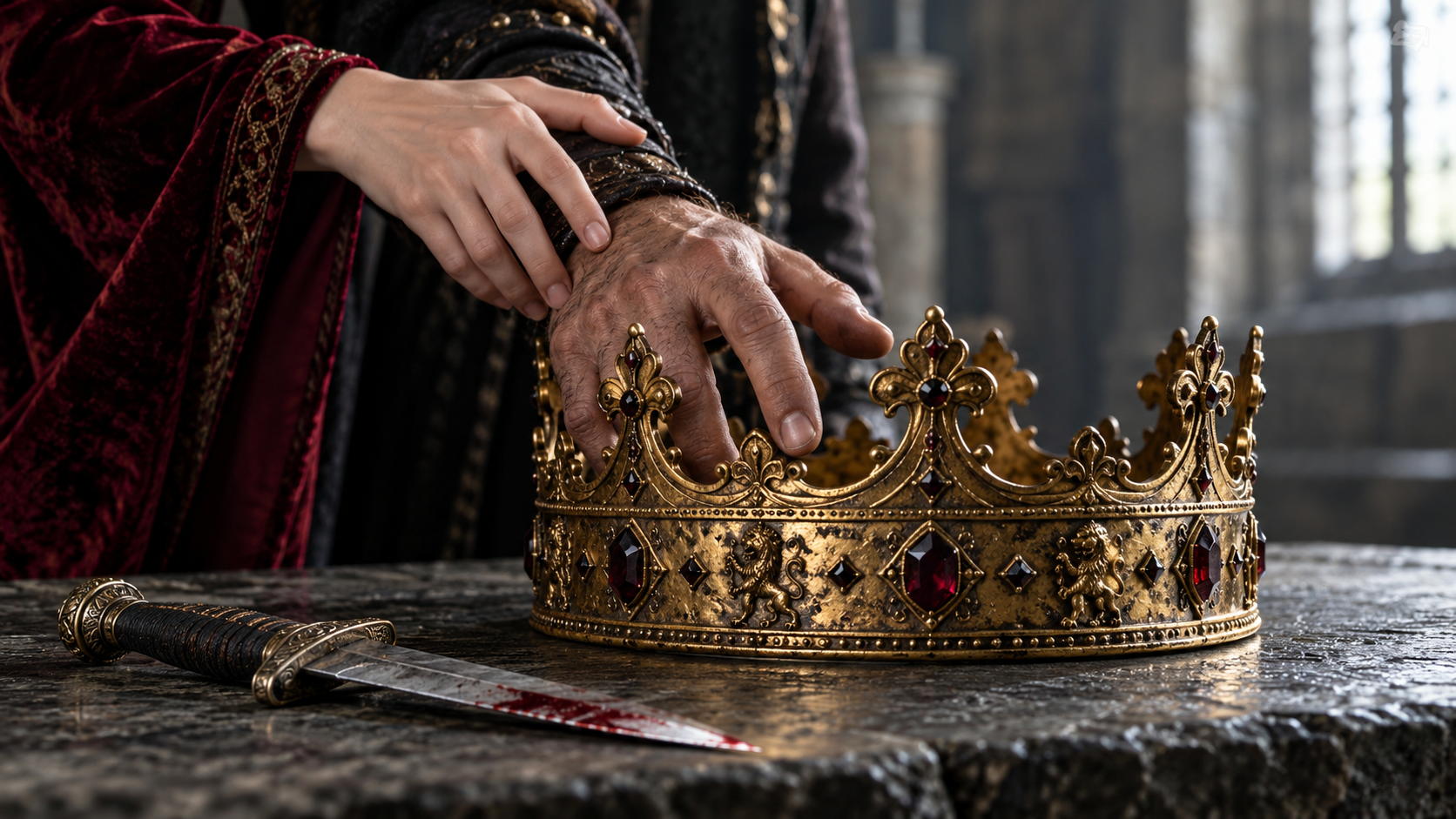
Alone, Macbeth sees a dagger apparently floating before him, pointing towards Duncan’s room. He tries to grasp it and cannot. Blood appears on the imagined blade.
The vision gives shape to the act occupying his mind. Macbeth himself considers whether it is a creation of his disturbed imagination. The scene does not require a settled supernatural explanation for the audience to understand its pressure: the murder he has planned now seems present before it occurs.
A bell signals that Lady Macbeth has completed her preparations. Macbeth goes to Duncan’s chamber and kills him offstage.
He returns carrying the bloody daggers. Instead of attending to the cover story, he becomes absorbed in what he has heard and what the act has done to him. He cannot say a prayer when he tries, and believes he has heard a voice announcing that he has murdered sleep.
Sleep represents something he cannot obtain through rank or force. It requires a surrender of vigilance. Macbeth has just created a secret that gives him reasons to fear discovery whenever he lets down his guard.
Lady Macbeth tries to restore practical order. He should have left the daggers with Duncan’s attendants. When he refuses to return to the chamber, she carries them back and smears the attendants with blood herself.
She has also admitted that Duncan resembled her father as he slept, preventing her from killing him. The detail complicates her demand for absolute hardness. Personal feeling remains present beneath the identity she has tried to impose on herself.
For the moment, however, she treats blood as a physical problem that washing can solve. Macbeth experiences it as evidence of an act that cannot be undone. Their different responses create strain inside their apparent success.
Knocking at the gate brings the ordinary world back into the castle. Macduff, another Scottish nobleman, arrives to wake Duncan and discovers the body.
In the confusion, Macbeth kills the attendants, claiming that rage at their supposed crime overcame him. Their deaths also prevent them from challenging the accusation. One killing has already created circumstances in which further killing benefits the person concealing it.
Duncan’s sons, Malcolm and Donalbain, fear that whoever killed their father may target them. They flee separately to England and Ireland. Their escape protects them while making them vulnerable to suspicion, helping create the opening through which Macbeth can take power.
Wearing the crown without feeling secure
Macbeth becomes king, but the crown does not settle his fear. The prophecy that once offered him a future now gives him a reason to distrust it. If Banquo’s descendants will reign, Macbeth may have committed murder to establish another family’s greatness.
Banquo suspects that Macbeth has acted dishonestly to obtain the throne. He also remembers the promise concerning his own descendants. The play allows him an interest in the prophecy without showing him adopt Macbeth’s methods.
For Macbeth, Banquo’s courage, judgement and knowledge make him threatening. Their former companionship cannot survive Macbeth’s attempt to make the crown completely safe.
Macbeth hires men to kill Banquo and his son Fleance. He manipulates the murderers by presenting Banquo as responsible for their troubles. Rather than approach a rival openly, he encourages other men to experience his political problem as their personal grievance.
Lady Macbeth is not given the full plan. Macbeth hints that another dreadful act will occur, but excludes her from its details. The marriage that organised Duncan’s murder together now contains a private operation directed by the husband who once needed persuasion.
This is a significant change in his conduct. He has moved from arguing over whether to kill to arranging deaths as a means of managing uncertainty. He does not need Lady Macbeth to explain the practical usefulness of violence.
The attack kills Banquo, but Fleance escapes. Macbeth receives both pieces of news while hosting a banquet intended to display the order and confidence of his reign.
The result gives him no lasting reassurance. Banquo is gone, yet the son through whom the prophecy might continue remains alive. Macbeth has taken another irreversible step without obtaining the security he wanted.
At the feast, he sees Banquo’s ghost occupying his place. The other guests cannot see it. Macbeth addresses the apparition with alarm, exposing a disturbance that the royal gathering was meant to conceal.
Lady Macbeth tries to explain his behaviour as a familiar fit and urges the guests to disregard it. When the disturbance continues, she sends them away. The evening ends with royal authority looking unstable.
Whether a production presents the ghost principally as supernatural visitation or embodied guilt, its dramatic effect is clear. Macbeth can order Banquo’s death, but he cannot control Banquo’s return to his consciousness.
Afterwards, Macbeth speaks of being so deeply immersed in blood that retreat seems as difficult as continuing. He treats the crimes already committed as an argument for more crime. The possibility of stopping is recast as impractical precisely because he has made stopping more necessary.
Returning to the witches
Macbeth decides to consult the witches again. Their first predictions helped make kingship seem attainable; now he wants information that will make it defensible. The authority he seeks from them has become a substitute for trust in the people around him.
Opposition is also taking shape. Macduff has gone to England, where Malcolm remains. Scotland’s political suffering is becoming a problem people discuss beyond Macbeth’s control.
The witches summon three apparitions. An armed head warns Macbeth to beware Macduff. A bloody child tells him that no one born of a woman will harm him. A crowned child carrying a tree declares that he will not be defeated until Birnam Wood comes to Dunsinane Hill.
Macbeth hears these statements as a combination of useful warning and extraordinary protection. Since people are born from women and forests do not normally move, the conditions appear to place his destruction outside ordinary possibility.
His interpretation turns their words into a promise broader than they explicitly make. He takes language about particular conditions and builds a general belief that he is safe.
Yet he still wants Macduff dead. The apparent guarantee does not remove his urge to eliminate a named threat. Certainty and fear coexist, each giving him a different excuse for continuing.
He also asks whether Banquo’s descendants will become kings. A procession of royal figures associated with Banquo appears before him. The question that troubled his newly acquired power has not been resolved in his favour.
Learning that Macduff has fled, Macbeth decides to attack his castle and kill his wife and children. He announces an intention to act on his impulses without allowing time for reflection.
This decision marks a further change. Duncan’s murder required an elaborate argument, and Banquo’s murder targeted someone Macbeth considered dangerous. Macduff’s family becomes vulnerable because Macbeth cannot immediately reach the man he fears.
At Macduff’s home, Lady Macduff struggles to understand why her husband has left them exposed. Her anger gives the political resistance a domestic consequence. His decision may serve Scotland while leaving his family without protection.
A warning arrives, but the murderers follow before she can escape. Her son is killed onstage, and she is pursued as she flees. Macbeth’s effort to secure himself has extended beyond opponents to people whose relationship with an opponent makes them targets.
The opposition learns what it must face
In England, Macduff urges Malcolm to act against Macbeth. Malcolm hesitates to trust him. His father trusted a man who became his murderer, and Macduff could conceivably be an agent sent to lure him into danger.
Malcolm tests him by claiming to possess appetites and vices that would make him a disastrous ruler. Macduff initially tries to accommodate these supposed failings, desperate for an alternative to Macbeth.
When Malcolm presents himself as lacking every quality needed for good government, Macduff despairs for Scotland. He will not endorse an unfit ruler simply because that ruler offers a route against the current one.
Malcolm then withdraws his claims. The test has persuaded him of Macduff’s sincerity. They can begin to cooperate, supported by an English force under the experienced commander Siward.
The exchange develops an idea of kingship beyond possession of a crown. Scotland needs judgement, restraint and responsibility from its ruler. Opposition has to concern what replaces Macbeth as well as the fact of removing him.
Ross arrives from Scotland and eventually tells Macduff that his wife, children and household have been slaughtered. The news turns the national emergency into an immediate personal loss.
Macduff struggles to take in the destruction of everyone he has left behind. He also reproaches himself for their vulnerability. His grief does not make him responsible for Macbeth’s order, but it reveals how the crime injures the surviving person’s understanding of his own choices.
Malcolm urges him to respond like a man. Macduff insists that manhood must also permit feeling. He cannot honour his family simply by replacing sorrow with aggression.
This response challenges the use of masculinity in Macbeth’s earlier decision. Lady Macbeth made willingness to kill a test of manhood; Macduff recognises grief as part of the same human identity. Courage need not require the elimination of tenderness.
He does seek a confrontation with Macbeth. His private purpose and the campaign to liberate Scotland now point towards the same enemy. The approaching conflict has acquired both organised military support and a personal demand for justice.
What the castle can no longer conceal
At Dunsinane, Lady Macbeth’s attendant and a doctor observe her walking in her sleep. She rubs her hands as though washing them and speaks fragments that recall the crimes surrounding the crown.
The woman who once treated water as sufficient now experiences blood as something she cannot remove. The repeated washing does not clean a visible stain. It reenacts an effort to escape knowledge.
Her speech also mentions Lady Macduff and Banquo. The scene does not establish exactly how she learned every detail of Macbeth’s later operations, but it shows that the violence has entered her inner life.
The doctor recognises that he cannot simply prescribe away the disturbance. The play gives Lady Macbeth a condition expressed through guilt, fractured recollection and sleeplessness without supplying a modern clinical diagnosis.
Macbeth asks for a cure. His language treats her suffering as something that should be extracted, just as he wants Scotland’s resistance removed. The doctor’s inability to provide that solution exposes a limit to the power Macbeth expects authority to possess.
Military reports bring another pressure. Scottish nobles are abandoning Macbeth, and his remaining followers increasingly serve through obligation or fear. He retains the title while losing the relationships that could give it strength.
He recognises something of this emptiness. The honour, affection and loyal companionship he might have expected in later life have been replaced by curses and formal obedience. Becoming king has not given him the kind of standing his earlier reputation seemed to promise.
Nevertheless, the prophecies remain a source of confidence. Macbeth relies on their apparent protections as Malcolm’s forces approach. The approaching army moves through a world of practical decisions while he interprets danger through the witches’ words.
At Birnam Wood, Malcolm orders each soldier to cut and carry a branch. The foliage will disguise the army’s numbers during its advance. A straightforward military tactic now brings the invaders towards Dunsinane.
The promises meet the battlefield
Inside the castle, Macbeth hears a cry and learns that Lady Macbeth is dead. Her death occurs offstage. Later, Malcolm reports that she is believed to have taken her own life; the play does not stage the act or establish its exact method.
Macbeth responds with the speech beginning “Tomorrow, and tomorrow, and tomorrow”. Time, once full of promised advancement, now seems a repetitive movement towards death. He compares human life to a brief performance that disappears.
The speech expresses his condition at this point. It need not be accepted as Shakespeare’s final judgement that all life is meaningless. Macbeth has destroyed much of what could have made his own achievements meaningful.
A messenger then reports that Birnam Wood appears to be moving. The soldiers carrying branches have produced the sight Macbeth believed impossible.
The trees have not uprooted themselves. The prophecy is fulfilled through the language of appearance and military action, exposing the difference between its wording and Macbeth’s assumption.
He begins to recognise the deception in the assurances he trusted. Nevertheless, he continues fighting, still relying on the claim that nobody born of a woman can harm him.
On the battlefield, Macbeth kills young Siward, the English commander’s son. His fighting skill remains real. The play does not erase the soldier introduced at the beginning simply because the ruler has become a tyrant.
Macduff seeks him out. Macbeth initially resists the encounter, referring to the blood of Macduff’s family already on his conscience. When they fight, he declares his supposed protection.
Macduff answers that he was taken prematurely from his mother’s womb. The description is commonly understood as a surgical birth, allowing the prophecy to distinguish him from an ordinary birth in the play’s terms.
The second apparent impossibility now gives way. Macbeth finally understands that the promises have sustained his hope while allowing an outcome he thought they excluded.
For a moment, he refuses to fight. When Macduff threatens capture and public humiliation, Macbeth rejects surrender. He chooses to continue without the certainty that previously protected his imagination.
Macduff kills him and returns carrying his severed head. Malcolm is acclaimed king. He promises to reward his supporters, recall exiles and confront the remaining agents of Macbeth’s tyranny, before inviting those present to his coronation at Scone.
What the ending settles and leaves open
The immediate political outcome is clear. Macbeth’s rule ends, and Duncan’s son takes the throne. The rightful succession displaced by the murder is restored, although the country and the surviving families retain losses no coronation can reverse.
The witches’ role becomes clearer without making Macbeth’s responsibility disappear. Their statements exploit the difference between literal wording and the reassuring meaning he wants to hear. Their influence works through his interpretation, ambition and decisions.
They never require Duncan’s murder. Nor do they instruct him to destroy Macduff’s household. Macbeth repeatedly supplies the violence himself, treating a desired future or a threatened position as permission to act.
Lady Macbeth bears responsibility for helping turn the first murder into an agreed plan. But her later exclusion from Macbeth’s decisions prevents a simple explanation in which she controls everything. His initiative grows while their partnership loses its capacity for shared purpose.
Their suffering also differs from repentance. Macbeth understands aspects of what he has lost, and Lady Macbeth cannot escape the crimes in sleep. Neither experience restores the victims or produces a sustained attempt to repair the damage.
Banquo’s prophecy remains an important open thread. Fleance escapes, leaving a possible future for the family, but the play does not show him crowned. Malcolm becomes king at the conclusion, and Banquo’s promised line belongs beyond the events presented.
Macduff likewise receives no restoration of his domestic life. Defeating Macbeth answers the question of who will rule Scotland, while leaving his bereavement untouched. Political justice has a real achievement and a real limit.
The final scene offers grounds for renewal through Malcolm’s attention to service, return and reconstruction. Yet the play ends at the beginning of that work. It does not demonstrate a permanently secure future or resolve every consequence of tyranny.
Macbeth’s tragedy rests on the failure of his central bargain. He sacrifices loyalty and peace to obtain a position he believes will secure him, then sacrifices more people to defend it. By the time he loses the crown, he has already destroyed much of the life that could have made possessing it worthwhile.
Sources
Macbeth: Entire Play — William Shakespeare — Public-domain primary text for the characters’ decisions, prophecies, speeches and final resolution.
Macbeth — Folger Shakespeare Library — Scholarly introduction, access to the edited text and publication history, including the play’s first printing in the 1623 First Folio.
Macbeth — Shakespeare Birthplace Trust — Supplementary synopsis used to cross-check the principal narrative developments.
