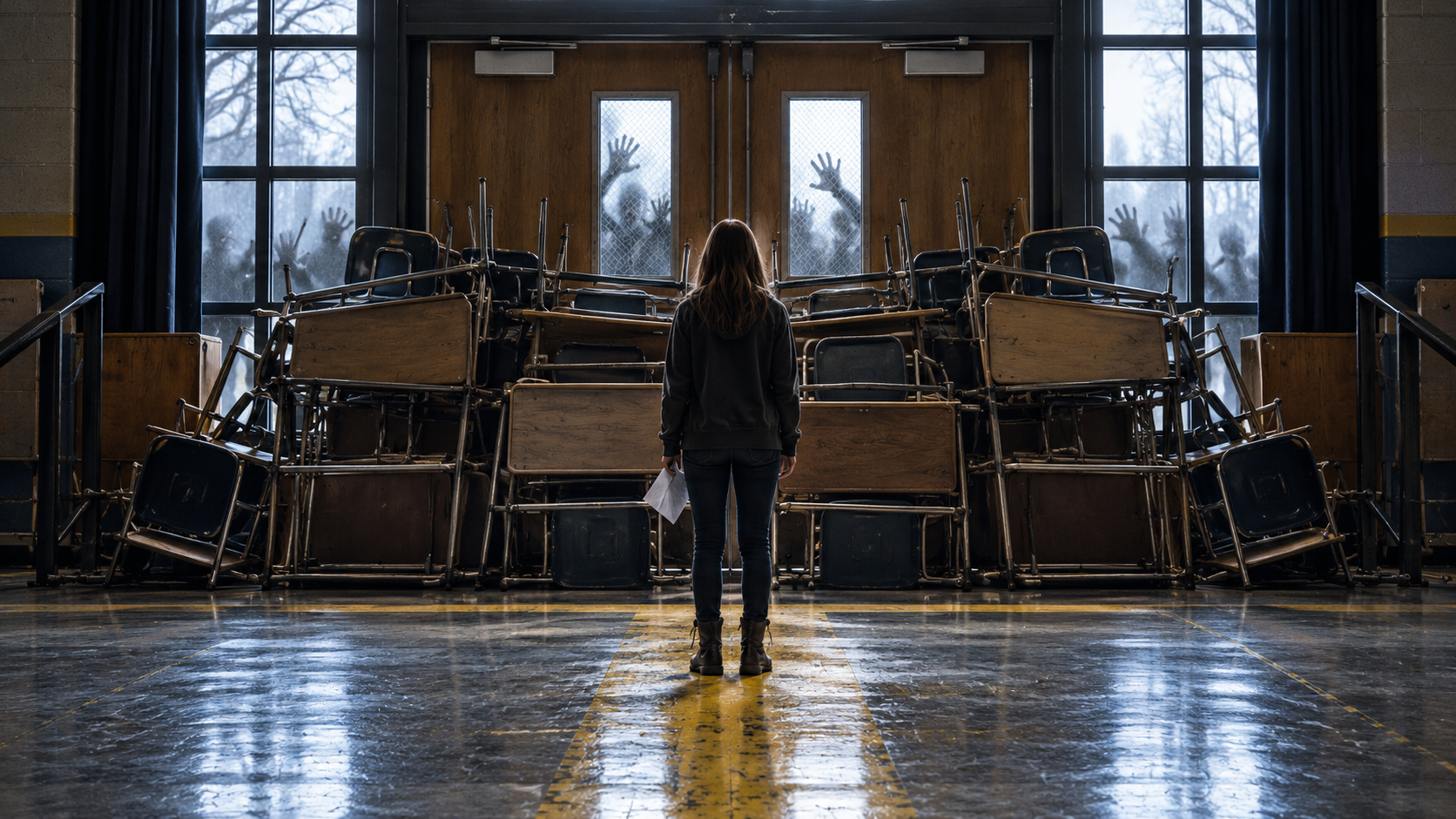
Inside the School Barricade
The World Ends Before Sloane Finds a Reason to Stay
Sloane Price has already lost faith in the life she is living when the dead begin attacking her town. Shelter offers protection from the immediate danger, but it cannot automatically give her the desire to survive. Courtney Summers’ This Is Not a Test places that conflict inside a barricaded high school, where six teenagers must depend on people they do not fully understand. First published in 2012, the novel makes the zombie emergency inseparable from the private histories its survivors bring through the doors. This discussion follows the original novel’s central story and ending, then distinguishes the revised 2026 edition and Adam MacDonald’s screen adaptation. The suspense comes from the danger outside and from the reasons each person has for opening, guarding or abandoning the barricade.
Sloane Arrives With a Crisis the Others Cannot See
Before the outbreak, Sloane lives with an abusive father. Her older sister Lily has left, breaking the expectation that they would escape together. Sloane experiences that departure as the loss of the person who made the household bearable, and she has been thinking about ending her life.
The apocalypse interrupts those thoughts without neatly replacing them. She runs, responds to immediate threats and reaches shelter with other teenagers. Her ability to perform those actions does not prove that the despair underneath them has disappeared.
Summers makes the gap between behaviour and intention central from the beginning. Sloane can look like another survivor while understanding survival differently from the people beside her. They are trying to protect futures that still matter to them. She struggles to imagine a future she wants to reach.
This does not make her detached from every feeling. Her connection to Lily remains intense, and her attention repeatedly returns to what the departure meant. A person can feel numb towards one part of life while experiencing another attachment as overwhelming.
The first-person perspective keeps that contradiction accessible. We hear a mind negotiating an emergency it did not choose while carrying another emergency that was already underway. The zombies make danger public; they do not make the earlier abuse less real or less important.
The premise also resists a familiar shortcut in survival stories. A worse external disaster does not automatically teach someone to appreciate everything they previously had. Sloane’s home was dangerous before the streets became dangerous. Restoring the old world would not, by itself, restore safety to her.
Cortege High Provides Shelter Without a Shared Purpose
The group reaches Cortege High and secures the building. Alongside Sloane are Rhys Moreno, Cary Chen, twins Grace and Trace Casper, and Harrison, the youngest member. Supplies and barricades give them a temporary means of remaining alive, while radio messages offer an uncertain connection to events beyond the school.
Their familiarity is incomplete. They have occupied the same school world, but that does not mean they know one another’s private lives or can predict how each will behave under pressure. The emergency forces intimacy before trust has developed.
Cary takes a leading role because he can organise action. Rhys supports him, while Trace challenges his authority. Grace often tries to reduce conflict, and Harrison’s distress irritates people who want every member to remain useful and composed.
The school changes from a place governed by adult routines into a space where teenagers must decide what rules can survive. Who keeps watch, who takes risks and whose account deserves belief become questions with immediate consequences. Status must be continually produced through decisions rather than inherited from an ordinary timetable.
The building is familiar enough to suggest safety but large enough to resist complete control. Corridors, entrances and rooms create problems of supervision. A barricade secures one route while leaving the group dependent on its understanding of the rest of the site.
Waiting also changes the emotional rhythm. Immediate flight gives people tasks with obvious purposes. Once sheltered, they have time to remember, accuse and imagine. The threat outside remains, but the interval between attacks allows unresolved relationships to become the group’s daily environment.
The title’s emergency announcement captures that condition. It promises seriousness and instruction without guaranteeing rescue. Recognising that the situation is real does not tell the teenagers how long the school can protect them or whether anyone outside is still able to help.
Trace’s Accusation Makes Leadership Unstable
Grace and Trace lost their parents on the way to the school. Trace blames Cary for directing them into danger, and the accusation repeatedly returns during arguments. The person organising the survivors is also the person whose earlier decision may have contributed to an unbearable loss.
That conflict prevents leadership from becoming merely a competition between confidence and aggression. Trace can behave cruelly while having a serious reason to distrust Cary. Cary can possess useful practical skills while carrying responsibility he would prefer the others not to examine.
Grace’s response differs from her brother’s. Their shared bereavement does not produce an identical attitude towards the people around them. Her willingness to connect and mediate frustrates the idea that loyalty to the dead must take one particular emotional form.
For Sloane, the twins’ relationship has another significance. They still possess each other. Watching them means encountering a version of sibling closeness that she no longer has with Lily, even when the relationship is angry or strained.
That perspective can make Sloane’s judgements surprising. She may see value in an attachment whose outward behaviour another observer would find unpleasant. Her attention is shaped by deprivation: the fact of someone staying can become more important than how comfortably they stay.
The group therefore contains several competing accounts of the same interaction. Trace hears a betrayal being dismissed. Cary hears an accusation threatening his ability to keep people alive. Grace seeks a future that does not require endless retaliation. Sloane watches the surviving bond between a brother and sister.
Summers gains tension by allowing those understandings to coexist. A confrontation can be about a practical decision, a dead parent and a missing sister at once. Resolving the immediate disagreement does not automatically resolve the losses feeding it.
Harrison Reveals the Limits of the Group’s Compassion
Harrison’s fear makes him difficult company for people who are frightened themselves. He cries, needs reassurance and does not easily fit the ideal of a competent survivor. The others’ impatience raises a question the group cannot avoid: whether someone must demonstrate usefulness in order to deserve protection.
Grace’s kindness offers a different response. She recognises his distress as something that calls for care, even when caring creates another demand on her. Her behaviour prevents the group’s practical vocabulary from becoming the only available measure of a person.
Harrison and Sloane also expose different relationships to the future. He fears losing the life he has barely had an opportunity to begin. She struggles to imagine why continuing would be worth the pain. Both are vulnerable, but their needs cannot be met by assuming that everyone is frightened in the same way.
The story becomes more troubling when Cary admits that he knowingly directed the group towards danger in the hope of getting rid of Harrison. The twins’ parents died instead. This revelation changes Trace’s accusation from an inconvenient grievance into a response to a genuine betrayal, although Trace does not possess all the information the reader receives.
Cary’s calculation shows how easily the language of collective survival can conceal a private decision about whose life matters. He has treated another person as an expendable obstacle and then continued to occupy a role built on trust.
His subsequent competence cannot undo that act. Equally, the confession does not make every useful decision he has made imaginary. The uncomfortable task is to hold the evidence together: someone can help a group survive while having deliberately endangered one of its members.
Going Outside Changes Sloane’s Calculation
A distressed man outside the school creates a new problem. Trace believes he may be his father and presses for action. Sloane volunteers to investigate, privately seeing the danger as an opportunity to stop surviving rather than an expression of uncomplicated courage.
Rhys goes with her. His presence alters the meaning of the risk because he will not simply leave her behind. What Sloane imagined as a decision concerning her own life now threatens someone who has chosen to help her.
The encounter reveals that the man is not the person Trace hoped to find. As danger closes in, Sloane acts to get herself and Rhys out, injuring the stranger in a way that leaves him exposed to the dead. Their survival carries a cost she cannot reduce to a clean heroic rescue.
The causal change is specific. Rhys does not persuade her that the world is suddenly good. His refusal to abandon her creates an immediate responsibility towards another person. She can still feel despair while recognising that her intended surrender would pull him into it.
That is an important limit on any romantic reading. The episode concerns attachment and consequence, not a cure produced by meeting a boy. Rhys’s involvement changes what one action would do. It does not settle every question about the life that might follow.
His anger when he understands her indifference to survival also complicates the relationship. Caring for someone does not automatically supply the language or patience needed to understand their despair. He has his own fear, and the prospect of losing her reaches him as a personal emergency.
The scene gives Sloane evidence that her actions matter to someone present. Lily remains absent and inaccessible; Rhys is beside her, making decisions in response to what she does. The emotional centre begins to move towards a relationship that exists in the current world.
Baxter Makes the Boundary of Safety Uncertain
The appearance of teacher Mr Baxter inside the school destabilises the group’s understanding of its refuge. An adult has entered a building the teenagers believed they had secured. His presence raises questions about the entrances, his condition and whether his account can be trusted.
Ordinary school authority offers little reassurance. The fact that he is a teacher does not establish that he is safe or truthful. The group must evaluate the person in front of it without relying on the hierarchy that once organised the building.
Their treatment of him also tests the limits of judgement under uncertainty. If they admit someone dangerous, everyone may suffer. If they expel someone who needs help, they may be condemning him without sufficient knowledge. The emergency makes the consequences severe while leaving the evidence incomplete.
This is a particular strength of the school setting. A familiar institution usually comes with rules for who belongs and who makes decisions. Once those rules lose their force, the same doors become ethical problems as well as physical barriers.
The question resembles one of the pressures in The Mist: a refuge must decide how to respond to people and dangers beyond its perimeter. Summers gives that problem the additional strain of Sloane’s private ambivalence. Membership in the group does not mean that each member is pursuing safety with equal conviction.
The later losses and breakdown of the refuge eventually force the story back outside. The school cannot remain a permanent pause in the apocalypse. Sloane must confront what she has been carrying into it, especially the hope that finding Lily could give the new world an intelligible purpose.
Returning Home Cannot Restore the Earlier Promise
The movement away from the school draws Sloane towards her old household. Home contains the history she wants to escape and the possibility of finding the sister she still wants to understand. Returning therefore combines practical danger with an emotional demand the barricades could not resolve.
Lily’s absence has organised Sloane’s thinking throughout the novel. It represents abandonment, but it also preserves the possibility of an explanation. As long as her sister remains missing, Sloane can imagine a future conversation in which the earlier promise might be repaired.
The final discoveries remove that possibility. Lily has died, and the father who dominated their lives is no longer a living parent who can resume the old household. The people around whom Sloane built her fear and expectation cannot provide a future answer.
Lily’s fate also changes the meaning of her departure without resolving every uncertainty around it. The fact that she left does not tell us everything she felt, intended or later attempted. Sloane’s pain remains valid, while her interpretation is necessarily the account of someone who was left behind.
That distinction protects the sister from becoming only a symbol of betrayal. Lily experienced the same violent home. Her escape may be understood within that pressure without pretending it did not devastate Sloane. Compassion for one sister need not require dismissing the other’s suffering.
The confrontation with the father likewise resists a simple revenge resolution. The original novel does not make killing his reanimated body the act that completes Sloane’s recovery. Her problem extends beyond the continued existence of the person who hurt her; she must decide how to inhabit a life after his power has shaped it.
What Does the Original Book’s Ending Mean?
The original ending leaves Sloane and Rhys facing an uncertain future after the losses of the school and the discovery of Lily’s fate. It does not restore the world or guarantee their long-term safety. Its central movement concerns Sloane confronting life beyond the relationship she had made responsible for giving it meaning.
The final encounter with a young infected girl sharpens that movement. The child reaches towards Sloane, and the scene brings the language of hunger and life into direct contact with her own struggle. Something that embodies death still reaches insistently for what she has been unable to value in herself.
That image supports a reading of renewed desire to live, but it should not be expanded into a detailed happy future the novel does not show. The conclusion offers a change in orientation under conditions that remain terrible. Continuing can become possible before safety or confidence becomes available.
Rhys’s presence matters because it provides a relationship outside the closed circuit of Sloane’s father and sister. He cannot replace Lily or erase the abuse. He can be someone with whom a next action, and potentially a next day, becomes imaginable.
The emotional force lies in the scale of that possibility. A conventional apocalypse ending might reveal a cure, a secure settlement or the restoration of government. Summers keeps the resolution close to a person whose earlier crisis would have remained even if those larger problems were solved.
The book’s ambiguity is therefore partly practical. We do not receive a complete account of what happens to the survivors afterwards. It is less useful to treat the final image as a secret code that must prove either permanent recovery or inevitable death. The narrative has made Sloane’s changing relation to survival its main question.
How the Film and the 2026 Edition Differ
Adam MacDonald’s adaptation, released theatrically in 2026 after festival exposure in 2025, preserves Sloane’s central predicament but changes the form and composition of the story. Olivia Holt plays Sloane, and the film places its events in 1998.
The novel’s main shelter group contains six teenagers, including Harrison. The film centres on five and omits him. That alteration removes a character whose fear tests the group’s patience and whose vulnerability is bound up with Cary’s moral failure in the original story.
The screen version also gives Sloane’s confrontation with her father a different shape. It shows her killing his zombified form early, whereas the publisher’s discussion guide for the original novel explicitly asks why she chooses not to kill him. The difference changes when, and through what action, the abusive household loses its immediate physical power.
The film’s closing movement uses Lily’s letter and Sloane’s discarded suicide note to make its emotional direction more explicit. Those objects give the audience a visible gesture of change. They should not be silently inserted into an explanation of the original novel’s final image.
There is a separate publishing distinction. The definitive edition released in January 2026 contains revised and expanded text and brings This Is Not a Test together with the sequel novella Please Remain Calm. Courtney Summers has described the revision as a substantive return to the work, rather than a new cover on an unchanged text.
Please Remain Calm continues the story through Rhys’s perspective. Its events belong to that continuation. A reader reaching the end of the combined volume has therefore read beyond the endpoint discussed here, and a summary should not present the novella’s later developments as though they were always part of the original novel.
The change of perspective also has a clear literary implication. Sloane’s first-person account makes her interior life available while leaving other people partly opaque. Moving to Rhys creates room to see a different experience of their attachment. The existence of that continuation does not remove the original ending’s deliberately restricted horizon.
This Is Not a Test makes survival meaningful through a young woman whose relationship to it cannot be assumed. The barricades protect Sloane’s body while exposing the limits of her earlier hopes, and the ending places her beyond the answer she wanted from Lily. What remains is smaller than certainty but more active than waiting: another person nearby, a changed understanding of the past and a future she has not yet lived.
Sources
This Is Not a Test — Macmillan Academic: original publication information, premise and authorised excerpt.
Courtney Summers Discussion Guides — Macmillan: original-novel character questions and the father comparison.
This Is Not a Test — Kirkus Reviews: original-edition perspective, setting and narrative scope.
February Book Club: This Is Not a Test — CSL Library: major moral choices, Cary’s confession and the original ending.
Afterword — Courtney Summers: the author’s explanation of the 2026 revision.
This Is Not a Test — Girl Friday Productions: definitive-edition scope and inclusion of Please Remain Calm.
This Is Not a Test Movie Review — Common Sense Media: film setting, five-person group and opening events.
This Is Not a Test — One Guy’s Opinion: adaptation and film-story cross-checks.
