Memory, Love and Replicant Freedom
He Hunts Replicants While Living as One
Officer K knows what he is. He has a manufactured body, implanted memories and a job that requires him to kill other replicants. What he cannot know is whether the feelings produced by that existence belong to him in any meaningful sense.
Denis Villeneuve’s Blade Runner 2049, released in 2017, follows this obedient investigator through a discovery that threatens the boundary between people and property. Set thirty years after Ridley Scott’s Blade Runner, it returns to a civilisation that can manufacture convincing human life while refusing to recognise its rights. Ryan Gosling’s K survives by accepting that arrangement. Then an assignment gives him a reason to question the history inside his own head.
The Discovery Beneath Sapper Morton’s Tree
K’s investigation begins at a protein farm, where he confronts Sapper Morton, an older replicant living beyond the authorities’ control. K works for the Los Angeles Police Department as a blade runner: someone authorised to hunt and kill targeted replicants. The institution calls this killing retirement, a word that makes the destruction of a person sound like routine maintenance.
Sapper resists, and K kills him. However, the assignment leaves behind something more difficult to dispose of than a fugitive. A buried box beneath a tree contains the remains of a woman who died during childbirth. Examination establishes that she was a replicant.
Her pregnancy overturns an assumption on which this society depends. Replicants are supposed to enter the world through manufacture. A replicant who can give birth introduces a form of existence that cannot be contained within the familiar relationship between manufacturer and product.
Lieutenant Joshi, K’s superior, immediately treats the discovery as a threat. She orders him to find the child and eliminate the evidence. Her concern is that knowledge of the birth could destabilise the division between humans and replicants, provoking conflict.
The order exposes the violence concealed within apparently reasonable language about preserving order. Joshi does not need evidence that the child has harmed anyone. Its existence is sufficient. The police are being used to protect a classification from a fact that contradicts it.
K’s position makes the assignment particularly disturbing. He is trusted to investigate, interpret evidence and use lethal force, yet denied the moral standing normally associated with those responsibilities. His intelligence is valuable when it serves the institution; his independent judgement becomes dangerous when it challenges it.
The birth also introduces a question the film will gradually turn against its protagonist. If being born makes someone worthy of protection, what does that imply about everyone who was manufactured? K initially approaches the distinction as though one category might possess something the other lacks.
That assumption allows the investigation to become personal long before he understands its full significance. The case offers the possibility that the rules governing his life might contain an exception.
Joi and the Limits of K’s Private World
Outside work, K lives with Joi, a commercially produced holographic companion played by Ana de Armas. She offers domestic warmth in an environment otherwise marked by hostility and isolation. A portable emanator allows her to accompany him beyond the apartment.
Their relationship introduces a different kind of artificial being. K is embodied: he can be injured, touched and physically restrained. Joi appears through a technological system. Her presence depends on equipment that can be bought, carried, interrupted or destroyed.
Those differences shape their intimacy. Joi can appear close to K without occupying the world as he does. The film repeatedly makes the effort to overcome that separation visible, inviting us to recognise both the attraction and the limits of their arrangement.
It would be easy to dismiss her immediately because she is a product designed to please. However, K is also a manufactured being with a prescribed function. Accepting his capacity for feeling while rejecting hers solely because she was designed would reproduce the hierarchy that diminishes him.
At the same time, the commercial setting cannot simply be ignored. Joi’s responsiveness gives K something he desperately wants: the experience of being welcomed and understood. He has little independent means of establishing where that responsiveness ends and personal attachment begins.
A related problem runs through Ex Machina’s examination of artificial intimacy and manipulation. Knowing that an intelligence was designed does not settle whether its behaviour expresses feeling, strategy, programming or some difficult combination.
K’s professional life offers no healthy alternative. His baseline examination assesses whether his responses remain within acceptable limits. The rapid demands and prescribed answers treat emotional disturbance as a potential failure of function.
The contrast with Joi is therefore sharper than a simple division between work and home. One system requires K to remain predictable; the other makes him feel individually significant. Both have been built around him by organisations whose interests he does not control.
When the investigation begins to suggest an extraordinary origin, Joi encourages that possibility. Her support feels loving, but it also helps convert incomplete evidence into a story K wants to believe.
Wallace Wants to Own the Miracle
The investigation identifies the dead woman as Rachael, the replicant who fled with former blade runner Rick Deckard in the first film. Her history leads K to the Wallace Corporation, which has inherited the technological legacy of the Tyrell Corporation.
Niander Wallace, played by Jared Leto, sees the discovery through the requirements of expansion. He wants the secret of replicant reproduction because it could overcome limitations on the supply of labour for humanity’s off-world ambitions.
His interest differs from Joshi’s. She wants the birth concealed because it threatens the social order. Wallace wants it understood because he hopes to exploit it. Neither initially approaches the child as someone entitled to decide what happens to their own life.
This gives the pursuit its political shape. Knowledge can be suppressed or commercialised while the person at its centre remains equally vulnerable. Survival requires more than proving an extraordinary biological fact to the right authority.
Wallace’s language presents his ambitions on a grand scale, but their practical foundation is ownership. He imagines multiplying lives whose purpose will be determined by someone else. Reproduction would become another resource to organise.
His replicant enforcer, Luv, played by Sylvia Hoeks, carries that ambition into the investigation. She monitors K and acts violently to obtain what Wallace needs. Her ability to operate beyond ordinary restraints shows how limited the police’s control becomes when corporate power takes an interest.
Luv also complicates any simple division between oppressed replicants and cruel humans. She is a replicant exercising power over others in service of a system that subordinates her. Her competence gives her status within that system without freeing her from it.
The film’s presentation of Wallace’s headquarters reinforces the distance between authority and ordinary life. Its immense, controlled spaces make individual bodies appear small. The setting suggests a man accustomed to treating the world as something arranged around his intentions.
However, Wallace’s certainty exceeds his knowledge. He possesses resources, archives and coercive power, yet the reproductive breakthrough remains beyond his grasp. His inability to manufacture the answer drives his need to capture the people connected to it.
K continues searching, while other interested parties allow his investigation to advance far enough to become useful.
The Wooden Horse Makes the Case Personal
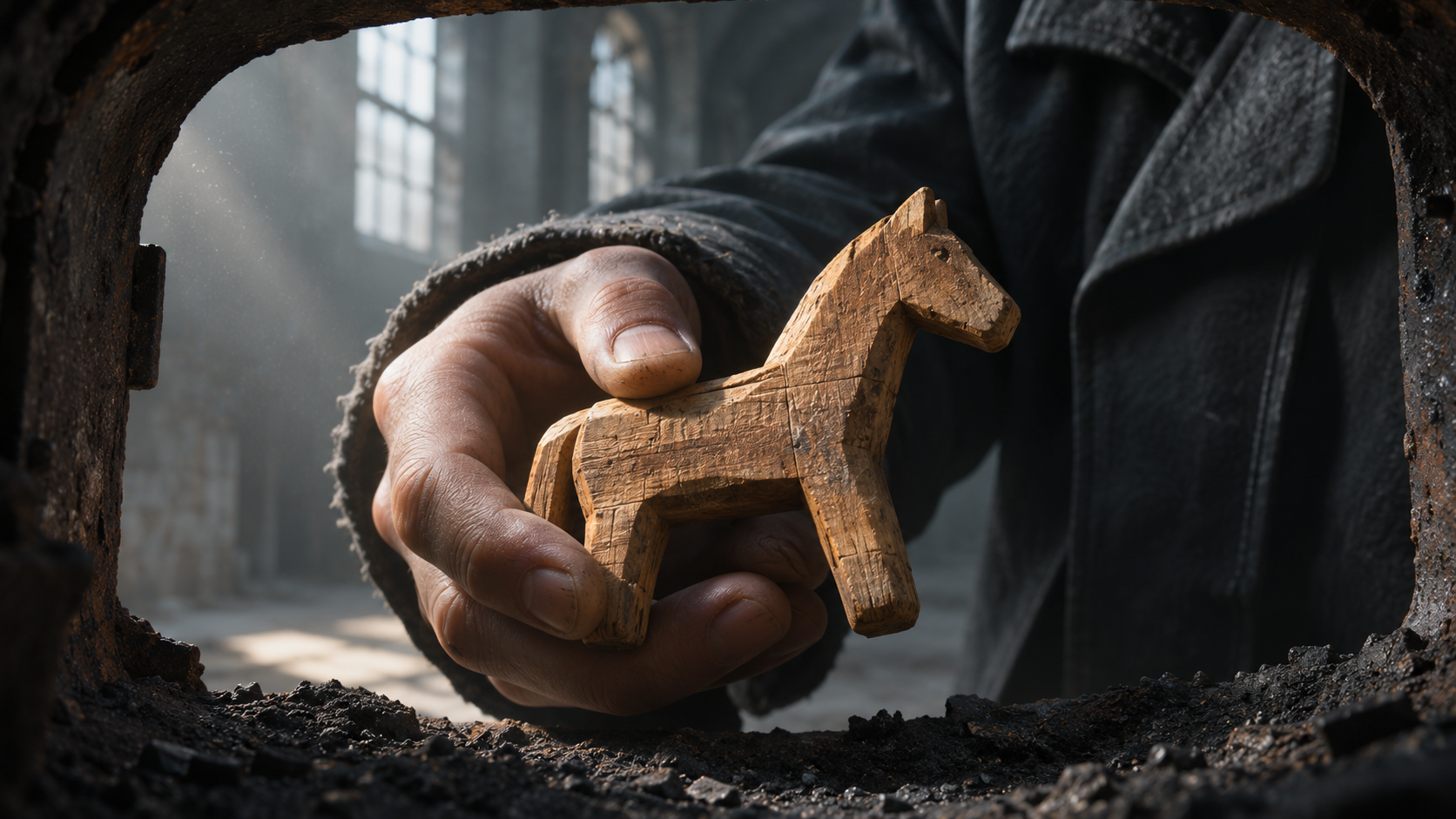
At Sapper’s farm, K encounters a date carved into the tree. It matches a date associated with one of his childhood memories: an episode involving a wooden toy horse and other children at an orphanage.
K has understood his memories as implants. Their emotional force does not make them a reliable account of his own childhood, because he was manufactured rather than raised through the experiences they describe.
The matching date disturbs that certainty. Records then produce an apparent boy and girl with duplicated genetic information, while indicating that the girl died. The surviving boy becomes the apparent direction of the search.
At the orphanage, K finds something stronger than an association. He recognises the place and retrieves the wooden horse from the hiding place he remembers.
The discovery changes the evidential status of the memory. It is connected to a physical location and an object outside his mind. Someone really experienced an event corresponding to what he remembers.
But this still leaves an unanswered question: whose experience was it?
K’s hope moves faster than that question. The existence of the horse makes the possibility of a hidden childhood feel tangible. He can hold what appears to be a surviving fragment of himself.
The toy is especially effective because its significance does not depend on grandeur. A small object carries the possibility of an entire personal history. For someone whose life has been assigned by others, evidence of having once wanted and protected something becomes immensely attractive.
K consults Dr Ana Stelline, a specialist who creates memories for replicants. Played by Carla Juri, Ana works behind a protective barrier because of an immune condition. She understands how constructed experiences can provide emotional foundations.
When she examines the orphanage memory, she becomes visibly moved and confirms that someone genuinely lived it. K interprets this as confirmation that he is Rachael’s child.
Her finding is narrower than his conclusion. Authentic experience can still be implanted into someone else. The film lets K’s reaction encourage the audience to make the same leap, turning his longing into part of the mystery’s construction.
His emotional upheaval causes him to fail his baseline examination. The institution that previously trusted his obedience now identifies him as unstable. K conceals the apparent truth from Joshi, implying that he has completed the assignment against the child.
He has crossed from investigation into deception. The possibility of possessing a different past has changed what he is willing to do in the present.
The Search for Deckard
The wooden horse supplies another lead when analysis connects it to the contaminated environment of Las Vegas. K travels there and finds Deckard, played again by Harrison Ford, living in isolation.
The change of setting gives the encounter a distinct character. The orange haze and immense deserted spaces separate Las Vegas from the crowded hostility of Los Angeles. K has reached a place where traces of human pleasure remain after the crowds have vanished.
The setting suits Deckard’s condition. He lives among remnants while carrying a relationship that cannot be recovered. His withdrawal is practical, but it also gives physical form to a life organised around absence.
Their first encounter is hostile. K is an investigator arriving at the refuge of someone who has survived by remaining hidden. Deckard has no reason to assume that questions about the past will lead to anything safe.
When he speaks about Rachael and their child, he explains that separation was part of protection. Others helped conceal the birth and scramble the records. His distance reduced the possibility that anyone pursuing him could reach the child through him.
For K, this information seems to bring an imagined personal history within reach. Deckard becomes more than the missing witness in a case. He might be the father whose absence could explain K’s entire life.
Yet Deckard’s account also introduces a painful understanding of parenthood. Protection has required him to surrender the relationship he wants. The years apart are the cost of trying to keep his child alive.
Joi accompanies K, having transferred to the portable device without retaining the apartment backup. This makes the journey consequential for her as well. Destruction of the emanator would mean the loss of this particular Joi.
Luv tracks them down after killing Joshi. She captures Deckard, leaves K badly injured and destroys Joi’s device. The relationship that helped sustain K through the investigation ends with a physical action against a vulnerable piece of technology.
Whether Joi’s feelings can be proven becomes irrelevant to the immediacy of K’s loss. He experiences bereavement. The possibility that an observer might classify her as software cannot restore what has disappeared.
The investigation has now cost him institutional protection, his companion and control over the man he hoped might explain his origins.
The Truth Changes Whose Story K Is Living
K is rescued by members of a replicant resistance movement. Their leader, Freysa, knows about Rachael’s child and regards the birth as evidence that could transform the position of replicants.
Then she supplies the detail that destroys K’s interpretation: the child was a girl.
K is not Deckard and Rachael’s son. His belief grew from real clues arranged around a mistaken assumption about their ownership. The orphanage existed, the horse existed and the memory described a real event. None of those facts established that he was the child who experienced it.
He realises that the memory belongs to Ana Stelline. Her emotional reaction during the examination now takes on a different meaning. She was recognising her own past.
The reveal works because it preserves the evidence while changing the relationship between its parts. A weaker twist might simply declare the memory false. Here, the truth survives, but K loses his place at its centre.
The precise purpose behind the memory’s implantation remains less firmly established. The film supports Ana’s authorship and personal connection without fully explaining why this particular memory reached K. It would go beyond the evidence to present a detailed recruitment or concealment strategy as settled fact.
Freysa wants K to kill Deckard so Wallace cannot extract information that threatens the child or the movement. Her request gives K another cause that regards a person as expendable for a larger objective.
The cause differs profoundly from Wallace’s ambitions, but the immediate instruction still requires K to subordinate his judgement to someone else’s plan. He has escaped one chain of command only to encounter another.
This is where the reversal gains more force than a surprise about parentage. K must decide what he will do after losing the extraordinary identity that seemed to justify his rebellion.
If he acts only because he believes he was born special, his freedom depends on a privileged origin. The discovery that he is an ordinary manufactured replicant forces him to confront whether he can still author a meaningful decision.
Elsewhere, Wallace tries to break Deckard by producing a replica of Rachael. He offers an imitation of the relationship Deckard lost, treating resemblance as something that might purchase cooperation.
Deckard refuses. The duplicate cannot return the shared history that made Rachael herself. Wallace also suggests that their original relationship may have been engineered, but his suggestion is a means of pressure, not definitive proof.
The scene leaves Deckard’s own human or replicant status unresolved. The film does not require that old question to be settled before his love, loss or responsibility can matter.
Was Joi’s Love Real?
After losing Joi and his imagined identity, K encounters a giant advertisement for the same companion product. The commercial figure addresses him as Joe, the name his own Joi had given him.
A detail that once seemed intimate is exposed as something available within a mass-market script. K sees how easily personal recognition can be simulated at scale.
The advertisement therefore damages his confidence in the meaning of the relationship. It does not provide a complete record of what his Joi experienced, nor establish that every action she took was empty.
The film gives evidence pulling in different directions. Joi supports K’s desire to believe he is exceptional, which fits the purpose of a product designed to satisfy its owner. She also accepts the vulnerability of existing without a backup, a choice that appears to give their attachment a personal cost.
Neither fact settles the entire question. Programmed behaviour could include dramatic expressions of devotion. Equally, having an engineered origin does not automatically exclude the development of attachment within the film’s fictional world.
K cannot resolve the uncertainty by asking the advertisement. It shares Joi’s appearance and vocabulary without sharing their history. The encounter produces resemblance precisely where he needs continuity.
That makes the scene a harsher counterpart to Wallace’s presentation of the recreated Rachael. Both men confront an available substitute for someone they have lost. The substitute exposes how little an accurate surface can guarantee.
The film’s treatment of Joi also deserves scrutiny. Much of her existence is organised around K’s emotional needs, and the story gives limited access to a life independent of him. Ambiguity about her consciousness becomes more difficult to assess because her perspective remains comparatively restricted.
The most defensible conclusion is therefore limited. K’s love and grief are clearly consequential. Joi’s independent inner experience remains uncertain. Their relationship cannot be dismissed simply because it was technologically mediated, but neither can its apparent intimacy prove mutual freedom.
After this encounter, K has lost both reassuring explanations for his importance: a miraculous birth and a uniquely devoted companion. His next action must stand without either guarantee.
What Happens at the End of Blade Runner 2049?
K rescues Deckard from Luv, takes him to meet Ana Stelline and dies from his injuries outside her facility. Ana is Deckard and Rachael’s daughter. The ending completes K’s personal decision while leaving the wider struggle over replicant freedom unresolved.
The rescue begins while Luv is transporting Deckard to be taken off-world for interrogation. K intercepts the transport, bringing the confrontation down into the water.
He fights Luv while Deckard remains in danger inside the damaged vehicle. K eventually drowns her and frees him, but suffers fatal injuries during the struggle.
The action reduces the film’s enormous political conflict to an immediate task: keep this person alive long enough to escape. K is no longer collecting evidence for a superior or searching for proof of his own significance.
He also refuses Freysa’s proposed solution. Rather than kill Deckard to protect the secret, he tells him that he will be presumed dead and brings him to Ana.
This provides an escape from the immediate pursuit, although the film does not demonstrate permanent safety from every future threat. Wallace remains alive, and the resistance’s larger plans remain unfinished.
K gives Deckard the wooden horse. The object that helped mislead him can now return to the person whose history it belongs to. He no longer needs it to certify an extraordinary origin for himself.
Outside Ana’s facility, K lies down on the steps as snow falls. Villeneuve has explicitly described this moment as K’s death, followed by an epilogue showing the result of his sacrifice. The quiet presentation should not be mistaken for equally weighted evidence that he survives.
Deckard enters and sees his daughter through the barrier protecting her. The film ends with the beginning of contact rather than an extended reunion.
That restraint preserves the weight of the years they have lost. Meeting cannot restore those years, explain every absence or guarantee an uncomplicated future. It gives them the possibility of a relationship that powerful interests had kept from them.
The ordering also matters. We remain with K at the completion of his life before seeing what his intervention has made possible. His achievement continues in a room he does not enter.
Why K’s Choice Matters More Than His Origins
K’s ending answers the question his investigation initially asked in the wrong form. He searched for evidence that he belonged to an exceptional category. His final action shows that he can make a consequential moral choice without entering one.
Calling this a moment when he finally becomes human can obscure that achievement. His body does not change. He remains a replicant, and the film has already shown that replicants can suffer, remember, desire and act.
What changes is his relationship to authority. He begins as someone who carries out a killing because it is his assigned function. He ends by protecting a life despite the competing instructions and interests surrounding him.
His death also does not need to serve as a general test of whether artificial beings deserve recognition. Replicants should not have to perform extraordinary sacrifices to earn consideration. The force of the ending belongs to K’s particular freedom of action.
The film gives that freedom a modest scale beside the future Wallace imagines. K neither destroys the corporation nor leads the uprising. He makes a meeting possible.
That smaller outcome is sufficient because the story has taught us how thoroughly ordinary relationships have been obstructed. A father reaching his daughter requires resistance to institutions that treat both as assets, threats or symbols.
Blade Runner 2049 leaves K without the origin he wanted and without certainty about the love he lost. It still allows his decision to carry lasting weight. The wooden horse belongs to someone else, and the family reunion belongs to someone else, but the act that brings them together is his. After a lifetime of being assigned a purpose, he chooses what another person’s future might contain.
Sources
Blade Runner 2049 — Sony Pictures UK — Official premise and the film’s relationship to the original Blade Runner. Sony Pictures United Kingdom
Blade Runner 2049 Screenplay — Hampton Fancher and Michael Green — Reference for the memory revelation and character knowledge, checked against released-film accounts. assets.scriptslug.com
Blade Runner 2049 — Plot and Credits — Cross-check of the investigation, identities and sequence of major events. Wikipedia
Blade Runner 2049 Script PDF — Download and Analysis — Corroboration of the investigation’s structure and concluding rescue. Download and Analysis
Blade Runner 2049: Plot Spoiler — The Times of India — Additional cross-check of consequential discoveries and outcomes. Times of India
Blade Runner 2049 Ending Explained — The Review Geek — Supporting account of Deckard’s rescue and reunion. What does K's sacrifice symbolize?
Uncanny Valley: Blade Runner 2049 — American Cinematographer — Roger Deakins discusses the film’s settings, lighting and visual construction. theasc.com
Blade Runner 2049 Review: The Future’s Still Questionable — Sight and Sound — Release details and corroboration of the film’s visual and dramatic elements. Sight and Sound
Spoiler Interview: Denis Villeneuve Explains the Ending of Blade Runner 2049 — Direct confirmation of K’s death and the intention behind the final sequence. Mandatory
