The Suspects, the Dinner and the Final Twist
A Holiday Sale Leaves an Entire Town Exposed
A bargain should not cost someone their life. In Thanksgiving, a disastrous shopping event leaves a Massachusetts town with deaths it cannot properly account for and survivors who cannot agree on where responsibility begins. When the holiday returns, someone decides that the people connected to the tragedy must answer for it personally.
Directed by Eli Roth and written by Jeff Rendell, the 2023 American horror film combines a masked-killer mystery with a deliberately grotesque attack on seasonal consumption. Its central character, Jessica Wright, belongs to the family whose business sits at the centre of the disaster. That connection gives her access to information, but also makes her vulnerable. Finding out who is behind the mask requires her to question both the people she distrusts and the people offering protection.
Spoiler warning: the following summary discusses the plot, major twists and ending.
The Black Friday Riot Creates the Suspects
The opening disaster takes place at RightMart in Plymouth, Massachusetts. Thomas Wright owns the store, and his daughter Jessica lets her boyfriend Bobby and their friends inside before the waiting customers can enter. Their privileged access aggravates an already volatile crowd. Once the entrance gives way, the rush for discounted goods becomes a crush in which people are injured and killed.
Among the dead is Amanda Collins, the wife of store manager Mitch. Bobby suffers an injury that damages his prospects as a baseball pitcher. The sequence gives the later mystery several different kinds of loss: bereavement, physical harm, a disrupted future and the knowledge of having participated in something that became catastrophic.
Crucially, the riot has no single masked figure directing it. The disaster grows out of overlapping decisions. Commercial pressure brings people together, inadequate control leaves them exposed, and individuals make the situation worse through aggression, panic or indifference. That structure makes responsibility harder to isolate than it will appear once a killer begins choosing targets.
Jessica’s involvement is uncomfortable because it is ordinary. Entering her father’s shop with friends is a casual exercise of privilege, not a deliberate plan to hurt anyone. Yet the consequences are much larger than the intention. The film establishes a gap between causing harm knowingly and being connected to a chain of events that produces it.
That gap becomes the mystery’s moral problem. A person can regret what happened without having committed murder. Someone can behave appallingly without deserving execution. Once the later attacks begin, the audience has to resist accepting the killer’s target list as a reliable judgement of everyone on it.
The opening also gives the town something public to remember. This is not an obscure crime that only a handful of people know about. A community has witnessed a disaster associated with a familiar business and a familiar holiday. Its failure to find an adequate response creates room for competing versions of what happened.
A Year Later, the Holiday Returns Without Closure
RightMart prepares for another Black Friday sale the following year. Mitch protests, while Jessica has begun a relationship with Ryan after becoming estranged from Bobby. Bobby’s return introduces tension into a group whose shared past has never been settled. The calendar moves forward more easily than the people affected by the riot.
Holding another sale makes commercial recovery visible before emotional recovery. From the business’s perspective, the holiday remains an opportunity. For someone who lost a loved one, the same preparations can look like evidence that the death has been absorbed into the cost of doing business. The film does not need a lengthy corporate conspiracy to make that difference intelligible.
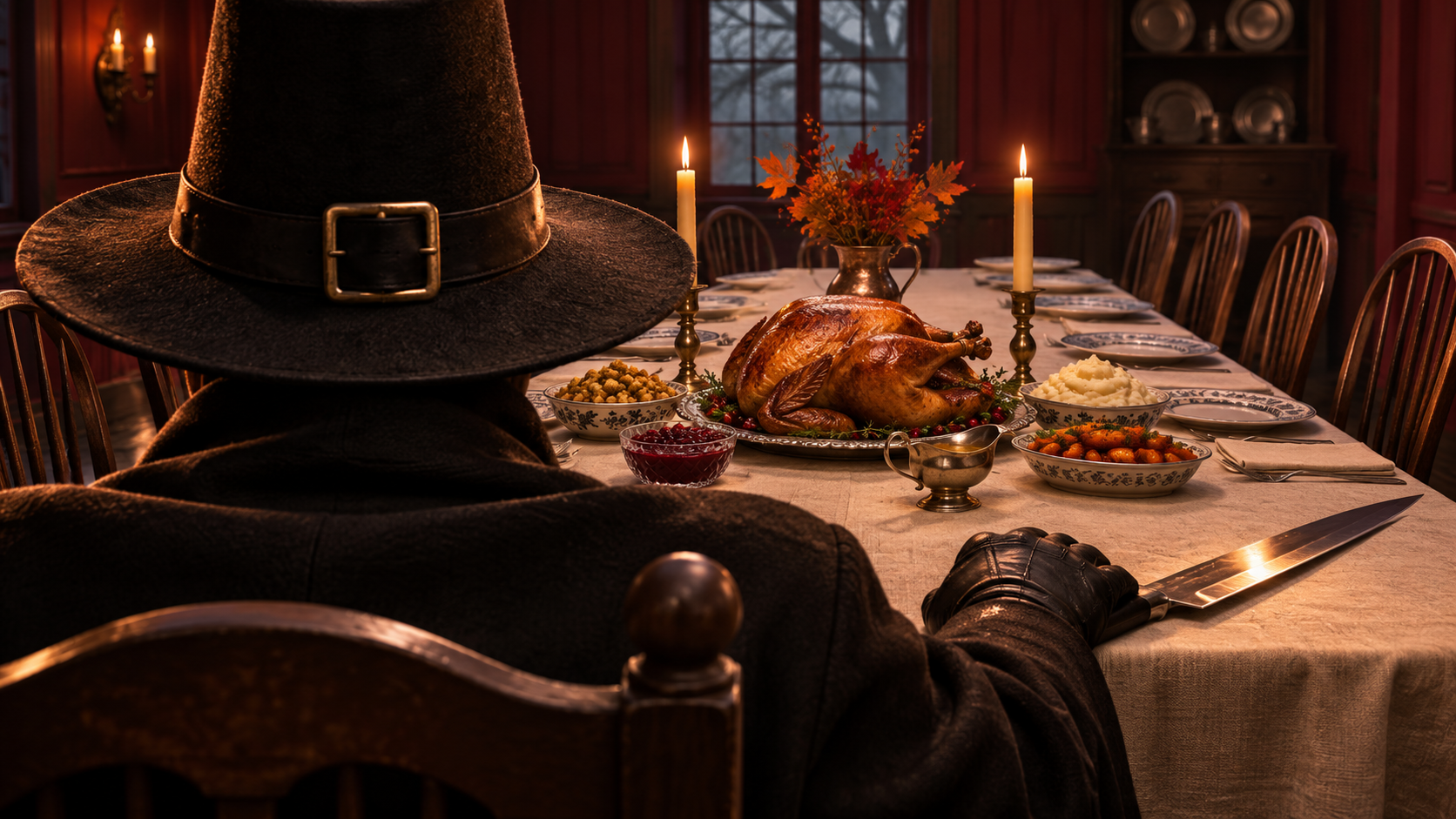
Then Jessica and her friends are tagged in social-media posts from an account using the name John Carver. A Thanksgiving table becomes an image of anticipated punishment. Their names turn an otherwise familiar arrangement into a threat directed at particular people.
The tags are an effective device because they make avoidance difficult. A private warning could be concealed or dismissed. A public invitation allows others to see who has been selected, while leaving the selected people uncertain about how much the sender knows. The killer begins organising their behaviour before physically bringing them together.
There is also a cruel inversion in the invitation itself. A place at a holiday table normally promises inclusion. Here, inclusion means that someone has decided you belong among the guilty. The victims have no opportunity to challenge the reasoning behind their assigned seats.
The first murder of this new cycle concerns Lizzie, a waitress involved in the earlier riot. Her death and the display of her remains at RightMart connect the current violence to the business. The attacks are no longer merely disturbing messages. Someone is using the town’s unresolved disaster to organise a new one.
The Evidence Connects the Victims Before the Killer
Sheriff Eric Newlon investigates, and Jessica supplies recovered security footage from the riot. That material offers a way to examine conduct more carefully than public memory or gossip allows. People who were simply described as present can now be connected to specific actions.
Providing the footage is an important choice for Jessica. Her family has a direct interest in the reputation of the store, yet she helps expose what happened there. She begins moving away from the protection afforded by her surname and towards a more uncomfortable account of the event.
The film thereby gives her something active to do before the final chase. She is not only waiting for a suspect to make a mistake. She changes the information available to the investigation, even though doing so may implicate people close to her. Her position inside the family becomes useful for reasons her family would not necessarily welcome.
Further attacks reinforce the connection to the sale. Manny, a security guard who abandoned his post during the disaster, becomes a victim, as do Lonnie and Amy. The pattern suggests that the killer is selecting people according to their involvement in the earlier chaos.
However, identifying a pattern is different from identifying its author. Knowing that the murders concern RightMart does not tell Jessica which grieving, angry or compromised person has taken revenge. The same evidence can narrow the motive while leaving several suspects plausible.
This is the central trick of the investigation. The film supplies a strong explanation for why someone might want retaliation before disclosing whose loss is driving it. Viewers can feel that they understand the case while still missing the relationship that will explain the killer’s personal investment.
The distinction also keeps the footage from becoming a magic solution. A recording can show what somebody did within its frame. It cannot automatically reveal a secret attachment, a later decision or the identity of someone wearing a mask. Jessica needs to connect different kinds of evidence rather than treating one recording as the whole truth.
Why Bobby, Mitch and Ryan Attract Suspicion
Bobby looks suspicious because his return coincides with the renewed threat and because the riot damaged his future. His absence has also left gaps in Jessica’s knowledge. Someone she once knew intimately has become a person whose recent life she cannot confidently explain.
That makes him a useful red herring: a suspect whose circumstances encourage an inference the ending will overturn. The audience can construct a motive from his injury, but a credible motive is not proof that he has acted on it. The film exploits the ease with which resentment can be mistaken for criminal intent.
Mitch has a more publicly visible grievance. Amanda’s death gives his anger an obvious cause, and his protests place that anger in front of the town. He seems to fit the broad outline of someone who cannot accept the community’s return to business as usual.
Yet public anger has an ambiguity of its own. A person protesting openly may be trying to make others acknowledge something they would prefer to avoid. Treating that visibility as proof of hidden violence would mean that the person most clearly expressing grief automatically becomes the easiest person to blame.
Ryan introduces a different uncertainty. Jessica’s current boyfriend has a connection to the riot footage that requires explanation, and his relationship with her puts him in competition with Bobby. His presence allows the film to mix romantic distrust with the practical search for a murderer.
These suspicions work best when kept separate. Bobby’s damaged future, Mitch’s bereavement and Ryan’s questionable behaviour are different pieces of information. They do not become equally strong simply because the film places them within the same mystery. Each invites a story, but the ending must still supply evidence that selects one story over another.
Meanwhile, Jessica continues working with the sheriff. His institutional role makes him the person to whom uncertainties are reported. The investigation therefore depends on an assumption about trust that feels routine enough to escape the scrutiny directed at the more conspicuous suspects.
Attempts at Protection Fail
The threat moves closer to Jessica’s immediate circle when Evan and Gaby are abducted. Jessica escapes an attack, but the disappearance of her friends changes the urgency of the investigation. Understanding the motive will be of limited comfort if the killer can keep reaching people while the police work towards an answer.
Yulia’s father tries to remove his daughter from danger by arranging to leave. The plan fails when Carver reaches their home. Jessica and Scuba, Yulia’s boyfriend, attempt to help, but they cannot prevent her murder.
Yulia’s death breaks the reassuring possibility that recognising the danger early enough guarantees survival. Her household takes protective action; her friends respond. The outcome is still terrible. This makes the threat harder to contain within a comforting rule such as staying alert, trusting friends or leaving town.
For Scuba, the crime also turns the investigation into an immediate personal loss. Before this, the anniversary links the group to a previous disaster. Now the killer is producing fresh grief among people who are already trying to survive its consequences. Revenge has acquired victims whose suffering generates no repair for the original harm.
The authorities then attempt to draw Carver out during the Thanksgiving parade, using members of the threatened group as bait. The plan assumes that a public event under observation can make the attacker easier to expose. Instead, the crowded setting gives him another opportunity to turn collective activity into confusion.
Using a different disguise, Carver attacks a mascot and deploys smoke, then abducts Jessica, her father Thomas, her stepmother Kathleen and Scuba. The proposed trap becomes a means of gathering the people he wants.
The parade echoes the opening without merely repeating it. At RightMart, disorder emerges from the crowd’s behaviour. Here, a murderer deliberately creates disorder and uses it as cover. The film has moved from a disaster with distributed responsibility to violence with a controlling author.
The Thanksgiving Dinner Reveals the Plan
The captives are brought into the meal promised by Carver’s messages. Kathleen is killed in an oven and her body is presented as the centrepiece. The surviving hostages are arranged around the table, and Evan is murdered during a livestream.
The dinner makes the killer’s conception of punishment unmistakable. He wants more than the removal of particular people. He wants a scene that others will witness, remember and associate with his chosen account of the earlier tragedy. The hostages become both victims and unwilling participants in that account.
Kathleen’s treatment is the most literal expression of the film’s consumption imagery. A person connected to the retail family is transformed into something presented for consumption. The grotesque joke depends on making the metaphor physical, which is why the scene belongs to the film’s exaggerated slasher world rather than a realistic account of revenge.
Its ugliness also exposes the limits of Carver’s claim to moral authority. Whatever failures preceded the riot, this performance requires him to reduce people to objects and force others to watch. His certainty about guilt allows him to ignore the humanity he claims the town failed to respect.
Jessica creates an opportunity to escape by using a sharp ring to cut her restraints, then passes it to Scuba. Their cooperation disrupts the arrangement. Rather than remaining isolated in the roles Carver has assigned, they share a practical means of resistance.
That small object is important because the killer’s apparent control depends partly on the captives having no useful choices. Once one person can act and help another, the dinner stops being a completely fixed performance. Jessica escapes and draws Carver after her, away from the others.
The pursuit takes her through woodland towards a building used for parade materials. There she encounters Newlon apparently incapacitated and sees Bobby in circumstances that seem to connect him to the killer. The story appears to be arranging its solution around the suspect whose injury and absence have already made him easy to fear.
What Happens at the End of Thanksgiving?
Sheriff Eric Newlon is John Carver. Jessica recognises the connection when she notices woodland debris on his clothing and footwear matching what caught on her during the chase. Newlon admits that Amanda was his lover and was pregnant with his child when she died. He has been targeting those he holds responsible for that loss.
The clue works because it contradicts the role he is performing in the immediate situation. He appears to belong outside Jessica’s pursuit, as someone she can turn to afterwards. The material caught on him instead links him to the route she has just taken with the killer behind her.
By itself, woodland debris would be circumstantial evidence. Within the scene, its significance is completed by Newlon’s admission. Jessica’s observation exposes the deception, and his response supplies the identity and motive. The film does not require the audience to treat a few burrs as a complete forensic case.
His relationship with Amanda explains the missing personal connection. Mitch’s bereavement was visible; Newlon’s was concealed by the affair. The mystery has encouraged attention towards the public husband while withholding the sheriff’s private stake in the same death.
Bobby has been framed. Newlon abducted and drugged him, using the Carver costume to make the innocent man appear responsible. This turns Bobby’s suspicious circumstances into evidence of manipulation. The sheriff has exploited a believable suspect rather than discovered the correct one.
Jessica counters him by livestreaming his confession. The technology he used to stage punishment now carries evidence against him beyond the room. Killing or intimidating a single witness can no longer restore the secrecy he expected to control.
Bobby intervenes as Newlon attacks, and he and Jessica try to escape in a vehicle. When their exit is obstructed, Jessica uses a gun to trigger an explosion involving a giant turkey balloon and its gas supply. Newlon is engulfed in flames. The holiday spectacle that provided his imagery becomes the means of stopping him.
Jessica survives, as do Bobby, Ryan, Gaby, Scuba and Thomas. Newlon’s body is not recovered, although the authorities believe the explosion killed him. Afterwards, Jessica has a nightmare in which a burning Newlon attacks her. The final attack belongs to that nightmare; it is not a confirmed physical return.
His fate therefore remains open in a limited, specific way. The absence of a recovered body allows doubt, but doubt is not evidence of survival. Likewise, a frightening figure among the emergency responders does not establish that Newlon has escaped in disguise. The film resolves who committed the murders while declining to provide complete reassurance about what follows.
What the Clues and Final Nightmare Mean
The reveal changes how the earlier investigation reads. Newlon’s access to information, his place within the police response and Jessica’s willingness to confide in him all become advantages available to the killer. Authority has helped him occupy the position from which everyone else’s behaviour is assessed.
That is a stronger explanation than treating his disguise as the whole deception. The mask conceals him during attacks, but his professional identity protects him between them. Jessica must eventually examine the investigator with the same scepticism she applies to the suspects.
There is a related problem of trust in the apparent protection offered in 10 Cloverfield Lane: practical help and authority do not automatically establish a person’s motives. Thanksgiving gives that question a different shape by placing its protagonist within an official investigation rather than an isolated shelter.
The revelation does not prove that every awkward transition or apparent logistical difficulty conceals a second murderer. The film identifies Newlon and supplies no confirmed accomplice. A viewer can find his movements implausibly convenient without converting that criticism into an additional character the story has established.
Nor does his grief make his judgement reliable. His targets include people with different levels of responsibility, and his campaign creates new bereavements while claiming to answer an old one. The affair explains the intensity of his motive; it does not validate the boundaries of his blame.
The nightmare then shifts attention from his explanation to Jessica’s experience. She has obtained an answer and survived the confrontation, yet her sleeping mind does not treat the threat as finished. The burning figure carries the image of his apparent destruction into a place where she should be able to rest.
This is distinct from the guilt explored in The Ritual, where a previous death shapes the protagonist’s experience of a new danger. Jessica’s final fear concerns whether the danger she has just escaped can ever feel securely past. Both stories make survival an experience with an aftermath rather than a clean reset.
Roth developed the feature from the fake Thanksgiving trailer included in Grindhouse in 2007. In interviews, he has described the importance of combining the holiday slasher with Black Friday excess. The completed story makes that combination work through competing spectacles: a sale, a parade, a staged meal and finally a public confession.
Thanksgiving ends with Jessica taking control of evidence that the killer expected to control himself. Her survival depends on observation, cooperation and getting the truth beyond his reach. The last nightmare preserves the cost of that achievement. She knows whose face was behind the mask, but knowledge alone cannot make every familiar room feel safe again.
Sources
Thanksgiving — Sony Pictures: official film identity, credits and premise. Sony Pictures Entertainment
Thanksgiving — The Movie Spoiler: plot corroboration, captivity and climax. The Movie Spoiler
Thanksgiving (2023) Ending Explained: What Happens at the Parade? — High on Films: investigation, killer reveal and aftermath. High On Films
Thanksgiving (2023 Film) — Wikipedia: additional cross-check of characters, credits and plot. Wikipedia
Eli Roth on the Importance of Original Horror and Evolving His Grindhouse Trailer — Bloody Disgusting: filmmaker discussion of the concept and Black Friday. bloody-disgusting.com
A Thanksgiving Interview with Eli Roth — Dread Central: the holiday-slasher approach and balance between horror and entertainment. dreadcentral.com
