Trust, Money and the Getaway
The Getaway Is Where the Plan Falls Apart
A bank robbery needs cooperation long after the money leaves the building. The people inside the getaway car must agree on where to go, what to hide and how much they can trust one another. In Collision Course, that agreement begins to collapse before the thieves have escaped the immediate danger.
Released on Netflix in 2026, Daniel Sánchez Arévalo’s Spanish thriller, also known as Colisión, places its robbery in Madrid during the economic crisis of 2013. A valuable target promises an escape from financial trouble, but the participants bring competing expectations to the same operation. When their flight from the bank ends in a collision, the immediate question is survival. The harder question is what survival will allow them to discover.
Spoiler warning: the following summary discusses the plot, major twists and ending.
A Robbery with an Unexpected Advantage
The operation begins with an apparently vulnerable visitor. Pedro approaches bank manager Ernesto before opening time, presenting a lottery-related reason for being admitted. Once he is inside, the opportunity opens for his accomplices. The encounter becomes a robbery, and the thieves seek access to the safety deposit boxes.
Their particular interest is box 34, where they expect to find diamonds. Pedro handles that part of the operation, but reports that the expected treasure is missing. The group leaves with other valuables, carrying away a problem as well as a haul: someone must explain why the central promise of the robbery has failed.
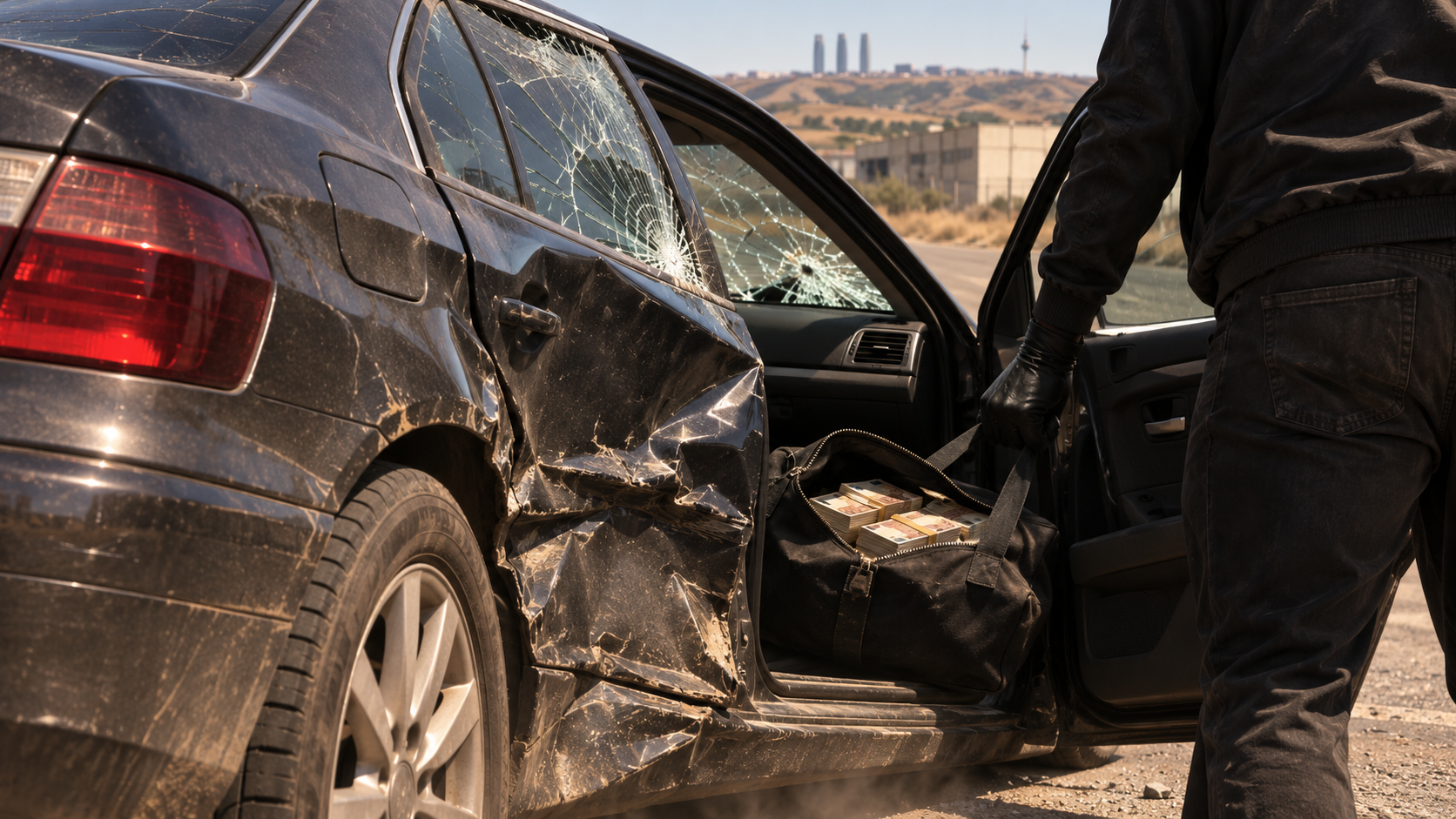
In the getaway car, Tomás suspects that Pedro has kept the stones. The argument distracts Raúl, who is driving, and another vehicle strikes them. Their disagreement has therefore become dangerous before anyone can establish whether the accusation is true.
The film then reveals the unusual protection surrounding the gang. Pedro is a retired police officer; the younger participants also have connections to police work. Carla can operate within the investigation, while Tomás has forensic expertise. Raúl is Pedro’s son, making their partnership more complicated than an arrangement between interchangeable professionals.
Their advantage depends on influencing what happens after the crime. Knowing how evidence is collected may allow a robber to anticipate an investigation, but participating in that investigation offers something more immediate: opportunities to redirect attention and interfere with the trail.
That also makes their position precarious. They must keep performing legitimate professional roles while concealing their involvement. Every personal connection between them can become useful to an investigator once one member is identified. The network that helps them coordinate the robbery can become a map of the suspects.
The First Outcome Tests Raúl’s Loyalty
In the first version of the crash’s aftermath, Pedro dies. The survivors burn the vehicle and leave, attempting to destroy evidence along with the body. Raúl has escaped the collision, but his father has become part of the material the others need to erase.
The attempted destruction does not make Pedro unidentifiable. Investigators trace him through a numbered medical implant. This is a particularly effective obstacle for a group relying on procedural knowledge: a damaged body can still contain a record connecting it to a person.
Ernesto also emerges as an accomplice. His apparent position as the bank robbery’s victim has concealed his participation in arranging it. The gang’s reach therefore extends across both sides of the crime, into the institution being robbed and the institution investigating the robbery.
Raúl’s response undermines that carefully distributed advantage. He wants the stolen money and moves towards abandoning the arrangement. A confrontation involving Tomás and Ernesto ends with Raúl killing Tomás and fleeing.
The sequence exposes a conflict that no division of the proceeds can easily settle. To the operation, Pedro’s death is a problem requiring containment. To Raúl, it is the death of his father. Asking him to maintain discipline means asking him to accept the others’ priorities at the point when those priorities feel least tolerable.
His violence is still his own action. Grief explains why the group’s calculations cease to persuade him; it does not remove responsibility for killing Tomás. The branch turns a supposedly manageable loss into an additional crime, making the consequences of the collision expand through a surviving character’s choices.
The Second Outcome Changes What Can Be Destroyed
The film returns to the crash and changes its victim. This time Raúl dies, leaving Pedro to face the decision previously imposed on his son. Pedro refuses to let the car be burned with Raúl inside because he wants Raúl’s mother to be able to say goodbye.
The refusal changes the investigation’s starting point. An identifiable body gives the police a much clearer route into the gang. Pedro’s relationship with Raúl becomes an obvious connection to examine, and the survivors have less room to shape the account of what happened.
This branch also confirms that Pedro’s claim about the deposit box was false. He has taken the stones and concealed that decision from his accomplices. Later, he attempts to hide them in his son’s coffin.
That action brings two incompatible uses of the same space together. A coffin belongs to the family’s attempt to acknowledge a death, yet Pedro treats it as somewhere to protect stolen property. His attachment to his son and his determination to retain the haul coexist without becoming morally consistent.
The investigation uncovers another hidden relationship: Carla and Raúl have been having an affair, despite Carla’s marriage to Tomás. Carla and Tomás are ultimately arrested as the connections surrounding the robbery become harder to conceal.
The reversal between these first two branches is revealing. Father and son can both participate in a plan that requires other people to behave ruthlessly. Neither can reliably accept that ruthlessness when it is directed towards the person he loves. Their professional knowledge remains available, but the emotional price of following its logic has changed.
This is why switching the casualty produces more than a different name on a death certificate. It changes who has the strongest reason to resist the agreed procedure, and therefore which evidence survives.
Carla’s Branch Turns Suspicion into Violence
The next return to the collision places Carla among the dead. Tomás survives to face questioning by investigator Luis, played by Lluís Homar. The interrogation connects the criminal inquiry to a part of Tomás’s life he cannot keep at a professional distance.
Luis tells him that Carla was pregnant. The possibility that she had concealed an affair, and that the child might not have been his, transforms the conversation. Tomás’s attention shifts towards Raúl and the relationship Carla had hidden.
When confronted, Raúl acknowledges the affair and the intention to leave together. He also says that he cannot have children. Tomás does not accept that explanation and shoots him. Pedro subsequently confronts Tomás, who kills him too before escaping with the money.
The pregnancy requires careful interpretation. It is information that destabilises Tomás, not permission for the audience to treat his immediate conclusion about paternity as an established fact. The confirmed affair and the identity of a child’s father are related questions, but they are not automatically the same question.
Tomás’s forensic role makes his response especially pointed. His work is associated with interpreting evidence, yet here his emotional certainty outruns what the available information proves. Someone can possess investigative skills and still reject a distinction that threatens the explanation he wants to believe.
Carla’s absence also shapes the branch. The people left behind argue over her relationship and intentions without allowing her any further opportunity to speak. Her death does not simplify their competing claims about her; it makes those claims impossible to resolve through a conversation with her.
By this stage, the film has exposed several kinds of betrayal without making them equivalent. Concealing money, concealing an affair and killing another person are different acts with different consequences. The shared atmosphere of dishonesty does not make everyone equally responsible for the violence Tomás chooses.
Tomás’s Branch Lets the Money Tell Its Story
When the crash is replayed with Tomás as its victim, the survivors manage to hold their operation together for longer. Pedro, Carla and Raúl avoid the immediate collapse seen in the previous branches. After roughly two months, the stolen proceeds can be divided.
For Carla and Raúl, the prospect of leaving together now looks more attainable. Pedro, meanwhile, attempts to turn his secretly retained stones into usable wealth. That practical step produces the discovery that changes the scale of the story: the supposed diamonds are imitations.
Until this point, the argument has largely concerned who took the valuable objects. The appraisal reveals that the participants have been fighting over an assumption about value. Possession of the stones never guaranteed possession of the fortune they imagined.
Pedro must approach the others with information that exposes his own dishonesty. He cannot explain the discovery without revealing that he had something to have examined. Seeking help therefore requires surrendering the version of the robbery he previously asked them to believe.
The resulting investigation leads towards an insurance arrangement involving the owner of the deposit box. The genuine stones had been removed before the robbery. The apparent theft makes it possible to claim compensation while the real valuables remain outside the robbers’ reach.
This does not mean that nothing was stolen or that every consequence of the heist was staged. The other valuables are real, and the violence remains real. The deception concerns what the gang thought it was obtaining and the larger transaction its actions helped make credible.
The branch earns its additional length by changing the problem. The survivors have enough time to discover that avoiding arrest and understanding the operation are separate achievements. They can perform their assigned part competently while remaining ignorant of why somebody else needed them to perform it.
Ernesto and Lola Reveal Another Layer of the Deal
Ernesto’s involvement extends beyond providing information about the bank. He is connected to the arrangement surrounding the genuine diamonds and the insurance claim. The people who entered the building with the greatest physical exposure did not possess the fullest account of the plan.
Lola, the café worker associated with Ernesto, also has a hidden role. She is his lover and participates in the movement of the stones. Her connection to him is complicated by resentment over the bank’s treatment of her brother.
The pursuit reaches the airport, where Carla and Raúl attempt to secure a better outcome after discovering the deception. Ernesto persuades them to settle for the proceeds they already have rather than continue pursuing the diamonds and increase their exposure.
Lola, meanwhile, attempts to leave separately with what she believes are the genuine stones. Ernesto has anticipated the possibility of betrayal: the stones she carries are also false, while he retains the real diamonds. Luis catches Carla and Raúl as their attempt to escape comes apart.
Within this branch, Ernesto is the person who keeps the authentic treasure. That result should be attached to this particular sequence of events rather than treated as something the film subsequently confirms for every possible future.
His advantage can be understood as control over who knows what. Pedro knows that he has concealed stones, but not that they are worthless. Lola knows that she intends to break with Ernesto, but not that he has already altered the value of what she carries.
The scheme turns partial knowledge into misplaced confidence. Each person can feel ahead of somebody else while still operating inside an arrangement that another participant understands more completely. The airport brings those unequal positions into the same space without giving everyone an equal opportunity to correct them.
Why the Film Keeps Returning to the Crash
The repeated collision introduces alternative outcomes. Pedro, Raúl, Carla and Tomás do not die successively in one continuous history, and the film does not require a character to travel backwards through time to resurrect them.
The simplest way to follow the structure is to distinguish the shared past from the changing aftermath. The robbery and the relationships surrounding it provide a common starting point. Each branch alters who survives the crash and then explores the consequences.
Crucially, the audience retains knowledge when the story restarts. The characters do not acquire memories of the versions we have just watched. We can recognise a danger that remains hidden from a person experiencing only the present branch.
This creates an unusual form of suspense. A familiar exchange can become more troubling because the viewer now understands a relationship or concealed interest behind it. The uncertainty concerns how existing pressures will develop under changed circumstances.
There is a related interest in controlled disclosure in The Prestige’s use of misdirection. Collision Course, however, asks us to organise mutually exclusive outcomes as well as reconsider information. Remembering a revelation is useful only if we also remember which consequences belong to which branch.
The structure has a cost. A death can feel less final once viewers recognise that another reset may follow. Emotional investment may shift away from mourning a character and towards predicting the next rearrangement. That is a limitation worth acknowledging rather than treating complexity itself as an achievement.
The strongest use of the device comes when the changed casualty produces a specific behavioural consequence. Pedro’s refusal to burn Raúl’s body provides that connection clearly: a different survivor makes a different decision, and the investigation receives different evidence.
What Happens at the End of Collision Course?
In the final version of the collision, all four robbers survive. They burn the damaged car and escape together in another vehicle. The film ends without showing a complete investigation, a final division of the proceeds or a confirmed later fate for this version of the group.
Carla and Raúl exchange a smile in the back seat. At the front, Tomás complains about an unpleasant smell: Pedro stepped in dog mess during the robbery. Pedro’s response turns the detail into a closing joke, but the audience has already learned why the trace can matter.
The ending therefore gives the group an immediate escape while preserving the conditions that made the earlier branches dangerous. Survival has changed. The existing secrets have not been shown to disappear.
It is reasonable to regard this as the film’s final scenario. It is less secure to claim that the film conclusively labels it the only real history and reduces everything else to somebody’s dream. No such explanation is needed to understand the structure presented.
Equally, the earlier airport sequence does not establish that Carla and Raúl must be arrested after this final escape. Those arrests belong to the branch that develops after Tomás’s death. Carrying them into the last version would erase the distinction on which the film depends.
The final scene’s unease comes from the gap between relief and knowledge. The characters have survived a terrible interruption and can resume their journey. The viewer knows reasons to doubt the stability of the arrangement they are resuming.
That is the answer to the apparent contradiction in the ending: everyone can survive the crash without the robbery becoming a demonstrated success. The film closes at an earlier stage of the consequences than several of the alternatives it has already explored.
Why the Financial Setting Matters
The 2013 setting gives the robbery a context of financial pressure and anger towards banking institutions. A haul can appear to promise recovery, independence or a way out of a life shaped by debt. Those expectations make the contents of the deposit box more than an attractive criminal prize.
The later insurance revelation adds a sharper imbalance. The people taking the visible risks have an incomplete understanding of the transaction, while those with access to the financial arrangements can benefit from an event presented as their loss.
One reading is that the heist reproduces the inequality its participants hope to escape. Carrying out the dangerous work does not guarantee control of its rewards. The ability to decide what an asset is, where it sits and how its disappearance is recorded proves more valuable than simply carrying it away.
The police connections complicate any easy division between institutions and outsiders. These robbers are also using privileged access for personal advantage. Financial grievance can explain why the opportunity appeals without turning their conduct into a public remedy.
The film’s darker joke is that almost everyone imagines a private exception: a hidden share, a concealed relationship, a separate departure. A collective operation is repeatedly made to serve an undisclosed individual plan.
Collision Course ends with that fragile collective still travelling together. The accident has spared them, but it has not made them honest or given them the knowledge the audience possesses. Its final escape remains provisional because a successful getaway only removes the group from the scene of the robbery. It leaves them in the company of the people, promises and hidden bargains that made the journey dangerous in the first place.
Sources
Netflix: Collision Course — official premise and cast. Netflix Official Site
Netflix: “Collision Course,” the New Film by Daniel Sánchez Arévalo, Premieres on Netflix on 30 October — release, director and writing credits. About Netflix
JustWatch: Final explicado de ‘Colisión’: las cinco versiones del atraco y quién se queda con los diamantes — the separate branches, relationship revelations and airport sequence. guides.justwatch.com
Moviedelic: Collision Course Ending, Explained: What Actually Happens After the Robbery? — robbery mechanics and the insurance arrangement. Its speculative identification of an unnamed accomplice is not adopted here. moviedelic.com
Abandomoviez: Final explicado de «Colisión» de Netflix — corroboration of the crash variations and unresolved final scenario. Abandomoviez.net
El Comercio: Final explicado de “Colisión” — character identities, airport outcome and final scene. Predictions beyond the closing scene remain interpretations. EL COMERCIO PERÚ
Pop Creep: Collision Course 2026 Movie Recap Ending Explained — supplementary cross-check of the separate outcomes. Pop Creep
Espinof: Colisión review — independent criticism of structure and pacing. espinof.com
HobbyConsolas: Crítica de Colisión — premise, financial setting and narrative organisation. hobbyconsolas.com
Otros Cines: Crítica de “Colisión” — independent review and production credits. otroscines.com
