How Jigsaw Turns Cooperation into a Trap
Two Strangers, One Room and a Deadline to Kill
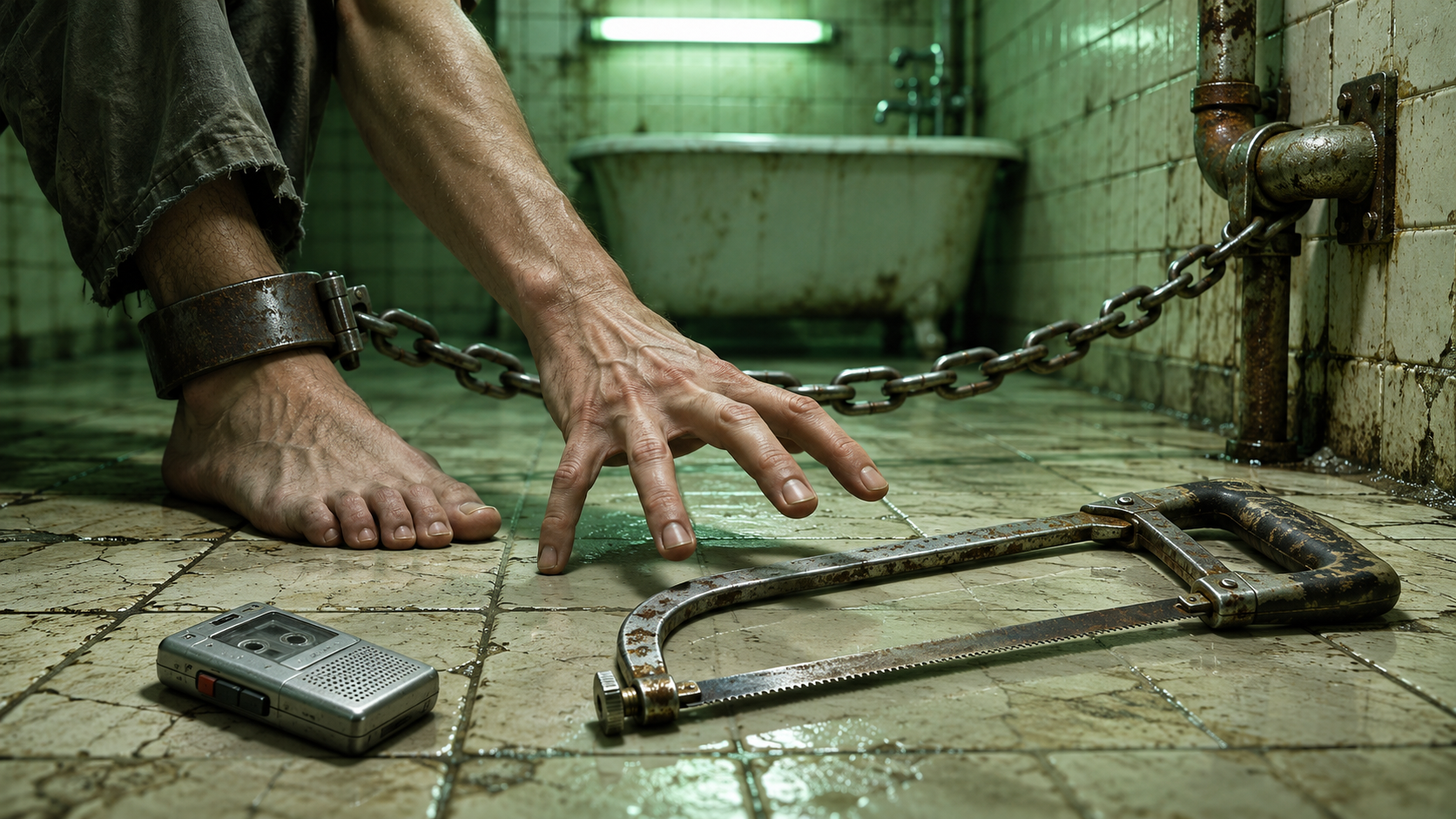
Two men wake in a filthy bathroom, chained far enough apart that neither can easily reach the other. Between them lies a bloodied body. They have no clear memory of arriving, no obvious route out and very different reasons to fear what happens next. In James Wan’s Saw, the 2004 horror thriller written by Leigh Whannell, escape begins as a problem of understanding: which objects are useful, which instructions can be trusted, and what does the person controlling the room actually want?
The situation becomes worse when survival stops looking like a shared objective. One prisoner receives a demand that turns the other into a target. Every attempt to cooperate must now contend with the possibility that helping the man opposite could make it easier for him to kill.
The Instructions Turn Cooperation into a Risk
Adam, played by Leigh Whannell, wakes submerged in a bath and struggles out as the water drains. Across the room is Dr Lawrence Gordon, played by Cary Elwes. Their ankle restraints limit what they can reach, making the space between them a practical obstacle as well as a source of fear.
The apparent corpse holds a gun and a cassette recorder. Recorded messages address the prisoners individually. Adam is challenged to act if he wants to survive. Gordon receives a more explicit instruction: kill Adam by six o’clock, or his wife Alison and daughter Diana will die. Gordon will also be left imprisoned.
The difference between those instructions immediately destabilises their relationship. Adam needs Gordon’s knowledge and composure, but Gordon has been given a reason to destroy him. Gordon needs Adam’s cooperation to examine the room, even while considering the threat against his family. Neither can safely assume that their common predicament produces common interests.
That makes conversation part of the trap. Sharing a discovery can help both men, but it can also give one an advantage. Withholding information may offer temporary protection while making the other person more suspicious. The captor has created circumstances in which sensible individual precautions obstruct collective escape.
A clue leads to two hacksaws concealed in the toilet cistern. They try the chains, without success, and Adam breaks his saw. Gordon recognises the more horrifying purpose of the tools: the blades are intended for their feet.
The title acquires its force through this change in function. A saw initially promises a straightforward solution to a mechanical problem. Once that possibility fails, the same object demands a decision about bodily sacrifice. The tool has not changed; the prisoners’ understanding of the available escape has.
Gordon believes the arrangement resembles the work of the Jigsaw killer. His familiarity needs explaining, especially to a man who has just learned that this doctor may be required to murder him. The film moves into the earlier investigation, opening the room’s mystery onto a history of other victims.
Earlier Victims Establish the Killer’s Method
Detectives David Tapp and Steven Sing investigate deaths involving recorded instructions and elaborate physical ordeals. One victim, Paul, has been trapped among razor wire. Another, Mark, faces a poisoned body, a hidden safe combination and a candle that becomes dangerous because he is covered in a flammable substance.
These cases establish the cruelty behind Jigsaw’s idea of a test. He takes some judgement about a person’s life and converts it into a compulsory physical ordeal. The victim must operate inside the explanation already chosen for them. There is no opportunity to dispute the accusation or refuse the lesson.
Paul’s case is especially revealing because the killer treats self-harm as something he can interpret and punish. Nothing about that judgement should be accepted as an authoritative account of Paul’s suffering. Jigsaw’s confidence tells us about his willingness to claim ownership over another person’s experience.
The traps also make apparently useful objects dangerous. A source of light can ignite the person carrying it. Movement towards an exit can deepen an injury. This prepares the audience to distrust the ordinary relationship between a problem and its solution: understanding how an object works does not mean using it is safe.
Gordon becomes involved when his penlight is found at a crime scene. Although his alibi clears him, the connection gives him access to information about the investigation. His knowledge in the bathroom therefore has an explanation that does not require him to be the killer.
The hospital material also introduces an important contrast in his behaviour. Gordon can discuss grave illness with professional detachment, while orderly Zep Hindle speaks of a patient named John as a person worth noticing. At this stage, the scene establishes a difference between clinical description and personal attention, without supplying a complete explanation for the crime.
Professional calm has value when someone must make difficult decisions. Yet inside the bathroom, Gordon’s controlled manner can also look evasive or cold. The same quality that makes him a useful partner gives Adam reasons to wonder how far his sympathy extends.
Amanda’s Survival Complicates the Promise of Escape
Amanda Young, played by Shawnee Smith, is the investigation’s crucial surviving witness. She describes waking with a device fixed around her jaws. A recording tells her that the key to removing it is inside another person’s stomach. The person presented as dead is actually alive but incapacitated.
Amanda kills him to retrieve the key and removes the device before it opens. Her survival demonstrates that a Jigsaw trap can be escaped. Her subsequent belief that the ordeal helped her gives the killer’s doctrine an unsettling voice beyond his own recordings.
However, the other captive prevents this from functioning as a simple success story. Amanda’s opportunity depends on someone else becoming the means of her escape. His experience receives no equivalent promise of improvement. A system advertised through its survivor can conceal the person whose death made that survival possible.
The sequence also creates a specific expectation for Gordon’s predicament. A prisoner may have to injure or kill another person because the killer has made that action appear necessary. Survival can therefore leave someone carrying responsibility for violence they would never have contemplated outside captivity.
Amanda’s testimony does not establish that such violence cures addiction or repairs a life. It establishes how she understands what happened to her at this point in the story. Keeping those claims separate allows the film to remain disturbing without granting Jigsaw the authority he claims for himself.
Her survival changes the bathroom’s prospects in another way. If every previous victim had died, the instructions could be dismissed as an elaborate prelude to execution. A survivor makes cooperation with the rules appear potentially useful. Hope becomes one of the mechanisms keeping the prisoners engaged.
That tension has a useful counterpart in 10 Cloverfield Lane, where a captive must assess claims about survival made by the person controlling her surroundings. In Saw, the evidence that escape is possible encourages participation without establishing that the terms are honest.
The Police Investigation Becomes a Private Obsession
Tapp and Sing locate Jigsaw’s workshop through clues in a recording. Their attempt to apprehend him becomes entangled with rescuing another captive. Jigsaw injures Tapp’s throat and escapes, while Sing is killed by a shotgun trap.
The encounter changes the investigation’s emotional centre. Tapp survives with both a physical injury and the loss of his partner. After leaving the police, he continues pursuing the case and remains convinced that Gordon is involved. He watches Gordon’s home despite the earlier alibi.
Tapp’s persistence offers the audience a possible route to rescue, but his certainty also creates a limitation. He is looking in a relevant place while working from an unreliable explanation of why it matters. The film can therefore bring help close to the victims without making that help straightforward.
This is more interesting than a detective simply overlooking an obvious clue. Tapp has encountered genuine danger, identified a real pattern and suffered a devastating consequence. Those experiences give his commitment weight, while making it harder for him to relinquish the suspect around whom his investigation has settled.
Meanwhile, Alison and Diana are being held hostage in their home. Their captor monitors the bathroom through surveillance equipment. The threat in Gordon’s recording is therefore real, and the film allows the audience to see evidence that Gordon himself cannot access.
The movement between these spaces changes the suspense. Inside the bathroom, events are interpreted through clues and messages. At the house, a mother and child face an immediate human threat. Outside, Tapp watches without possessing a complete understanding of either situation.
Each location contains part of the explanation. Nobody trying to stop the crime can yet connect those parts reliably. Physical distance is only one barrier; the more consequential separation lies in what each person knows.
A Failed Deception Exposes the Limits of the Game
Back in the bathroom, a concealed box provides cigarettes, a lighter and a mobile phone that can receive calls but cannot make them. A message suggests using blood from the apparent corpse to poison a cigarette and kill Adam.
Instead, the men attempt a deception. Adam pretends to die after smoking, hoping their observer will accept that Gordon has complied. An electric shock through his restraint exposes the performance and establishes that the person controlling the game can intervene directly.
Their plan matters because they are trying to exploit the distinction between a rule and its verification. If Gordon only needs to appear to have killed Adam, the demand might be satisfied without a murder. The shock closes that loophole and makes the body itself a source of evidence against the performance.
The telephone provides another carefully limited opportunity. Gordon can hear from his family, but he cannot use the device to summon independent help. Communication reaches him through conditions established by his captor. The phone increases his emotional exposure while leaving his practical freedom almost unchanged.
Alison warns Gordon that Adam knows more about him than he has admitted. Adam then reveals that he was paid to photograph Gordon. His employer was Tapp, and the photographs document Gordon’s secret visits to a woman named Carla.
The disclosure changes the relationship without making Adam responsible for the kidnapping. He has concealed a connection, but concealment and authorship of the trap are different things. Gordon must decide whether the lie makes all of Adam’s behaviour suspect or whether their immediate dependence still offers grounds for cooperation.
Adam’s occupation also gives his recording a more particular meaning. He earns money watching other people while remaining outside the encounters he records. The bathroom forces him into an event he cannot observe from a safe distance. That connection explains the killer’s accusation without making photography a justification for punishment.
For Gordon, the photographs collapse the boundary between his respectable public identity and his private conduct. His family’s danger makes that concealed life painfully immediate. Nevertheless, his marital failures do not explain away the violence directed at Alison and Diana, who have been made instruments in somebody else’s supposed moral lesson.
The Deadline Breaks the Connection Between Action and Knowledge
Among Adam’s photographs is an image of Zep inside Gordon’s home. Gordon recognises the hospital orderly, connecting a familiar person with the hostage situation. The mystery now appears to have an identifiable human centre.
At the house, Alison frees herself and fights back against Zep. Tapp intervenes, and Alison and Diana escape the immediate threat. Zep flees towards the location of the bathroom, pursued by Tapp, whom he shoots during their confrontation.
Gordon does not possess that complete account. He hears violence through the telephone and loses the ability to establish what has happened. The audience can recognise the terrible gap between his family’s actual situation and the catastrophe he believes may be unfolding.
This gap drives the climax more effectively than a simple countdown. A deadline usually creates suspense by asking whether an action can be completed in time. Here, Gordon is also acting on information that has become incomplete at the moment it matters most. Additional urgency makes his interpretation less reliable.
Desperate to reach his family, he cuts off his foot, freeing himself from the restraint. He then takes the gun from the apparent corpse and shoots Adam. The injury and shooting fulfil the violence the room has been designed to make imaginable.
There is no need to assume that shooting Adam is a carefully agreed plan. Gordon’s distress, his fear for his family and his attempt to satisfy the demand explain the act. Adam’s subsequent survival does not retrospectively prove that Gordon knew the shot would be non-fatal.
The doctor’s profession makes his bodily sacrifice particularly grim. He understands that he is creating another emergency while trying to escape the existing one. Freedom from the chain will not make him safe; it will begin a race to obtain treatment before blood loss kills him.
Alison’s resistance also deserves to remain visible within this account. She is more than the reason Gordon panics. Her own action helps prevent the threatened murders, even as the interruption of communication stops that progress from reaching him. The tragedy lies partly in effective resistance occurring in one place while desperation produces further harm in another.
What Happens at the End of Saw?
Adam survives Gordon’s gunshot and kills Zep when he enters the bathroom to kill Gordon. Gordon crawls away to seek help. Searching Zep’s body, Adam discovers a recording revealing that Zep was himself being coerced. Then the apparently dead man on the floor rises: he is John, the cancer patient, and the real Jigsaw killer.
Zep’s recording explains that he has been poisoned and must carry out instructions to obtain an antidote. His role in the crime is real, but his apparent position as its mastermind is false. Killing him removes an immediate attacker without dismantling the arrangement controlling the room.
This revelation revises the structure of responsibility. Zep has terrorised Gordon’s family while facing a threat to his own life. That coercion explains his participation without turning the people he threatens into acceptable casualties. Jigsaw has distributed the violence among captives whose interests he deliberately places in conflict.
John’s emergence supplies the final change in perspective. The central body has been treated as evidence of an earlier death, an object to work around and a possible source of tools. It is now revealed as the person whose agency the prisoners have been trying to locate elsewhere.
John tells Adam that the key to his restraint was in the bath. The film returns to the opening, revealing that it went down the drain as Adam woke and the water emptied. The potential means of release disappeared before he understood the situation.
Adam attempts to shoot John using Zep’s gun, but John shocks him through the chain. He then leaves, shuts the bathroom door and abandons Adam in darkness. The final declaration, “Game over”, belongs to the person who retains control of the exit.
The original film leaves Gordon’s eventual fate unresolved. He is alive when he crawls away, severely injured and promising to find help. Saw does not show him reaching safety or returning. Adam is also alive at the closing moment, although his abandonment plainly implies a fatal outcome without rescue.
Later films add information, but that information should not be inserted into the first film’s ending as though it has already been revealed. Within this story, the decisive outcome is Jigsaw’s escape and Adam’s continuing imprisonment. Identifying the culprit has not delivered the practical means to survive him.
Why the Twist Works—and What Its Rules Cannot Explain
The ending exploits a distinction between noticing something and continuing to question it. The body is conspicuous from the start. Once the prisoners and audience accept it as dead, however, attention moves towards messages, hidden objects and people who appear capable of acting.
That is why the reveal can feel both surprising and connected to the original premise. The film does not need to introduce a stranger at the last moment. It changes the category of a presence already built into our understanding of the room.
Zep strengthens that misdirection because he supplies a convincing explanation before the final one. He has access to the family, monitors the prisoners and arrives armed. Those facts establish participation. The mistake is treating participation as proof that no authority exists behind him.
The lost key introduces a less comfortable question. Adam’s message does not provide the same precise deadline-and-action bargain that Gordon receives. Staying alive until six is therefore not explicitly presented as an automatic guarantee of release. Equally, the film gives little reason to regard his opportunity as fair when the key disappears during his confused awakening.
The first film does not fully explain the placement of that key or establish an equitable alternative after its loss. Treating every uncertainty as proof of an ingenious, perfectly fair design would repair the villain’s argument on the film’s behalf. The contradiction is worth preserving: Jigsaw claims to test choices while controlling whether meaningful choices remain available.
John’s terminal illness makes the relationship between time and power especially pointed. His own future is restricted, yet he gives other people even narrower deadlines. He cannot remove mortality from his life, but he can determine how urgently somebody else experiences it.
That interpretation explains the relationship between his condition and his methods without suggesting that illness naturally produces cruelty. The relevant act is his decision to turn other people’s lives into demonstrations of his beliefs. His suffering does not confer permission to set the value of theirs.
There is a related misuse of promised transformation in The Invitation: reassuring language becomes dangerous when the speaker assumes the right to decide what another person needs. Saw makes that claim brutally concrete through restraints, instructions and a locked door.
The original Saw ends with knowledge arriving too late to function as escape. Adam understands who has controlled the ordeal, but understanding cannot unlock his chain or compel mercy. The final horror comes from that separation. A mystery has been solved while a person remains trapped inside it, and the man who calls the experience a lesson walks away without having to answer for what his lesson has done.
Sources
BFI — Saw (2004): film identity and principal creative credits. BFI
Wikipedia — Saw (film): cross-check of the principal narrative, characters and final revelations. Wikipedia
Filmsite — Saw (2004): trap details and illustrated descriptions of key sequences. Its inference that Gordon dies after leaving is not treated here as an established event. filmsite.org
Horror Guys — Saw (2004): corroboration of the bathroom discoveries, surveillance and attempted deception. Horror Guys
The Cinemaholic — Saw 1 Ending, Explained: comparison of the investigation, hostage crisis and ending. John Kramer Ending Scene - Cinemaholic
