Forrest Gump (1994) Summary
A clear, plot-first summary of Forrest Gump (1994): how momentum, love, war, and chance shape Forrest’s life
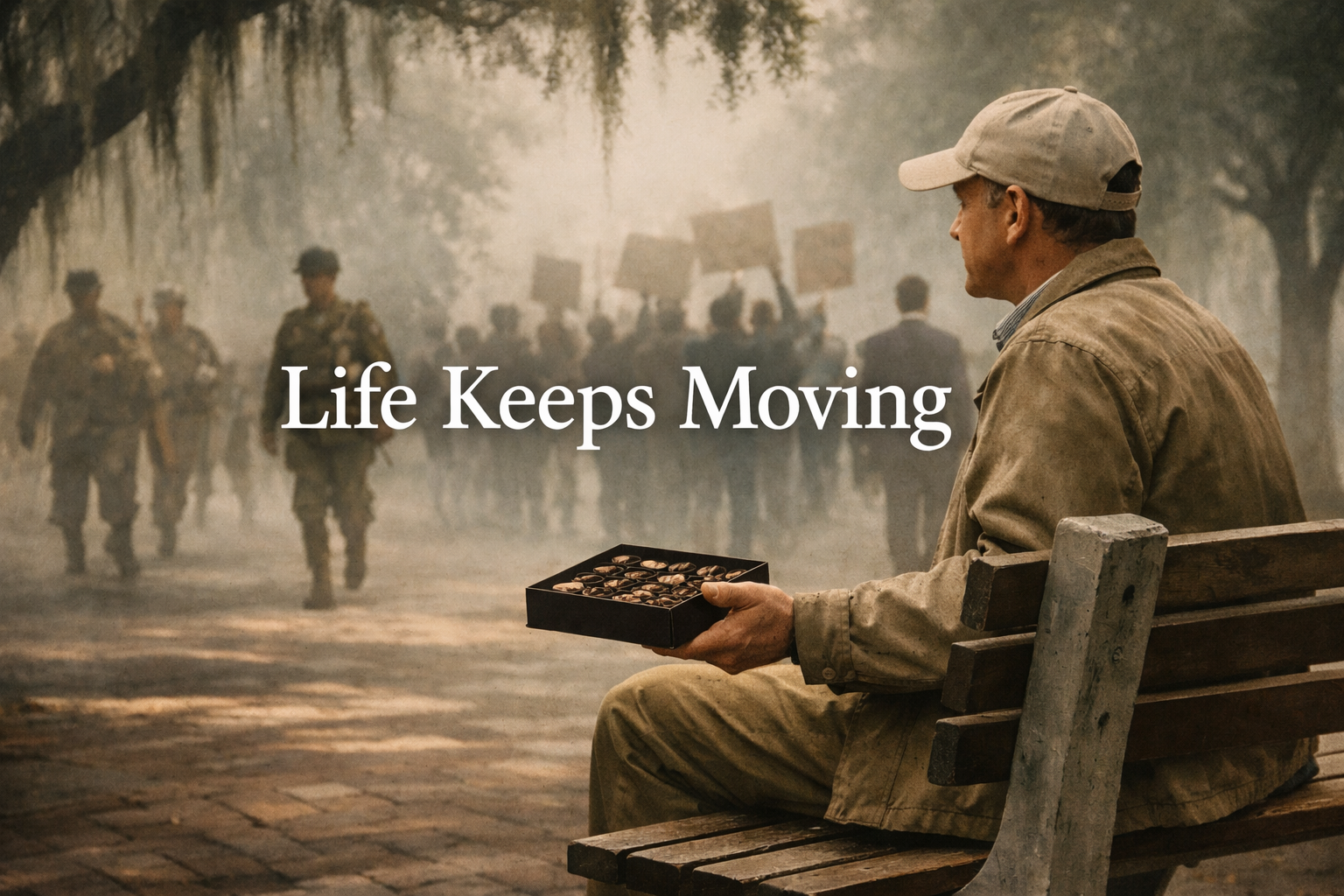
A man sits on a bench in Savannah, offering chocolates to strangers. He speaks plainly, like he’s reporting the weather. But what spills out is an entire American era—war, fame, money, protest, grief—seen through someone who keeps moving when everyone else gets stuck.
Forrest Gump isn’t a mystery. It’s a momentum film: one life colliding with history and one love story refusing to disappear.
Key Points
The frame is a confession, not a lecture. Forrest tells his life story on a public bench, turning private memory into a simple, linear chain.
The plot is powered by one fixed desire. Forrest wants closeness with Jenny, even when life keeps pushing them into different worlds.
Success happens as a side effect, not a goal. Forrest excels by doing what’s in front of him—running, serving, practising—without chasing status.
History is background noise to a personal story. Big national moments pass through the film, but the emotional stakes stay intimate and local.
War creates two different survivors. Forrest returns with a story; Lt. Dan returns with a wound that changes his entire relationship with life.
The film keeps testing one question. If someone loves you, what do you owe them: protection, honesty, distance, or simply presence?
The Film’s Plot Engine
Forrest is a man with a low IQ who moves through several decades of American life, repeatedly ending up in situations that most people spend their lives trying to reach—or trying to avoid. He doesn’t strategise his way into them. He stumbles into them, then outlasts everyone around him.
The central tension is not “Will Forrest succeed?” He often does. The tension is whether the one relationship he cares about—Jenny—can survive the distance between their lives: his literal-minded steadiness versus her hunger for escape, reinvention, and control.
Structurally, the film is a long domino chain told through a frame: Forrest recounts his past to strangers while waiting for a bus in Savannah. That framing keeps the story moving in clean cause-and-effect rather than feeling like a random greatest-hits montage.
This is a life-odyssey with a love story as the anchor: the world changes; Forrest keeps going; Jenny keeps returning—until something forces the final shape of their story.
Key Characters
Forrest Gump — a kind, literal man whose steadiness carries him through chaos.
Jenny Curran — Forrest’s childhood friend and lifelong love; she’s constantly trying to outrun where she came from.
Mrs. Gump — Forrest’s mother; his moral engine and his shield against a cruel world.
Lt. Dan Taylor — Forrest’s platoon leader in Vietnam; a man who believes his life is supposed to end in war, then has to live when it doesn’t.
Benjamin Buford “Bubba” Blue — Forrest’s friend in the Army; obsessed with a shrimping dream that becomes Forrest’s promise.
Synopsis
Forrest Gump grows up in Alabama with a body that doesn’t cooperate and a mind the world refuses to take seriously. He wears leg braces. He’s bullied. The local doctors and school system view him as a manageable problem instead of understanding him as a person. At home, his mother refuses that framing. She teaches him short, sturdy rules for living—phrases that are simple enough to carry anywhere.
The first person who makes Forrest feel chosen is Jenny, a girl from a rough home who becomes his best friend. They sit together on the school bus. They walk together. They create a tiny private world where Forrest feels safe and Jenny feels seen. That bond becomes the emotional spine of the film: when they’re close, Forrest is whole; when they’re apart, he keeps moving as if movement itself might close the distance.
One day, something flips. Forrest is chased by bullies, and his braces break as he runs. It’s a moment that feels like pure accident—until it becomes his superpower. Running stops being an escape and turns into a kind of competence. People notice. Opportunities appear. Forrest doesn’t “network” his way into them. He simply keeps doing the thing that works.
That pattern repeats across Forrest’s life. He enters institutions that usually chew up people like him—school, sport, the army—and he survives by being relentlessly present. He listens. He follows instructions. He practises. He endures pain without dramatising it. In a world full of performance, Forrest’s lack of performance becomes strangely disarming.
As Forrest rises in visibility, Jenny runs in the opposite direction. She leaves home. She pursues stages and movements and new identities. She wants freedom, but liberty keeps coming with teeth: exploitative men, risky choices, and the constant fear that she can’t become someone new without first destroying who she was. When she and Forrest cross paths, there’s warmth—sometimes joy—but also a mismatch. Forrest wants a life together. Jenny wants a life that finally belongs to her.
Forrest’s path takes him into the Vietnam War, where he forms a close friendship with Bubba, another soldier who talks about shrimp as if it’s a blueprint for happiness. Bubba’s dream is specific, practical, and repeatable—the opposite of Jenny’s restless searching—and Forrest absorbs it like a promise. In Vietnam, Forrest also meets Lt. Dan, a commanding officer whose entire identity is built on the idea of heroic sacrifice. Dan believes the story of his life has already been written. Forrest, without meaning to, interferes with that story in a way Dan cannot forgive.
After the war, Forrest returns to America carrying experiences he doesn’t fully interpret but that still reshape him. He falls into unexpected fame. He becomes associated with national moments and public spectacles without ever aiming for them. In public, he looks like a symbol. In private, he remains a man trying to keep faith with a handful of people: his mother, Jenny, Bubba, and—whether Dan likes it or not—Lt. Dan.
Money arrives later, but it doesn’t change what Forrest wants. He doesn’t use wealth to reinvent himself. He uses it to keep promises, to create stability, and to offer people a way back when their lives have collapsed. The film keeps returning to this contrast: some people use success as escape; Forrest uses it as support.
In the later stretch of the story, Forrest’s life becomes quieter from the outside and heavier from the inside. The people who shaped Forrest in his early life begin to drift away, disappear, or return with changed perspectives. Forrest stays in motion, not because he’s chasing a new goal, but because he doesn’t know how to do nothing when love feels unresolved.
The spoiler line is the film’s final act—what ultimately happens with Jenny, and what Forrest is asked to become when the story stops being about running through history and starts being about standing still for one person.
Full Plot Summary
This section reveals major plot turns and the ending.
Forrest tells his story from a bus bench in Savannah, offering chocolates to anyone who sits beside him. He repeats his mother’s sayings as if they’re portable tools. He also reveals the blunt truth of his beginnings: childhood disability, isolation, and a fierce mother who refuses to let the world decide his worth.
Because Forrest can run, he is recruited into American football and ends up at the University of Alabama. Because he is in the right place at the right time, he brushes against nationally famous moments and figures. The film treats these encounters as incidental: Forrest doesn’t “seek history”; history simply happens around him.
After university, Forrest is drafted into the Army and sent to Vietnam. There, he befriends Bubba, who describes his family’s shrimping background and lays out a shrimp-boat future in obsessive detail. Bubba’s dream becomes a mental home for both of them: a simple plan in a world built on chaos. Lt. Dan, their platoon leader, expects to die in combat like the men in his family before him.
In a battle, Forrest survives and runs through gunfire to carry wounded soldiers to safety. He repeatedly goes back for more. Because Forrest refuses to leave people behind, he saves several men—including Lt. Dan, who loses his legs. Because Dan survives when he believes he was meant to die, he feels robbed of purpose. Bubba is mortally wounded and dies, leaving Forrest with the last and most binding kind of promise: the promise made to someone who can no longer come back and claim it.
Forrest returns to the United States as a decorated soldier. He is awarded the Medal of Honor and becomes a public symbol for reasons he barely understands. In Washington, he reunites briefly with Jenny at a rally—an encounter that underlines the film’s core ache: they can find each other, but they can’t yet stay aligned.
Jenny’s life, shown in parallel, is a series of attempts to outrun pain. She sings, drifts, attaches herself to men who hurt her, and flirts with movements and substances that offer identity on credit. Forrest can offer her safety, but safety is not what Jenny believes she deserves—or what she believes would heal her.
Forrest’s next accidental talent is table tennis. Because he practices constantly, he becomes elite, and he plays internationally, including in China. Because he ends up at the Watergate complex and innocently reports suspicious activity, he becomes a comic hinge in another major American scandal. The film keeps doing this: it places Forrest at the edge of significant events, then pulls the camera back to remind you the emotional story is elsewhere.
After his public run of fame, Forrest tries to build something stable. He remembers Bubba’s shrimp plan. He buys a shrimp boat and names it “Jenny,” which says everything about how he merges longing with duty. He invites Lt. Dan—now bitter, homeless, and self-destructive—into his life. Dan initially treats Forrest’s optimism as an insult.
Then the plot delivers one of its cleanest cause-and-effect pay-offs. Forrest’s shrimping venture struggles until a hurricane wipes out competing boats, leaving Forrest’s boat functional and his business suddenly viable. Forrest's persistence, even when the plan seems foolish, ultimately leads to its success. Money arrives. Forrest shares it. He gives Bubba’s family a large share of the earnings, and he makes Lt. Dan a partner rather than a dependent.
Dan, still furious at life, finally confronts the question under his anger: if your story breaks, what do you do with the rest of your life? Over time, Dan’s relationship with Forrest changes from contempt to reluctant gratitude. He admits Forrest saved him and, eventually, makes peace with being alive.
Forrest’s mother becomes ill. Forrest returns home to care for her. Before she dies, she speaks to him with a rare clarity that reframes the film’s running motif: maybe destiny matters, maybe chance matters, maybe it’s both. After her funeral, Forrest’s stability collapses into motion. Jenny is gone again. His mother is gone. Bubba is gone. Dan is drifting. So Forrest runs.
He runs across America for months, then years, drawing followers who treat his private grief as a public philosophy. Forrest never claims to be a guru. People simply project meaning onto his endurance because they’re desperate for meaning. When he eventually stops, he doesn’t announce a revelation. He just says he’s worn out and goes home—another quiet reminder that Forrest’s life is not built on speeches, but on decisions.
Back at home, Forrest receives a letter from Jenny asking him to come to Savannah. Because Jenny finally chooses to stop running, Forrest finally finds a place to arrive. He goes to her, and the film reveals its final emotional turn: Jenny has a young son—Forrest’s son. Forrest’s first reaction is not anger or triumph, but fear: he asks whether the child is like him. Jenny assures him the boy is smart, and Forrest’s relief is immediate and overwhelming.
Jenny tells Forrest she has an unnamed serious illness, describing it only as “some kind of virus.”. Forrest doesn’t interrogate. He simply stays. They marry, with Lt. Dan attending—now visibly rebuilt, engaged to be married himself, and no longer defined by rage. Soon after, Jenny dies.
In the final stretch, the film becomes small again: not history, not spectacle, just a father and son. Forrest raises his child, repeating the same simple care that his mother gave him. The story ends where it began: with ordinary life, carried forward, and a feather drifting on the wind—chance, fate, or both.
The Domino Chain
Because Forrest’s mother insists he belongs in school, therefore he enters the wider world instead of being hidden.
Because Jenny treats him with kindness on the bus, therefore Forrest’s loyalty fixes on her for life.
Because Forrest can run, therefore he gains access to institutions that usually exclude him.
Because he is drafted, therefore he meets Bubba and Lt. Dan in Vietnam.
Because Forrest runs back into danger, therefore he saves soldiers and Lt. Dan survives without his legs.
Because Bubba dies, therefore Forrest inherits a promise and a future plan (shrimping).
Because Forrest keeps practising (ping pong), therefore fame and opportunity keep finding him.
Because he buys a shrimp boat, therefore he creates a path for wealth that isn’t built on status-chasing.
Because a hurricane removes competition, therefore the shrimp business becomes a success.
Because Forrest shares the money, therefore Bubba’s family is supported and Dan is given a stake, not charity.
Because Forrest’s mother dies and Jenny is absent, therefore grief becomes motion and he runs across America.
Because Jenny writes, therefore Forrest returns to her at last.
Because Jenny has a son, therefore Forrest’s life shifts from running through history to raising a child.
Because Jenny is ill, therefore the story compresses into marriage, loss, and fatherhood.
The Point of No Return
Jenny leaving after the night she and Forrest finally sleep together is the hinge that makes the ending inevitable.
From Forrest’s perspective, it triggers the long run: the moment where longing becomes movement and the film pivots towards its final act. From Jenny’s perspective, it’s the last time she chooses distance as “protection”—and it sets up the future where Forrest will eventually be called back, not as a suitor chasing closure, but as a father stepping into responsibility.
8 Key Ideas
1) Steadiness Beats Strategy
The point: Forrest wins by being consistent, not clever.
How it works: The film repeatedly shows competence as repetition: do the obvious thing well, keep doing it, and let time compound the results. That doesn’t guarantee happiness, but it does create stability in a chaotic world.
Example: Running turns from escape into a skill; ping pong turns from pastime into mastery; shrimping turns from a promise into an enterprise because Forrest refuses to quit when it looks foolish.
Do this:
If you don’t know the “best” move, choose the repeatable move.
Let consistency run longer than your doubt.
Retrieval cue: If you can’t out-plan life, outlast it.
2) Love as a Fixed Point
The point: Jenny is Forrest’s emotional north star, even when she can’t be his partner for most of the story.
How it works: The film treats love less as romance and more as orientation. Forrest doesn’t negotiate his loyalty. He simply has it. That constancy is both his strength and his vulnerability.
Example: He names the boat “Jenny,” waits for her without bargaining, and shows up the moment she asks—no questions first, no scorekeeping.
Do this:
Separate “I love you” from “I can fix you.”
Be present without pretending you can control outcomes.
Retrieval cue: A fixed point keeps you from drifting.
3) Projection Turns People Into Symbols
The point: The world keeps using Forrest as a blank screen.
How it works: Because Forrest doesn’t present a complex persona, people assign one to him. They treat his endurance as wisdom and his simplicity as a message—often to avoid their own uncertainty.
Example: During the cross-country run, strangers follow him and build philosophies out of whatever he happens to do or say, even when he offers no doctrine.
Do this:
When people praise you for a “message,” check whether they heard your actual words.
Resist becoming a mascot for someone else’s need.
Retrieval cue: If you stay quiet, others will write your script.
4) Trauma Splits Into Two Paths
The point: Vietnam produces Forrest’s loyalty and Dan’s bitterness—two different survivals.
How it works: Forrest processes pain through action and care. Dan processes pain through identity: when his identity breaks, everything breaks. The film uses Dan to show how suffering becomes corrosive when it is fused to a story about “what should have happened.”
Example: Dan’s rage isn’t only about losing his legs; it’s about losing the ending he expected—dying in battle like his ancestors.
Do this:
Notice when grief becomes “a theory of the world.”
If your old story is gone, build a smaller one you can live inside.
Retrieval cue: Survival is easy; meaning is the fight.
5) Money Isn’t Meaning—But It Is Leverage
The point: Wealth doesn’t solve Forrest’s longing, but it lets him keep promises.
How it works: The film refuses the fantasy that money heals emotional damage. Forrest stays emotionally the same before and after. But money becomes a tool for responsibility: sharing, stabilising, providing.
Example: Forrest gives Bubba’s family a share, makes Dan a partner, and uses wealth to simplify life rather than inflate it.
Do this:
Treat money as a tool to reduce chaos, not a scoreboard.
Use leverage to keep promises you actually value.
Retrieval cue: Cash can’t buy love, but it can buy stability.
6) Escape Can Become a Cage
The point: Jenny’s constant reinvention is both survival and self-erasure.
How it works: Jenny flees pain by changing contexts—cities, lovers, scenes, causes. But the film shows a hard truth: if you don’t heal the wound, changing the room doesn’t change the wound.
Example: Her relationships repeatedly reproduce harm in new costumes, until she finally stops running and chooses a quieter life.
Do this:
Ask: am I leaving to grow, or leaving to avoid?
Build safety that doesn’t depend on someone else’s approval.
Retrieval cue: If you keep fleeing yourself, you never arrive.
7) Small Rules Survive Big Chaos
The point: Mrs. Gump’s sayings function like portable survival gear.
How it works: Simple phrases can sound naïve—until you realise they reduce panic and decision paralysis. They give Forrest a way to move forward when the world is morally noisy and emotionally confusing.
Example: “Life is like a box of chocolates” isn’t philosophy; it’s permission to act without certainty and keep going anyway.
Do this:
Create two or three “default rules” you can trust under stress.
Choose rules that produce decent behaviour even on bad days.
Retrieval cue: When life gets loud, live by small rules.
8) The Ending Is About Staying
The point: The film begins as motion, but it ends as commitment.
How it works: Running is Forrest’s solution when he can’t resolve love or grief. Fatherhood is the opposite: it demands repetition in one place, day after day. The story closes by turning the same steadiness that carried him through history into a form of care.
Example: Forrest raising his son mirrors Mrs. Gump raising him: uncomplicated presence, practical kindness, and a refusal to treat a child as broken.
Do this:
When your instinct is to run, ask what “staying” would look like for one week.
Invest in the ordinary routines that build trust.
Retrieval cue: Running changes location; staying changes a life.
Themes
1) Fate vs Chance (and the space between)
Proof: Mrs. Gump frames life as partly unpredictable; Forrest’s life repeatedly turns on coincidence—being present, being noticed, meeting the right person—yet those chances only matter because he acts consistently afterwards.
2) American history as lived experience, not ideology
Proof: The film moves through public events (politics, war, protest, scandal) but anchors meaning in private consequences: a friend dying, a body altered, a woman searching for safety, a man trying to keep promises.
3) Love without control
Proof: Forrest never “wins” Jenny through persuasion. He loves her through distance, disappointment, and long silence. When she finally asks him to come, he comes. When she is ill, he stays.
4) Identity built on a story can shatter
Proof: Lt. Dan’s collapse after Vietnam is not only physical. It’s narrative: he believed his purpose was a heroic death. When Forrest disrupts that, Dan has to rebuild a life without the script he trusted.
5) Innocence as a mirror that exposes others
Proof: Forrest’s literal-minded honesty makes other characters’ self-deception more obvious. People either soften around him (because they feel safe) or lash out (because he exposes what they can’t admit).
Close
If you only remember one thing…
Forrest Gump is a film about what happens when one person keeps moving through chaos—until love demands he finally stay.
