Frankenstein (2025) Summary
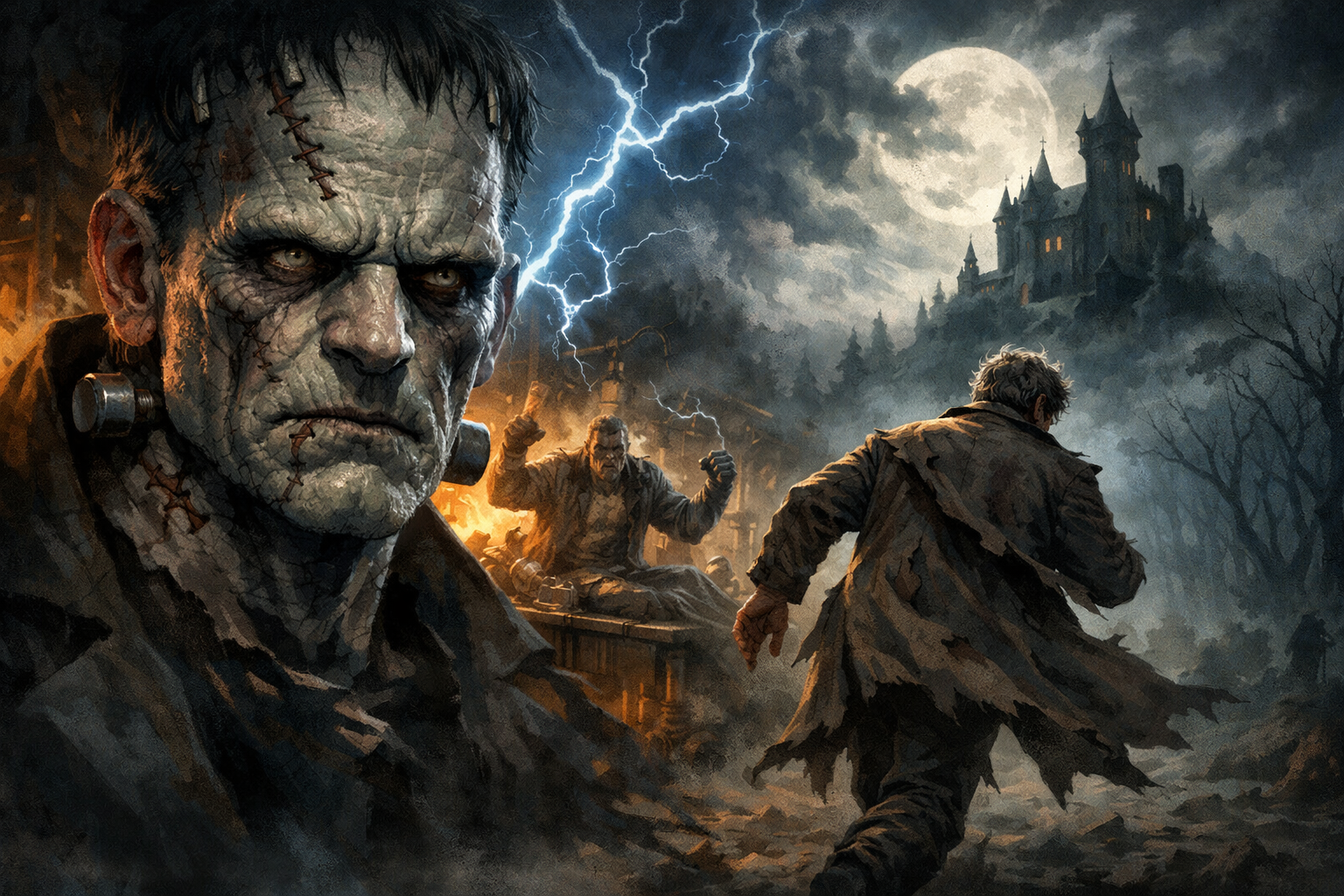
A creator builds life, then spends the rest of it trying to outrun what he made
A ship is trapped in Arctic ice. The crew are cold, tired, and running out of patience.
Then they spot an explosion in the distance. In the snow lies a man so broken he barely looks alive. They pull him aboard. He has one leg. His name is Victor Frankenstein.
Before the crew can decide whether to save him or throw him back to the ice, something else arrives. A towering figure charges the ship, demanding Victor. Bullets don’t stop it. Panic spreads fast. A captain’s ambition suddenly has teeth.
This film turns on whether a man can take responsibility for the life he created.
By the end, you’ll know exactly how Victor’s obsession turns into a chain of choices that destroys his brother, the woman he fixates on, and the being he brings into the world.
You’ll also see why the Creature becomes more human than the people who call him a monster and why the story ends not with victory, but with a quieter, harder kind of surrender.
Key Takeaways
Creation is the easy part. Ownership is the part that breaks you. Victor can make a body live, but he cannot live with what that responsibility demands.
If you treat someone like a tool, they will eventually act like one. This is not because they were inherently cruel, but rather because you instilled in them the notion that love is conditional.
Money doesn’t just fund experiments. It sets the deadline, picks the moral compromises, and decides what “success” must look like.
The most dangerous lie in the film is a simple one: blaming the Creature for the choices Victor made while no one was watching.
Kindness given in secret still changes people, but it doesn’t protect you from being misunderstood when fear arrives.
Immortality without belonging is not a gift. It’s a sentence with no appeal.
The person who sees the Creature clearly pays a brutal price for it, because compassion makes others feel exposed.
The captain’s story mirrors Victor’s. Different setting, same sickness: pushing forward until the world pushes back.
The Plot
Set-up
In 1857, the Horisont, a Royal Danish Navy ship, is trapped in the ice on its way to the North Pole. Captain Anderson is determined to keep pressing on, even as morale and strength fade.
A distant explosion draws the crew out onto the ice. They find Victor Frankenstein, frostbitten and near death, and bring him aboard. Almost immediately, a massive Creature attacks the ship, demanding Victor’s surrender. Anderson uses a blunderbuss to knock the Creature into the icy water.
Victor admits the truth. He made that being. Then he starts at the beginning.
Inciting Incident
Victor’s childhood is a study in loss and control. His mother, Claire, dies giving birth to his younger brother, William. Their father, Leopold, a renowned surgeon, is strict and oppressive. William becomes the favourite. Victor grows up grieving and hard, desperate to prove he can master what took his mother away.
By 1855, Victor is brilliant, arrogant, and obsessed with curing death through science. Victor's work surpasses ethical boundaries. A tribunal at the Royal College of Surgeons of Edinburgh condemns him for reanimating corpses. Victor is expelled and publicly humiliated.
He needs money, privacy, and a place to work. That’s when Heinrich Harlander steps in.
Rising Pressure
Harlander is an arms merchant with deep pockets and his own appetite for risk. He offers Victor unlimited funding and an isolated tower to continue his experiments. Victor accepts, and he pulls William into the build, using his brother’s skill and loyalty to raise the laboratory Victor needs.
William is engaged to Elizabeth, Harlander’s niece. Victor becomes smitten with her and tries to move closer than he’s entitled to. Elizabeth declines him. The rejection does not correct Victor. It sharpens his need to win.
Harlander wants progress, not philosophy. Victor starts harvesting parts from hanged criminals and soldiers killed in the Crimean War. The work becomes industrial. A body is assembled from the dead, built for strength, prepared for a single purpose: to be proof that Victor can defeat the final limit.
A storm approaches. Victor prepares to harness lightning and run electric current through the Creature’s body.
Then Harlander reveals the price he really wants to pay.
He is dying of syphilis. He demands that Victor put his brain into the Creature’s body. Victor refuses. He will not let his achievement become a vessel for a patron’s fear.
Harlander tries to sabotage the experiment. In the struggle, he falls to his death.
The Midpoint Turn
Victor goes through with it. Lightning hits. The apparatus drains. The Creature does not move. Victor is left with a tower full of dead effort and a silence he cannot tolerate.
The next morning, he finds the Creature alive.
This should be the moment that changes Victor. Instead, it reveals him.
He chains the Creature in the cellar. He marvels at its strength and rapid healing but treats those gifts like threats that must be controlled. He tries to teach it speech and manages only one word: his own name. When frustration rises, Victor slips into the same cruelty he learned from Leopold. Discipline becomes humiliation. Curiosity becomes punishment. The Creature’s anger begins here, in a room where it is treated like an error that breathes.
William and Elizabeth visit. Elizabeth questions Victor’s treatment and, unlike him, chooses contact over control. She bonds with the Creature and teaches it to say her name. For the first time, the Creature is given language that points outward, not just back at its maker.
Victor cannot stand what that implies.
Crisis and Climax
Victor lies to William, claiming the Creature killed Harlander. He sends William and Elizabeth away, isolating himself with the evidence of his failure. Then he tries to erase the whole thing.
He sets fire to the tower with the Creature trapped inside.
The Creature cries out for him. Victor hesitates, turns back, and tries to re-enter. The tower explodes. Victor survives, but his leg is grievously wounded. His body serves as a permanent reminder of the night he attempted to escape responsibility.
Back on the Horisont, the Creature returns. It boards the ship and confronts Captain Anderson. Victor’s tale is not the whole story.
The Creature tells itself.
It escaped the explosion, broke its chains, and fled into the woods. Hunters shot at it. It found shelter in the gears of a mill on a farm. Hidden behind walls, it watched a family live. It observed tenderness, routine, and small mercies that Victor never offered.
The Creature starts helping them in secret. It brings them vast supplies of firewood. It builds a pen for their sheep. The family благодарises an unseen benefactor, calling it the Spirit of the Forest.
When winter comes, the family leaves. The blind patriarch stays behind. The Creature finally steps into the open, presenting itself as a weary traveller. The blind man cannot recoil from its appearance. He can only respond to its voice and need.
He teaches the Creature to read. The Creature learns to speak fluently. It tries to place itself in the world, but its memory is fractured. It doesn’t know what it is, only that it is alone.
It journeys back to the ruins of the tower and discovers the truth of its creation, along with the address to Victor’s estate. It returns to the farm and finds the blind man attacked by wolves. The Creature fights them off, but the old man is dying. The Creature comforts him anyway.
When the hunters return, they see the body, see the Creature, and decide they understand the story. They shoot it dead.
It revives.
Now the Creature knows something worse than pain: it cannot die, and it cannot belong. It decides it needs one thing to make eternity bearable. A companion.
It goes to Victor’s estate on the night of William and Elizabeth’s wedding. It finds Victor and asks him to create another being like it. Victor refuses, terrified not just of making another Creature, but of what might happen if such beings could reproduce.
The Creature attacks him. The commotion draws Elizabeth in. She sees the Creature and, instead of screaming, embraces it. Victor fires at his creation and hits Elizabeth instead. She is mortally wounded by the bullet meant for the Creature.
In the confusion, William dashes in and sustains a fatal wound. With his last breath, he calls Victor the true monster.
The Creature carries Elizabeth away to a cave. She dies there, away from the house that was supposed to hold her future.
Victor pursues the Creature into the Arctic, dragging his wound and rage across the ice until revenge becomes the only thing keeping him upright. In one confrontation, the Creature tries to destroy itself with dynamite.
It fails. It lives.
Resolution
The story returns to the ship. Victor is spent. The Creature is exhausted in a way that has nothing to do with blood loss.
In Captain Anderson’s cabin, creator and creation finally face each other without an audience. Victor recognizes— too late, what he has done. The Creature forgives him. Not because Victor deserves it, but because forgiveness is the only way the Creature can stop being chained to him.
They address each other as father and son. Victor dies from his injuries.
Captain Anderson lets the Creature leave in peace. In return, the Creature uses its strength to free the Horisont from the ice. Anderson abandons his own reckless pursuit and turns the ship homeward.
Alone in the Arctic sun, the Creature reaches out toward the light, carrying an existence it never asked for into a world that still may not want it.
The Insights
A miracle treated like an embarrassment
Victor doesn’t panic because the Creature is violent. He panics because it is real.
Once the Creature lives, Victor is forced to move from fantasy to responsibility. He cannot bear the shift. He wants applause for the breakthrough, not the daily work of care.
That’s why the first relationship between them becomes a cage. Victor looks at strength and healing and sees a problem to manage, not a person to raise.
The cost is immediate: the Creature learns that its existence is tolerated only if it performs correctly.
Harlander’s money turns hope into a deadline
Harlander doesn’t just pay for the tower. He narrows Victor’s options.
Funding comes with impatience, and impatience breeds shortcuts. Victor goes from forbidden curiosity to harvesting the dead on an industrial scale, because the man with the money wants results now.
Then Harlander demands the ultimate conversion: science into personal survival. A patron wants his brain in the new body.
Victor refuses, and Harlander dies trying to force the issue. The experiment becomes soaked in the same kind of violence that built Harlander’s wealth.
The cost is moral drift. Victor continually insists that he is conquering death, yet every surrounding step he takes is permeated with its presence.
The first lie that kills people
Victor’s most destructive act is not lightning. It’s blame.
He tells William that the Creature killed Harlander. It’s a neat story that protects Victor from consequences and keeps William loyal.
That lie matters because it trains everyone around Victor to fear the wrong thing. It also provides Victor a private permission slip: if the Creature is the monster, then anything done to it is justified.
The cost shows up later in blood. Once you label someone as a threat, you become blind to your own actions.
Elizabeth names him, and the world punishes her for it
Elizabeth does something simple that changes everything. She sees the Creature, questions Victor’s cruelty, and gives the Creature language that isn’t just Victor’s ego.
It’s not sentimental. It’s practical. When you give someone a name, you give them a place to stand.
That’s why her embrace at the estate lands feels like a rupture. She responds to the Creature as a being, not an error.
The cost is brutal: Victor’s bullet hits her. Compassion becomes collateral damage in a room built for control.
Even when help is done in secret, it ultimately leads to a firing line.
The Creature’s life at the farm is the film’s quiet argument: goodness can be learnt.
It watches over a family. It copies kindness. It provides without being seen. It builds, carries, and repairs. It starts to believe there might be a place for it if it stays gentle.
Then winter ends, the hunters return, and fear does what it always does. They see a body, see a stranger, and decide the simplest explanation is the true one.
The cost is the death of the only human bond the Creature had, and the shattering of its belief that good deeds guarantee safety.
Immortality becomes a cage with no door
The hunters shoot the Creature dead, and it returns.
That single fact turns loneliness into horror. If it cannot die, it cannot escape itself. Every rejection becomes permanent. Every loss repeats forever.
That’s why the demand for a companion isn’t a scheme. It’s desperation.
The cost is escalation. When you cannot end your pain, you start bargaining with other people’s lives.
The captain’s mirror
Captain Anderson begins as a man with a map in his head and a crew under him.
Victor’s story shows him what that posture can become: obsession dressed up as purpose, with other people paying the price.
By the end, Anderson makes the choice Victor never could. He turns away. He goes home.
The cost is pride. He gives up the dream of reaching the horizon so his men can live to see their own.
The Engine
The mechanism is simple and relentless: Victor creates life, then tries to control it through shame and force. The Creature responds by seeking belonging elsewhere, and every rejection pushes it toward desperation.
Each attempt to erase the problem raises the stakes. Victor burns the tower. The Creature survives. Victor blames the Creature. People die. Victor hunts it into the Arctic. The world freezes around their feud until the only way out is a kind of surrender neither of them wanted.
What This Looks Like in Real Life
A senior researcher builds a breakthrough tool, then starts treating the team maintaining it like servants. The tool fails publicly. The blame rolls downhill. The researcher doubles down on control instead of ownership. People leave, and the project becomes a monument to one person’s ego.
A founder takes money from an investor who insists on speed over safety. Shortcuts pile up. A serious incident hits, and the founder tries to burn the evidence rather than fix the harm. The product survives in some form, but the trust never does.
A manager creates a performance culture where only one “right” answer is rewarded. Staff stop learning and start mimicking. The team looks compliant until a crisis arrives. Then the suppressed anger turns into open conflict, and the manager acts shocked by the monster they trained into existence.
A Simple Action Plan
What are you building right now that you secretly hope you won’t have to take responsibility for?
Where have you confused control with care?
Who benefits from your urgency, and who pays for it?
What is the lie you tell that keeps your self-image intact?
If the thing you made could speak freely, what would it accuse you of?
Where do you punish people for not being the version you imagined?
What would it cost you to turn back before pride turns into damage?
Conclusion
Frankenstein ends with a reversal that stings: the created being becomes the one capable of mercy, while the creator collapses under the weight of his own choices. Victor’s quest doesn’t just cost him his body. It costs him William, it costs Elizabeth, and it costs the Creature any simple path into the world.
In the end, the light is still there. The question is what you do after everything else burns.
Relevance Now
This story lands hard in an age of systems that reward building things fast and punish admitting fault. Work metrics, reputation games, and constant comparison all push people toward Victor’s posture: produce the miracle, hide the mess, deny the cost.
It also fits the pressure of online identity, where you can be defined by a single frame of how you look, not by what you’ve done. The Creature helps a family survive the winter, yet one fearful return turns him into the obvious villain.
And it speaks to institutional mistrust, where blame becomes a tool for survival. Victor’s lie about Harlander is not clever. It’s convenient. It buys him time, then burns through everyone else’s life.
Watch for the moment you start treating responsibility like an attack, rather than a duty.
A life you create does not stop being your problem just because you stop looking at it.
