The Matrix (1999) Summary
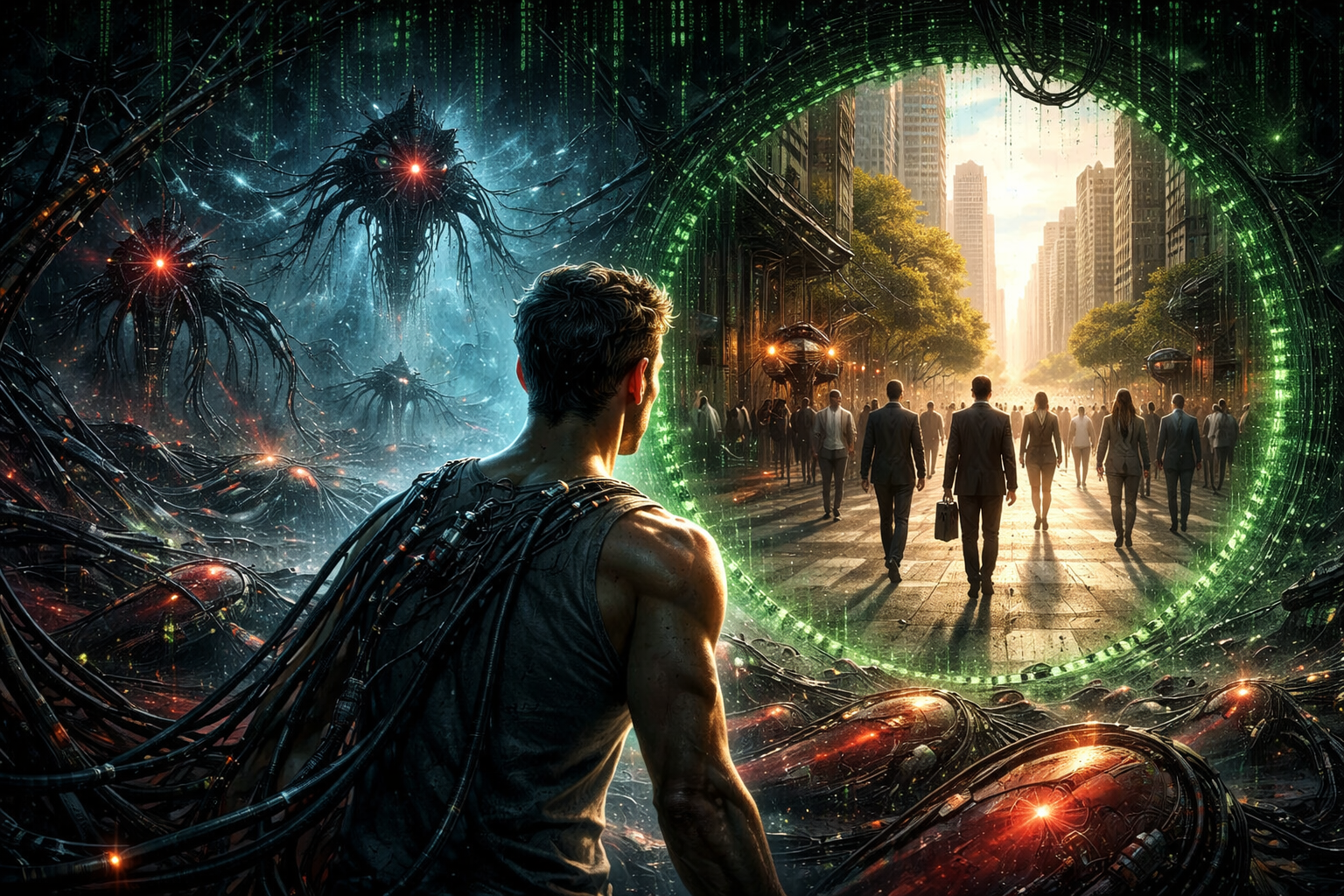
A man wakes up to discover the true war that lies hidden beneath ordinary life.
Thomas Anderson lives two lives that never quite fit together. By day he is a quiet office worker. By night he is “Neo”, a hacker who can’t shake the feeling that something about the world is wrong.
Then the messages start to find him. Not adverts. Not spam. Instructions. Names he has never given anyone. Additionally, there is a warning that those who control his life are already taking action.
He meets a group that treats his private suspicion like a public fact. They tell him the world he knows is a system built to hold him still and that his comfort is part of the cage.
This film explores the question of a single individual's ability to choose the truth, even at the cost of everything.
By the end, you will know what the Matrix is, why Neo matters to people who are risking their lives, and what finally forces him to stop running.
You will also feel the real hook of this story: it is not about cool fights. It is about what happens when your sense of reality collapses and you still have to decide who you are.
Key Takeaways
Most cages do not look like cages. They look like routines, pay cheques, and a life that is “fine” as long as you stop asking questions.
People will betray a truth they can’t live with, even after they have seen it. Comfort is a powerful drug when fear is constant.
Authority often wins by insisting it is inevitable. The fastest way to break a spell is to notice how often you say “I have to”.
Training is not about becoming superhuman. It is about unlearning rules you never agreed to, then testing which ones were real.
Prophecy can be a trap. When you outsource your choices to someone “who knows”, you shrink your own freedom.
Loyalty becomes clear under pressure. It is easy to believe in a cause when it is clean, and harder when it is messy and expensive.
Control systems hate uncertainty. The moment you stop behaving predictably, you become difficult to manage.
The person you are waiting for might be you, after you finally commit.
The Plot
Set-up
Thomas Anderson is a software employee who hides a second life as Neo, a hacker chasing rumours about something called “the Matrix”. He is restless, exhausted, and drawn to the idea that the world has a hidden structure he cannot name.
Trinity reaches him first. She treats Neo like someone already important and points him towards Morpheus, a wanted figure who seems to know what Neo has been looking for.
Before Neo can choose that path cleanly, the system closes in. Agents arrest him and interrogate him, showing that they can invade his body and silence him when they want. The message is simple: your life is not as private as you think.
Neo is released, but the fear sticks. He is being watched. He is being handled. And someone is offering him a way out.
Inciting Incident
Neo meets Morpheus. Morpheus offers a decision: return to his old life and forget, or take the truth and lose the world he knows.
Neo chooses the truth.
He wakes into a reality that breaks everything he believed. His life in the Matrix was a manufactured experience. His body has been used as part of a vast machine system. Morpheus’s crew recover him, explain the basics of what has been done to humanity, and introduce the harshness of living outside the simulation.
Neo’s question changes. It is no longer, “What is the Matrix?” It becomes, “What can I do now that I know?”
Rising Pressure
Neo is brought into the crew’s routines and training. He learns that the Matrix has rules, but those rules can be bent by someone who understands its nature.
Neo also comprehends the consequences of this knowledge. People can die in the simulation and not wake up. Agents are not just enemies. They are a kind of enforcement tool that can take over bodies inside the system, turning ordinary people into lethal threats.
Morpheus believes Neo is “the One”, a person who can do what others cannot and shift the balance of this war. Neo does not feel like a saviour. He feels like a man trying not to drown.
The Oracle becomes the next pressure point. She is presented as someone who can see what matters. Neo meets her and hears something that does not give him clean comfort. It leaves him uncertain about himself, and it reframes what Morpheus wants from him.
That uncertainty follows him back into action.
The Midpoint Turn
Cypher, a member of Morpheus’s crew, reveals his true position. He wants out. Not just out of the fight, but out of reality. He makes a deal with an Agent: betray Morpheus in exchange for being reinserted into the Matrix with his memory altered.
Cypher’s betrayal is not subtle. It is practical and brutal. He kills members of the crew while they are vulnerable, their bodies limp in the real world because their minds are inside the simulation.
The team is suddenly fighting two wars at once: one inside the Matrix against Agents, and one outside against the consequences of a traitor.
Morpheus is captured.
Crisis and Climax
With Morpheus imprisoned, the stakes spike. The Agents want access to what Morpheus knows, and Morpheus expects to be broken. The crew considers escape the only rational move.
Neo refuses to accept that. He decides to go back in.
It is a choice that cuts against the logic of survival and against the idea that Neo is still “in training.”. Trinity goes with him. Their goal is direct: rescue Morpheus from a place built to be inescapable.
The rescue becomes a sustained collision with the system’s power. Neo and Trinity push through heavily guarded spaces, reach Morpheus, and extract him under fire. The Agents respond with relentless force, using their ability to appear where they are least expected.
The final pursuit strips away anything decorative. It becomes a test of belief, speed, and commitment. Neo fights an Agent directly and holds his ground longer than anyone expects, but he is still outmatched. He runs, he is cornered, and he is shot.
In the real world, the crew watches as Neo's vital signs flatline.
Trinity refuses to accept that ending. Neo’s fate pivots on a human insistence that he is not finished yet. He returns, gets back up, and meets the system differently. The things that once felt fixed start to look optional.
He stops running.
Resolution
Neo faces the Agents with a new calm. He no longer treats them as unbeatable forces of nature. He moves through the Matrix with control that was previously out of reach, and the balance shifts.
When it is done, he makes a final statement of intent. He is not simply surviving inside the system. He is challenging it.
The film closes on that promise: Neo will not keep the truth to himself.
The Insights
The prison that feels like your own life
The Matrix works because it matches what people already expect. It is characterised by jobs, routines, small rewards, and low-grade fear. It does not need chains when it can offer normality.
Neo’s early life shows the trap clearly. He is functional enough to keep going, unhappy enough to keep searching, and isolated enough that the search stays private. That is the sweet spot for control.
The Agents do not persuade him. They demonstrate power over his body and choices, then they dare him to pretend he is free. Neo realises that the threat is not only violence. It is the ability to rewrite what “reality” means for him.
The cost is constant disorientation. Once you suspect the world is staged, you cannot relax inside it.
Training is a fight with inherited rules
Neo’s training is not just physical practice. It is a controlled demolition of assumptions.
Inside the Matrix, he learns that his reflexes, fear, and certainty are part of the system’s grip. When he believes a limit is real, it becomes real for him. When he tests it, the boundary shifts.
A concrete example is how the crew treat simulation training as a life-or-death rehearsal. Mistakes matter because belief matters. They are conditioning Neo to respond differently under pressure, not merely to “learn moves”.
The consequence is uncomfortable. Growth here is not soothing. It is the repeated experience of being wrong about what you thought you were.
The Oracle represents the trap of relying on outsourced certainty.
The Oracle’s power in the story is not that she provides Neo a neat answer. It is that she forces him to confront the way he wants certainty more than truth.
Neo goes to her hoping for a label. Am I special or not? She gives him something messier, something that doesn’t let him hide behind destiny. It leaves room for choice, and that room feels like risk.
The example that matters is how Neo walks away still carrying doubt. He cannot lean on “prophecy” as a crutch. He has to act, and then own the result.
The cost is psychological weight. When you cannot delegate the decision-making process, you must take responsibility for it.
Cypher’s bargain: comfort over reality
Cypher’s betrayal is the ugliest mirror in the film because it is understandable.
Life outside the Matrix is harsh, frightening, and full of loss. Cypher wants the softer lie. He chooses a fabricated life where he can stop feeling the daily stress of survival and moral responsibility.
His betrayal is not driven by abstract evil. It is transactional. He trades other people’s lives for his relief.
The consequence is immediate bloodshed, but the deeper cost is what it says about the war. You are not only fighting the enemy. You are fighting the temptation to surrender.
Morpheus as a test of faith and leadership
Morpheus is not only a mentor. He is a symbol. He holds the group’s belief together, and the Agents understand that.
When Morpheus is captured, the crew face a leadership crisis. Do they protect the idea or protect themselves? Neo’s decision to go back for Morpheus becomes his first truly adult commitment. He is not following instructions. He is choosing a cost.
The rescue is concrete proof. Neo acts as if Morpheus matters more than the odds. That belief pulls Trinity into the same commitment, and it pulls the story into its final turn.
The cost is exposure. Once you choose, you lose the option of pretending you were merely swept along.
"The One" should be viewed as a decision rather than a certificate.
The film toys with the idea of a chosen saviour and then pushes it into something more human.
Neo does not become different because someone stamps his passport. He becomes different when he stops splitting himself into two versions: the man who doubts and the man who acts. The shift is not magical. It is commitment under pressure.
The key example is the moment he returns from being shot. He rises with a new relationship to fear and rules. He does not beg the system to spare him. He meets it on his terms.
The cost is permanence. Once you wake up, you cannot go back to sleep without lying to yourself.
The Engine
The story keeps forcing change because Neo cannot live with half-truths, and the system cannot tolerate people who stop behaving predictably.
Every time Neo takes a step towards the truth, the Agents escalate. Every time he survives, Morpheus’s belief in him grows, raising the burden of expectation. Then Cypher’s betrayal removes the safety net, making the choices irreversible.
That pressure cooker is the engine: knowledge increases risk, and risk forces identity.
What This Looks Like in Real Life
A junior analyst in a large firm suspects their work is being used to justify decisions already made.
The old approach: keep your head down, deliver the dashboards, and tell them it is "just the job."
New approach: ask sharper questions, document assumptions, and push for clarity on how the numbers will be used.
Consequence: they lose some comfort, but they gain control over their integrity and reputation.
A call centre team leader works under constant performance monitoring.
Old approach: chase metrics, copy the script, pretend the pressure is normal, and burn out quietly.
New approach: focus on the controllables, coach real conversations, and push back on targets that break service quality.
Consequence: they may take heat short-term, but they stop living as if the system’s demands are natural law.
A university student builds an online identity that starts to swallow their real life.
Old approach: curate everything, chase approval, let other people’s reactions decide who they are.
New approach: choose what stays private, set boundaries, and act in line with offline priorities.
Consequence: attention may drop, but anxiety drops with it, and their sense of self stabilises.
A Simple Action Plan
Where in your life do you suspect the “normal” story is doing the most controlling?
What is the smallest truth you are avoiding because it would force a decision?
If you stopped blaming “the rules,”, what choice would become visible?
Who benefits from you staying confused, worn out, or isolated?
What is your version of the red pill: a step that cannot be unseen once you take it?
Which comfort would you trade other people’s trust for, if you were not careful?
What would acting with full commitment look like for one week?
Conclusion
The Matrix is the story of a man who learns his life is manufactured and then discovers the harder fact: even after you wake up, you still have to choose who you are.
Neo pays for the truth with fear, loss, and the end of his old identity. He also gains something rare: the ability to meet a controlling system without begging it for permission.
The last beat is not victory. It is a refusal to sleepwalk.
Relevance Now
The film’s tension fits modern life because so much control now feels ambient. Online identity can become a performance you maintain without noticing. Workplace surveillance and metrics can turn people into obedient shapes rather than thinking adults. Algorithmic attention can keep you reacting instead of choosing.
Neo’s early life mirrors that drift. He is productive, watchful, and quietly hollow. The Agents work as a reminder that systems do not always need your consent to manage you. They only need your predictability.
Cypher’s betrayal still lands because comfort is still for sale. People trade truth for relief all the time, sometimes in tiny ways that add up. The film does not scold that impulse. It shows the cost when it becomes your moral centre.
Watch for the moment you start calling your own choices “inevitable..”. That is usually where the Matrix starts.
Freedom begins the second you stop asking permission to see clearly.
