Interstellar Film Summary
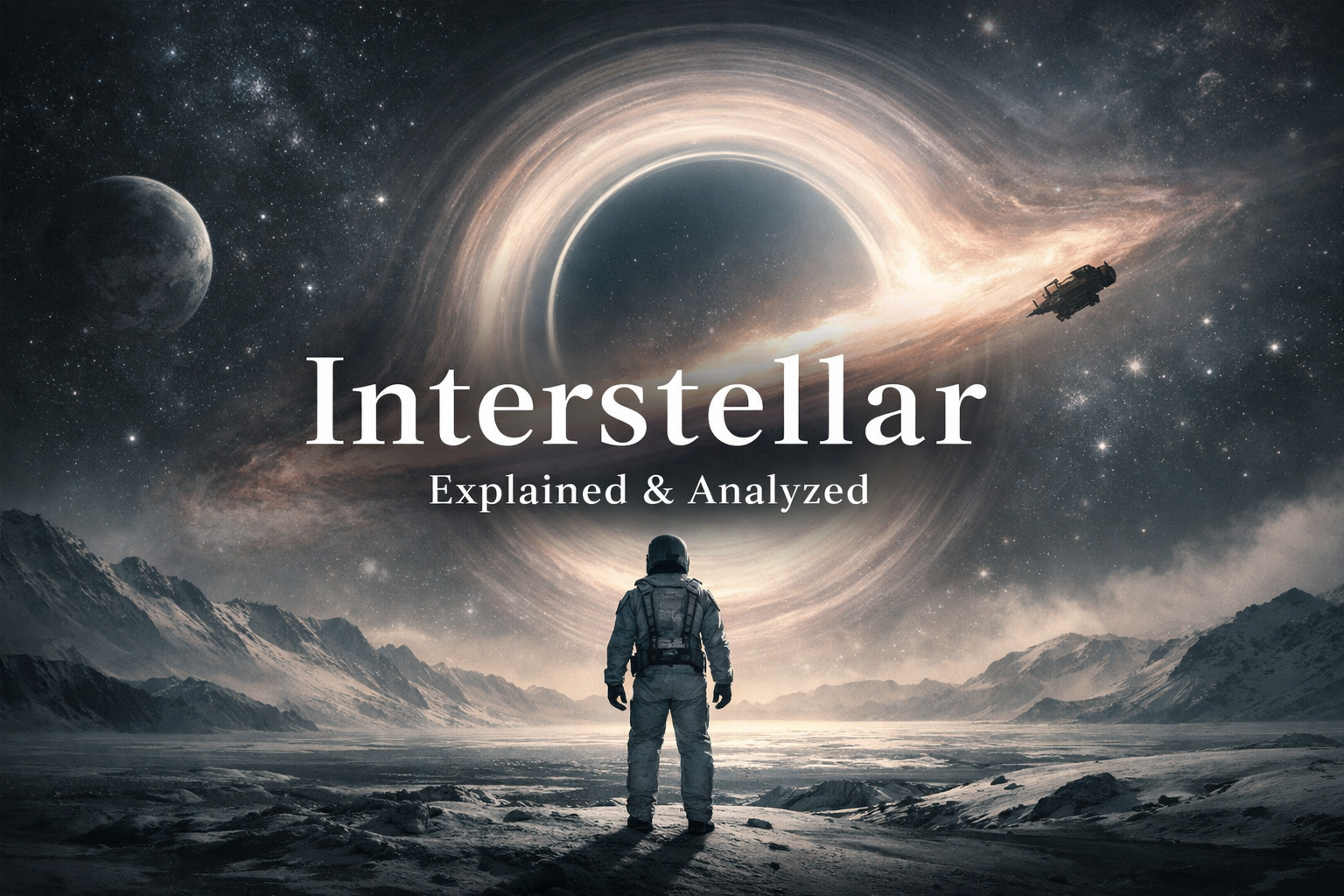
Interstellar plot summary with spoilers: the full story, ending explained, themes of time, love, and survival, plus what it means today
Interstellar plot summary: a father, a dying Earth, and a message sent through time
Interstellar (directed by Christopher Nolan, 2014) is a science-fiction epic that treats space travel like a brutal job and parenthood like a vow you cannot safely keep. This Interstellar plot summary explains the full story, then digs into what the film is really arguing about: time, love, survival, and moral compromise.
The surface problem is simple: Earth is failing. Crops are dying. Dust is everywhere. The deeper problem is harder: when the future demands sacrifice, who gets chosen to pay for it, and who gets told the truth?
Interstellar is driven by a paradox that feels emotional before it feels scientific. The only way to save the species may be to abandon the people you love most. And even if you succeed, time may make you a stranger to them.
“The story turns on whether a father can help save humanity without losing his children to time.”
Key Points
Interstellar follows Cooper, a former pilot turned farmer, as he joins a secret space mission to find a new home for humanity.
The film frames climate collapse as a slow, grinding emergency where optimism becomes a luxury and denial becomes policy.
A wormhole near Saturn opens a route to distant worlds, but time dilation makes every decision cost years back on Earth.
The mission confronts a moral split between saving everyone (Plan A) and saving only a chosen few (Plan B).
Betrayal, fear, and institutional lies become as dangerous as space itself.
The story’s climax hinges on gravity as a way to transmit information across time.
Interstellar’s emotional core is the bond between Cooper and his daughter Murph, tested by absence and decades of lost time.
Quick Facts
Title: Interstellar
Author/Director: Christopher Nolan
Year: 2014
Format: Film
Genre: Science fiction, adventure, drama
Primary setting: Near-future rural America and deep space (wormhole and exoplanets)
One-sentence premise: A retired pilot joins a last-chance mission through a wormhole to find habitable worlds, while time itself threatens to sever his family forever.
Names and Terms
Cooper — a former NASA pilot turned farmer; the mission’s lead pilot and the story’s emotional anchor.
Murph (Murphy Cooper) — Cooper’s daughter; brilliant, stubborn, and determined to understand the “ghost” in her room.
Dr. Amelia Brand — a scientist on the mission; torn between duty, hope, and love.
Professor Brand — Amelia’s father; a NASA leader guarding a plan to save humanity.
Tom — Cooper’s son; practical, loyal to the farm, and slowly trapped by a failing world.
Romilly — an astronaut and scientist; the mission’s patient conscience.
Doyle — an astronaut; a working professional who treats the mission like life-or-death labor.
TARS — a robot with a dry personality and strict competence; becomes central to the film’s logic.
Wormhole — a shortcut through spacetime that makes distant star systems reachable.
Time dilation — extreme gravity and high-speed travel make time pass differently for different observers.
Full Plot
Spoilers start here.
Here is the full plot summary with spoilers. Interstellar begins with Earth in ecological free fall. Crops fail from a blight that spreads across fields and economies. Dust storms roll through towns like weather with teeth. In this world, ambition has been downgraded from “virtue” to “dangerous nostalgia”.
Cooper is a former NASA test pilot who now farms because the world has decided exploration is wasteful. He lives with his father-in-law Donald and his two children, Tom and Murph. Murph is sharp and angry at the way adults accept decline. She also believes her bedroom is haunted. Books fall from shelves. Dust settles into patterns. Something seems to be pushing at the edges of her reality.
Cooper initially treats it like a mystery that might have a practical explanation. But Murph’s “ghost” begins leaving what looks like a signal. The dust patterns form coordinates. Cooper follows them, and the coordinates lead to a hidden NASA facility.
NASA never truly died. It went underground, protecting itself from a culture that decided the past was a lie and the future was not worth funding. At the base, Cooper meets Professor Brand, a senior scientist who explains the stakes: Earth is running out of breathable time. Humanity must leave, or it will choke inside its own dwindling harvest.
Brand reveals a wormhole has appeared near Saturn, providing a path to another galaxy. NASA previously sent explorers through it on the Lazarus missions, each targeting a potentially habitable planet near a massive black hole called Gargantua. Now the “Endurance” mission will follow, gather data, and choose the best world.
Brand frames two plans. Plan A is to solve a gravity equation that would allow humanity to lift massive stations off Earth and evacuate the population. Plan B is a smaller, colder solution: transport frozen human embryos to seed a colony elsewhere, accepting that everyone on Earth will die. The mission’s public story is Plan A. The mission’s hidden readiness includes Plan B.
Cooper is recruited as the Endurance’s pilot because skill matters more than ideology when the margin is thin. He agrees, but the decision breaks his family. Murph feels betrayed. She refuses to say goodbye. Cooper leaves anyway, carrying the kind of guilt that does not fade, it only changes shape.
Act I: Setup and Inciting Incident
The Endurance launches with a small crew: Cooper, Dr. Amelia Brand, Romilly, Doyle, and two robots, TARS and CASE. The mission’s tone is practical rather than heroic. They sleep in cryogenic pods to reduce time lost in transit, because even travel requires its own moral math.
They reach Saturn and enter the wormhole, experiencing it as a physical event, not a fantasy portal. When they exit, they are in a new region of space near Gargantua, where three candidate worlds wait: Miller’s planet, Mann’s planet, and Edmunds’ planet, each named for a Lazarus explorer.
The first target is Miller’s planet, because Miller’s signal suggests it might be viable. But Miller’s planet orbits very close to Gargantua, which means intense gravity and severe time dilation. Romilly warns them: one hour on the surface could equal years back on Earth.
They land anyway, because every delay carries its own cost. The planet is shallow water under a low sky, and what looks like mountains in the distance are waves. A massive tidal wave hits. In the chaos, Doyle is killed. Cooper and Brand escape, but they spend too long trying to recover data.
When they return to the Endurance, they find Romilly older. More than two decades have passed for him while they were on the planet for hours. The mission absorbs this like a punch to the ribs. It means Earth has kept moving without them. It means Murph is now an adult. It means Cooper has lost years he will never get back.
Cooper watches video messages from Earth. Tom grows up. Murph grows up. The children become strangers through recorded time, and the film makes that distance feel like a physical wound.
What changes here is that space stops being a destination and becomes a thief.
Act II: Escalation and Midpoint Shift
The crew has to choose again. Miller’s planet is a dead end. They decide to go to Mann’s planet because Mann’s signal indicates hope. Dr. Mann is a celebrated explorer, treated like a symbol of human courage.
They reach Mann’s planet and find a frozen, hostile landscape. Mann is alive in cryosleep, and they revive him. At first, he seems grateful and noble. He praises their bravery. He talks about the psychological hell of isolation. He presents data that suggests his planet might support life.
But Mann’s optimism is an act built on desperation. His planet is not viable. His positive signal was false. He sent it because he could not accept dying alone, and he knew a false beacon might bring rescue. Interstellar makes this betrayal ugly in an ordinary way: not a villain’s grand scheme, but a frightened human choosing self-preservation over truth.
Mann escalates from lies to violence. He tries to kill Cooper during a supposedly routine outing, arguing that survival justifies any action. He intends to steal the Endurance and return through the wormhole, even if it strands the others.
Back at the ship, Mann attempts a docking procedure he is not skilled enough to execute. The docking goes wrong and triggers a catastrophic spin, tearing the Endurance apart. Mann is killed in the failure. Cooper performs a desperate manual docking to stabilize the ship, a sequence that turns physics into suspense and teamwork into life support.
The Endurance survives but is badly damaged and low on fuel. Plan A is still unresolved, and time is still bleeding away. The crew cannot return home with everyone. They can barely continue forward.
Brand argues they should go to Edmunds’ planet because Edmunds’ data may be real and because she has personal reasons to believe in it. Cooper insists they must maximize the chance of saving the people back on Earth. Their debate is not just tactical, it is philosophical: do you follow the clean logic of probability, or do you admit that love might be a form of truth about human choice?
They choose a last gamble involving Gargantua. Cooper realizes they can slingshot around the black hole to reach Edmunds’ planet, but the maneuver will cost enormous time due to dilation and will require shedding mass. Someone may have to be sacrificed.
What changes here is that the mission stops being about finding a planet and becomes about deciding who gets a future.
Act III: Climax and Resolution
The Endurance swings toward Gargantua. To make the math work, Cooper sacrifices himself, detaching his craft along with TARS to reduce weight so Brand can reach Edmunds’ planet with enough fuel. Cooper is not simply choosing death. He is choosing a chance that his loss will become a bridge.
Cooper and TARS fall into the black hole. Instead of being destroyed, Cooper wakes inside a strange structure: a tesseract, a vast grid of repeating moments of Murph’s bedroom across time. He realizes the “ghost” Murph sensed was him. The tesseract is a constructed space that lets him interact with gravity across different times, as if time were a physical dimension he can reach sideways.
TARS has collected quantum data from inside the black hole—information needed to complete the gravity equation. Cooper cannot send it through normal communication, but he can encode it through gravity effects Murph will notice in her room.
Cooper tries to communicate with Murph at multiple moments: as a child, as a teenager, as an adult. He becomes frantic because he sees how many times he almost succeeds and how close he comes to failing. Eventually, he finds a method Murph will understand. He manipulates the second hand of a wristwatch he gave her, tapping out the quantum data in Morse code.
Murph, now a scientist working under Professor Brand, finally recognizes the pattern. She decodes the message, completes the equation, and makes Plan A possible. Humanity can lift enormous stations off Earth. The species can evacuate without leaving almost everyone behind.
The tesseract collapses after its purpose is fulfilled, and Cooper is ejected back into space near Saturn. He is recovered by humans living on a massive orbital habitat called Cooper Station—named after him as a historical figure, not as a father who missed decades.
Cooper reunites with Murph, now elderly and near death. Their meeting is tender but painful, because time has turned their relationship into something asymmetrical. Murph tells him that parents are not supposed to watch their children die. She urges him not to stay. She tells him to go find Brand, who is likely alive on Edmunds’ planet establishing the colony.
Cooper leaves again, this time with a different shape of hope. He sets off to reach Brand and help build the next chapter of human life, carrying the knowledge that the future was saved by a message hidden inside a private object in a child’s room.
Analysis and Themes
Theme 1: Time as the price
Claim: Interstellar treats time as the real currency of survival, and it is always paid in relationships.
Evidence: The mission’s first major loss is not only Doyle’s death, but the decades Cooper loses after Miller’s planet. Video messages show his children aging while he remains unchanged, turning love into a timeline he cannot re-enter. The final reunion with Murph happens when she is old, collapsing an entire father-daughter life into a short farewell.
So what: Many modern choices function the same way, just slower: careers, relocation, caregiving, and ambition all spend time. The film pushes a hard question: if you had to save something bigger than yourself, what would you be willing to lose that you cannot replace?
Theme 2: Survival versus truth
Claim: The film argues that institutions will lie when the truth might break cooperation, even if those lies poison the future.
Evidence: Professor Brand presents Plan A as achievable while hiding the reality that he cannot solve the equation without data he does not have. Mann fakes his planet’s data because he cannot face dying alone. In both cases, the lie is justified as necessary for morale, but it creates downstream betrayal and violence.
So what: In crises, leaders often trade transparency for compliance. Interstellar doesn’t let that trade feel clean. It shows how “necessary lies” can turn ordinary people into collateral, and how trust—once broken—becomes another resource that cannot be mined twice.
Theme 3: Love as a form of navigation
Claim: Interstellar treats love not as sentiment, but as a force that guides decisions when data cannot.
Evidence: Brand argues that love can push people toward truths that cold calculation misses, especially in choosing Edmunds’ planet. Cooper’s defining motive is not scientific curiosity but his bond with Murph, which drives him to interpret the tesseract, persist through panic, and translate impossible information into a language she will recognize. The watch becomes a bridge because it is emotionally charged, not because it is technologically special.
So what: The film reframes love as an information system. In real life, our strongest commitments shape how we interpret risk, opportunity, and meaning. Interstellar suggests that in human systems, “rational” choices are often incomplete without the values that love reveals.
Theme 4: The cruelty of “greater good” logic
Claim: The story exposes how the phrase “for humanity” can hide brutal decisions about who counts.
Evidence: Plan B assumes Earth’s population is expendable, replaced by embryos that will inherit a future without the people who built it. Cooper’s departure is framed as necessary, but the emotional cost is paid by his children, who did not consent. Mann’s ideology becomes a caricature of survival ethics: he claims the species matters more than any person, while he murders to protect himself.
So what: Modern systems often justify harm through abstraction: markets, national security, productivity, efficiency. Interstellar asks the viewer to feel the human cost behind those abstractions and to question when “the future” becomes a permission slip for cruelty in the present.
Theme 5: Human limits in an inhuman environment
Claim: Space in Interstellar is not romantic; it is a pressure test that reveals what humans are too fragile to carry.
Evidence: Miller’s planet kills through simple physics. Mann’s planet reveals psychological collapse and reveals how quickly hero worship can rot. The Endurance nearly dies not from aliens, but from human error and ego in a docking bay. Even Cooper’s breakthrough comes through desperation and grief, not calm mastery.
So what: When systems get extreme—climate stress, financial shocks, war, disaster response—people don’t become cleaner versions of themselves. They become more themselves. The film’s realism is a warning: future challenges will not be solved by technology alone, because human weakness travels with us.
Theme 6: Parenthood as a moral oath
Claim: The movie frames parenthood as a promise that conflicts with every heroic narrative about leaving home.
Evidence: Cooper’s choice to go is portrayed as both necessary and traumatic, and Murph’s refusal to say goodbye is treated as rational, not childish. Tom’s arc shows the other side of abandonment: the child who stays, becomes responsible, and is slowly crushed by duty. Murph’s adult life is shaped by anger and longing, yet she still becomes the one who saves humanity.
So what: Interstellar challenges the fantasy that sacrifice automatically redeems itself. It suggests that even if the sacrifice “works,” it still leaves scars. The film’s tenderness comes from admitting that saving the world does not fix what you broke to do it.
Character Arcs
Protagonist: Cooper begins as a man suffocating in a world that has renounced the future, but he is also a father who believes presence is a form of love. By the end, he accepts a harsher truth: love is also what you build toward, even if you cannot live inside it. His shift is forced by time dilation, Murph’s adulthood, and the tesseract revelation that his role is to become the “ghost” who guides her, not the father who stays.
Secondary arc: Murph begins as a child who refuses the story adults tell her, and she ends as a scientist who solves the problem those adults could not. Her defining shift is moving from personal betrayal to purposeful action, without letting that action erase her grief.
Secondary arc: Dr. Amelia Brand begins as a disciplined scientist shaped by her father’s authority, and she ends as a builder of a new world, carrying both the burden of loss and the responsibility of beginnings. Her arc matters because she embodies the film’s argument that duty and love are not opposites, they are entangled.
Craft and Structure (What makes it work)
Interstellar works because it anchors cosmic scale in domestic emotion. The story keeps returning to a bedroom, a farm, a watch, a video message—objects that make time measurable in human units. That choice prevents the film’s science from becoming an empty flex. Every concept is attached to a relationship.
The structure uses time dilation as narrative violence. Instead of relying on constant external enemies, the film turns physics into consequence. This creates suspense that feels different from standard disaster storytelling: the fear is not only death, but absence, lost decades, and arriving too late to matter.
The film also blends the procedural tone of a mission with moments of spiritual awe. It moves between competent work and overwhelming mystery, letting the audience feel both the grit of survival and the vertigo of the unknown. The result is a story that can be argued with, but is hard to forget.
What Most Summaries Miss
Most summaries reduce Interstellar to “love saves the day,” as if the film is making a simple sentimental claim. The sharper reading is that love is what makes the costs legible. The film does not erase sacrifice with feeling. It insists the sacrifice is real, and then shows that love is what pushes people to keep acting anyway.
Another overlooked element is the story’s discomfort with institutional virtue. Professor Brand is not purely heroic, and NASA is not purely noble. Their secrecy and manipulation are framed as understandable, but still morally corrosive. The film refuses the fantasy that humanity will be saved by clean leadership. It suggests survival will be messy, compromised, and dependent on individual acts of stubborn loyalty.
Finally, the “ghost” is not a twist meant to be clever. It is the emotional thesis in disguise: what we leave behind in other people’s lives can become a force that shapes them. The most important kind of “time travel” in the film is not moving your body through time, but imprinting meaning that persists.
Relevance Today
Climate stress and slow catastrophe: The film’s Earth does not end in one explosion. It declines through crop failures, dust, and narrowed imagination, echoing how real environmental crises often feel incremental until they become irreversible.
Public trust and expertise backlash: Interstellar depicts a society that distrusts science and reframes exploration as waste. That tension mirrors modern debates over expertise, institutions, and what counts as “useful” knowledge.
The ethics of crisis messaging: The conflict between Plan A and Plan B reflects real-world dilemmas about transparency during emergencies—how much truth people can bear, and who gets protected when resources shrink.
Technology as a multiplier, not a savior: The mission has advanced ships and robots, yet human fear and ego still nearly destroy it. That maps onto today’s AI and biotech reality: tools amplify intention, including bad intention.
Long-distance family life: The emotional logic of time loss resonates with modern work patterns—migration for opportunity, remote parenting, military deployment, and careers that demand years away from home.
Polarization around the future: In the film, one culture clings to survival and another insists on horizons. That split resembles modern politics where “protect what we have” collides with “build what we need,” often with no shared timeline.
Space as strategy again: Interstellar treats space not as vanity but as contingency planning. As space becomes more central to infrastructure, defense, and long-term resource thinking, the film’s “exit plan” logic feels less like fantasy and more like a strategic mirror.
Ending Explained
Interstellar ends by revealing that the “ghost” in Murph’s room was Cooper all along, enabled by a constructed space that lets him influence gravity across time. Inside the tesseract, he gains the one thing Professor Brand lacked: quantum data from inside the black hole, carried by TARS.
The ending means Cooper’s sacrifice becomes communication, and communication becomes survival. Murph receives the data through the watch, completes the gravity solution, and makes it possible for humanity to leave Earth on giant space habitats rather than abandoning everyone to die.
At the same time, the ending refuses to pretend this fixes the personal cost. Cooper does not get his lost years back. He meets Murph only at the end of her life. The victory is real, but it arrives with grief intact, which is the film’s final honesty.
Why It Endures
Interstellar endures because it delivers spectacle with consequences. It gives the audience wormholes, black holes, and alien worlds, but it keeps insisting that the most violent distance is the one between a parent and a child measured in years.
It is also a rare big-scale film that argues for ambition without romanticizing it. The story respects the need to reach outward, but it does not disguise what reaching outward costs. That tension makes the film feel adult: it refuses both cynicism and easy comfort.
If you want airtight realism, Interstellar may frustrate you, because it uses science in service of emotion and meaning. If you want a story that makes cosmic ideas feel personal—and personal love feel like a commitment with real stakes—it will hit hard.
In the end, Interstellar is not asking whether humans can travel far. It is asking whether we can choose a future without destroying what we claim we are saving.
More insight, less noise—subscribe and explore the full range at Taylortailored.co.uk
