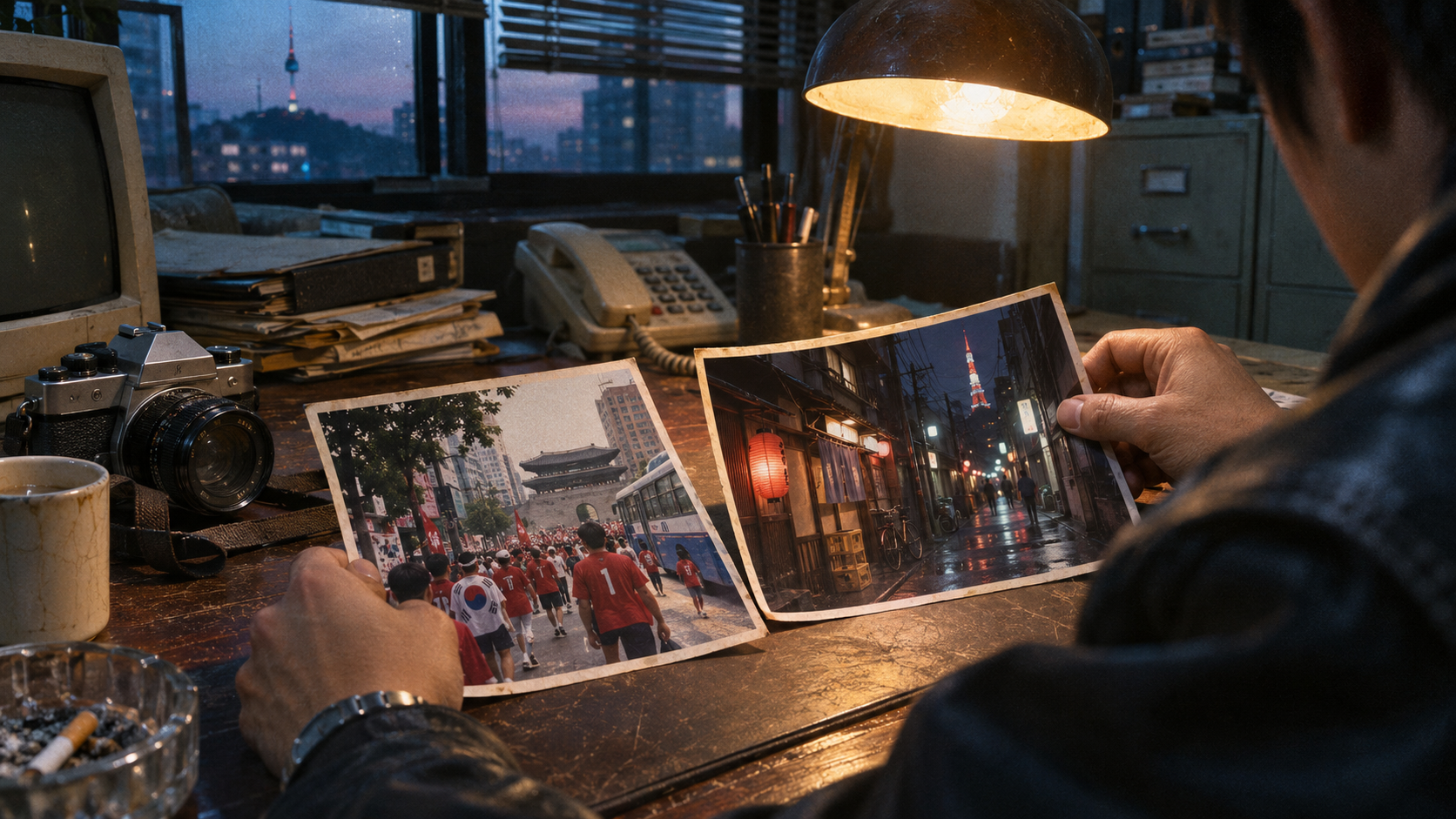
Who Was Meant To Read The Message In Tokyo?
A body turns up in Tokyo with a message written in Korean. Then another body is found in South Korea, this time with a message in Japanese. For a detective arriving at either scene, the language looks like a lead. For anyone who knows about both murders, it raises a more unsettling possibility. Someone may be counting on the police to read each message differently.
Netflix’s The Blue Road is a fictional crime thriller adapted from a Korean–Japanese comic. No real serial murder investigation has been identified as the basis for its Seoul–Tokyo case. The 2002 World Cup in the background, however, really did bring the two countries together. And during that very summer, readers in South Korea and Japan could pick up a magazine and follow the mystery that would reach Netflix almost a quarter of a century later.
The Comic You Could Buy in 2002
Netflix calls Blue Road a webcomic in its early production notes. Anyone looking for the original on the strength of that description could easily miss it. Its first readers encountered the story in print. Chapters ran in Haksan’s Korean comics magazine Booking and in the Japanese magazine Weekly Comic Bunch. The Japanese issue dated 7 June 2002 carried the opening instalment. Haksan published the first Korean collected volume that November, with the fifth following in May 2004.
Japanese writer Keisi Edogawa wrote the story. Korean artist Kwon Kaya drew it and appears in Netflix’s English production credits as Kwan Ga Ya. The Korean title is 푸른길. Those details are handy for anyone hunting down an edition. A search for the English television title and the name of Son Suk-ku’s detective misses both the title on the Korean books and the name of the man who originally took the case.
What was unusual about the arrangement was who got to read the mystery as it unfolded. A Japanese readership didn’t have to discover it years after it had become a Korean hit, or vice versa. Both magazines carried the serial during the same period. A Tokyo reader and a Seoul reader could each recognise familiar streets, then follow a detective somewhere the other reader knew better. The creators made that change of perspective part of the pleasure of solving the crime.
What the First Detective Gets Wrong
The comic gives its Tokyo crime scene a precise location. The dead woman is found in Kabukicho, in the Shinjuku district. The message mixes Korean letters and Chinese characters. Inose, the Japanese investigator, already knows of a killing in Yokohama. He thinks he may be looking at another episode in a series close to home, and his suspicion falls on ethnic Koreans living in Japan.
It takes a young detective from Seoul to show him how little of the case he can actually see. In the comic, that officer is called Kang Cheong-do. He brings news of bodies found in Seoul and Busan. The writing at those scenes is Japanese. Everything Inose saw in Tokyo is still there, down to the last character of the message. What changes is the conclusion he can reasonably draw from it.
Imagine applying his first instinct consistently. Korean writing in Japan directs suspicion towards one group. Japanese writing in Korea would send another police force looking in the opposite direction. Put the two files side by side and the choice of language begins to look deliberate. Whoever left the words could anticipate something about the people who would find them. The most revealing clue may be what the writer knows about the police.
The partnership begins to earn its place here. Kang has information Inose lacks, and the Japanese detective can pursue connections his Korean counterpart has only just encountered. In the second volume, material left by Kang’s mentor supplies a Japanese name worth following. Inose travels to Korea, and both men then head back to Japan. Their enquiries lead towards a similar discovery on the Noto Peninsula some twenty years earlier. For readers, that opens up a new question. How far back do these two men need to look before the pattern makes sense?
What Netflix Changed About the Partnership
On television, the Seoul detective is Kim Seok, played by Son Suk-ku. Eita Nagayama plays Inose, retaining the Japanese investigator’s name. It is one of the simplest differences to spot between the five collected books and the eight-part series. It also puts a limit on what a curious viewer can learn by looking up the plot of volume two. The screenwriters, Cho Eu-gene and director Han Jun-hee, had room to decide which parts of each man’s history belonged in their version.
The trailer gives Kim a straightforward offer to make. They could work together. Inose turns him down. He wants to catch the killer, and at that moment he sees little advantage in the arrangement Kim proposes. It is an awkward start for two men whose evidence makes such a good argument for cooperation. A viewer can grasp why Kim needs a partner considerably sooner than he can persuade Inose to become one.
Han wanted each detective to be capable of carrying the drama in his own right. One of the nicest accounts of how he went about it involves a meal. Nagayama recalled the director experimenting with which character might reach for the food first. It sounds an absurdly small decision alongside the business of staging an international manhunt. Yet think how much an actor can convey by waiting for another man to eat. Depending on the look that accompanies it, the gesture could be courtesy, caution or a quiet contest over who controls the room.
Son also spoke about changing his voice and appearance for Kim, and about feeling he had reached a limit in his acting before taking the part. His work with Han gave him the confidence to suggest things he might previously have kept to himself. For someone who already knows Son from D.P., there is an extra reason to watch the scenes between these two. He had worked with this director before, but he was still finding out what sort of detective he could play.
Why the World Cup Crowds Belong Here
In 2002, South Korea and Japan became the first joint hosts of the men’s football World Cup. The tournament opened in Seoul with France playing Senegal. Its final took place in Yokohama. Those names carry an entirely different set of associations for a reader of Blue Road, where news of deaths in those same cities helps draw two investigators together. A football fan and a comic reader could follow quite different journeys across the same map that summer.
For the original audience, 2002 was the present. A Japanese reader picking up Weekly Comic Bunch that June didn’t need a costume designer to explain why Korean fans were wearing red. For the Netflix production, the same year was a period setting. Its publicity picks out supporters dressed in red and draped in their national flag. What an artist working in 2002 could take for granted as part of the world outside the window had become something a television crew had to reconstruct.
Han has his own point of reference for those images. He remembers being near the end of high school in 2002 and recalls how thoroughly the tournament occupied people’s attention. That memory helps explain the appeal of setting a private, disturbing investigation against such a public occasion. Plenty of people could tell you where they watched a particular match. It takes very little for a thriller to make you wonder what else might have been happening while everyone was looking at the same screen.
What a Subtitle Can Leave Out
For viewers watching in English, there is a small complication at the heart of The Blue Road. An English subtitle can make two people equally easy to understand even when one of them has had to work considerably harder to make himself understood. Son performs some of Kim’s dialogue in Japanese. He practised with Nagayama and an interpreter, learning unfamiliar passages in much the way he might memorise music. Nagayama, in turn, speaks Korean in the series.
Listen to what happens around the words. How long does someone wait before answering? Who feels able to interrupt? A viewer can hear the answers to those questions without knowing either language. They matter in a story where the first investigators are prepared to make consequential assumptions about a stranger on the strength of a piece of writing.
The most revealing example from the production concerns Li Yoon-ok, the businesswoman played by Kim Shin-rock. Li is Zainichi Korean and works in Japan’s pachinko industry. Three Zainichi Korean language instructors helped the actress prepare. She had initially thought there might be a recognisable speech pattern she could adopt. Then she heard the three instructors speak. Each sounded different.
That discovery gave the actress a more exact question to answer. How would this particular woman speak, given the life she had led? It also gives viewers a way into Li before they know what she wants from the detectives. At the first crime scene, the writing encourages a detective to imagine he knows the sort of person behind it. Playing Li convincingly required the actress to hear the differences between three people whom that kind of reasoning would put in a single category.
Can the Comic Tell You How the Series Ends?
Han has said the ending of the television series changed several times during development. It would take a comparison of the completed works to establish exactly where they part company. But his account gives readers of the comic a good reason to keep an open mind when the adaptation premieres on Netflix on Friday 20 November 2026. Even the people making it considered more than one way for the investigation to end.
There is a particular pleasure in returning to that first message with the comic’s history in mind. Inose sees writing that appears to point away from Tokyo. The reader holding the Japanese magazine has an advantage he cannot yet imagine. Somewhere across the water, another reader is following the same case in a Korean magazine, and the man who drew the page has already given them both a reason to doubt the detective.
Sources
Netflix’s 2026 Korean production slate, including the original comic and screenwriting credits
Cine21’s April 2003 review of the original Korean–Japanese comic
Netflix’s official trailer notes, character descriptions and premiere announcement
Aju Press on the cast’s language preparation and Han’s approach to the partnership
Contemporary coverage of the 2002 World Cup opening in Seoul
