Why Does Haymitch Say “Nevermore” at the End of Sunrise on the Reaping?
When Did Anyone Last Wish Haymitch A Happy Birthday?
Haymitch Abernathy turns sixteen on the day District 12 sends him to the Hunger Games. It is an easy detail to remember at the beginning of Sunrise on the Reaping and an easy one to forget by the time he comes home. The film trusts two people to remember it for us.
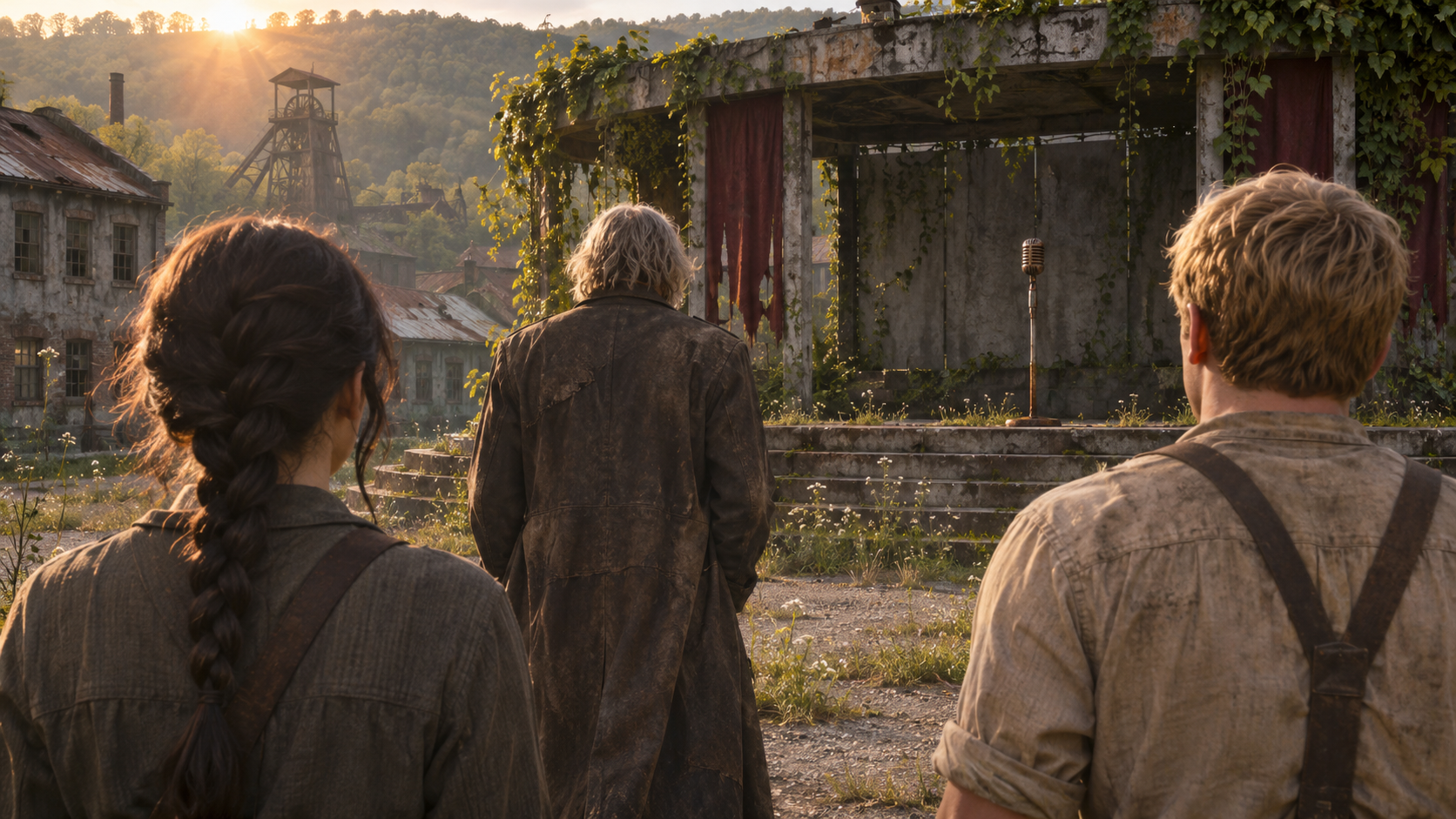
Katniss and Peeta return in a flash-forward set after Mockingjay. Jennifer Lawrence and Josh Hutcherson reprise their roles alongside Woody Harrelson as the older Haymitch. They join him at the old reaping site in District 12, wish him a happy birthday and thank him. The people he once had to prepare for the arena can now meet him on reaping day knowing that every child in the district is going home.
That explains why these two belong in the scene. What explains its timing is a promise Haymitch made to Lenore Dove decades earlier.
Why the Film Returns to the Reaping Site
The main story takes place during the 50th Hunger Games, twenty-four years before Katniss volunteers for her sister at the 74th. By the time the adult Katniss and Peeta appear, both those Games and the rebellion that followed are over. The ivy growing across the old reaping site tells us something about the intervening years. Someone once had to keep that place ready for a ceremony. Now it has been left long enough for plants to take it back.
For most people in District 12, the end of the reapings means that a particular date has lost its terror. For Haymitch, that date already had another use. It was his birthday before the Capitol took him, and it remained his birthday through all the years he spent mentoring other people’s children. Every year he survived brought another pair of tributes for him to advise. A birthday greeting would have been a difficult kindness on a morning like that.
Coming from Katniss and Peeta, it means more. Haymitch saw both of them leave this district with every expectation that at least one would die. Here they are, old enough to look back on it with him. The film can account for much of his adult life simply by putting those three actors in the same place and letting two of them say happy birthday.
The Promise Haymitch Made to Lenore Dove
Lenore Dove asks Haymitch to help bring about a morning when the sun rises and there is no reaping. When she dies, he has good reason to believe he has already lost his chance. He challenged the Capitol inside its own arena. Snow retained power, the broadcast concealed much of what Haymitch had done, and the people he hoped to come home to paid for his defiance. Even the sweets he offers Lenore Dove have been poisoned.
Ending the story there would leave an uncomfortable gap between the young man who loved her and the older man audiences met in The Hunger Games. We know why Snow punished Haymitch. We also know that, decades later, he had the wit and nerve to help two teenagers survive the same institution. What became of Lenore Dove’s request in the years between?
Katniss and Peeta supply the answer because we have already seen the part of his life that he spent with them. We watched Haymitch secure help from sponsors. We saw him take seriously a girl who was furious with him and a boy who understood how to speak to an audience. Later, we learnt how far he was prepared to go with the rebellion. The flash-forward lets those familiar decisions count towards a promise viewers only hear him make in the prequel.
Haymitch had no way of knowing, when Katniss first came to him, that helping her might one day bring the reapings to an end. That makes his earliest decision on her behalf especially moving. Trying to get her home alive was reason enough.
Why Peeta Belongs Beside Katniss
Katniss has an obvious claim on the closing scene. She became the Mockingjay, helped bring down Snow and has a connection to Haymitch that predates her own memories. The film even lets us see her as a baby when her parents, Burdock and Asterid, visit Lenore Dove’s grave. Haymitch knew her father when the future symbol of the rebellion was simply his friend’s little girl.
Peeta’s claim is different. He was the other child Haymitch was supposed to send into the arena with Katniss. Under the rules they grew up with, a mentor who brought either one home would have done extraordinarily well. At the end of their first Games, the threatened double suicide with the poisonous berries forced the Capitol to let both live. The old reaping site gives the film a chance to show what that victory amounted to years later. Both can turn up for somebody’s birthday.
There is also an exchange of thanks. Katniss and Peeta have ample reason to be grateful to their former mentor. Haymitch makes clear that the gratitude goes both ways. Across the original films, the two younger characters were usually the ones who needed something from him, sometimes urgently enough to be furious when he withheld it. Here they can invite him to spend time with them, and he can tell them he wants to walk out to the fields where he remembers Lenore Dove. They know him well enough to make the invitation. He trusts them enough to say where he would like to go.
What the Book Does With Goose Eggs
Suzanne Collins gives the three survivors a different exchange in the novel. The older Haymitch finally tells Katniss and Peeta about the people he loved and lost. His memories can take their place in the book they have been compiling to remember the dead. The next day, Katniss brings him goose eggs. Peeta makes an incubator so he can hatch them.
Lenore Dove kept geese. That small fact is the difference between a kindly meant present and one that could only have come from people who listened to him. Katniss has heard enough about Lenore Dove to know what the birds meant. Peeta has thought about what an egg needs if anything is going to come of the gift. For a man who spent years keeping people at a distance, there is an intimacy in letting them know him that precisely.
It also changes what it means for Haymitch to tell the truth. During his Games, the Capitol could take events he had lived through, rearrange them for television and send its version into homes across Panem. Even Katniss once had to rely on what survived in the recording of his Games. Years later, she can sit with the person who was there. A detail that would have meant nothing to the people editing the broadcast matters enough to her that she goes looking for goose eggs.
Collins leaves his grief intact. Haymitch knows what years of drinking have done to him. He still loves Lenore Dove. Raising birds gives that love somewhere to go on an ordinary morning, when there are eggs to tend and eventually geese to take out to the Meadow.
Why Haymitch Says “Nevermore”
The older Haymitch’s “Nevermore” carries an echo of Edgar Allan Poe’s The Raven, the poem that mourns a lost Lenore. For the speaker in Poe’s poem, the word closes off the hope of reunion. Haymitch has lived with that meaning for most of his life. He can walk to the place where he used to sit with Lenore Dove, but she cannot meet him there.
At the reaping site, the word has a second meaning. Lenore Dove wanted the annual selection of children to end. Haymitch has lived long enough to stand where it happened and say, with reason, that it is over. The same word can hold the thing he most regrets and the thing she most wanted.
That is what the film gains by bringing the audience back to Haymitch through Katniss and Peeta. The younger Haymitch could only promise Lenore Dove a future he found almost impossible to imagine. The older man gets to spend a little of his birthday with two people who lived to see it.
Sources
Slashfilm — The Katniss and Peeta scene explained. Details of the birthday greeting, the former reaping site and Haymitch’s final word.
Radio Times — The ending of Sunrise on the Reaping explained. The post-Mockingjay timeline, Lenore Dove’s request and the earlier appearance of Katniss with her parents.
SparkNotes — Sunrise on the Reaping book summary. The novel’s account of Haymitch’s losses, his relationship with Katniss and Peeta, and the gift of the goose eggs.
