Midsommar Explained: Dani, the Hårga, the May Queen and the Ending
The Price of Belonging
A Summer Invitation Offers Little Escape From Grief
Dani wants to feel secure with the person closest to her. Christian wants to avoid a difficult conversation about their relationship. When an invitation takes them to a secluded Swedish midsummer celebration, the journey promises distance from the pressures surrounding them. It also places their strained partnership inside a community with very different expectations of intimacy, suffering and belonging.
Written and directed by Ari Aster, Midsommar (2019) builds its horror around that emotional mismatch. Florence Pugh plays Dani, whose need for reassurance meets Christian’s increasingly reluctant attention. Flowers, communal meals and almost continuous daylight give their destination an inviting surface. Understanding the film means following how that welcome works, what each visitor hopes to gain, and how the ceremonies gradually change Dani’s relationship with the people around her.
Dani’s Loss Changes a Relationship Already Under Strain
Before Sweden enters the story, Dani is frightened by a disturbing message from her sister, Terri. She tries to contact her family and turns to Christian for reassurance. His response encourages her to treat the situation as another familiar crisis rather than a reason for immediate alarm.
Their conversation establishes an uncomfortable pattern. Dani needs support, but she also worries about exhausting his patience. Even while frightened, she monitors how much fear she allows him to hear.
Christian, meanwhile, discusses the relationship with his friends. He has considered leaving, and their impatience with Dani reinforces his inclination to withdraw. Yet wanting to end the relationship and accepting responsibility for ending it are different things. Christian remains suspended between them.
Then Dani learns that Terri has killed their parents and herself.
The film gives this loss devastating weight without requiring a lengthy family history. Dani’s entire immediate family disappears at once. Christian becomes the person holding her as she cries, although the audience already knows how uncertain his commitment was before the tragedy.
That knowledge changes the meaning of their continued relationship. Staying can resemble loyalty while also allowing Christian to postpone a decision he was already avoiding. Dani receives his presence without receiving the security she needs from it.
Pugh makes this uncertainty visible through the effort involved in ordinary conversation. Dani repeatedly tries to contain herself, recover her composure and make her needs manageable. Grief becomes something she experiences and something she fears other people will resent.
The opening also establishes a particular kind of isolation. Dani is capable of expressing pain, but expression does not guarantee that anyone can meet it. Christian can physically hold her while remaining emotionally difficult to reach.
Months later, that gap still shapes their lives together.
The relationship has survived the immediate catastrophe. It has acquired no convincing new foundation.
The Journey to Sweden Exposes What Christian Withholds
Dani discovers that Christian has plans to travel to Sweden with his friends. Their Swedish friend Pelle has invited them to visit the community where he grew up and attend a special midsummer festival.
For Josh, an anthropology student, the trip offers valuable research. Mark approaches it more as a holiday, with the possibility of meeting women. Christian has not properly included Dani in the planning.
His omission matters because it places her in another familiar position: she must ask for consideration and then worry that asking makes her unreasonable.
When they discuss the trip, the conversation becomes less about why he concealed it than about managing his discomfort at being challenged. Dani’s attempt to understand what has happened turns into another occasion for reassurance to flow towards him.
He eventually invites her. The invitation lacks the ease of a plan they have chosen together.
Pelle responds differently. He appears pleased that she will come, takes an interest in her and offers attention without making her negotiate for it. His manner introduces an alternative experience of being noticed.
That difference is initially small. Christian’s failures are often omissions rather than spectacular acts of cruelty. Pelle’s apparent kindness therefore becomes powerful through contrast: he remembers, asks and listens.
The journey carries these unresolved relationships into a landscape that looks dramatically different from the film’s opening. Winter darkness gives way to open countryside and bright skies. A camera movement that turns the travelling landscape upside down makes the transition feel physically unsettling.
The change of setting promises relief while disturbing the audience’s sense of orientation.
Dani has travelled with Christian, but she remains dependent on a group whose original plans did not centre her. Pelle supplies the connection to their destination. Once they arrive, his knowledge becomes increasingly important.
The visitors have come for different reasons. None possesses the same understanding of the place that their host does.
The Hårga Make Their Welcome Feel Entirely Natural
Before entering the main settlement, the visitors take psychedelic mushrooms. Dani hesitates, then joins the others. The experience intensifies her vulnerability rather than freeing her from it.
A passing reference to family unsettles her. Distorted perceptions and images associated with her loss turn the gathering into another place where she cannot control what returns to her mind.
The film’s shifting surfaces give this distress a visual form. Nature appears unstable, and the boundary between Dani’s surroundings and her bodily experience becomes less secure.
These effects establish an important distinction. The film shows altered perception, but altered perception does not automatically establish a supernatural world. Drugs and distress already provide reasons for what Dani experiences.
The Hårga settlement initially offers order after that disorientation. Residents wear pale clothing, eat together and organise their activities collectively. Flowers and decorative artwork surround the visitors.
They also meet Simon and Connie, a British couple brought by Ingemar, another member of the community.
The presence of other guests helps the visit resemble an unusual cultural exchange. The Americans are not the only outsiders, and unfamiliar customs can initially be approached as things to observe and understand.
Yet the welcome comes with an imbalance. The residents know the schedule, the rules and the significance of their surroundings. Their guests depend on explanations supplied by the people controlling the experience.
Even the visual openness becomes unsettling. Daylight exposes the settlement without explaining it. The visitors can see buildings, gatherings and ceremonial objects while remaining uncertain about what those things require.
Cinematographer Pawel Pogorzelski’s bright images give the place a beauty that complicates an easy response. The environment does not warn the characters through conventional darkness or decay. Its reassuring appearance coexists with their lack of knowledge.
Dani is especially responsive to the possibility of being welcomed. After months of feeling burdensome, she encounters people who make communal participation look effortless.
For the moment, the Hårga seem to offer a way of living in which nobody has to carry an experience alone.
The First Ceremony Makes Cultural Distance Impossible to Ignore
The visitors attend a ceremony involving two elderly members of the community. What begins as a formal gathering becomes an act of public violence.
The elders jump from a cliff. One dies on impact. The other survives the fall and is killed with a mallet.
The scene destroys any assumption that the festival’s strangeness will remain decorative.
Different reactions divide the visitors. Simon and Connie are openly horrified. Dani is overwhelmed. The Hårga respond through a shared ritual framework, including collective vocal reactions to suffering.
Their elder Siv explains the deaths as part of the community’s understanding of life. At seventy-two, residents are expected to complete their cycle rather than continue into further old age.
The explanation supplies a rationale. It does not remove what the guests have witnessed.
This distinction becomes central to the film’s treatment of anthropology. Understanding how a practice is justified inside a community does not settle whether someone should accept it. The visitors’ interest in cultural difference becomes dangerous when explanation begins to substitute for judgement.
For Dani, the ceremony also forces a confrontation with death that she did not choose. She has travelled away from the place associated with her family’s loss, only to encounter another violent ending presented as something orderly and meaningful.
The Hårga offer a system in which death has an assigned position. That can possess emotional appeal for someone whose own bereavement feels senseless.
Pelle reinforces the connection. He tells Dani that he also lost his parents and describes the community as the family that supported him afterwards. He directs her attention towards the question of whether Christian gives her that same sense of being cared for.
The timing gives his reassurance influence. Dani has just been destabilised, and Pelle offers both recognition and a place within an explanation.
His account of his parents should remain his account. The film does not establish a complete history of their deaths, and later events do not justify inventing one.
What matters here is the use he makes of the disclosure. He presents himself as someone who understands loss and the Hårga as people who know how to answer it.
Dani’s attachment to Christian now exists beside an increasingly persuasive invitation to belong elsewhere.
The Visitors’ Interests Keep Them Inside the Community
After the cliff ceremony, remaining at the settlement requires the visitors to explain away an enormous warning.
Simon and Connie want to leave. Their response establishes that the violence is not universally accepted by outsiders as a challenging but worthwhile cultural experience.
Connie is subsequently told that Simon has already been taken to the station without her. She objects because his departure makes little sense to her.
The explanation asks her to trust the community’s version of her own partner’s behaviour.
Elsewhere, Christian decides to make the Hårga the subject of his thesis. This brings him into conflict with Josh, whose research interests helped motivate the trip.
Their dispute exposes another weakness in Christian’s relationships. He wants the opportunity in front of him while minimising the cost of claiming it from someone else. Josh’s anger becomes something Christian must manage rather than a reason to reconsider.
The academic rivalry also changes what the settlement represents. An alarming place becomes a resource whose value may justify staying.
Josh’s seriousness offers no complete protection either. Research gives him a reason to remain engaged with people who control access to the information he wants.
Mark’s carelessness creates a different conflict when he urinates on a sacred tree. His failure to recognise its significance deeply offends members of the community.
The visitors therefore become entangled through different weaknesses: ambition, opportunism, distraction and emotional dependence.
Those differences explain their behaviour without making them responsible for violence committed against them. Disrespecting a custom or pursuing research does not authorise murder.
Meanwhile, Pelle’s attention continues to distinguish him from Christian. Dani’s birthday becomes another occasion when she receives recognition from Pelle that her boyfriend has failed to provide.
The emotional scale is painfully ordinary. Remembering a birthday requires little beside the elaborate rituals surrounding them. Its importance comes from how long Dani has been waiting for evidence that someone is glad she exists.
The Hårga’s attraction grows through these small recognitions as well as their grand claims about community.
Disappearances Reveal the Limits of Being a Guest
Mark leaves with a woman from the settlement. Later, Josh enters a building to photograph the Hårga’s sacred text despite being forbidden to do so.
During this intrusion, he encounters a figure wearing Mark’s face as a mask and is attacked.
The sequence turns absence into something much worse. Mark’s departure can no longer be understood simply as a private encounter, and Josh’s research has brought him into immediate danger.
The Hårga’s control of information becomes increasingly clear. They can explain who has left, who has broken a rule and what outsiders are permitted to know. Their guests lack independent ways to verify those accounts.
The sacred text also raises a broader question about authority. The community presents its practices as belonging to an established order. Yet the people explaining that order also determine how it should be interpreted.
An outsider seeking clarification must appeal to the same structure whose actions require scrutiny.
That circularity makes the settlement difficult to challenge from within. A troubling practice can be explained through tradition, while tradition is explained by those carrying it out.
Dani is moving along a different path from the men. As they become more isolated through research, conflict and disappearance, she is increasingly drawn into activities with the women.
The contrast does not yet give her a complete understanding of her position. It changes the emotional texture of her stay.
Christian remains physically present but offers little dependable orientation. Pelle and the women provide forms of attention that feel more immediate.
The danger is therefore unevenly experienced. Dani can feel more included while the audience becomes more aware of the community’s capacity for violence.
Aster makes those developments coexist. Emotional welcome does not suspend the horror occurring around it.
Instead, the welcome makes the horror harder for Dani to recognise as a reason to reject the people offering it.
The Maypole Dance Gives Dani a New Place
Dani joins the women for the maypole dance after taking a hallucinogenic drink. The competition continues as dancers lose their footing and fall away.
For much of the film, she has struggled to participate without feeling that she is imposing. Here, participation becomes bodily and shared. She follows a rhythm rather than negotiating for reassurance.
At one point, communication with another dancer seems to escape the ordinary barrier of language. Within the drugged experience, belonging feels immediate.
The moment does not require literal supernatural translation. Its dramatic function is to let Dani experience connection without the exhausting work that has defined her conversations with Christian.
She wins and is crowned May Queen.
The honour gives her a public position. People gather around her, celebrate her and organise themselves in relation to her. Someone who has spent the film fearing that she takes up too much emotional space becomes the centre of attention.
That reversal helps explain the force of the ceremony. Recognition arrives through an entire group rather than a single reluctant partner.
Yet Dani receives a role before she understands its full obligations. Being celebrated does not mean she has been given informed control over what follows.
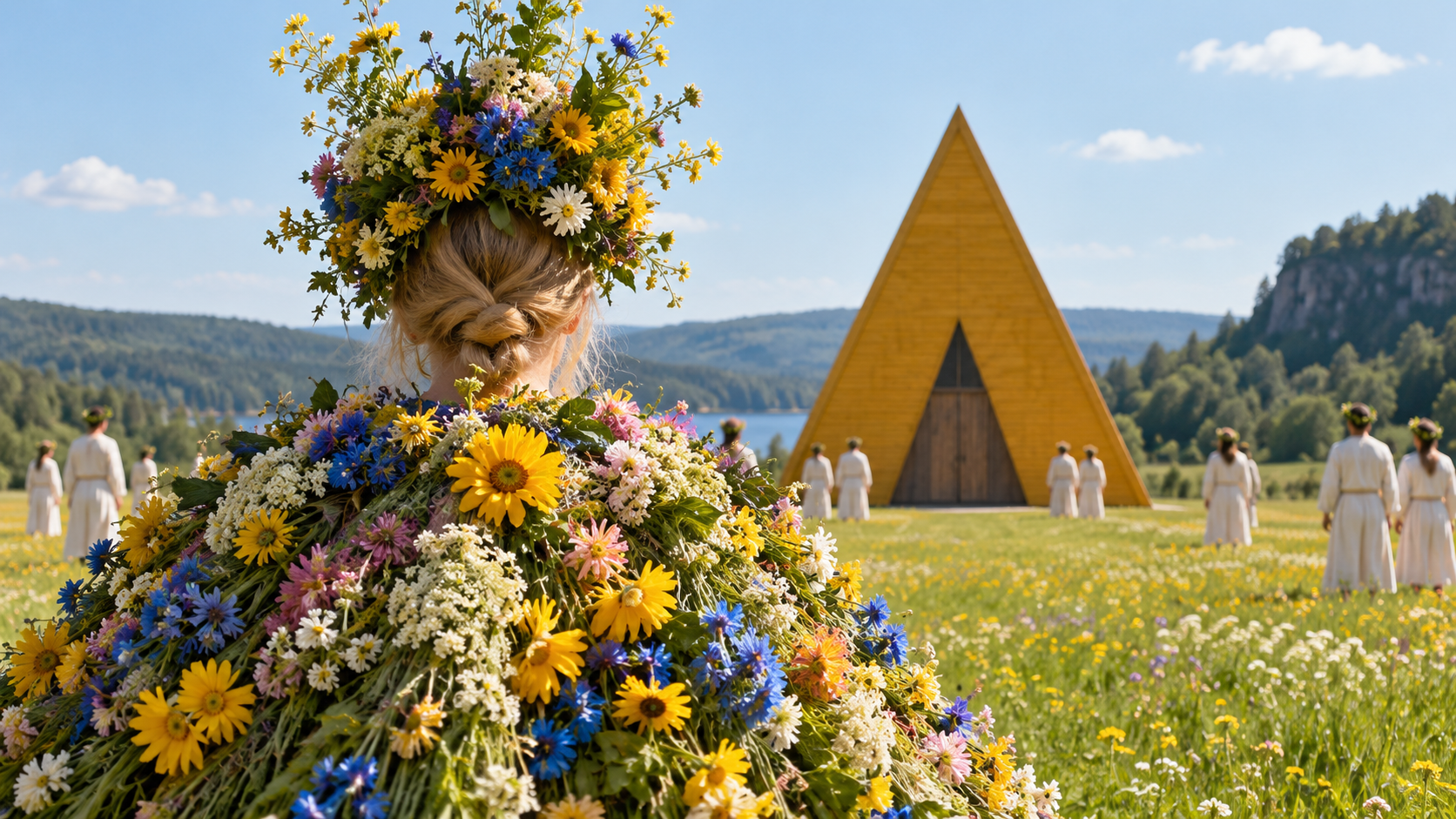
The flower crown and later floral clothing express that uncertainty visually. They distinguish her as special while increasingly enclosing her within the community’s design.
A crown can confer status. It can also mark the person expected to perform a function.
Christian is now visibly displaced from Dani’s experience. Her new relationships develop through gestures, movement and ritual in which he plays little part.
For once, she does not have to organise an interaction around his willingness to engage.
The relief is real within the scene. Its source remains a community that has already demonstrated how severely it can restrict other people’s choices.
Two Rituals Give the Couple Different Experiences
As Dani performs ceremonial duties associated with her new position, Christian is drawn towards a sexual ritual involving Maja, a young woman who has shown interest in him.
The Hårga have discussed their management of reproduction and the use of outsiders. Christian’s body has become relevant to plans he does not control.
He is heavily affected by drugs when the encounter takes place. Older women surround the pair, vocalising together and directing the ritual.
That context is essential. Christian’s earlier emotional failures do not make him capable of freely consenting to whatever the community arranges. The scene depicts sexual exploitation under conditions of intoxication and coordinated pressure.
Reynor’s exposed performance turns someone who has often avoided emotional responsibility into a person with almost no control over his own situation.
Dani does not receive the audience’s full perspective on that vulnerability. She discovers the sexual act and experiences it as a devastating betrayal.
Her reaction grows from everything that precedes it: insecurity, withheld reassurance and the sense that Christian remains with her without choosing her wholeheartedly.
The distinction between their experiences matters. Dani’s pain is understandable. Her understanding of the event is incomplete.
When she breaks down, the women gather around her and mirror her crying and breathing.
The scene transforms the form of grief established at the beginning. Earlier, Dani’s pain seemed too large for the relationship available to contain it. Now an entire room responds at her intensity.
She does not have to become quieter to remain acceptable.
That responsiveness explains the scene’s emotional power. It also makes its circumstances disturbing. The group providing consolation belongs to the same community that has arranged the event triggering her collapse.
The Hårga can participate in producing a crisis and then become the people who seem uniquely capable of answering it.
For Dani, those experiences may feel like injury followed by rescue. For the audience, their connection makes the rescue difficult to trust.
The Final Ceremony Places a Choice Before Dani
Christian leaves the sexual ritual naked and disoriented. As he moves through the settlement, he encounters evidence of what has happened to the missing visitors.
The place that offered research and pleasure now reveals the violence supporting its order.
He discovers Simon suspended in a grotesquely mutilated state. Before Christian can escape, a substance is blown into his face, leaving him paralysed.
The Hårga then explain the requirements of their sacrificial ceremony.
Nine human offerings are to be placed inside the yellow temple. Four come from outside the community: Mark, Josh, Simon and Connie. Four come from within it, including the two elders and two living volunteers, Ingemar and Ulf.
The final offering requires a decision from the May Queen.
Dani is presented with Christian and a member of the Hårga selected by lottery.
This is the moment when her celebrated position reveals its most terrible responsibility. The community grants her a choice within a ritual whose basic terms she has never been allowed to reject.
She is not invited to decide whether anyone should die. She is asked to determine which person completes the number.
Christian becomes the final victim. He is placed inside the emptied body of a bear and carried into the temple with the other offerings.
The bear turns him into a ceremonial object, concealing his human body beneath a form assigned meaning by the Hårga. The individual becomes something the ritual can claim to expel.
The temple is set alight.
As the living volunteers suffer, the residents outside respond with collective cries and movements. The shared expression that appeared to offer Dani comfort now accompanies deaths the group has deliberately arranged.
Dani watches from within her vast covering of flowers. Her expression passes through distress and uncertainty.
Then she smiles.
The film ends with that change in her face, leaving the audience to assess what it has just been encouraged to feel.
Why Dani’s Final Smile Is So Difficult to Trust
Dani’s smile can be understood as relief, identification with the Hårga and the emotional severing of her attachment to Christian. Those meanings can coexist.
The relationship that left her feeling unwanted has ended with absolute finality. The community surrounding her appears willing to share feelings that once made her feel isolated.
Yet a feeling of release cannot establish that she has become safe.
The Hårga have controlled information, administered drugs, arranged sexual exploitation and killed visitors. Their acceptance of Dani does not undo those acts. It places her inside the group responsible for them.
Aster has described her movement towards the community in terms of replacing one dependent relationship with another. That interpretation explains why the ending can feel emotionally satisfying without representing recovery.
Dani has found people who respond to her pain. Whether they permit an independent self to emerge from that pain is a different question.
The final choice demonstrates the restriction. Her authority extends to selecting a victim. It does not extend to dismantling the situation.
Her apparent empowerment therefore serves the community’s existing purpose.
Christian’s death also tests the audience’s judgement. The film spends considerable time aligning us with Dani’s hurt and exposing his evasions. It then places his suffering inside an elaborate scene of emotional release.
Disliking his behaviour can make the punishment feel satisfying before its scale is properly considered.
Aster has called this effect “toxic catharsis”. The phrase captures the ending’s capacity to offer pleasure that becomes harder to defend on reflection.
Christian’s emotional neglect and his victimisation remain separate moral facts. He can have treated Dani badly and still be a person subjected to sexual exploitation and murder.
Allowing both facts to remain visible prevents the ending from becoming a simple fantasy in which the disliked boyfriend receives an appropriate consequence.
Pelle’s role also becomes clearer retrospectively. His kindness helped make the community attractive to Dani, while his recruitment of visitors served its violent purposes.
The film supports reading his attention as part of that process. It does not prove that he controlled every outcome, guaranteed Dani’s victory or arranged the deaths of her family.
Such theories would turn suggestive design into unsupported certainty.
The same care applies to the film’s visions. Moving flowers and unstable surfaces communicate intoxication and altered experience. The story does not need supernatural intervention to explain the community’s success.
Its most disturbing powers are recognisably human: attention, persuasion, isolation and control over another person’s circumstances.
Even the daylight belongs to that logic. The horror does not depend on remaining unseen. The residents can perform violence openly because they possess a shared explanation that makes it acceptable to them.
Bobby Krlic’s swelling final music adds emotional grandeur to the destruction. The sound helps the scene feel like an arrival, even while the image shows people being burned alive.
Dani’s smile completes that tension. It gives the ending the appearance of fulfilment without resolving its violence.
At the beginning, she has a partner who cannot reliably meet her grief. At the end, she has a community that meets it with overwhelming intensity and demands participation in its cruelty.
The closing image offers an answer to her loneliness. What makes it horrifying is the cost of accepting that answer.
Sources
Midsommar: Official Film Page — Credits and the film’s central premise.
Ari Aster Discusses the Ending and Its “Toxic Catharsis” — The director on emotional alignment and the final sequence.
Jack Reynor Discusses Christian’s Vulnerability and the Sexual Ritual — Performance, intoxication and the treatment of Christian.
Next Reads
Rebecca Explained: Manderley, the Second Mrs de Winter and the Ending — Another unsettling story about intimacy, insecurity and the desire to belong.
The Kite Runner Explained: Amir, Hassan, Betrayal and the Ending — How emotional allegiance can complicate responsibility and judgement.
Romeo and Juliet Explained: The Feud, the Lovers and the Ending — Private relationships shaped by the demands of a surrounding community.
