Enemy Explained: Adam, Anthony, the Spiders and the Ending
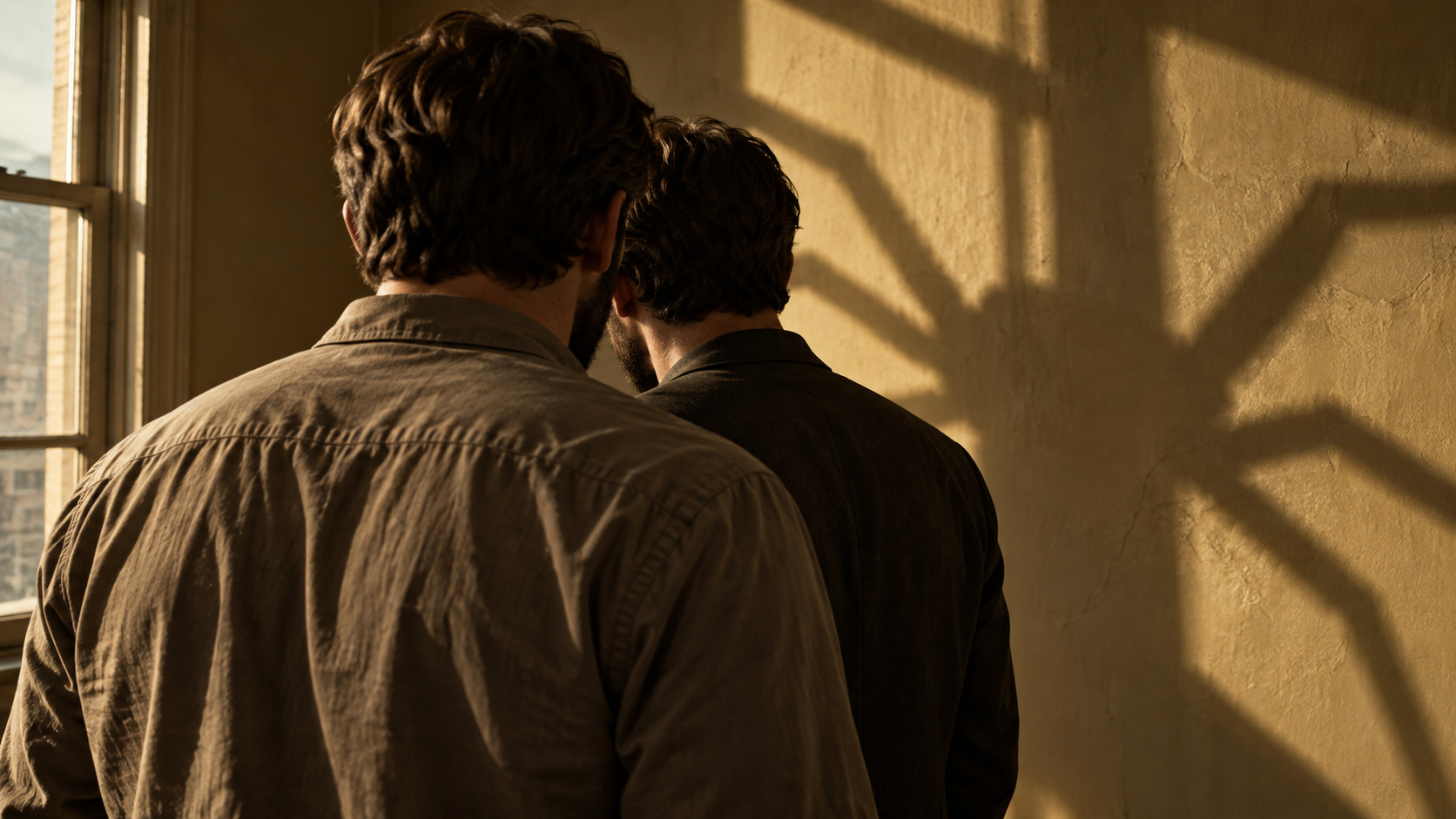
The Key, the Car Crash and the Spider
A Stranger on Screen Has His Exact Face
Adam Bell watches a film and notices something he cannot explain: a minor actor looks exactly like him. What begins as curiosity becomes an investigation into another man’s work, marriage and private life, unsettling Adam’s already fragile sense of himself.
Directed by Denis Villeneuve, Enemy premiered in 2013 before its 2014 theatrical release. Jake Gyllenhaal plays both the withdrawn history lecturer and the actor whose appearance disturbs him. Loosely adapted from José Saramago’s The Double, the film turns an encounter between lookalikes into a troubling exploration of identity and desire.
Understanding it means following what happens while recognising that its images may express fears as well as events. The distinction becomes crucial as the two lives begin to overlap.
A Private Ritual and a Repetitive Life
Before Adam begins investigating his double, Enemy establishes an atmosphere of secrecy. In an underground club, men watch an erotic performance. A woman approaches a tarantula with her high heel poised above it.
The scene offers no explanation of the club’s rules or the spider’s significance. Sexual attraction and threatened violence occupy the same space. Something vulnerable has become part of a spectacle arranged for an audience.
Then the film introduces Adam’s ordinary existence.
He teaches history in Toronto, returns to his sparsely furnished flat and spends time with his girlfriend, Mary. His days seem to repeat rather than develop. Work provides structure, but little visible satisfaction. Physical intimacy does not necessarily produce emotional closeness.
His lectures concern control, dictatorship and recurring historical patterns. These ideas establish a question that extends beyond the classroom: how easily can people recognise the forces directing their own behaviour?
Adam can explain systems of control professionally. Whether he understands the routines governing his private life is less certain.
The film’s oppressive atmosphere makes that uncertainty tangible. Toronto appears under a yellowish haze, while buildings and interiors offer few inviting places of escape. The city feels inhabited without feeling companionable.
Sound reinforces this discomfort. The film’s sound designer, Oriol Tarragó, describes an approach built around detailed minimalism and silence. Ordinary spaces therefore remain exposed: a pause or faint background noise can become unsettling because there is so little to distract from it.
This matters to the story’s starting point. Adam does not move from contentment into an inexplicable nightmare. His life already feels estranged. Discovering the double gives that estrangement a face.
Adam Finds Another Version of Himself
A colleague recommends a film called Where There’s a Will There’s a Way. Adam rents it and eventually notices a background performer whose appearance matches his own.
The actor is playing a bellhop. His role is insignificant within the film, but his presence becomes overwhelmingly important to Adam.
Searching the credits and looking online, Adam identifies the performer as Anthony Claire, who works under the professional name Daniel Saint Claire. Adam seeks out further appearances to examine the resemblance.
The discovery reverses the usual relationship between a viewer and a screen. People often look to films for an alternative to their own lives. Adam finds his own image there, apparently belonging to somebody else.
The more evidence he gathers, the less reassuring the discovery becomes.
A passing resemblance could be dismissed. A recurring face attached to another career and another name suggests an independent existence. Adam wants confirmation, yet confirmation would make the situation harder to explain.
His behaviour also changes. The passive man whose days appeared interchangeable becomes persistent and intrusive. Anthony’s existence supplies a purpose that his established routine seems unable to provide.
That does not mean Adam understands what he wants from the encounter.
He might hope to establish a biological connection, expose a misunderstanding or simply see the man in person. The film does not reduce his fascination to one explicit motive. His investigation proceeds ahead of any clear understanding of what a satisfying answer would look like.
This is the first trap of the double: another person appears to promise an explanation of the self, but investigating him may only deepen the uncertainty.
A Phone Call Reaches Anthony’s Marriage
Adam visits Anthony’s talent agency, where staff mistake him for the actor and give him a private envelope intended for Anthony.
His resemblance has now crossed a boundary. It does not merely disturb Adam when he watches a film. It allows him to enter another person’s professional identity.
He also obtains contact information and calls Anthony’s home.
Helen, Anthony’s pregnant wife, answers. Hearing her husband’s voice, she initially assumes she is speaking to him. Adam’s insistence that he is somebody else makes the conversation increasingly uncomfortable.
A later conversation with Anthony is hostile. Anthony treats the unexplained caller as an intrusion rather than an opportunity.
Helen, however, has reasons to question her husband’s account. Her concern about renewed infidelity suggests that their marriage already contains a history of damaged trust.
The double has therefore entered a relationship that was unstable before Adam’s call.
Helen investigates independently and finds Adam at the college where he teaches. Meeting him is profoundly unsettling: he looks like her husband, yet does not recognise her.
For Adam, she is an unfamiliar woman. For Helen, his face carries the weight of an intimate relationship.
That imbalance gives the encounter its emotional force. The same appearance can mean almost nothing to one person and an entire shared life to another. Helen cannot solve the problem simply by looking more closely. Recognition itself has become unreliable.
Her investigation also changes the film’s perspective. Until now, Anthony could seem like an object Adam needs to understand. Helen makes clear that Anthony’s life contains another person’s vulnerability.
He is somebody’s husband and an expectant father. Whatever Adam’s discovery means, its consequences cannot remain confined to the two men.
Their Meeting Creates a Struggle for Control
Adam and Anthony eventually meet in a hotel room.
Their resemblance extends beyond the face. Even a bodily scar is duplicated. The meeting provides physical confirmation without supplying an origin story.
There is no explanation involving an experiment, a secret institution or a newly discovered family history. Instead, the film concentrates on how the men behave when confronted with each other.
Adam is apprehensive and wants to withdraw. Anthony is more assertive, testing the situation and taking up space.
Gyllenhaal makes the distinction through posture, tension and delivery rather than a dramatic physical transformation. The men have the same visible features, but different ways of inhabiting them.
This raises an uncomfortable possibility. If bodily appearance cannot distinguish them, personality becomes the apparent boundary between their identities. Yet personality is also something that changes with circumstance.
A timid person can become aggressive. A confident person can become frightened. The contrast is legible without being secure.
Anthony’s subsequent interest in Mary turns that instability into a threat.
He follows Adam and observes his girlfriend. Then he accuses Adam of having slept with Helen and uses this claim to demand access to Mary. He wants Adam’s clothes and car so that he can impersonate him.
The accusation supplies a supposed justification for what Anthony already wants. He presents sexual access to Mary as compensation in a dispute between men.
Mary has agreed to none of this.
That omission exposes the ugliness beneath Anthony’s confidence. He treats resemblance as permission and another person’s relationship as something he can appropriate.
Adam’s submission is disturbing for a different reason. His discomfort does not translate into effective resistance. The investigation he began now gives Anthony the means to direct his behaviour.
Finding another version of himself has left Adam less in control.
The Mother Complicates Adam’s Account
Adam’s conversation with his mother introduces a different kind of uncertainty.
She dismisses the possibility of a double, refers to his respectable life and tells him to abandon his ambitions as a minor actor.
The remark is difficult to reconcile with the clean division established so far. Acting supposedly belongs to Anthony’s life, while Adam is the lecturer investigating him.
His mother’s familiarity cuts across that separation.
The significance lies in the contradiction, rather than in treating her as an infallible narrator. She does not deliver a complete explanation. Her comments undermine the version of himself Adam appears to inhabit.
The scene also makes his identity feel subject to somebody else’s authority. His mother speaks as though she knows what his life is and what he should do with it. Adam’s uncertainty meets her certainty.
A huge spider later appears above the city, extending the film’s disturbing imagery beyond the private club.
Here, scale changes the effect. A creature small enough to be threatened under a heel becomes something that dwarfs human buildings. What seemed containable now dominates the landscape.
At this stage, the film still resists a fixed explanation. The spider connects unease, sexuality and power without behaving like an ordinary animal within a consistent physical world.
Its presence encourages a different way of watching. Some images may be showing the size of a feeling rather than the size of an actual creature.
That possibility becomes increasingly important as Adam and Anthony exchange places.
Two Relationships Face the Exchange
Anthony takes Mary away while impersonating Adam. Adam, meanwhile, enters Anthony’s home and encounters Helen.
The exchange appears symmetrical, but the two women respond differently.
Mary initially believes she is with her boyfriend. Her understanding depends on the familiar face concealing an unfamiliar person.
Helen has already met Adam. Her response therefore carries a more complicated awareness. The man before her resembles her husband, but his behaviour offers a different emotional presence.
In the flat, Adam also encounters an intact version of a photograph resembling a torn picture he possesses. Helen is the woman beside the man.
The image makes the apparent boundary between the two lives harder to maintain. Photography would normally help confirm identity by preserving a moment from the past. Here, it further entangles the evidence.
Adam’s distress eventually gives way to an emotional encounter with Helen. She asks him to stay.
The request can be heard in two ways. Within the literal exchange, she is asking the gentler double to remain. Within a psychological reading, she may be asking for a more attentive version of her husband to return.
The film allows both possibilities to operate before resolving neither into a straightforward explanation.
Mary’s experience becomes more explicitly alarming. She notices the mark left by a wedding ring on Anthony’s finger.
The body that made the deception possible now exposes it.
Her response is a recognition that the situation is wrong. Anthony cannot make that recognition disappear by insisting that nothing has changed. An intimate encounter has become unsafe because the person she believed she knew no longer seems identifiable.
She demands to leave. During the subsequent drive, their argument culminates in a violent crash.
The film presents the collision as apparently fatal, without providing a conventional aftermath confirming the occupants’ deaths. A shattered window forms a web-like pattern, bringing the recurring spider imagery into contact with the destruction.
Meanwhile, Adam’s encounter with Helen offers the appearance of reconciliation.
One relationship seems to open towards renewed intimacy as the other ends in catastrophe. That juxtaposition becomes central to understanding what the double may represent.
The Key and the Final Bedroom
The following morning, Adam finds a key inside the envelope originally intended for Anthony.
It connects him to the underground club.
He tells Helen that he intends to go out that evening. When she does not answer, he approaches the bedroom.
Instead of Helen, he sees an enormous tarantula pressed into the room.
The spider recoils.
Adam’s response is a weary sigh rather than the panic such a sight would ordinarily produce.
The final image withholds the kind of explanation a conventional mystery might provide. Nobody reveals a secret history or identifies a mechanism responsible for the doubles. Instead, the film places a disturbing transformation at the exact point where domestic reconciliation appears to meet renewed temptation.
The sequence gives the key its importance.
Adam has an opportunity to remain emotionally present with Helen. Then an object associated with secrecy and erotic spectacle redirects his attention.
His announcement that he will go out might sound ordinary in isolation. After the club’s opening appearance and the night’s apparent reconciliation, it carries a different implication.
The final spider suggests that something has returned.
Its defensive posture complicates the initial shock. A huge creature should make Adam seem vulnerable, yet the creature appears afraid of him.
That reversal shifts the question from what threatens Adam to what his behaviour may threaten.
The ending therefore contains two simultaneous perspectives: his fear of being trapped by intimacy, and another being’s fear of the harm he may repeat.
Are Adam and Anthony the Same Person?
The strongest psychological interpretation is that Adam and Anthony represent conflicting aspects of one man whose infidelity has fractured his relationships and self-understanding.
This reading has direct support from Villeneuve. He has described the underlying story as a man leaving his mistress and returning to his wife, presented through his subconscious. He has also explained that the film was constructed to sustain uncertainty between an extraordinary encounter and an internal division.
The distinction matters.
Saying that the film concerns one divided man does not establish a clinical diagnosis. Nor does it provide a timetable identifying which scenes are dreams, memories or literal events.
It offers an organising interpretation.
On that reading, the doubles make compartmentalisation visible. A man who separates desire from commitment can imagine those competing demands as belonging to different selves.
Anthony expresses entitlement and pursuit. Adam expresses inhibition, distress and the desire for another form of connection.
Neither is a complete moral opposite of the other. Adam’s passivity does not prevent harm, while Anthony’s confidence does not amount to freedom. Both participate in a structure that keeps the women affected by their choices outside full knowledge.
This is why identifying one double as wholly good and the other as wholly bad simplifies the film too far.
The deeper problem is the refusal to recognise a shared responsibility.
Helen’s response becomes particularly moving through this interpretation. The person she wants to stay may be the husband she remembers being able to reach. His tenderness feels like a return, even while the film represents that return as somebody else entering the home.
The mother’s remarks and the overlapping photograph also become intelligible without becoming perfectly solved. They suggest a shared history pressing against the separation the protagonist maintains.
A literal reading remains available: two identical men meet and become entangled in an uncanny exchange. It preserves the immediate threat of replacement and the horror of discovering that appearance cannot guarantee identity.
The psychological reading, however, connects more directly to the film’s treatment of secrecy, intimacy and recurrence. It explains why the encounter matters emotionally, beyond its impossibility.
The film’s ambiguity is consequently structured rather than limitless. Not every explanation has equal support.
What the Spiders and the Crash Can Mean
The spiders work most effectively as related images rather than entries in a fixed symbolic dictionary.
Their contexts change.
At the club, a spider is exposed to possible destruction within an erotic spectacle. Above Toronto, a spider becomes impossibly large. In the bedroom, a giant spider recoils from Adam.
Together, these appearances associate desire with vulnerability, fear and power.
One persuasive interpretation is that women become spider-like within the protagonist’s anxious perception. Emotional dependence, pregnancy and commitment appear to him as forms of capture.
That interpretation should not be mistaken for the film declaring women predatory.
The distinction between a character’s fear and a film’s judgement is essential. Helen’s vulnerability gives reason to question the protagonist’s view of her. If he sees a trap where there is also a person asking for care, the distortion belongs to his perception.
The final spider’s fear makes that distortion harder to overlook.
Villeneuve has connected the imagery to male sexuality and the subconscious while deliberately leaving its precise meaning open. His comments support interpretation without authorising one universal translation.
The crash requires similar care.
Within the surface narrative, Anthony and Mary appear to suffer a fatal accident. Within the psychological reading, the collision can represent the catastrophic ending of the affair and the attempted rejection of the self associated with it.
The editing places that destruction alongside renewed intimacy with Helen. Desire is being reorganised through an image of annihilation.
However, the film does not establish that a real crash occurred at a specific earlier date, caused the shared scar and generated the entire division. That reconstruction goes beyond what the available evidence confirms.
There is an ethical reason to preserve the distinction. Calling Mary symbolic should not make her experience irrelevant.
Her alarm exposes deception. Whether she occupies a literal event or a distorted recollection, the story presents a woman discovering that the man beside her has withheld something fundamental.
Likewise, interpreting Helen as a figure within the protagonist’s subconscious does not exhaust her significance. Her request for him to stay expresses a need that his internal conflict repeatedly puts at risk.
The women are affected by his division; they are not merely clues explaining it.
Why the Ending Returns to the Beginning
The key prevents the apparent reconciliation from becoming a secure conclusion.
Adam may have changed places, but the route back to secret gratification remains available. His renewed interest suggests that occupying a different role has not necessarily changed the pattern directing him.
That returns the film to the lectures about control.
The protagonist can analyse repetition from a distance. He struggles to recognise or interrupt it in himself.
There is an irony in that gap. Knowledge does not automatically become self-knowledge, and self-knowledge does not automatically become different behaviour.
The film’s design makes the viewer experience a related frustration. Discovering a clue creates the hope that the next piece will finally settle everything. Yet the accumulation of information does not produce the clean mastery a mystery usually promises.
Understanding requires accepting that the central conflict concerns accountability as much as identity.
The title Enemy becomes meaningful here. A double appears to offer a convenient external opponent: somebody else who can be followed, feared or blamed.
The psychological reading removes that convenience. The threat belongs to impulses the protagonist cannot simply defeat by replacing one version of himself with another.
The ending does leave room for a moment of recognition. Adam’s sigh may suggest familiarity, exhaustion or awareness of recurrence. His reaction is open enough to resist a single emotional label.
But recognition has not yet become a demonstrated choice to stop.
That is why the final image remains troubling after its initial shock. The film offers the possibility of tenderness, then exposes how quickly it can coexist with the wish to escape responsibility.
Helen’s apparent transformation does not answer whether he will change. It shows how his fear may continue to deform the person before him.
The final room contains a relationship he could inhabit and a frightening image through which he may avoid inhabiting it. The key in his possession makes that tension immediate.
He has found his way back to intimacy. Whether he can remain there is the question the film leaves open.
Sources
A24 — Enemy: Official Synopsis, Credits and Theatrical Release
Film Comment — Denis Villeneuve Interview on Identity, Infidelity and the Film’s Imagery
Nerdist — Denis Villeneuve Interview on the Doubles and Subconscious Storytelling
Next Reads
Fight Club Explained: Tyler Durden, Project Mayhem and the Novel’s Ending — Another exploration of identity and divided responsibility, covering the novel.
Shutter Island Explained: Teddy Daniels, Ashecliffe and the Ending — Dennis Lehane’s novel examined through memory, grief and uncertainty.
Gone Girl Explained: Nick, Amy, the Marriage and the Ending — A novel about deception, competing identities and the struggle to control a relationship’s story.
