The Shining Explained: Jack Torrance, the Overlook Hotel and the Ending
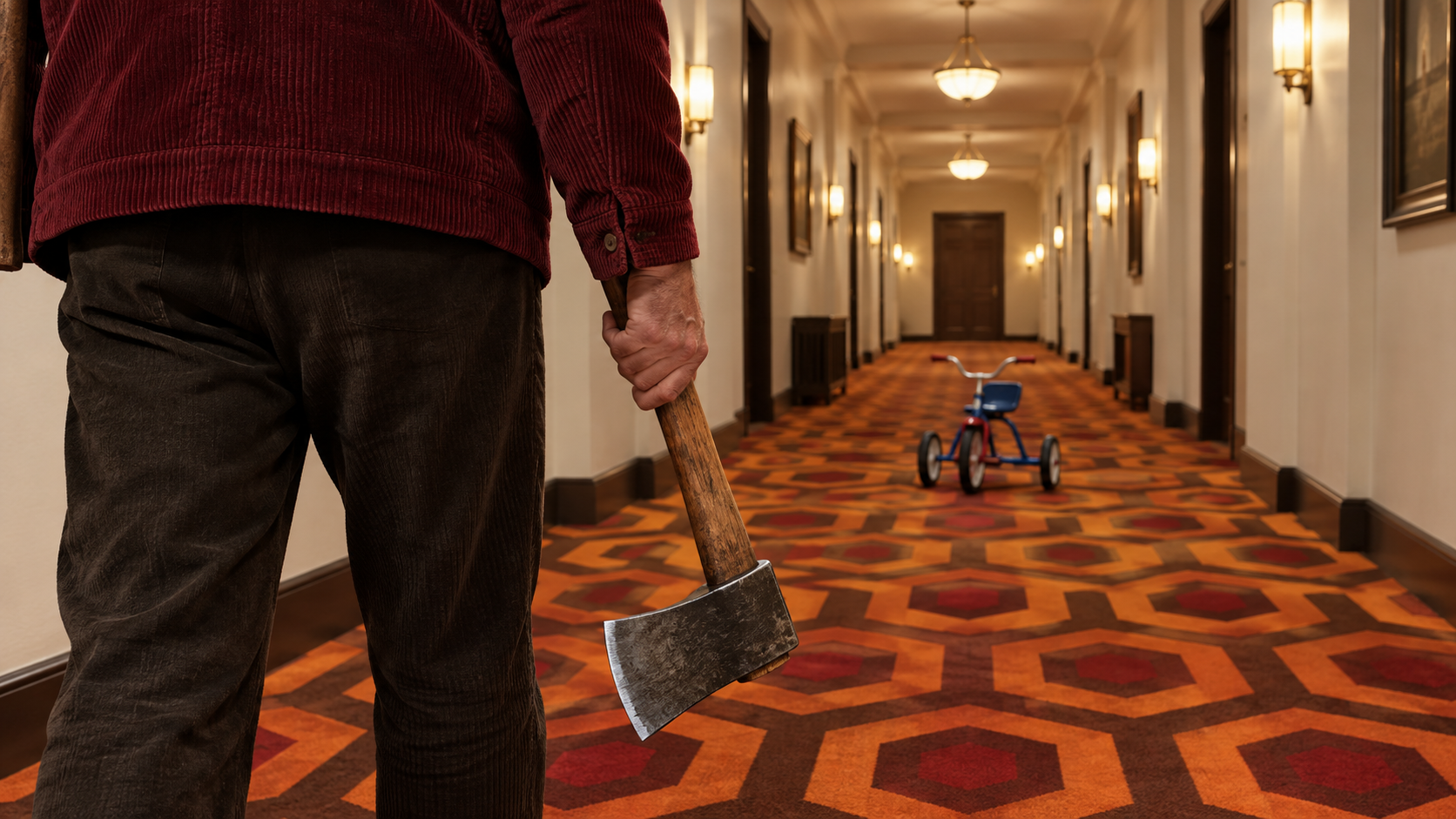
What Really Happened at the Overlook?
A Winter Job Leaves a Family Alone Together
Jack Torrance wants somewhere quiet to write. The Overlook Hotel offers accommodation, paid work and months without guests. His wife Wendy and their young son Danny will keep him company while he looks after the building through winter. For Jack, isolation looks like an opportunity. For Danny, something about the hotel is already frightening.
Stanley Kubrick’s The Shining (1980), adapted from Stephen King’s novel, turns this arrangement into a story about family violence, supernatural influence and the danger of trusting appearances. Jack Nicholson, Shelley Duvall and Danny Lloyd play a family whose difficulties accompany them into the mountains. Understanding the film means following both the hotel’s disturbances and the choices Jack makes in response.
Jack Accepts the Overlook’s Winter Vacancy
The Overlook stands in the Colorado mountains, where winter weather makes ordinary access impossible. Its seasonal closure leaves a caretaker responsible for maintaining the building until the guests return.
During Jack’s interview, hotel manager Stuart Ullman explains what happened to an earlier caretaker, Charles Grady. After becoming overwhelmed during an isolated winter, Grady murdered his wife and two daughters before killing himself.
Jack treats this information as something he can manage. He is interested in the job and confident that the solitude will suit his writing.
His response establishes an unsettling imbalance. The audience has been given a reason to fear the arrangement, while Jack regards his own confidence as sufficient protection. He hears a warning without seriously examining whether it applies to him.
Meanwhile, Danny experiences disturbing visions. He communicates with Tony, an unseen presence whose voice he produces while moving his finger. Tony resists the prospect of going to the hotel, and Danny sees images that include blood pouring from lift doors.
An examination by a doctor introduces another source of concern. Wendy explains that Jack previously injured Danny while drunk. Her account describes an episode of anger and rough handling, although she tries to soften its significance. Jack has since stopped drinking.
This history matters before the hotel has done anything to Jack. Wendy and Danny already live with the consequences of his behaviour.
The longer cut gives Wendy room to describe the incident in a manner that is uncomfortable precisely because she wants to make it sound manageable. Her effort to reassure the doctor reveals how much she needs to believe the family has moved beyond it.
The Overlook therefore receives a family with an existing wound. Its isolation will remove the people and routines that might otherwise interrupt their private difficulties.
Danny Finds Someone Who Understands His Visions
On closing day, the Torrances tour a hotel still populated by departing staff. Its kitchens contain enough provisions to sustain them through winter. Its corridors, lounges and function rooms suggest an almost absurd abundance of space.
The head chef, Dick Hallorann, recognises something unusual about Danny. He communicates with him without speaking aloud, then explains that he and his grandmother shared a similar ability. She called it shining.
Within the film, shining includes a capacity for mental communication and for perceiving things outside ordinary experience. It is not presented as a power Danny can reliably control.
Hallorann also explains that places can retain traces of events. The Overlook contains unpleasant memories, and Danny’s sensitivity makes those traces accessible to him.
His warning about Room 237 gives this general explanation a specific boundary. Danny should stay away from it.
Hallorann’s kindness offers an alternative to Jack’s authority. He listens to Danny, recognises his experience and speaks without ridiculing him. Their conversation briefly makes Danny’s strange perceptions something shared rather than something he must carry alone.
Yet Hallorann’s reassurance has limits. Explaining a disturbing impression as a trace of the past does not establish how harmless it will remain.
Once the staff leave, the scale of the hotel changes meaning. Facilities designed for crowds become spaces in which a child can travel a long distance without finding another person.
Kubrick repeatedly follows Danny at his level as he rides through the corridors. The changing sound of his wheels on carpet and hard flooring gives the journeys a rhythm. Each corner interrupts what he can see ahead.
The effect is to make movement itself suspenseful. Danny can explore, but neither he nor the audience can inspect the whole route at once.
The Family’s Routines Begin to Break Apart
A month into their stay, Wendy and Danny have developed ways to occupy themselves. They explore the grounds and the hedge maze outside. Jack remains increasingly absorbed in the space he has claimed for writing.
His insistence on being left alone becomes aggressive. When Wendy approaches him, he treats her presence as interference. Ordinary conversation becomes something for which she is expected to apologise.
This changes the meaning of the job. Jack’s supposed opportunity to work begins to govern the family’s behaviour, while Wendy carries practical and emotional responsibilities around him.
The writing is important even before we know what he has produced. It gives Jack a reason to demand silence and a language through which to describe himself as obstructed.
His frustration repeatedly travels outwards. Instead of examining his difficulties, he treats Wendy as their source.
Meanwhile, Danny’s encounters with the hotel become more direct. He sees the two Grady girls standing together in a corridor. Their invitation to join them is interrupted by images of their bloodied bodies.
The contrast between their composed appearance and the violence of those flashes makes the past feel unstable. Danny cannot comfortably place what he sees in a category such as memory, prediction or present encounter.
Tony provides a way for him to speak about experiences he cannot explain. However, the film does not fully define Tony as an independent being, a future identity or a supernatural guide. Those more elaborate explanations should not be imported automatically from the novel.
For the film’s immediate purposes, Tony mediates Danny’s fear and knowledge. He gives a voice to things Danny struggles to articulate as himself.
Jack, too, begins to seem strangely connected to the Overlook. He describes a feeling of familiarity with the building.
For Danny, unusual perception produces alarm. For Jack, familiarity encourages attachment. The same location increasingly divides the family according to what each person needs from it.
Room 237 Creates a Crisis Nobody Can Explain Away
A ball rolls towards Danny while he is playing. Nearby, Room 237 stands open.
The film does not show his encounter inside in full. Instead, Danny later appears distressed and injured. Wendy initially believes Jack has hurt him again.
Her suspicion follows directly from the family’s history. She does not need a supernatural explanation to imagine her son being harmed by his father.
Shortly beforehand, Jack has awakened from a nightmare about killing Wendy and Danny. For a moment, he appears frightened by himself. But when Wendy accuses him, his response moves towards resentment.
He retreats to the Gold Room and encounters Lloyd, a bartender who appears behind a previously empty bar.
Their conversation gives Jack an audience for his grievances. He drinks and describes the earlier injury to Danny in ways that minimise his responsibility. Lloyd offers attentive service without moral resistance.
The scene can be understood as a disturbing form of hospitality. Jack receives the comfort of being heard while avoiding the challenge of being held accountable.
Wendy interrupts to report Danny’s account of a woman in Room 237. Jack investigates.
Inside the bathroom, he sees a young naked woman emerge from the bath. He approaches and embraces her. A reflection then reveals a decaying older body, transforming attraction into disgust and fear.
Jack has now experienced something that should make Wendy’s concern harder to dismiss. Nevertheless, he returns and says he found nothing.
That denial is a decisive choice. Whatever remains uncertain about the apparition, Jack withholds his own disturbing experience from the person trying to protect their child.
When Wendy proposes taking Danny away, Jack reacts as though leaving would be an attack on him. His employment and ambitions take priority over the practical question of whether the hotel is safe.
The family’s problem has therefore become more than a disagreement over what happened. Wendy is trying to respond to danger, while Jack is increasingly invested in preventing that response.
The Gold Room Offers Jack a Place to Belong
On Jack’s next visit, the Gold Room contains a party. Formally dressed guests fill a space that should be deserted.
The atmosphere offers him something his family does not: welcome without demands. Here, his presence seems valued. The hotel supplies service, conversation and an image of belonging.
A waiter spills a drink on him and accompanies him into a bathroom to clean his jacket. The waiter introduces himself as Delbert Grady.
Jack recognises the surname and associates him with the caretaker who murdered his family. Grady initially resists that identification. He then redirects the conversation towards Jack’s responsibilities and Danny’s behaviour.
There is a genuine discrepancy between Charles Grady, the name in Ullman’s account, and Delbert Grady, the name the waiter supplies. The film leaves their precise relationship unresolved.
They are clearly connected through the narrative of domestic violence, but the name difference does not establish a complete theory of reincarnation or prove that every detail has a single hidden solution.
Grady’s more consequential claim concerns Jack: he tells him that he has always been the caretaker.
The conversation turns an employment role into an apparently timeless identity. Jack is being invited to regard obedience to the hotel as something deeper than a temporary contract.
Grady also describes the murder of his family through the language of correction. Violence becomes the supposed answer to a wife and children who resist male authority.
His racism towards Hallorann belongs to this same outlook. The possibility of an outsider helping Danny is treated as an intolerable challenge.
The hotel’s seduction works through Jack’s resentment. It gives his anger an approving voice and presents domination as duty.
This makes the scene more disturbing than a simple instruction from a ghost. Grady does not have to invent Jack’s grievances. He organises them into a justification for action.
Wendy Discovers What Jack Has Been Writing
Away in Florida, Hallorann receives a psychic impression of Danny’s distress. Concerned by what he senses and unable to establish reassuring contact, he begins the journey back to Colorado.
His return unfolds through practical obstacles: distance, weather, transport and the difficulty of reaching a closed mountain hotel. Those ordinary details make him a tangible possibility of help.
Inside the Overlook, Wendy approaches Jack’s work carrying a baseball bat.
She discovers that his manuscript consists of repeated versions of a single sentence: “All work and no play makes Jack a dull boy.”
The pages destroy the explanation around which the family has organised its winter.
Jack has demanded solitude for a substantial creative project. Wendy now sees repetition where she expected progress. The quantity of paper makes the discovery worse, because it suggests sustained activity without the purpose he claimed.
The sentence itself turns his grievance into a closed circuit. Jack writes about work and deprivation while producing something that cannot develop beyond the same complaint.
When he confronts Wendy, the physical arrangement becomes as important as the words. She retreats up the stairs with the bat between them. He advances, alternately mocking her fear and threatening her.
The scene gives a concrete form to their relationship. Wendy is required to manage his anger even while defending herself against it.
Her distress does not prevent action. She strikes him, and he falls down the stairs. She then drags him to the kitchen pantry and locks him inside.
This is an important change in her behaviour. She acts on the danger she can establish, without waiting to solve the mystery of the hotel.
Jack’s subsequent shifts between pleading and threats offer little reason to trust him. He also reveals that their means of escape have been sabotaged. The radio and the hotel’s snow vehicle can no longer provide the help Wendy needs.
Her temporary success has contained Jack, but it has not restored access to the outside world.
The Locked Pantry Changes the Supernatural Question
Grady speaks to Jack through the pantry door. He questions Jack’s commitment and presses him to deal with his family.
Jack agrees. The door is then released.
This is one of the strongest reasons to treat the Overlook’s supernatural activity as real within the story. Earlier encounters could invite arguments about hallucination, dreams or unreliable perception. Here, an apparent ghost is associated with a physical change that allows Jack to resume his pursuit.
The film does not supply an elaborate account of how the mechanism works. Its dramatic significance is clearer: locking Jack away has not neutralised the force supporting him.
A purely psychological interpretation can still illuminate the film’s patterns of fear, denial and aggression. It becomes much harder to use that interpretation to explain away everything that happens.
Crucially, supernatural assistance does not erase Jack’s participation. He has repeatedly defended the hotel, concealed information and attacked the people closest to him.
At this stage, he accepts the opportunity Grady offers.
Meanwhile, Danny repeatedly voices “redrum” and writes the word on a door in lipstick. When Wendy sees its reflection, the reversed letters reveal “murder”.
The mirror makes the warning intelligible.
That reversal belongs to a broader pattern in the film: apparently familiar surfaces conceal a different meaning. A desirable room contains something horrifying. A manuscript contains no developing work. A caretaker becomes a source of destruction.
Danny’s warning does not give Wendy a detailed plan. It makes the nature of the immediate threat unmistakable.
Jack arrives with an axe.
The Escape Depends on More Than Rescue
Wendy takes Danny into the bathroom and helps him through its small window. She cannot fit through it herself.
Jack attacks the door, breaking through the wood. When he reaches inside, Wendy cuts his hand with a knife.
The closeness of the scene strips away much of the hotel’s grandeur. The danger now occupies the width of a doorway. Wendy has very little space, but she continues to use what she has.
Hallorann’s arrival in a borrowed snowcat interrupts the attack. Hearing the vehicle, Jack leaves to investigate.
The film has followed Hallorann’s journey long enough to make his presence feel like the beginning of a rescue. Instead, Jack ambushes and kills him inside the hotel.
His death removes the most obvious adult protector.
Yet his journey still changes what is possible. He has brought a working vehicle to the Overlook. His intervention matters even though he cannot complete the rescue himself.
Danny’s distress reveals his location, and Jack pursues him outside into the hedge maze.
Wendy searches for her son and now encounters the hotel’s apparitions herself. She sees grotesque figures and the torrent of blood associated with Danny’s earlier visions.
These encounters broaden the haunting beyond Jack’s private experiences. Wendy’s practical struggle to find Danny takes place inside a building whose buried horrors have become visible.
Outside, the snow creates a different problem. Danny leaves footprints that Jack can follow.
He cannot simply outrun his father indefinitely. Instead, he stops and carefully walks backwards along his own tracks before stepping aside to hide. Jack continues towards the apparent end of the trail and loses him.
Danny then retraces his route out.
His escape depends on understanding what Jack is looking at and making that evidence misleading. The child who has struggled to interpret frightening images now deliberately controls an image his father believes.
Wendy and Danny reunite and leave in Hallorann’s snowcat.
Jack remains lost in the maze. The following morning, the film shows his frozen body.
The immediate outcome is clear: Wendy and Danny escape, while Jack dies outside the hotel. The Overlook itself remains standing.
The Final Photograph Reopens the Story
After resolving the chase, the film returns inside the Overlook. The camera approaches a display of old photographs and settles on an image of a formal gathering.
Jack stands at the front of the crowd.
The caption identifies the occasion as the Overlook Hotel’s July Fourth Ball in 1921.
This does not undo his death in the maze. It adds a disturbing question about his relationship with the hotel’s past.
The distinction matters. The ending is uncertain about Jack’s place in history, rather than about whether Wendy and Danny escaped the immediate attack.
One interpretation is reincarnation. Jack may be a returning presence whose connection with the Overlook predates the winter we have watched. His familiarity with the hotel and Grady’s claim about his role support that reading.
Kubrick himself associated the photograph with reincarnation in his interview with Michel Ciment. That provides substantial support for the interpretation, although the film still withholds a detailed explanation of its rules.
Another reading is absorption: Jack has become part of the hotel’s permanent collection of people and events.
On this interpretation, the image gives visible form to the belonging the Overlook offered him. He has lost his living family while acquiring a place among its guests.
The film never shows the photograph changing. It therefore does not establish that a new figure was visibly added after Jack’s death. Absorption remains an interpretation of the final image, rather than a process demonstrated on screen.
The two readings also share a thematic possibility. Jack has joined, or rejoined, a recurring pattern in which men describe violence against their families as a defence of order.
He wants recognition for being a provider, writer and authority figure. The hotel grants recognition to the version of him willing to sacrifice other people to those claims.
The party photograph makes that recognition look respectable. Jack is smiling, formally dressed and surrounded by company. The violence we have witnessed sits behind a socially acceptable image.
The concluding use of “Midnight, the Stars and You” deepens the contrast. The music evokes intimacy and elegant pleasure while the photograph preserves a man who has tried to murder his family.
The Overlook’s welcome has become inseparable from its horror.
What the Ending Establishes—and What It Leaves Open
The Shining gives firm answers to the family’s immediate crisis while leaving the hotel’s deeper nature unresolved.
Wendy and Danny survive through a combination of outside help and their own actions. Hallorann answers Danny’s distress and brings the vehicle they use. Wendy resists Jack and gets Danny out of the bathroom. Danny defeats the pursuit through observation and deception.
Their escape is therefore neither an effortless supernatural rescue nor an accident that makes their decisions irrelevant.
Jack’s death is equally concrete. What remains uncertain is how the final photograph relates his life to the Overlook’s past.
The hotel’s precise motives are less fully explained than many summaries suggest. The film does not establish a complete system in which it feeds on particular powers, collects every dead person or repeats an identical cycle according to fixed rules.
Those ideas may draw on the novel, later stories or individual theories. They should not be mistaken for information this film supplies directly.
The adaptation’s differences from King’s novel are especially important here. Hallorann’s fate, the destruction or survival of the hotel, and the manner of Jack’s death differ substantially. The novel cannot be used as a missing instruction manual for Kubrick’s conclusion.
There is also a danger in making the photograph the only thing that matters.
Its mystery is compelling, but Wendy’s discovery of the manuscript and Danny’s footprints explain more about the family’s struggle than a theory of the hotel’s chronology can.
Jack demands that others accept the story he tells about himself. Wendy survives by recognising evidence that contradicts it. Danny survives by understanding that his father’s reading of evidence can be manipulated.
The difference between those responses gives the ending its emotional force. Jack becomes fixed in an image. Wendy and Danny retain the possibility of a life beyond the place that tried to define them.
The Overlook remains unexplained in important ways. The family’s danger never was.
