Memento Explained: Leonard, Sammy Jankis, the Two Timelines and the Ending
The Tattoos, the Lies and the Ending
A Man Hunts a Killer He Cannot Remember
Leonard Shelby can remember the life he has lost. He cannot reliably remember the conversation he has just finished. In Christopher Nolan’s Memento (2000), that divide turns a revenge mission into a problem of evidence: how do you investigate a crime when every discovery must survive without your memory?
Leonard builds a system of photographs, handwritten instructions and tattoos. People become names on pictures. Suspicions become statements on his skin. Yet the more carefully he organises his world, the harder it becomes to establish who deserves his trust.
The film’s two timelines make us confront that uncertainty alongside him. Understanding how they connect reveals both the mechanics of its mystery and the responsibility at the centre of its ending.
Leonard Builds a Life From Instructions
Leonard Shelby, played by Guy Pearce, introduces himself through an explanation he has clearly delivered many times. An injury has left him unable to form lasting new memories. He can hold a conversation and respond intelligently to immediate circumstances, but the recent past slips away.
He describes his condition as the result of an attack in which his wife was raped and murdered. According to Leonard, he killed one intruder before a second attacker struck him. He believes that surviving man remains at large.
His investigation centres on a name, or part of one: John G.
Leonard’s past work as an insurance investigator gives his search an appearance of professional discipline. He talks about evidence, routines and the unreliability of eyewitness recollection. He regards ordinary memory as vulnerable to distortion and presents his written records as a stronger alternative.
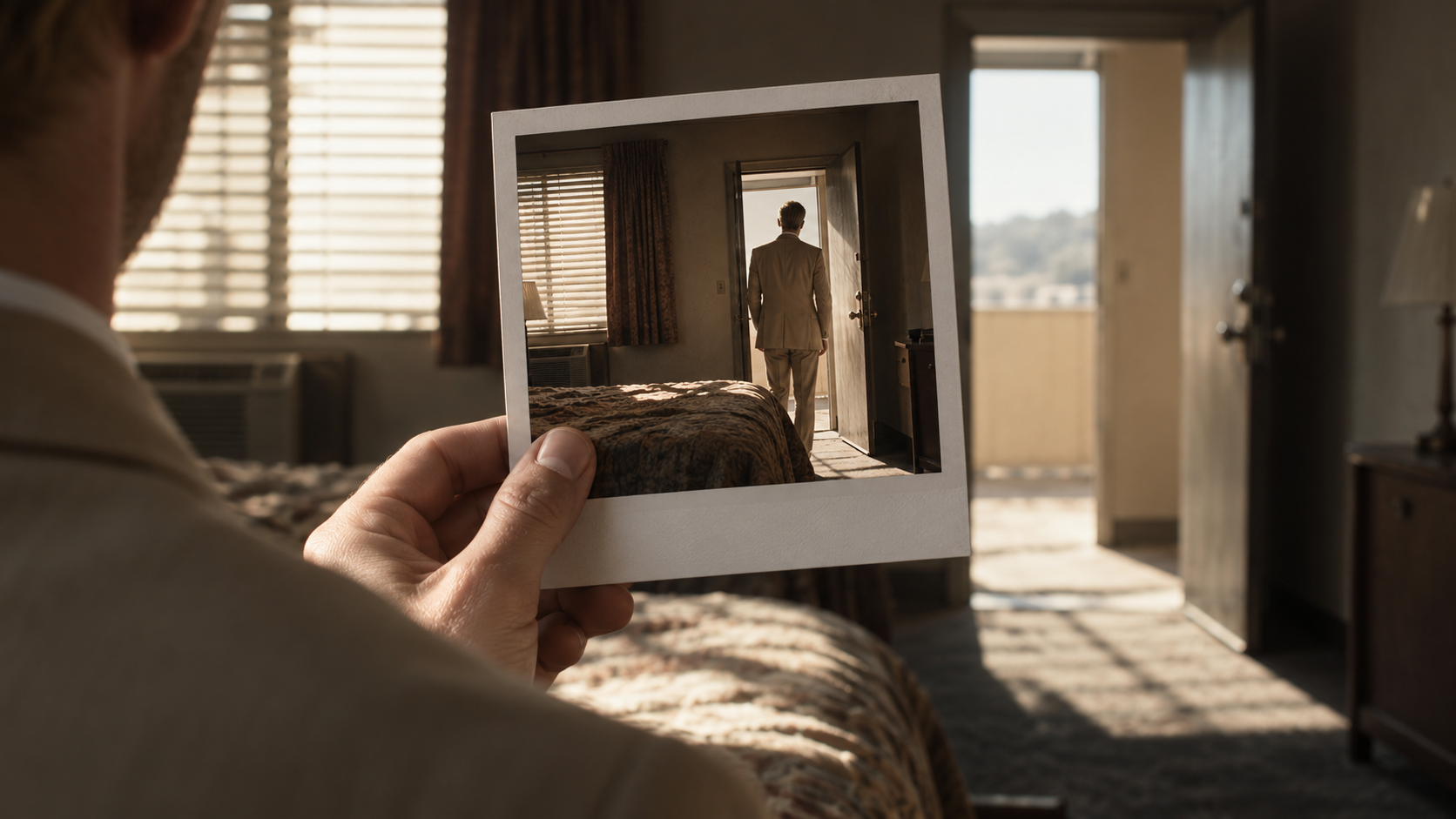
Polaroid photographs identify people, places and possessions. Notes tell him what those photographs mean. Tattoos preserve information he considers too important to lose.
These objects perform different jobs. A photograph can show him a face, but the writing on its reverse tells him whether to trust that face. His body carries the larger purpose that makes the smaller instructions intelligible.
The distinction matters. A picture records someone’s appearance. It cannot independently establish that person’s intentions. Leonard nevertheless needs both kinds of information before he can act.
Guy Pearce makes that dependency visible through the contrast between Leonard’s confidence and his sudden uncertainty. He can sound composed while explaining his method, then become stranded by a missing key or an unfamiliar room.
His difficulty is not a simple absence of intelligence. It is the loss of continuity that normally allows intelligence to test a situation against what happened minutes earlier.
For a viewer, the natural response is to help him assemble the missing context. We study the photographs and tattoos because he studies them. His system becomes our route into the story.
That early cooperation is essential. Before the film can question Leonard’s evidence, it makes us understand why he needs it.
Two Timelines Change What We Can Know
Memento alternates between colour sequences and black-and-white sequences. Their relationship is the film’s basic organising principle.
The black-and-white strand moves forwards. Leonard sits in a motel room, speaks on the telephone and explains his circumstances. These scenes gradually advance towards an encounter outside the room.
The colour strand moves backwards through a later period. Each new colour sequence takes us to events preceding the colour sequence shown before it.
Within most individual scenes, actions unfold normally. The reversal concerns the order of the scenes, rather than everyone continually moving backwards.
This arrangement repeatedly places us in a situation before giving us its cause. Leonard might already be angry, injured or committed to an action when a scene begins. We must interpret the immediate evidence without knowing how he arrived there.
For him, that missing context is a consequence of his condition. For us, it is created by the editing.
The film does not make our experience identical to Leonard’s. We can remember earlier scenes and revise our understanding as new information arrives. He often cannot. That difference gradually gives the audience a responsibility he struggles to exercise: holding conflicting accounts together.
The black-and-white material appears to offer relief. Leonard’s explanations are measured, and the forward movement feels easier to follow.
However, a clearly told account is still an account. Its orderly presentation cannot prove that its narrator understands everything he describes.
The film’s opening also establishes a crucial distinction between outcome and explanation. It presents a killing in reverse, beginning with a photograph whose image fades instead of developing. The uncertainty concerns the reasons for that violence and the evidence behind it.
We will return to the victim and the meaning of that opening when the two strands converge.
For now, Nolan has made the central viewing problem clear. Knowing what an action looks like does not mean knowing why it happened.
Teddy Offers Help That Leonard Cannot Verify
One of Leonard’s recurring contacts is Teddy, played by Joe Pantoliano. Teddy behaves with the familiarity of someone who has been through these introductions before.
Leonard must consult his photograph to establish who Teddy is. The instruction attached to it tells him not to believe Teddy’s lies.
That warning shapes every subsequent encounter. Teddy can offer practical assistance, but Leonard already possesses a written reason to distrust him.
Teddy’s manner does little to settle the question. He is talkative, intrusive and frequently amused by Leonard’s habits. His familiarity can seem reassuring in one moment and exploitative in the next.
He also challenges Leonard’s confidence in his methods. Their conversations raise the possibility that someone could manipulate the investigation by controlling the information Leonard receives.
At this stage, the warning is plausible without being conclusive. Teddy might be identifying a real danger, protecting his own interests or doing both.
The photograph cannot resolve that uncertainty. Its handwritten judgement is powerful precisely because Leonard cannot remember the circumstances in which it was made.
The same vulnerability appears in a less dramatic form at the motel. The clerk, Burt, takes advantage of Leonard by renting him more than one room.
This small deception establishes how easily his condition can become someone else’s opportunity. Exploitation does not require an elaborate criminal conspiracy. It can begin with a person who expects him to forget an ordinary transaction.
It also complicates the value of apparent honesty. Someone may admit a minor wrong while remaining willing to benefit from it. A candid manner does not necessarily provide reliable protection.
Leonard’s investigation therefore depends on people whose motives he cannot continuously monitor. He needs assistance, yet every useful relationship introduces another person capable of shaping his next decision.
His written system helps him recognise that dependency. It cannot remove it.
Natalie Connects Compassion With a Dangerous Favour
Natalie, played by Carrie-Anne Moss, enters the colour narrative as another person whose relationship with Leonard must be pieced together.
She works in a bar and has lost someone important to her: her boyfriend, Jimmy. Her situation involves drugs, missing money and a threatening man named Dodd.
Leonard’s notes describe her sympathetically. She appears to understand something about loss, and she offers practical help with his investigation.
She obtains information linking a vehicle registration to a man named John Edward Gammell. The name and registration appear to correspond with Leonard’s existing clues.
That apparent agreement is persuasive. A document seems to confirm information already preserved on his body. The investigation begins to resemble a chain of independent verification.
Yet at this point, the origin of each link remains essential. Confirming who owns a car is different from confirming what that owner has done.
Natalie’s assistance is also connected to Leonard’s intervention against Dodd. As the colour scenes move backwards, we encounter the consequences of that intervention before seeing how it began.
Leonard finds himself dealing with a beaten man and instructions directing him back to Natalie. The physical danger is clear, but his own role requires reconstruction.
Dodd is eventually forced to leave. Leonard has used violence to address a problem whose full background he cannot retain.
The reversal makes Natalie’s position difficult to assess. Her gratitude and vulnerability may be real, but they do not explain everything she has asked Leonard to do.
Their closeness adds another complication. Leonard can experience comfort in the present without being able to preserve a shared history of how that comfort developed.
For Natalie, he is someone she has already met and influenced. For Leonard, she can become a trusted person through the authority of a note.
That imbalance means the relationship is never conducted with equal access to its own past.
A Missing Pen Exposes How Manipulation Works
The earlier stages of Natalie’s encounter with Leonard reveal the mechanism behind the Dodd episode.
Natalie deliberately provokes him. She insults his condition and his wife until he strikes her. She has ensured that he cannot readily find a pen to record what is happening.
She then leaves, waits for his memory of the confrontation to disappear and returns with a different explanation for her injuries.
She claims Dodd hurt her.
Leonard can see the injury. He cannot remember causing it. The explanation Natalie supplies fills the gap between visible evidence and inaccessible events.
Her success depends on understanding his system. She does not need to persuade him that writing is useless. She prevents him from writing at the one moment when a record would protect him.
The missing pen becomes as consequential as any weapon. Without it, the truth remains temporarily available in Leonard’s mind but cannot be carried forward.
This scene also changes the meaning of the help he later gives her. His intervention against Dodd follows an account manufactured to recruit him.
Natalie’s situation contains real pressure, but that pressure does not make her explanation true. The film allows us to recognise her vulnerability while also recognising her deliberate abuse of Leonard’s.
Her behaviour is especially disturbing because she can acknowledge her intentions while she is manipulating him. She knows that being exposed in the present will not necessarily create consequences in the future.
Ordinarily, discovering someone’s dishonesty changes a relationship. Here, the discovery itself can vanish.
The scene turns Leonard’s condition into a problem of unequal power. Whoever remembers the whole encounter can arrange what the person who forgets will believe happened.
For the audience, this is a decisive correction. We have already seen Leonard responding to Natalie’s apparent suffering. Now we must reconsider the moral certainty attached to his response.
His emotional commitment was sincere. Its sincerity did not make its foundation accurate.
Sammy Jankis Gives Leonard a Story About Himself
Alongside these colour sequences, Leonard’s telephone conversation develops the story of Sammy Jankis.
Sammy, played by Stephen Tobolowsky, was a man Leonard investigated during his insurance career. In Leonard’s account, Sammy developed severe memory difficulties after a car accident.
Leonard describes tests intended to establish whether Sammy could learn through conditioning. Sammy could not reliably avoid an unpleasant stimulus, even after repeated exposure.
Leonard concluded that the condition did not have the physical basis required for the insurance claim. The insurer rejected it.
For Sammy’s wife, the distinction between physical and psychological causes became entangled with a desperate hope: perhaps her husband could recover if the right pressure reached him.
Leonard then recounts the tragedy at the centre of the case.
Sammy’s wife had diabetes. She repeatedly asked him to administer her insulin, testing whether he would remember having already done so.
According to Leonard, Sammy continued giving the injections. She died, and he could not retain what had happened.
The account is horrifying because the test cannot safely distinguish between the possibilities she fears. If Sammy truly cannot remember, asking again exposes her to further danger. Her attempt to obtain certainty becomes inseparable from the harm it creates.
For Leonard, Sammy serves as a warning and a comparison. Leonard believes his own routines and determination allow him to function differently.
That comparison gives his system an emotional role beyond practical organisation. It supports the belief that he can remain purposeful and competent despite his injury.
He carries Sammy’s name on his hand, keeping the story close to every task.
Yet repetition has a particular effect here. Leonard can tell this account fluently because it belongs to the history he believes he still possesses. Fluency makes it sound settled.
The viewer has little opportunity to examine its source independently. We receive images accompanying his narration, but those images are embedded in the film’s presentation of his account.
At this stage, Sammy’s story explains Leonard’s fears. Its relationship to Leonard’s own past remains to be tested.
The Search Reaches a Man Named Jimmy
As the black-and-white strand advances, Leonard’s telephone contact helps direct him towards a man who supposedly fits the investigation.
The contact is revealed to be Teddy.
Leonard goes to an abandoned building, where he confronts Jimmy Grantz, Natalie’s boyfriend. Teddy has presented Jimmy as the man Leonard is seeking.
Leonard attacks and strangles him.
He takes Jimmy’s clothes and subsequently his Jaguar. These familiar objects acquire an origin that changes how we understand Leonard’s appearance throughout the colour narrative.
The suit and car have helped present him as an established person moving through a world of strangers. They are possessions he has taken from someone else.
Jimmy’s apparent death should provide the conclusion Leonard wants. Instead, a final utterance disrupts his certainty: Jimmy says Sammy’s name.
Leonard is alarmed. He associates that name with the story he tells people who know him. Jimmy’s recognition suggests a connection that the simple account of a newly located attacker does not explain.
It does not prove every alternative. It does give Leonard a reason to question whether he has killed the right man.
The visual transition then joins the film’s two strands. As Leonard’s Polaroid develops, the black-and-white image gives way to colour.
The movement makes the structure intelligible without turning it into a purely abstract diagram. A photograph forming in Leonard’s hand connects the advancing past with the retreating later events.
We have reached the point towards which both timelines have been moving.
The encounter also clarifies Natalie’s circumstances. The missing Jimmy, the car and clothing associated with him, and Leonard’s arrival in her life belong to the same chain of events.
That connection does not make her earlier manipulation less calculated. It makes the surrounding loss more concrete.
Teddy arrives, and Leonard demands an explanation. The investigation can no longer proceed on the assumption that the target was correctly identified.
Teddy Challenges the Past Leonard Believes He Knows
Teddy admits that Jimmy was a drug dealer and that the encounter served interests beyond Leonard’s revenge.
Then he challenges the entire basis of Leonard’s mission.
According to Teddy, Leonard already found and killed the real attacker more than a year earlier. Teddy says he helped him do it.
He produces a photograph of Leonard looking triumphant, presenting it as evidence of that earlier success.
If Teddy is telling the truth, the obstacle was never simply finding the right man. Leonard achieved his objective but could not retain the achievement.
Teddy says the investigation continued because Leonard still needed a purpose. There would always be another person whose name fitted John G.
Teddy himself fits those initials: his name is John Edward Gammell.
The distinction between a clue and a target suddenly becomes unstable. A common name can be made to support a search that has no lasting endpoint.
Teddy then offers a more painful claim. He says Leonard’s wife survived the original assault. The fatal insulin story, he alleges, belongs to Leonard’s marriage rather than Sammy’s.
In this account, Leonard has transferred an unbearable part of his own history onto another man. Teddy says the real Sammy was unmarried and that Leonard exposed his deception.
These statements should be distinguished from facts established through an impartial witness. Teddy has manipulated Leonard and stands to benefit from controlling the explanation.
However, the film gives his account disturbing support. Brief images associate Leonard with Sammy’s position, including the substitution of Leonard in the institutional setting. The imagery surrounding Leonard’s wife and insulin also unsettles his confident denial.
The strongest reading is that Teddy exposes a truth Leonard cannot bear to preserve. The film nevertheless leaves room to question details of Teddy’s version.
Its uncertainty has limits. We are not required to treat every explanation as equally supported. Nor should Teddy’s unreliability make everything he says automatically false.
The crucial development is that Leonard now faces information capable of ending his current understanding of himself.
What he does with that information becomes the film’s final revelation.
Leonard Decides What His Future Self Will Believe
Leonard responds by changing the evidence his future self will inherit.
He writes an instruction on Teddy’s photograph telling himself not to believe Teddy’s lies. He records Teddy’s vehicle registration as a clue to be tattooed.
He knows where that number came from. He also knows the significance he is choosing to give it.
The registration is real. Its supposed connection to his wife’s attacker is manufactured.
That difference explains the ending. Leonard does not have to invent every document or falsify an official record. He introduces a false relationship between genuine pieces of information.
Later, Natalie’s registration search can correctly identify John Edward Gammell while appearing to confirm a conclusion Leonard has already arranged.
The system will function as designed. It will preserve the information he selected and discard the context he chose not to keep.
Leonard also destroys photographs that could complicate the mission, including the image Teddy presents as evidence of his earlier revenge.
His act is therefore more than an emotional refusal to accept Teddy’s story. It is an intervention in what he will be able to investigate after that refusal has vanished from memory.
The film’s final scene shows him driving towards a tattoo parlour. The intention formed in the confrontation is about to become an apparently durable fact on his body.
We can now return to the killing shown at the beginning.
The victim is Teddy. Leonard later takes him to the abandoned building and shoots him, believing that his accumulated evidence identifies his wife’s killer.
The final revelation changes the meaning of that apparent conclusion. Leonard has deliberately helped create the certainty that authorises it.
Teddy’s death is the last major event chronologically. Leonard’s decision to construct the path towards it is the film’s last major disclosure.
That separation gives the ending its force. We begin with the violent result and finish with the act of authorship that makes it possible.
Leonard will forget that he chose Teddy. The audience cannot.
What the Ending Establishes and Leaves Uncertain
The most securely established truth in Memento concerns Leonard’s conduct in the present.
We see him arrange a false evidential trail against Teddy. Whatever uncertainties remain about the original attack, that decision is deliberate.
His condition explains why he will later lose access to the decision. It does not mean the decision was never made.
Responsibility therefore becomes distributed across time. The Leonard who acts later trusts the records available to him. The Leonard who writes those records knows that they will mislead.
The film makes both versions part of the same person without pretending their knowledge is identical.
Teddy’s account of Leonard’s wife remains less securely resolved. The visual clues strongly support an overlap between Leonard’s history and the Sammy story, but the film does not give us a completely independent reconstruction of the marriage.
Similarly, the photograph of an apparently successful revenge supports Teddy’s claim without identifying every surrounding circumstance. An image can prove that a moment existed while leaving its explanation open.
These distinctions keep the ending precise. The film leaves aspects of the past uncertain while making the manufacture of future certainty visible.
Leonard’s imagined image of himself beside his wife, with a tattoo marking the completion of his revenge, expresses the resolution he wants. It should not be treated as straightforward evidence that such a peaceful outcome occurred.
He wants the punishment of an attacker, the recovery of his marriage and relief from grief to fit together. No actual killing can restore all three.
That is why his mission is so difficult to finish. Revenge promises an event that will change how the loss feels. His condition prevents him from carrying that change forward, while his dependence on the mission gives him a reason to resist its completion.
The repeated return to photographs becomes especially painful in this light. They preserve surfaces while losing the living circumstances around them.
A face remains. Trust must be supplied in writing.
A number remains. Its relevance must be explained.
A smiling Leonard remains. Whether the smile records justice, manipulation or something else requires a story.
The final tragedy is that Leonard can control that story at the moment it is written, then encounter it later as if it arrived from outside him.
Memento ends with a man converting a choice into evidence. By the time he acts on it, he will believe he is simply following the facts.
Sources
British Film Institute: Memento — Film Details and Credits. Confirms the film’s identity, director, principal cast and running time.
American Film Institute: Memento — Synopsis and Production Record. Provides a detailed account of the narrative and distinguishes its 2000 festival premiere from its 2001 American theatrical opening.
Christopher Nolan: Memento — Screenplay. Supporting reference for the investigation and final confrontation; a screenplay can differ from the released film. The interpretation above also draws on corroborating published accounts of the ending.
