The Science Behind Astrophage
The Spaceship Works Because Its Fuel Breaks the Rules
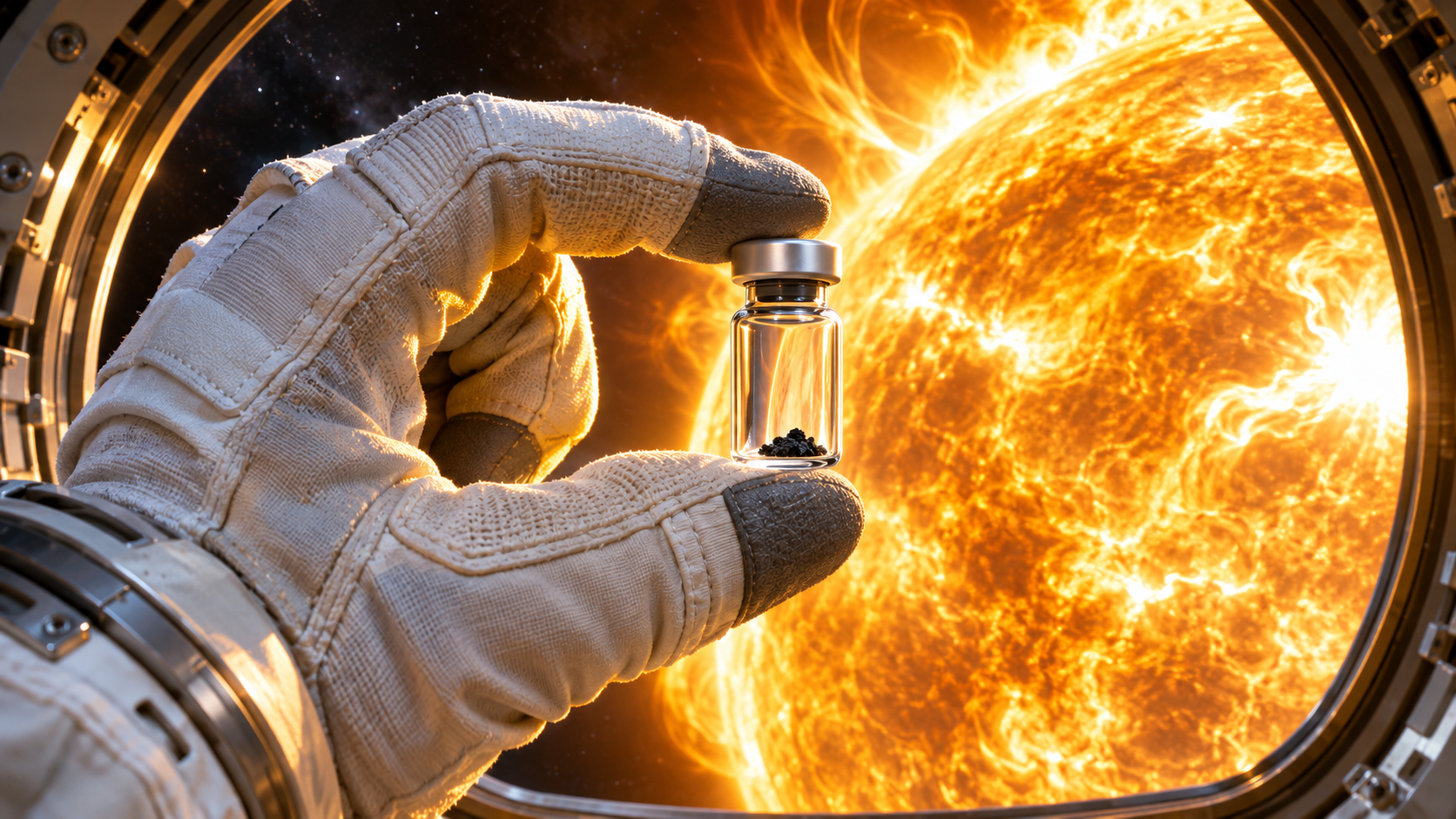
Project Hail Mary builds a convincing scientific adventure around an invention that real science cannot currently supply. Its star-consuming organism, Astrophage, makes the emergency possible and gives humanity the extraordinary energy storage needed to respond. Around that fictional foundation, Andy Weir uses recognisable physics, experimental reasoning and engineering constraints.
The result is neither a prediction of an imminent space mission nor a story in which every technical detail is arbitrary. Some elements are established principles, others are plausible research questions, and several are deliberate inventions. Separating them makes the story more interesting: the realism often lies in the consequences Weir follows after allowing himself an impossible starting material.
What Astrophage Is Doing to the Sun
In the fictional premise, Astrophage absorbs stellar energy. The resulting reduction in sunlight threatens Earth with severe cooling, prompting a mission to investigate why Tau Ceti does not show the same problem.
The threat depends on a real relationship: Earth’s climate receives its energy from the Sun. A sustained reduction in incoming sunlight would change the planet’s energy balance. The scale and speed of the climatic response would depend on the reduction and on feedbacks involving the atmosphere, oceans, clouds and ice.
The biological explanation is invented. The Sun is not an ordinary habitat that a familiar microorganism could colonise. Its visible surface is already thousands of degrees hotter than environments in which known life can function, and the deeper interior is hotter still.
It is also misleading to imagine Astrophage simply switching off nuclear fusion in the solar core. The story’s useful scientific question concerns energy reaching Earth. Intercepting or redirecting energy outside a star would be a different mechanism from stopping the reactions that generate it.
The Real Scale Hidden in a Tiny Sample
The relation between mass and energy gives Astrophage’s fictional storage capacity its force. Einstein’s equation says that a small amount of mass corresponds to an enormous amount of energy.
For scale, complete conversion of one gram of mass would yield roughly ninety trillion joules, or about twenty-five million kilowatt-hours. That is an illustrative calculation using mass–energy equivalence, not a claim that an ordinary one-gram battery can release that energy.
The crucial word is “complete”. Chemical fuels release energy through changes in chemical bonds, converting only a tiny fraction of their mass. Nuclear reactions exploit a larger mass difference, but they still do not make an ordinary fuel sample a device that converts all its mass into controllable useful output.
Astrophage therefore does more than provide a better version of a current battery. It supplies a storage and conversion mechanism that bypasses limitations central to existing engineering. Once that invention is granted, questions about thrust, fuel supply and mission design can be explored with much firmer rules.
Why the Neutrino Explanation Is Fiction
Weir has explained that he invented properties allowing Astrophage to store energy through neutrinos. His proposed cell membrane behaves in a way that prevents those particles from escaping.
Real neutrinos are extraordinarily reluctant to interact with matter. Vast numbers pass through the Earth and through human bodies without the sort of collision that would make them easy to trap. A biological container capable of holding them as convenient fuel would require a major departure from demonstrated physics.
Another distinction concerns whether neutrinos are their own antiparticles. That is a genuine research question, not an established fact that can simply be borrowed to validate the fictional mechanism.
Technical language can make an invention sound more settled than it is. The honest description is that Weir connects his imagined organism to real particle-physics concepts, then supplies new behaviour where the story requires it. That is a legitimate science-fiction choice, provided the invented step remains visible.
Can Light Really Push a Spaceship?
Yes. Light carries momentum, so emitting it in one direction can push an object in the other. Reflecting sunlight can also produce thrust, which is the principle behind solar sails.
The distinction between the two arrangements matters. A solar sail receives its light from an external source such as the Sun. The fictional Hail Mary uses a powerful onboard energy source to generate directed radiation. Both involve momentum carried by light, but their energy supplies and engineering demands differ.
The difficulty is the amount of energy needed for substantial thrust. For an ideal beam emitted by a photon rocket, producing just one newton of thrust requires about three hundred million watts of radiant power. That illustrative calculation follows the relation between photon momentum and energy.
Real solar-sail projects exploit gentle pressure over long periods. Astrophage makes a far more powerful fictional version possible by providing the extraordinary energy source. The propulsion principle is sound; the biological power supply is the speculative leap.
Artificial Gravity Does Not Need a Gravity Machine
A spacecraft can produce a sensation of weight through acceleration. If its floor accelerates towards the occupant, the floor exerts a force on the body, much as the ground supports somebody standing on Earth.
Rotation provides another route. Inside a rotating habitat, the structure continually changes the direction of the occupant’s motion. The contact force required to keep that circular path can feel like weight.
These principles are real, but a practical rotating spacecraft involves compromises. A smaller radius needs faster rotation to produce a chosen acceleration. Faster rotation can make movement uncomfortable and complicate the relationship between balance, vision and the forces felt by different parts of the body.
The Hail Mary’s rotating arrangement therefore belongs to the more credible part of the imagined mission. Its existence does not mean building, deploying and maintaining such a structure for an interstellar voyage would be easy. Correct physics establishes a possibility; it does not complete the engineering.
Time Dilation Is Real, but It Does Not Remove Distance
At speeds approaching that of light, travellers can experience less elapsed time than observers who remain behind. The effect is a consequence of relativity, not a failure of the traveller’s watch or an illusion caused by fatigue.
A crew member’s body and onboard equipment follow the time experienced along their journey. An Earth-based account of the trip can assign a different duration. Neither clock needs to be defective for the difference to occur.
This does not allow a spacecraft to ignore the speed of light or make interstellar communication instantaneous. A message sent across light-years still faces a long transmission delay. Travelling quickly also demands energy, and slowing down at the destination is part of the mission rather than an optional final detail.
Science fiction often uses a fast drive as a universal solution. Project Hail Mary is more interesting where speed produces new constraints: limited communication, separation from Earth and decisions that cannot wait for somebody at home to answer.
The Human Body Is a Separate Engineering Problem
A spacecraft capable of reaching another star would still need to keep its occupants alive and functional. Propulsion does not solve radiation exposure, muscle and bone changes, nutrition, medical emergencies or the reliability of a closed environment.
NASA’s human-spaceflight research treats those hazards as connected problems. A countermeasure that helps one part of the mission may add equipment, mass or operational demands elsewhere.
The novel’s prolonged induced coma belongs to its speculative mission design. It should not be mistaken for a demonstrated method of keeping healthy astronauts safely asleep for years and waking them ready to work. Reducing conscious time aboard a ship would not, by itself, stop the body from needing care.
This is a useful test for any apparently realistic space story. Ask separately whether the vehicle can travel, whether its systems can operate for the necessary duration, and whether the people inside can survive the journey in a condition that allows them to perform the mission.
Alien Life Is a Scientific Question, Not a Blank Cheque
Astrobiology investigates the origins, development and possible distribution of life beyond Earth. It can draw on extreme environments here, planetary chemistry and the detection of potentially habitable conditions elsewhere.
Those approaches do not tell us exactly what an alien organism would look like. All known terrestrial life shares a history, so its variety does not constitute a collection of independent examples of life beginning.
Water is central to the search because it is essential to life as we know it and supports useful chemistry. That focus is a practical research strategy, not proof that every imaginable form of life must reproduce every feature of Earth biology.
Weir’s alien inventions work as disciplined speculation when their environmental requirements have consequences. If two organisms need incompatible conditions, cooperation requires a boundary between those conditions. Friendship cannot remove a pressure difference or make a harmful atmosphere safe to breathe.
How Would Scientists Recognise a Living Sample?
A strange structure or chemical signal would not automatically prove life. Scientists would need to test alternative explanations, establish that the signal belongs to the sample and determine whether contamination or an instrument could have produced it.
The same principle applies to distant observations. A gas associated with life on Earth may have a non-biological source elsewhere. Its significance depends on the surrounding environment and on other evidence.
Project Hail Mary’s experiments are compelling because observation changes what Grace can reasonably attempt. A useful test distinguishes between explanations; it does not merely provide impressive-looking activity before the hero guesses correctly.
The story necessarily compresses parts of scientific work. Real investigations often involve failed measurements, replication and long periods in which a result remains ambiguous. The transferable lesson is the habit of changing an explanation when evidence contradicts it, rather than the expectation that every urgent question has a quick decisive experiment.
A Powerful Organism Would Create a Containment Problem
Discovering a biological energy source would not end the safety assessment. Researchers would need to understand how it reproduces, what it consumes, which conditions disable it and how it interacts with other organisms.
A useful property can become a vulnerability when the system changes. Something excellent at absorbing energy may be difficult to contain. An organism adapted for one environment may respond unexpectedly when introduced to another.
The important analytical point is that capability and control are separate achievements. Demonstrating that a sample can perform a useful task does not establish that a large production system can remain stable or that an accidental release would be harmless.
The novel turns biological relationships into engineering constraints. That is a credible way to organise the questions even when the organisms answering them are fictional. It asks the reader to consider dependence: a spacecraft powered by life must account for what can happen to that life.
What the Story Gets Most Right
Project Hail Mary earns its scientific character through the interaction between knowledge and action. Grace cannot simply want an outcome strongly enough; he needs an explanation that allows him to do something different.
Its most important invention remains Astrophage, whose extraordinary properties make the mission possible. Light propulsion, rotational gravity and relativistic time differences belong to established physics. Interstellar human survival and the detailed alien biology demand much larger assumptions.
The useful verdict is therefore specific. This is a story that builds carefully around an invented enabling technology, not a demonstration that its complete mission could be launched. Its best invitation is to examine the boundary: identify which rule is real, which material is imagined and what follows when the two meet.
Sources
The Planetary Society — Author Andy Weir and Project Hail Mary — Weir’s explanation of the fictional organism and the scientific assumptions behind it. The Planetary Society
Astronomy — Andy Weir on Project Hail Mary — Further author discussion of scientific choices and speculative elements. astronomy.com
US Department of Energy — DOE Explains Neutrinos — Established particle properties and unresolved neutrino questions. Department of Energy
NASA — Sun Facts — Solar conditions and the distinction between stellar energy production and energy reaching Earth. NASA Science
NASA — How NASA Uses and Improves Solar Power — Solar energy and the use of light for propulsion. NASA Science
NASA — Kilometer-Scale Space Structures From a Single Launch — Rotating structures as an engineering approach to artificial gravity. NASA
Einstein Online — The Case of the Travelling Twins — Relativistic differences in elapsed time. einstein-online.info
NASA — The Human Body in Space — Physiological hazards of long-duration spaceflight. NASA
NASA — Life on Other Planets: What Is Life and What Does It Need? — The evidential basis and limitations of searching for extraterrestrial life. NASA Science
NASA Astrobiology — Ladder of Life Detection — Evaluating possible biosignatures and alternative explanations. NASA Science
Next Reads
Was Mars Once Habitable? What Perseverance Has Discovered — A real-world companion on the difference between habitable conditions and evidence of life.
Dark Matter Explained: Blake Crouch’s Box, the Different Jasons and the Meaning of the Ending — Another novel whose consequences depend on understanding an invented scientific mechanism.
Recursion Explained: Blake Crouch’s Memory Chair, the Timelines and the Meaning of the Ending — A contrasting use of scientific speculation, memory and causal rules.
