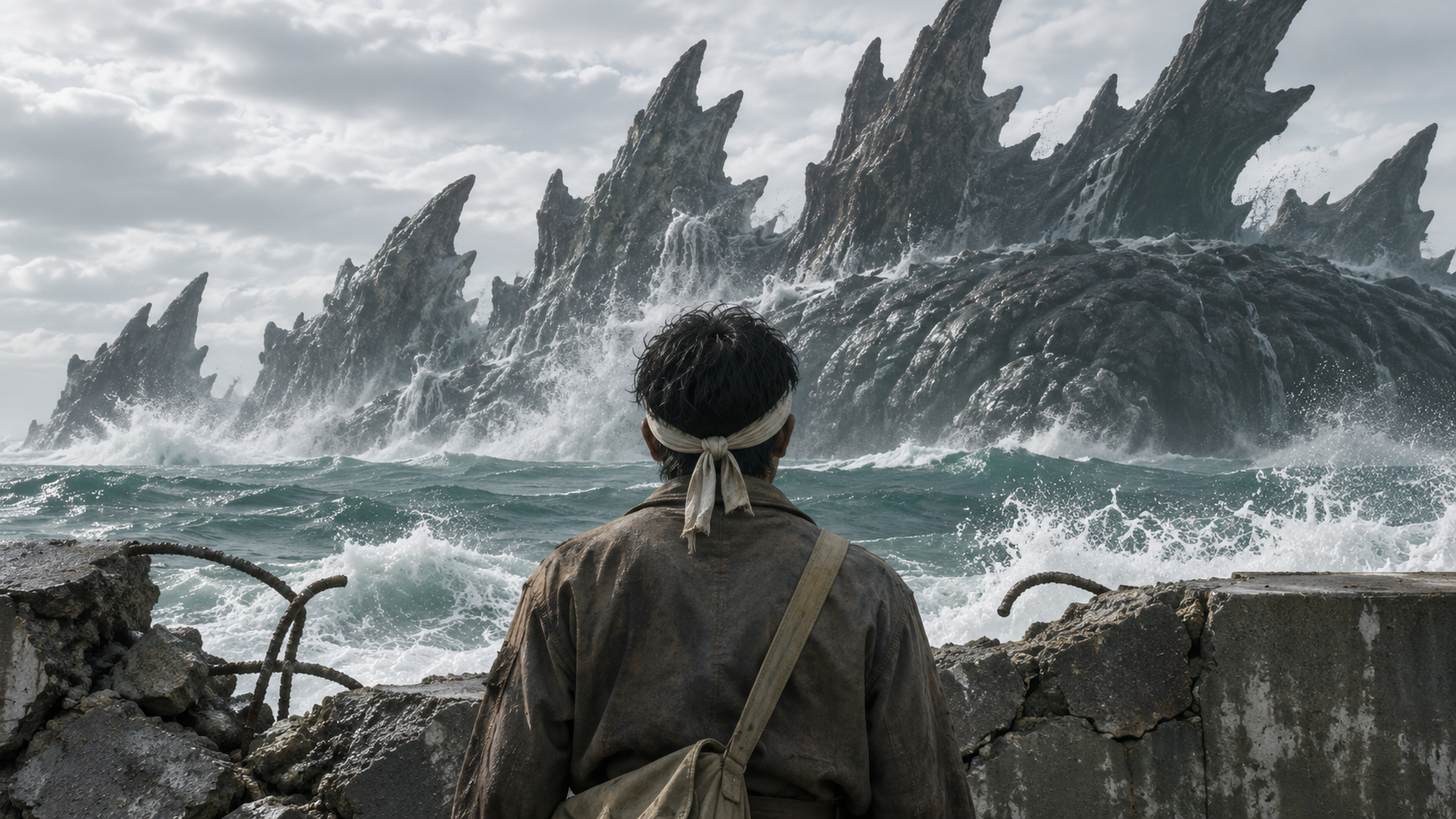
The Human Story Behind the Monster
A Survivor Comes Home to Another War
Koichi Shikishima has returned from a war he was not expected to survive. Rebuilding his life should mean finding work, shelter and people to care for. Instead, he carries a private conviction that his continued existence requires an explanation. In Takashi Yamazaki’s 2023 film Godzilla Minus One, that burden meets a threat large enough to destroy the fragile world taking shape around him.
The monster supplies the spectacle, but Shikishima supplies the difficult question: what does a person owe the dead? His struggle makes an enormous creature’s arrival feel personal without reducing it to a metaphor. Godzilla can destroy a city. Shikishima’s guilt can prevent him from inhabiting the life that remains.
The film belongs to Toho’s Japanese Godzilla series, rather than the American MonsterVerse continuity. Its postwar setting supplies its own starting point, so understanding Shikishima does not require importing another franchise’s history or rules.
The Landing That Shikishima Cannot Leave Behind
Near the end of the Second World War, Shikishima lands at the military base on Odo Island, claiming that his aircraft needs attention. The mechanics find no fault. He is a kamikaze pilot who has avoided the death assigned to him, and the discrepancy between his explanation and the aircraft’s condition makes that avoidance visible.
Then a creature attacks the island. Given an opportunity to fire from his aircraft, Shikishima freezes. The devastation leaves him and mechanic Sosaku Tachibana alive among the dead. Tachibana holds him responsible for failing to act, giving Shikishima’s survival a specific accusation to carry home.
The opening establishes two different decisions that Shikishima subsequently struggles to separate. Avoiding a suicide mission is one thing; being unable to help people under attack is another. His guilt folds them together until survival itself begins to resemble wrongdoing.
That confusion makes his later behaviour understandable without making his judgement reliable. He experiences the disaster through what he believes he should have done. The film does not establish that his aircraft’s weapons would certainly have saved everyone. His certainty concerns his own failure more than the outcome of an alternative attack.
This is a useful distinction when reading the character. Feeling responsible is not the same as possessing complete knowledge of responsibility. Shikishima has witnessed people die and can identify an action he failed to take. From those facts he builds a much larger conclusion about whether he deserves a future.
Tachibana also matters as a surviving witness. Shikishima cannot dismiss the accusation as a private nightmare because another person remembers the same night. Their unfinished relationship gives the opening a consequence that extends beyond a scene designed to introduce the monster.
A Household Forms Before He Can Accept It
Back in Tokyo, Shikishima learns that his parents died in the bombing. Noriko Oishi enters his life with Akiko, an orphaned baby she has taken into her care. The three begin sharing the practical work of survival, although Shikishima struggles to accept the emotional meaning of the arrangement.
Akiko is not Noriko’s biological daughter. That detail is essential because the household begins through responsibility rather than inheritance. Noriko has accepted an obligation to a child who needs her, and the developing family asks whether Shikishima can make a comparable commitment.
The film places ordinary reconstruction beside unresolved grief. A home can become more habitable while its occupant remains unable to feel secure inside it. Work and routine improve the conditions of survival without automatically settling what surviving means.
Noriko offers a possible future that Shikishima cannot fully receive. His attachment to her and Akiko is real, but acknowledging it would require admitting that something valuable can exist after the deaths he carries. His difficulty is therefore more complicated than simple emotional coldness.
There is also a danger in allowing guilt to define a household’s priorities. The dead cannot benefit from Shikishima refusing affection, while the living can be hurt by that refusal. Akiko needs care now. Noriko needs a partner in the life they are building, rather than an indefinitely postponed promise of one.
This gives the domestic material a clear dramatic function. It establishes what is at stake before another attack takes place. A city is no longer an abstract collection of buildings when the story has shown people trying to make a home within it.
The family also complicates the familiar heroic journey. Shikishima does not simply need enough confidence to face danger. He needs to recognise that returning from danger can itself be part of his responsibility. Courage detached from attachment could leave the people around him with another absence.
Clearing the War From the Water
Shikishima finds work on a minesweeping boat. Its crew includes captain Yoji Akitsu, engineer Kenji Noda and the younger Shiro Mizushima. Their job is to remove explosives left behind by the war, turning the sea into another place where the past remains physically dangerous.
The setting gives reconstruction an unusually concrete form. Peace has not made the water safe. Someone must undertake hazardous work so that ordinary activity can resume, and the people doing it cannot afford to treat the war as a completed chapter.
The boat also creates a different kind of group from the military base. These men work together because their skills and judgement are useful to one another. Their relationships make room for experience, disagreement and mutual protection rather than measuring value solely through obedience.
When they encounter the enlarged Godzilla, the scale of their equipment becomes painfully inadequate. Their mine attack injures the creature but does not stop it permanently. Regeneration changes the problem: delivering damage and achieving lasting defeat are no longer the same thing.
That discovery gives the action a purpose beyond escalation. The crew learn that a plausible attack can succeed locally while failing strategically. They can hurt the monster, yet remain unable to control what happens next.
Their experience also prevents Noda’s later planning from appearing out of nowhere. The men have seen the creature, tested its vulnerability and survived the limits of their own methods. Practical knowledge accumulates through encounters rather than arriving as a convenient answer at the climax.
Shikishima’s skills are useful in this setting, but usefulness does not settle his private conflict. He can contribute to a team while continuing to believe that his eventual contribution must involve dying. The film allows competence and emotional damage to coexist.
Ginza Makes the Disaster Intimate
Godzilla’s attack on Ginza brings Noriko directly into the destruction. Shikishima reaches her, but the creature’s atomic blast separates them. Noriko pushes him clear of the immediate danger and disappears in the devastation. He believes she has died.
The sequence reconnects the monster with the household the film has patiently established. What is lost is not merely a romantic possibility. Noriko has been one of the people holding together a child’s daily life, and her absence threatens that fragile structure.
Shikishima now experiences survival through another person’s apparent sacrifice. The recurrence is devastating because it resembles the pattern he already fears: someone else is gone, and he remains. His earlier guilt supplies a ready explanation for a new catastrophe.
Yet the two events are not interchangeable. On Odo, he was accused of failing to act. In Ginza, Noriko acts to protect him. Treating both incidents as proof that he should die would erase the difference between a reproach and a gift of survival.
The film’s emotional argument depends on that difference. If Noriko’s action has any claim on his future, it cannot be reduced to an instruction to throw that future away. Akiko’s continued need makes the contradiction sharper.
This does not mean that grief can be corrected by a tidy argument. Shikishima’s response remains emotionally convincing precisely because understanding an obligation and feeling able to fulfil it are different experiences. The people around him must do more than tell him that his reasoning is wrong.
Ginza also exposes the limits of reconstruction based on the assumption that the worst is over. The new threat attacks a society still recovering from an earlier catastrophe. The film’s title describes that movement below an already devastated starting point.
The Civilians Build a Plan With an Exit
Noda proposes an operation at sea. The plan uses ships, cables and gas released around Godzilla to drive it rapidly into deep water. If the pressure does not kill it, the team will bring it back up, relying on the violent change in pressure to finish the task.
The basic fictional mechanism is a rapid movement between very different pressure conditions. It should not be described as merely drowning the monster, nor treated as a demonstrated scientific method for defeating a creature that does not exist. Within the story, it is an attempt to use the environment against an opponent that has resisted conventional attacks.
The operation makes cooperation visible. No single participant possesses everything required. Ships must hold position, equipment must work and people must respond when the original assumptions fail. Expertise becomes valuable through coordination.
More importantly, the volunteers do not treat death as the desired proof of commitment. The operation is dangerous, but its purpose includes bringing people back. That principle separates the new effort from the system that originally assigned Shikishima a suicide mission.
The difference is practical as well as moral. A group that wants its members to survive plans differently from one that regards them as expendable. Escape, recovery and assistance become part of the task rather than signs of insufficient resolve.
Mizushima’s position makes the point from another direction. His youth and lack of wartime experience do not make him a lesser person. The film resists the idea that having missed combat is a shame that must be corrected through fresh exposure to death.
Shikishima, however, has another possibility in mind. He intends to use an aircraft packed with explosives against Godzilla’s mouth. Because of his history, this plan carries an unresolved question: is he preparing to save other people, or using that purpose to complete the death he once avoided?
Tachibana Returns to an Unfinished Argument
Preparing the aircraft brings Shikishima back into contact with Tachibana. Their reunion reconnects the final operation with Odo Island, ensuring that the original accusation is not simply forgotten once a larger action sequence begins.
Tachibana has a concrete role as a mechanic, but he also occupies a powerful position in Shikishima’s understanding of himself. He is the person whose anger gave the survivor’s guilt an external voice. What he now asks of Shikishima therefore matters beyond technical preparation.
The aircraft resembles a route back into the opening dilemma. Once again, Shikishima can imagine his value being established by flying towards a target from which he does not return. The repetition creates suspense because the film has spent its middle showing what such a decision would cost.
Akiko makes that cost impossible to treat as purely personal. Shikishima’s life is connected to someone who did not choose any of these disasters. An act presented as settling his own debt would create a new deprivation for her.
The story’s challenge is to reconcile action with continued life. Simply refusing to fight would not answer the danger. Simply embracing death would repeat the logic that has trapped him. The final operation must test whether a third possibility can be made real.
What Happens at the End of Godzilla Minus One?
The pressure operation damages Godzilla but fails to destroy it outright. When the lifting equipment cannot complete the task alone, Mizushima arrives with additional boats to help. Shikishima then flies his explosive-laden aircraft into the creature’s mouth, breaking apart its head and bringing the immediate battle to an end.
Shikishima survives because he ejects before impact. A flashback reveals that Tachibana showed him the aircraft’s escape mechanism and urged him to live. The person associated with his original condemnation has helped provide a practical route out of it.
This is more than a last-minute rescue device. The seat changes the relationship between the useful action and the sacrifice Shikishima imagined it required. He can strike the target without making his own death the moral condition of success.
The delayed revelation briefly allows the action to resemble a completed kamikaze mission. Then the film corrects that reading. The emotional release comes from discovering that he has accepted an exit, not from discovering that he has finally become willing to die.
Noriko is also alive. Shikishima reunites with her in hospital, where the household’s future becomes possible again. Their reunion does not erase what happened at Odo or Ginza, but it gives him an opportunity to stop treating those events as a permanent prohibition on happiness.
The final images complicate that relief. A dark mark moves on Noriko’s neck, and Godzilla’s remains regenerate underwater. Yamazaki subsequently identified the mark as Godzilla cells. The film itself does not explain a complete biological process, establish that Noriko will become another monster or resolve what the cells will do.
Those unanswered questions should remain separate from the completed emotional movement. Godzilla’s regenerative capacity means the physical threat may continue. Shikishima’s decision to live is nevertheless real; uncertainty about the future does not cancel it.
Why Survival Is the Film’s Decisive Choice
The ending changes the meaning of the opening without pretending that Shikishima was never afraid. His growth consists in acting while accepting that his life is worth preserving. The final flight answers the immediate threat, while the ejection rejects the belief that usefulness must culminate in death.
Tachibana’s contribution is crucial because forgiveness becomes an action. He does not merely offer reassurance and leave Shikishima inside an unchanged machine. He helps make survival possible through the equipment Shikishima will actually use.
The civilian effort provides the wider version of that choice. People combine the skills left to them by catastrophe while attempting to avoid reproducing its disregard for human life. Their expertise has a different purpose because the people exercising it are allowed to matter.
Noriko’s return is emotionally generous, and viewers may reasonably find the survival reveal convenient. It restores a relationship the film had apparently destroyed. The neck mark prevents the reunion from becoming completely uncomplicated, but it does not remove the convenience of receiving her back.
What gives the conclusion substance is the choice Shikishima makes before that reunion. He uses the escape mechanism without knowing that Noriko awaits him. His decision therefore cannot be explained simply as a response to a promised romantic reward. He accepts life while its future remains uncertain.
Godzilla Minus One leaves two scales of resolution deliberately unequal. The monster’s story remains open, while a survivor has changed his relationship with the living. The sea may still contain a threat. For the first time, Shikishima can face that uncertainty as someone entitled to return home.
Sources
Netflix Tudum — What to Know About Godzilla Minus One—and How It Ends — Credits, continuity, principal events and the reported director confirmation concerning Noriko. Netflix Tudum
BFI Sight and Sound — Godzilla Minus One: The Titan of Terror Returns — Period setting, opening situation and the relationship between human drama and monster spectacle. Sight and Sound
Entertainment Weekly — Godzilla Minus One Ending Explained — Corroboration of the sea operation and its principal stages. ew.com
Next Reads
This Is Not a Test Explained: Sloane, the Ending and Film Differences — Another survival story in which a public catastrophe intersects with a private struggle to keep living.
Project Hail Mary: How Much of the Science Could Really Work? — A useful companion on distinguishing a film’s scientific mechanisms from its inventions.
