What Happens in the Woods?
They Can Film the Woods, but Cannot Leave
Three filmmakers enter a forest to investigate a local legend. They bring cameras, recording equipment and the confidence that their trip will produce a documentary. Then the route home becomes uncertain, the nights become threatening, and recording what happens begins to feel more manageable than understanding it.
The Blair Witch Project, the 1999 American horror film written and directed by Daniel Myrick and Eduardo Sánchez, builds its terror around that shrinking sense of control. Heather, Josh and Mike want to turn other people’s stories into images. Instead, they find themselves struggling to explain their own experience. The cameras continue working, but their footage offers no reliable protection from whatever might be waiting beyond the light.
A Documentary Takes Them Beyond the Town
Heather Donahue leads the project, accompanied by Joshua Leonard and Michael Williams, usually called Josh and Mike. The performers use their own names for their fictional characters, helping the film blur the boundary between an organised production and material apparently recorded without an audience in mind.
Their destination is Burkittsville, Maryland, where interviews introduce the Blair Witch as a mixture of local folklore, frightening recollection and stories passed between generations. The filmmakers encounter people who treat the legend differently. Some sound amused, some doubtful and some troubled by what they describe.
That unevenness makes the opening convincing. A town united behind one perfectly delivered account would resemble an exposition scene. These conversations instead suggest a story that has circulated long enough to acquire variations, sceptics and embarrassing believers.
Among the accounts is the story of Rustin Parr, a man associated with the murder of children. An interviewee describes how Parr made one child face a corner while he killed another. At this stage, the information belongs to the documentary’s subject matter: one disturbing detail among several the crew gathers.
Another interviewee, Mary Brown, describes an encounter she believes involved the witch. Her testimony does not arrive with independent verification. The film allows the crew’s reactions and her manner of speaking to shape our judgement, placing us in the uncomfortable position of deciding whose fear deserves respect.
Heather’s project depends on this distinction between collecting testimony and accepting it. She can find a story useful without believing that it describes a literal supernatural encounter. Going into the woods initially seems like the next practical step: filming places associated with the accounts will give the documentary images to accompany its interviews.
That decision moves the crew away from people who can offer alternative perspectives. In town, a disturbing claim can be followed by another conversation. In the forest, an unexplained experience remains with the three people who share it.
Their investigation becomes increasingly self-contained. They will have their own observations, their own disagreements and whatever the equipment manages to preserve.
The Forest Stops Being a Filming Location
The trip includes Coffin Rock, a location associated with a gruesome story about a search party. Heather records material about the alleged events, approaching the place as something that can be researched, framed and explained.
The distinction between the old story and the present expedition initially seems secure. The violence belongs to an account she is presenting. The crew’s immediate concerns are ordinary ones: getting usable footage, carrying equipment, finding their way and establishing somewhere to sleep.
Then they encounter arrangements of stones and begin hearing unexplained noises at night. Later, stone piles appear near their own campsite. The possible connection between the things they have come to document and their immediate surroundings becomes harder to dismiss.
The change is frightening because the objects themselves are so undramatic. A few stones have no obvious power. Their arrangement, timing and proximity suggest that somebody has been close enough to observe the campers and leave something for them.
This creates a practical problem before it creates a supernatural one. If another person is moving around their tent at night, the crew is vulnerable. Believing in the witch is unnecessary to recognise the danger of an unseen stranger who knows where they sleep.
The forest also changes according to what the filmmakers need from it. During the documentary shoot, trees and trails provide atmosphere. Once the group wants to leave, the same environment must supply recognisable landmarks and dependable routes. It becomes frightening when it fails to perform that second function.
A place can look ordinary while becoming unusable.
The film exploits that possibility without constantly announcing it through spectacular discoveries. There is rarely a clean boundary between an inconvenient camping trip and a serious emergency. Each problem can initially be explained away, but the explanations become less reassuring as the problems accumulate.
That gradual deterioration gives the characters reasons to remain uncertain. They do not enter the woods expecting to fight a monster, and they cannot instantly reorganise their thinking around one. Their first response is to keep trying familiar solutions.
The Missing Map Turns Anxiety into Accusation
As the journey continues, Heather’s confidence in their route becomes a source of conflict. The others need her assurances to be reliable because they have followed her into the woods. Every additional delay makes those assurances harder to accept.
The disappearance of the map gives the frustration a specific target. Eventually, Mike admits that he kicked it into a creek because he was angry and considered it useless. His confession turns a navigational difficulty into an argument about responsibility.
The act is destructive precisely because the map might have been inadequate without being worthless. Even if Heather has been reading it badly, removing it prevents the group from reconsidering the route together. Mike converts his private frustration into a decision that affects everyone.
His behaviour also complicates the temptation to blame Heather for every mistake. She can be defensive and overconfident, but she is not the only person making the situation worse. The group’s failure develops through several people responding badly to pressure.
Heather’s leadership has become a trap of its own. Admitting uncertainty might help the others assess the situation more honestly, yet it would also expose how little authority she has left. She continues trying to provide the confidence they want from her, even when that confidence no longer persuades them.
Josh and Mike have understandable reasons to be angry. However, anger does not supply a route out. Their arguments consume attention while leaving the central problem unchanged: nobody can demonstrate that the next decision will work.
This is one of the film’s strongest observations about panic. People often find it easier to identify who should have prevented a crisis than to decide what to do now that it exists.
The camera adds another participant to these disagreements. Recording a confrontation means preserving somebody’s mistake, accusation or loss of control. Heather’s determination to keep filming therefore becomes irritating in a different way from her navigation. Her companions want help in the present; she is also producing a record for some future viewer.
That future audience cannot intervene. Nevertheless, the possibility of being seen and judged keeps entering a situation in which the three people urgently need to cooperate.
Darkness Changes What Counts as Evidence
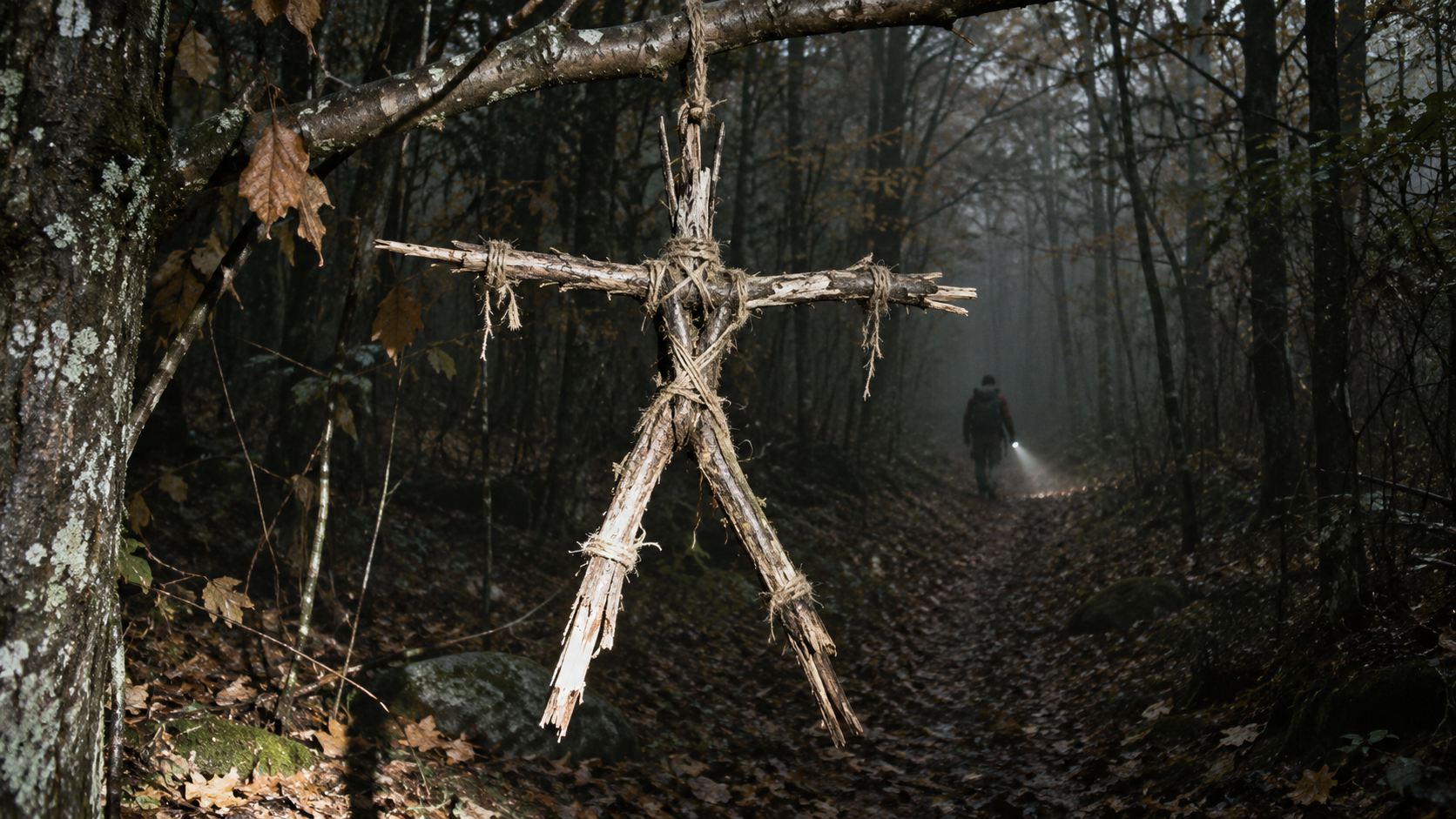
The discovery of figures made from sticks gives the forest a more deliberate appearance. Branches have been arranged into recognisable shapes and suspended among the trees. Whatever their meaning, they look constructed.
At night, the disturbances become more difficult to explain comfortably. The crew hears sounds that include children’s laughter, and an attack on the tent sends them running into the darkness. Their equipment records fragments of the experience without supplying a clear view of its source.
An ordinary horror film might cut away to show the threat approaching. Here, the cameras are carried by frightened people trying to move, listen and stay together. The images become least informative at the moments when information would be most valuable.
This limitation changes the audience’s work. We search the frame for something the person holding the camera may have missed. A patch of darkness becomes a possible hiding place because we cannot confidently exclude anything from it.
Sound creates a different kind of uncertainty. A noise can establish that something has happened without revealing who caused it, how far away it is or whether it is moving closer. The group must make decisions using evidence that supplies urgency more readily than understanding.
The combination of colour video and black-and-white film also prevents the footage from settling into a polished, uniform visual world. The changing texture continually reminds us that these are recordings made with particular equipment by particular people. There is no detached view available to correct their impressions.
The tent is especially effective because its protection is so obviously limited. It creates a small interior space, but the boundary is fabric. The campers can temporarily stop looking into the forest without becoming secure from it.
Running away breaks even that fragile arrangement. They escape the immediate disturbance while entering a space in which they cannot properly see. Fear forces a choice between remaining beside something threatening and moving towards something unknown.
Daylight then brings a different disappointment. It allows them to inspect what has happened, but inspection does not produce a useful explanation. The passage from night to morning offers visibility without restoring confidence.
Walking Becomes a Test They Cannot Pass
The group’s repeated attempts to leave eventually bring them back to a place they recognise. Movement has consumed time and energy without delivering the expected progress.
The immediate explanation could be navigational failure. Frightened, exhausted people can misjudge direction, and the loss of the map has made their task harder. The supernatural interpretation is more disturbing: perhaps the forest is no longer behaving like a space that ordinary navigation can solve.
The original film does not establish a precise system of moving boundaries, time loops or magical rules. It gives us the experience of people who believe they should have escaped and cannot understand why they have not. That distinction preserves the uncertainty instead of replacing it with an instruction manual.
Recognition, normally a source of reassurance, now becomes evidence against them. A familiar landmark ought to help establish location. Here, it tells them that the effort they trusted has failed.
This reversal explains why the woodland setting can feel claustrophobic despite its openness. The characters can move in many directions, but none has demonstrated that it leads to safety. Freedom of movement means little when movement cannot be converted into escape.
Their physical circumstances sharpen the problem. Rest is interrupted, supplies are limited and tempers are deteriorating. Each additional attempt will be made by people less capable of assessing it calmly than they were before.
The film’s repetitions can also be frustrating. Viewers who do not find the atmosphere persuasive may experience another argument or stretch of woodland as delay rather than escalation. The method depends heavily on whether the characters’ exhaustion becomes emotionally convincing.
Yet the repeated walking has a specific narrative purpose. The crew is running out of credible actions. Continuing, stopping, changing direction and trusting one another have all become difficult choices.
Then Josh disappears, and the question of how to leave becomes inseparable from whether they can leave without him.
Josh’s Absence Makes Every Choice Worse
Heather and Mike cannot locate Josh. His disappearance changes the expedition from a shared ordeal into a possible rescue situation, forcing them to consider danger to someone who is no longer beside them.
Later, they hear cries that sound like him. The voice appears to offer a way forward, but it also raises a possibility neither can safely resolve: they may be hearing their friend in distress, or something may be using that sound to draw them elsewhere.
The uncertainty is cruel because both interpretations demand action. If Josh needs help, remaining where they are could abandon him. If the voice is a lure, following it could expose the remaining pair.
Their earlier disagreements cannot prepare them for this decision. Being right about the map or the route would no longer settle what matters. They need knowledge about an absent person and an unseen threat, and neither is available.
Heather subsequently discovers a small bundle containing bloodied material apparently connected to Josh. The discovery strongly suggests injury, but it does not provide a complete account of what has happened. She does not tell Mike. The BBFC’s description confirms the film includes the discovery of bloody human material wrapped in a missing character’s clothing.
Withholding the discovery preserves an imbalance between them. Heather now carries a particular reason for dread that Mike does not share. Even when they respond to the same sound, they are no longer evaluating it with the same information.
Her silence can be understood as shock, avoidance or an attempt to prevent his distress from becoming worse. The film does not require a single tidy motive. What matters practically is that the pair cannot fully discuss the danger while one person conceals evidence.
The bundle also changes the role of filming. Earlier, a disturbing object might have been useful documentary material. Now, documenting a discovery would mean acknowledging something Heather can barely bear to confront.
The project has reached a point at which evidence itself is frightening. Finding more does not necessarily help.
Heather’s Apology Gives the Camera a Different Purpose
Heather eventually records a direct apology. She addresses the families affected by the expedition and accepts responsibility for bringing the others into the situation.
The close framing is painfully unlike a composed documentary presentation. Her distress dominates the image, while the surroundings provide little usable context. She can explain her regret more clearly than she can explain where she is or what is happening.
Her confession should not be treated as an objective verdict establishing that everything is her fault. Mike destroyed the map; all three took part in the expedition; the source of the threat remains unknown. Heather’s willingness to accept total blame reveals the intensity of her guilt.
The camera now has a purpose distinct from investigation. It gives her a way to address people who are absent and might eventually see what she leaves behind. She cannot know whether the message will reach them, but recording it is an action she can still complete.
This helps answer a familiar criticism of found-footage horror: why continue filming when survival is at stake? No single explanation justifies every moment of recording, and the device still requires some acceptance from the viewer. Here, however, Heather’s behaviour has an emotional logic.
Filming began as her responsibility. As the other responsibilities become impossible to fulfil, operating the camera remains familiar. It gives her a task with an immediate result, even when navigation, reassurance and rescue have stopped doing so.
Her apology also changes the imagined audience. The footage is no longer principally for people interested in a local legend. It may be watched by parents trying to understand what happened to their children.
That possibility makes the scene more intimate than a general declaration of fear. Heather is trying to leave an account of herself that recognises the consequences for other people.
The filmmakers have credited the cast’s ability to perform exhaustion and terror, rather than suggesting that every reaction was an unsuspecting actor’s genuine panic. The convincing distress belongs to a constructed film and to performances that make its circumstances feel immediate.
What Happens at the End of The Blair Witch Project?
Heather and Mike follow what sounds like Josh into an abandoned house. Mike reaches the basement ahead of Heather, and his recording is abruptly interrupted. When Heather arrives, she sees him standing with his face towards a corner. Her camera then falls, and the footage ends without showing the attacker or explaining the pair’s ultimate fate.
Mike’s position recalls the earlier story about Rustin Parr, who made one child face the wall while killing another. The ending therefore has a clear connection to information already supplied. The apparently incidental interview detail becomes the means by which the audience recognises a threatening pattern.
The connection suggests that Heather and Mike have entered a repetition of the violence described in the local account. It does not establish exactly who has placed Mike there, why he remains in that position or what force interrupts Heather’s recording.
His stillness is disturbing because it breaks the behaviour the sequence has led us to expect. They have entered the house urgently seeking Josh. A companion facing the wall offers neither assistance nor explanation.
Heather also loses the response that might help her understand the situation. Mike does not turn towards her and translate the scene into something manageable. She finds his body present but his participation in their shared effort absent.
The camera’s fall prevents a further investigation. There is no concluding interview, police explanation or recovered testimony establishing the mechanism of the attack. The film stops where the available record stops.
Death is strongly implied, but the original film does not show three bodies or provide a forensic account of three killings. Its opening premise describes the filmmakers’ disappearance and the later recovery of their footage. The final moments make that disappearance terrifying without resolving every question it creates.
The corner detail was a deliberate explanatory addition. Daniel Myrick has described how an interview reference to Parr’s method was incorporated to connect the final image to the earlier material. That production history supports reading the image as a callback, rather than a random pose requiring an elaborate hidden solution.
The answer to why Mike faces the corner is therefore clearest at the level of storytelling: his position invokes Parr’s murders. The answer to what physically makes him do it remains withheld.
What the Film Establishes—and What It Leaves Open
The most direct supernatural reading is that the filmmakers encounter the power behind the Blair Witch legend. The disturbances, apparent failure to escape and final connection to an earlier atrocity make that interpretation persuasive.
However, the film never provides a clear image of the witch or an authoritative explanation of her abilities. It leaves room for human persecution, deception and failures of judgement alongside the supernatural possibility. Myrick has explicitly discussed preserving uncertainty between a supernatural presence and a more earthly threat.
That does not make every theory equally supported. Claims that Josh and Mike secretly planned everything require additional assumptions about their intentions, movements and cooperation. The original film supplies no confession or decisive revelation establishing such a conspiracy.
Likewise, detailed explanations involving altered time or rules governing the witch should be kept separate from what this film actually demonstrates. Later franchise material can expand a fictional world, but it should not be mistaken for information available to someone watching the original story on its own.
There is also a distinction between uncertainty inside the fiction and uncertainty about whether the production was real. The Blair Witch Project is a fictional film. Its characters’ disappearance was part of the premise and publicity, not a genuine missing-person case.
The promotional campaign extended the illusion through material resembling evidence and reports about the missing filmmakers. That approach helped carry the story beyond the cinema, encouraging audiences to encounter its invented history in formats associated with factual information.
The film was not the first to use recovered footage as a storytelling device. Its significance lies partly in how effectively it brought that approach to a broad audience, making rough images and incomplete recordings central to a major horror phenomenon. The BFI places it within a longer tradition that includes earlier fictional archives and found-footage films.
Its lasting dramatic strength is more specific than the claim that unseen things are frightening. The cameras preserve enough to establish the characters’ distress, yet not enough to settle what causes it. We can witness their situation without gaining the knowledge that might have helped them.
The Blair Witch Project ends with a recognisable pattern and an unfinished explanation. An early story becomes a final image, while the person recording it loses the opportunity to discover more. Heather’s project succeeds in leaving evidence that something terrible has happened. It fails to make that evidence complete. The audience inherits the footage and the same central limitation that trapped its makers: being able to look does not guarantee being able to understand.
Sources
The Blair Witch Project (1999) — BFI — Film identity, country, credits and principal cast.
The Blair Witch Project — BBFC — Classification records and corroboration of disturbing content.
Interview with Eduardo Sánchez and Daniel Myrick — Eye for Film — Direct discussion of ambiguity, influences and performances.
The Blair Witch Project Director Daniel Myrick Details the Film’s Difficult Decisions and Surreal Success — ComicBook.com — Filmmaker explanation of the ending and the added Rustin Parr connection.
Q&A: ‘Blair Witch Project’ Celebrates 20th Anniversary in Frederick — WTOP — Interview with Eduardo Sánchez covering fictional mythology, production and the finale.
10 Great Found-Footage Films — BFI — Historical context for the format and the film’s publicity.
