Inside the Locked-Room Mystery
How Do You Defend a Story That Keeps Changing?
Adrián Doria needs someone to believe him. A successful businessman facing a murder accusation, he insists that the evidence points towards an explanation that cannot be true. The woman brought in to prepare his defence has little time, considerable confidence and a demand he finds increasingly uncomfortable: he must tell her everything.
Written and directed by Oriol Paulo, The Invisible Guest, originally titled Contratiempo, turns a consultation into a contest over who controls the story. This Spanish thriller builds its mystery through competing explanations, each apparently clarifying what came before while raising a more troubling question. Understanding it means following both the events being described and the reasons someone might describe them that way.
A Hotel Room With No Convincing Exit
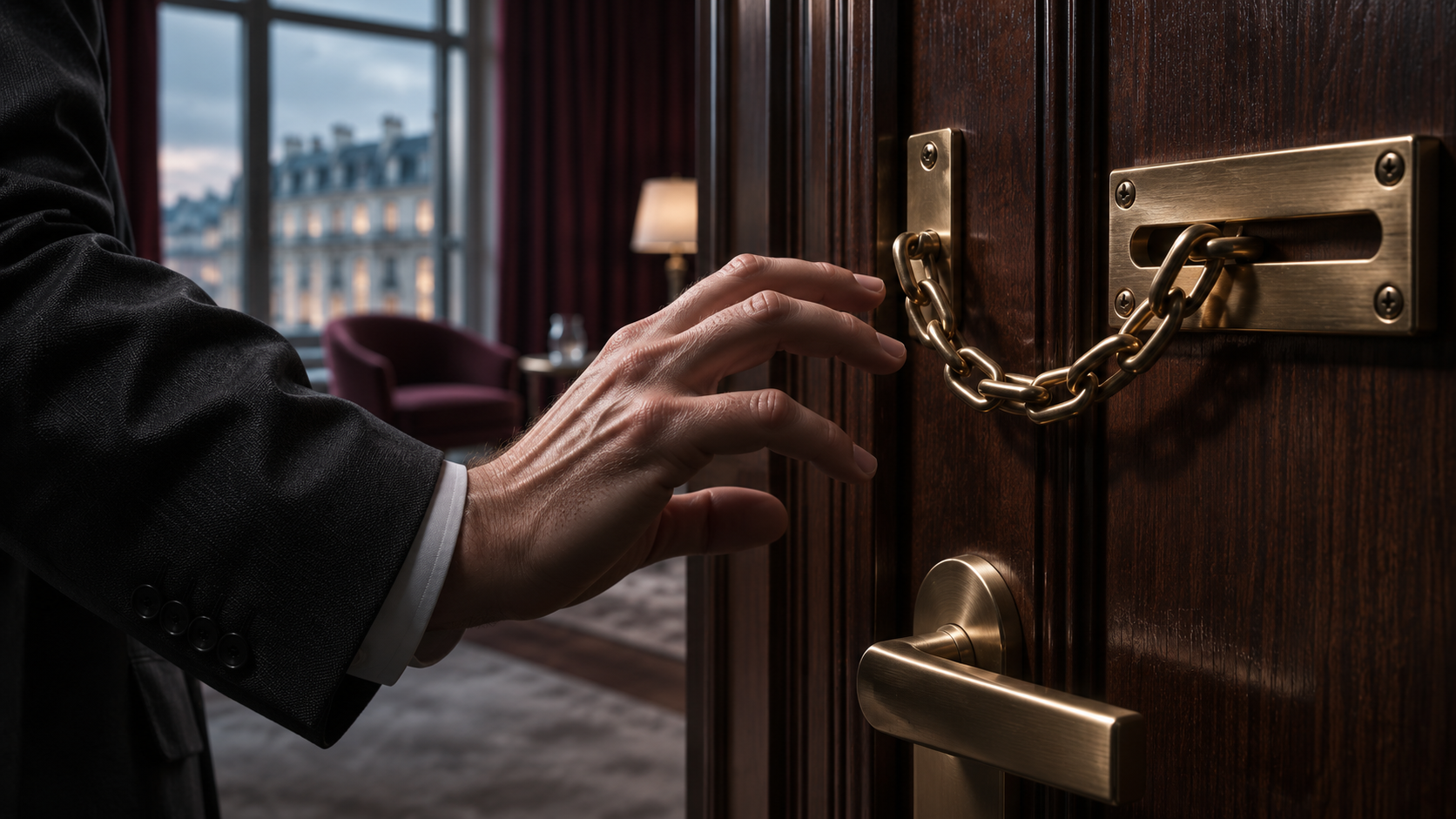
Adrián, played by Mario Casas, is accused of killing his lover, photographer Laura Vidal, played by Bárbara Lennie. He was discovered with her body inside a hotel room. His explanation requires another person to have committed the murder and escaped, yet the room offers no credible route for that escape.
His lawyer, Félix Leiva, has arranged specialist help. A woman identifying herself as Virginia Goodman arrives at Adrián’s apartment, presenting an urgent problem: a new prosecution witness could undermine his position, and they have only a few hours to prepare.
The immediate task appears straightforward. Virginia must identify weaknesses in Adrián’s account before someone else exposes them. He must supply the information that allows her to defend him.
Their difficulty is that they understand cooperation differently. Adrián wants his account accepted as the starting point. Virginia treats that account as something to be tested.
That difference gives the conversation its tension. He believes he has hired expertise to solve a problem outside himself. She keeps directing attention towards the details he chooses to omit.
The hotel mystery also establishes a useful boundary between observation and explanation. A locked room is a physical circumstance. The presence of an escaped attacker is Adrián’s interpretation. Accepting both as equally established would allow his defence to dictate the investigation.
Paulo encourages that temptation by placing Adrián at the centre of the film. We spend time with his anxiety, his damaged reputation and his efforts to explain himself. Proximity can create sympathy before reliability has been earned.
Virginia’s questioning interrupts that process. She refuses to let his confidence settle questions that the evidence leaves open.
The Earlier Journey That Changes the Case
Adrián initially describes blackmail. He and Laura were instructed to bring money to the hotel, where he claims an attacker knocked him unconscious. When he recovered, Laura was dead.
Virginia presses beyond the immediate crime scene. The conversation moves back to a journey during their affair, when a collision involved another driver, Daniel Garrido.
In Adrián’s account, Daniel appears to have died at the scene. Rather than report the crash, the lovers conceal what happened. Adrián disposes of Daniel’s car in a lake with Daniel inside.
This disclosure changes the scale of the story. The hotel can no longer be understood simply as a place where an affair became public and someone died. It belongs to a sequence that already includes a missing person and deliberate concealment.
Adrián’s narrative nevertheless preserves a distinction favourable to himself. He presents Laura as the more decisive partner, the person who pushes events towards a cover-up while he responds to pressure.
That arrangement asks the listener to separate participation from responsibility. He admits enough wrongdoing to make the confession seem substantial, but places the strongest initiative elsewhere.
A partial admission can be particularly persuasive because it appears costly. Someone who acknowledges disgraceful behaviour may seem less likely to be concealing something worse. The film exploits that assumption without making it a reliable rule.
There is also a practical reason the affair matters. Reporting the crash would expose a private journey that Adrián has hidden from his family. His public and domestic identities become obstacles to telling the truth.
The collision creates a crisis. The decision to conceal it creates a continuing dependence on secrecy.
A Stranger Offers Help at the Worst Possible Moment
While Adrián deals with Daniel’s car, Laura remains with their damaged vehicle. A passing man, Tomás, offers assistance and takes her to his home so that he can repair it.
There, Laura meets his wife, Elvira, and discovers that the couple are Daniel’s parents.
The encounter transforms the missing driver from an immediate practical problem into someone with a place in a family. Laura is inside a home whose occupants are waiting for the person she believes has just died.
The scene’s force comes from unequal knowledge. The parents offer ordinary kindness while Laura understands why their concern may soon become unbearable. Their hospitality makes her concealment more difficult without requiring them to threaten her.
It is also the film’s boldest coincidence. The person who helps Laura happens to be the father of the young man involved in the collision. That is a conspicuously engineered connection, and the thriller depends on the audience accepting it.
Once established, however, it does substantial work. It brings the two households into direct contact and creates opportunities for observations that the cover-up cannot entirely control.
Tomás notices details that make Laura’s account questionable. Her use of the car does not quite fit the story she tells about it. Those small inconsistencies will matter because he has a reason to remember them.
An invented explanation usually works best when an encounter ends quickly. Here, a repair prolongs the contact. Laura must inhabit her story while someone examines the object at its centre.
The film turns help into exposure. The more Tomás does for her, the more closely their lives become connected.
A Missing Man Becomes a Convenient Explanation
The concealment extends beyond the roadside. Daniel’s disappearance becomes associated with an allegation of financial wrongdoing, creating the impression that he may have fled.
For Adrián, that alternative story is useful. A missing man who is believed to be escaping discovery attracts a different kind of attention from someone thought to have suffered violence.
Adrián again attributes the manipulation to Laura. The audience should retain that attribution as part of his account, rather than quietly treating it as independently established history.
The underlying method is more revealing than the details of the financial allegation. Making someone disappear is one task. Giving other people a reason to stop looking for them is another.
Daniel’s supposed misconduct supplies an explanation for absence. It also damages the credibility of anyone insisting that something terrible has happened to him. His parents must struggle against an account that gives their search an apparently less sympathetic meaning.
Adrián, meanwhile, has access to legal assistance and the protective influence of professional standing. The contrast is built into who gets to frame the questions. One family wants to know where their son is; the businessman wants to know how his connection can be removed.
The film does not need to claim that wealth makes every obstacle vanish. Its more specific point is that resources allow Adrián to keep generating alternatives when other people are trying to establish one answer.
That imbalance gives the investigation an emotional direction. Daniel risks becoming a supporting detail in the story of a prominent man’s inconvenience.
Tomás’s persistence prevents that reduction from becoming complete.
Why Tomás Refuses to Accept the Story
Tomás connects Adrián to the damaged car and confronts him. His central demand is painfully concrete: he wants to know what happened to Daniel and where his son can be found.
Adrián resists.
The encounter brings two incompatible priorities into the same space. For Tomás, information is necessary for mourning and accountability. For Adrián, information is dangerous because it can connect separate events into a coherent accusation.
This is why the missing body matters beyond its usefulness as evidence. Concealment prolongs the family’s uncertainty. The harm continues after the original incident because the people responsible retain control over what the parents are allowed to know.
Tomás also introduces a problem for Adrián’s preferred understanding of power. He cannot easily dismiss the father as someone who merely wants money or professional advantage. The demand concerns a relationship that Adrián’s resources cannot replace.
Within the consultation, however, Tomás’s persistence can be described another way. A grieving father might be presented as someone seeking revenge. His determination therefore becomes material that a defence could exploit.
That possibility is disturbing because it uses a reasonable response to loss as the basis for suspicion. The more insistently he searches, the easier it becomes to portray him as obsessed.
The film asks the viewer to keep motive and proof separate. Tomás has a powerful reason to pursue Adrián. That does not automatically establish that he committed the hotel murder.
The same discipline applies to the changing accounts in Below: a story can accommodate the available circumstances while still protecting the person telling it.
Virginia Offers a Way Through the Contradictions
Virginia develops a possible explanation that places Tomás inside the hotel mystery. Elvira’s connection to the hotel could, she suggests, help account for access and an escape that investigators failed to identify.
This is a proposed reconstruction, not a solved crime.
Its importance lies in Adrián’s response. He becomes receptive when an explanation promises to reconcile the physical problem with his insistence that another person killed Laura.
The consultation begins to resemble a negotiation over which version he can safely accept. Virginia offers possibilities; Adrián supplies information when doing so appears useful.
She then introduces a more troubling proposal: evidence could be used to connect Laura to Daniel’s submerged car while distancing Adrián from responsibility. To pursue that approach, she needs its location.
The offer changes the apparent purpose of disclosure. Naming the location would ordinarily expose Adrián. Under the proposed strategy, he can imagine that the same information might protect him.
That is the conversation’s crucial psychological mechanism. He does not become candid because an appeal to conscience suddenly succeeds. He talks because the cost of talking appears to have changed.
The scene also makes the audience uncomfortable with the apparent defence process. Virginia’s willingness to discuss manipulation can look like proof that she is entirely committed to her client’s survival.
Professional confidence becomes a form of reassurance, even when the proposed conduct is appalling.
Paulo uses that reassurance to make the consultation unstable. The person challenging Adrián’s account may also appear willing to help him construct a more effective one. Asking penetrating questions does not, by itself, tell us what someone intends to do with the answers.
The Detail Adrián Cannot Explain Away
Adrián finally reveals the location of the submerged car. He also admits something that destroys the distinction on which his earlier account depended: Daniel was still alive when he pushed the vehicle into the water.
The disposal was therefore an act that killed Daniel.
This revelation changes the moral meaning of the sequence without requiring the film to invent another collision or another victim. The decisive difference is what Adrián knew when he acted.
An emergency can explain confusion. It cannot turn his awareness of a living person into an irrelevant detail.
His attempt to describe events as having gone too far exposes the logic of his self-defence. He treats his earlier decisions as though they removed his ability to make a different choice.
But Daniel’s survival created precisely such a choice. Adrián could stop. Continuing protected the cover-up at the cost of another person’s life.
The admission also weakens his presentation of Laura as the person who controlled everything. Whatever influence she exerted elsewhere, she could not make this particular decision for him at the lake.
Virginia’s response briefly breaks the detached rhythm of their exchange. The revelation has a weight that cannot be absorbed as merely another complication in preparing a persuasive account.
For the viewer, this is where uncertainty about Adrián’s character narrows sharply. His problem is no longer adequately described as panic after an accident.
He has supplied evidence of his willingness to sacrifice someone else to preserve his own position. Any remaining explanation of the hotel must now be considered alongside that knowledge.
What Really Happened at the Hotel?
Adrián killed Laura. The mysterious attacker is part of the explanation he constructs afterwards.
The final reconstruction reverses the roles he assigned earlier. Laura has become overwhelmed by the concealment and intends to tell Daniel’s parents the truth. She arranges the hotel meeting, using the appearance of blackmail to bring Adrián there.
The money is connected to her attempt to offer something to the family alongside the confession. A scheduled message and the reservation help prevent Adrián from treating the meeting as something he can simply abandon without consequences.
When he realises that Laura intends to expose what happened, he kills her.
The locked room now makes sense. There is no missing escape route to discover because the killer has not escaped. Adrián is present when the police arrive.
His injuries and account of an assault help create the appearance of a second victim. The supposed intruder provides someone onto whom he can transfer responsibility.
This resolution is effective because it removes an assumption rather than supplying an elaborate mechanical trick. The audience has been encouraged to ask how another person left. The more fundamental question is whether another person needed to be there.
Laura’s reassessment should not erase her earlier involvement. Becoming willing to confess does not undo participation in the concealment. Her change concerns what she is prepared to do next.
Adrián’s behaviour moves in the opposite direction. When the arrangement that protects him begins to fail, he uses further violence to preserve it.
His confession settles the central murder question. The film still has another question to answer: why has the woman listening been able to bring him to this point?
Who Has Been Sitting Opposite Adrián?
The woman presenting herself as Virginia Goodman is Elvira, Daniel’s mother.
She and Tomás have arranged the encounter to obtain the information and admissions Adrián has refused to give them. Elvira has adopted the identity of the legal specialist he expects to meet.
After she leaves, Adrián discovers the recording device concealed in her pen. Looking across to the opposite building, he sees her remove the disguise beside Tomás.
The real Virginia then arrives.
That final arrival confirms the impersonation independently of any further explanation Adrián might invent. His visitor was not simply an unusually aggressive lawyer. He has misunderstood the identity and purpose of the person conducting the conversation.
Elvira’s acting background helps explain the performance. The parents’ observation of Adrián and his legal arrangements supplies the opportunity. Their plan depends on entering an appointment he already has reason to expect.
The recording gives the conversation a life beyond his apartment. Until this point, Adrián has repeatedly relied on the gap between what happened and what others can establish. His own words can now be carried outside the encounter.
The location of Daniel’s car supplies a second, different gain. A confession addresses responsibility; a location gives investigators somewhere specific to search and offers the parents the possibility of recovering their son.
Tomás contacts the police. The film closes with Adrián’s control collapsing, rather than showing a completed trial or sentence.
That boundary matters. The ending establishes the success of the parents’ deception and the exposure of his admissions. It does not require an invented courtroom aftermath to make its outcome clear.
Why the Final Conversation Works
Elvira succeeds by giving Adrián a role in which he feels safe enough to become revealing.
As Daniel’s mother, she would be someone he has every reason to resist. As an apparently formidable defence specialist, she becomes someone whose knowledge might save him.
The disguise changes the meaning he assigns to her questions. A demand for the body’s location can appear to be preparation for a defence strategy. Anger can be explained as a rehearsal of hostile questioning. Pressure can be presented as professional urgency.
Her performance therefore works on more than appearance. It supplies an interpretation for behaviour that might otherwise expose her.
Adrián contributes to the deception through his expectations. He assumes that exceptional professional competence will be available to protect him, and that securing someone’s services aligns their interests with his.
He also wants to believe that there is a sufficiently clever solution to every new difficulty. Elvira’s proposed manipulations appeal to that belief. She makes confession look like another stage in managing the problem.
The resulting irony is precise. His desire to control other people’s accounts makes him vulnerable to someone who can control the circumstances in which he speaks.
This is also why the recording matters formally. Much of the film has involved stories that can be revised in conversation. The pen fixes an account that Adrián cannot withdraw merely by producing a more convenient version.
The parents’ victory does not restore Daniel’s life. Its significance is narrower and more painful: the person who withheld the truth has lost his exclusive possession of it.
What the Film Asks Us to Believe
The Invisible Guest depends on conspicuous devices. The roadside coincidence, the effectiveness of Elvira’s disguise and the timing of the real Virginia’s arrival all serve a tightly arranged dramatic design.
Viewers who find those devices implausible have a concrete basis for that response. The impersonation must survive close attention in a private room, and the plan relies on Adrián making useful disclosures before circumstances interrupt it.
The film’s strongest defence is structural rather than realistic. Each device places pressure on the same central weakness: Adrián’s belief that he can keep directing the interpretation of events.
Its flashbacks create a related challenge. A photographed scene feels more authoritative than a spoken claim, even when the scene is illustrating that claim. The viewer must repeatedly revise the status of what has been shown.
That can be exhilarating, but it also places a burden on the storytelling. Surprise is most satisfying when the revised version clarifies earlier behaviour rather than making previous detail feel disposable.
Here, the strongest revisions concern agency. The changing question is who proposed, chose and carried out the acts that produced the present crisis. Those distinctions determine responsibility.
The title can consequently be read in more than one way. It evokes the alleged visitor to the hotel room, but it also suits the person whose true identity remains unseen during the consultation. That second reading is interpretation, rather than a separate factual revelation.
Adrián begins the encounter expecting help with a story he already controls. He ends it facing a listener whose purpose he never understood. The film’s most satisfying reversal is that the parents obtain the truth by making him believe he is still arranging his escape. His words survive the performance that encouraged them, and Daniel finally becomes more than a disappearance that someone else has explained away.
Sources
Film Factory Entertainment — The Invisible Guest — Official international sales information, premise, director, cast and Spanish theatrical release details. Film Factory Entertainment
Cineuropa — The Invisible Guest — Production identity and writing, directing and cast credits. Cineuropa
The Invisible Guest — Plot and Cast — Cross-check of the principal events, character identities and final reveal. Wikipedia
The Invisible Guest — English-Language Transcript — Dialogue reference for the changing accounts, proposed defence and final admissions; an unofficial transcription rather than an authenticated production screenplay. transcripts.simpleremix.com
MovieSense — The Invisible Guest Ending Explained — Secondary corroboration of the disguise, recording and central ending revelations. MovieSense
